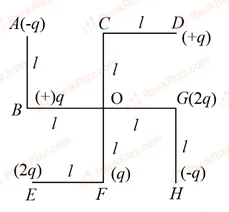
The two thin coaxial rings, each of radius and having charges and respectively are separated by a distance of . The potential difference between the centres of the two rings is:
- A
- B
- C
- D
Every Electrostatics question JEE Main has set from 2004–2026, grouped by the idea it tests rather than the order of the syllabus. 294 questions across 9 distinct ideas. Free to read, answer key on every one.
DATA UPDATED
Questions
294
Distinct ideas
9
Share of marks
6%
Difficulty
MEDIUM
A chapter is not one subject — it is a handful of procedures the examiner reuses. These are the ones Electrostatics questions actually test.
161–180 OF 294 · NEWEST FIRST
The two thin coaxial rings, each of radius and having charges and respectively are separated by a distance of . The potential difference between the centres of the two rings is:
Two identical tennis balls each having mass and charge are suspended from a fixed point by threads of length . What is the equilibrium separation when each thread makes a small angle with the vertical?
What will be the magnitude of the electric field at point as shown in the figure? Each side of the figure is and perpendicular to the other.

A particle of mass 1 mg and charge is lying at the mid-point of two stationary particles kept at a distance 2 m when each is carrying same charge . If the free charged particle is displaced from its equilibrium position through distance ( m). The particle executes SHM. Its angular frequency of oscillation will be ___ rad s (if )
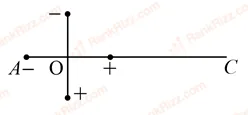
Two ideal electric dipoles and , having their dipole moment and respectively are placed on a plane with their centres at as shown in the figure. At point on the axis of dipole , the resultant electric field is making an angle of 37° with the axis. The ratio of the dipole moment of and , is: (take sin 37° = )

An electric dipole is placed on -axis in proximity to a line charge of linear charge density C m. Line charge is placed on -axis and positive and negative charge of dipole is at a distance of 10 mm and 12 mm from the origin respectively. If total force of 4 N is exerted on the dipole, find out the amount of positive or negative charge of the dipole.
815.1 nC
8.8 C
0.485 mC
4.44 C
The total charge enclosed in an incremental volume of m located at the origin is ___ nC, if electric flux density of its field is found as C m
A certain charge is divided into two parts and . How should the charges and be divided so that and placed at a certain distance apart experience maximum electrostatic repulsion?
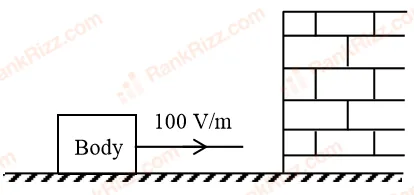
A body having specific charge 8 C g is resting on a frictionless plane at a distance 10 cm from the wall (as shown in the figure). It starts moving towards the wall when a uniform electric field of 100 V m is applied horizontally towards the wall. If the collision of the body with the wall is perfectly elastic, then the time period of the motion will be ___ s.

An infinite number of point charges, each carrying charge, are placed along the y-axis at m, 2 m, 4 m, 8 m .....
The total force on a 1 C point charge, placed at the origin, is N. The value of , to the nearest integer, is ___.
[Take N m C]
The electric field in a region is given by with N C. The flux of this field through a rectangular surface, area 0.4 m parallel to the plane is ________ N m C.
Find out the surface charge density at the intersection of point m plane and -axis, in the region of uniform line charge of 8 nC m lying along the -axis in free space.
0.424 nC m
47.88 nC m
0.07 nC m
4.0 nC m
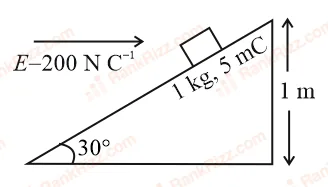
An inclined plane making an angle of 30° with the horizontal is placed in a uniform horizontal electric field 200 as shown in the figure. A body of mass 1 kg and charge 5 mC is allowed to slide down from rest at a height of 1 m. If the coefficient of friction is 0.2, find the time taken by the body to reach the bottom.
[g = 9.8 m ; ; ]

0.92 s
1.3 s
0.46 s
2.3 s
Given below are two statements
Statement I: An electric dipole is placed at the centre of a hollow sphere. The flux of electric field through the sphere is zero, but the electric field is not zero anywhere in the sphere.
Statement II: If is the radius of a solid metallic sphere and be the total charge on it. The electric field at any point on the spherical surface of radius is zero but the electric flux passing through this closed spherical surface of radius is not.
In the light of the above statements, choose the correct answer from the options given below:
Both Statement I and Statement II are true
Statement I is false but Statement II is true
Statement I is true but Statement II is false
Both Statement I and Statement II are false
27 similar drops of mercury are maintained at 10 V each. All these spherical drops combine into a single big drop. The potential energy of the bigger drop is ______ times that of a smaller drop.
The electric field in a region is given by N C. The ratio of flux of reported field through the rectangular surface of area 0.2 m (parallel to plane) to that of the surface of area 0.3 m (parallel to plane) is , where = ______?[Here and are unit vectors along and -axes respectively]
512 identical drops of mercury are charged to a potential of 2 V each. The drops are joined to form a single drop. The potential of this drop is ______ V in Volt.
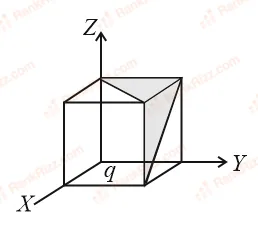
A charge is placed at one corner of a cube as shown in figure. The flux of electrostatic field through the shaded area is:

An electron with kinetic energy enters between parallel plates of a capacitor at an angle with the plates. It leaves the plates at angle with kinetic energy . Then the ratio of kinetic energies will be:
Two small spheres each of mass 10 mg are suspended from a point by threads 0.5 m long. They are equally charged and repel each other to a distance of 0.20 m. The charge on each of the sphere is C. The value of will be ______. [Given m s]
JEE Advanced has set 61 Electrostatics questions too. Electrostatics JEE Advanced PYQs →
OTHER PHYSICS CHAPTERS