RankRizz

Electrostatics — JEE Main Previous Year Questions

Every Electrostatics question JEE Main has set from 2004–2026, grouped by the idea it tests rather than the order of the syllabus. 294 questions across 9 distinct ideas. Free to read, answer key on every one.

DATA UPDATED

Questions

294

Distinct ideas

9

Share of marks

6%

Difficulty

MEDIUM

The ideas inside Electrostatics

A chapter is not one subject — it is a handful of procedures the examiner reuses. These are the ones Electrostatics questions actually test.

Every Electrostatics question

201–220 OF 294 · NEWEST FIRST

JEE MAIN 2020 · 09 JAN S2Electric flux and Gauss's law

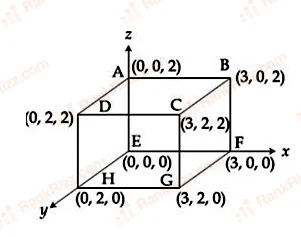
An electric field E⃗=4xi^−(y2+1)j^\vec{E} = 4x\hat{i} - (y^2 + 1)\hat{j} N/C passes through the box shown in figure. The flux of the electric field through surfaces ABCD and BCGF are marked as ϕI\phi_I and ϕII\phi_{II} respectively. The absolute difference between (ϕI−ϕII)(\phi_I - \phi_{II}) is (in Nm2^2/C) ___________.

Figure for JEE Main 2020 Physics question on Electric flux and Gauss's law
JEE MAIN 2020 · 08 JAN S1Electric field due to point charges and superposition

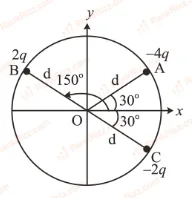
Three charged particles A, B and C with charges −4q-4q, 2q2q and −2q-2q are present on the circumference of a circle of radius dd. The charged particles A, C and centre O of the circle formed an equilateral triangle as shown in the figure. The electric field at the point O is

Figure for JEE Main 2020 Physics question on Electric field due to point charges and superposition
  1. A

    3qπε0d2\frac{\sqrt{3}q}{\pi\varepsilon_0 d^2}

  2. B

    23qπε0d2\frac{2\sqrt{3}q}{\pi\varepsilon_0 d^2}

  3. C

    3q4πε0d2\frac{\sqrt{3}q}{4\pi\varepsilon_0 d^2}

  4. D

    33q4πε0d2\frac{3\sqrt{3}q}{4\pi\varepsilon_0 d^2}

JEE MAIN 2020 · 08 JAN S1Electric flux and Gauss's law

In finding the electric field using Gauss law the formula ∣E⃗∣=qencε0∣A∣\left|\vec{E}\right| = \frac{q_{enc}}{\varepsilon_0|A|} is applicable. In the formula ε0\varepsilon_0 is permittivity of free space, A is the area of the Gaussian surface and qencq_{enc} is charge enclosed by the Gaussian surface. This equation can be used in which of the following situation?

  1. A

    Only when the Gaussian surface is an equipotential surface

  2. B

    Only when the Gaussian surface is an equipotential surface and ∣E⃗∣|\vec{E}| is constant on the surface.

  3. C

    Only when ∣E⃗∣|\vec{E}| = constant on the surface.

  4. D

    For any choice of Gaussian surface.

JEE MAIN 2020 · 08 JAN S2Motion and equilibrium of charged bodies in electric fields

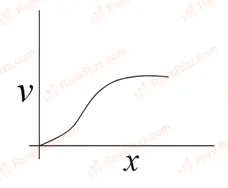
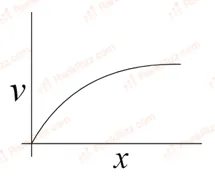
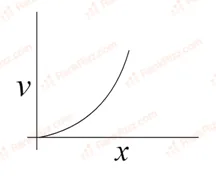
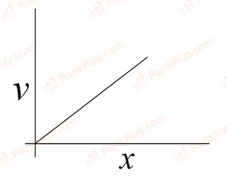
A particle of mass mm and charge qq is released from rest in a uniform electric field. If there is no other force on the particle, the dependence of its speed vv on the distance xx travelled by it is correctly given by (graphs are schematic and not drawn to scale)

  1. A
    Figure for JEE Main 2020 Physics question on Motion and equilibrium of charged bodies in electric fields
  2. B
    Figure for JEE Main 2020 Physics question on Motion and equilibrium of charged bodies in electric fields
  3. C
    Figure for JEE Main 2020 Physics question on Motion and equilibrium of charged bodies in electric fields
  4. D
    Figure for JEE Main 2020 Physics question on Motion and equilibrium of charged bodies in electric fields
JEE MAIN 2020 · 08 JAN S2Electric potential and potential energy

Consider two charged metallic spheres S1S_1 and S2S_2 of radii R1R_1 and R2R_2, respectively. The electric fields E1E_1 (on S1S_1) and E2E_2 (on S2S_2) on their surfaces are such that E1E2=R1R2\frac{E_1}{E_2} = \frac{R_1}{R_2}. Then the ratio V1V_1 (on S1S_1)/V2V_2 (on S2S_2) of the electrostatic potentials on each sphere is:

  1. A

    R1R2\frac{R_1}{R_2}

  2. B

    (R1R2)2\left(\frac{R_1}{R_2}\right)^2

  3. C

    (R2R1)\left(\frac{R_2}{R_1}\right)

  4. D

    (R1R2)3\left(\frac{R_1}{R_2}\right)^3

JEE MAIN 2020 · 07 JAN S1Electric field of continuous charge distributions

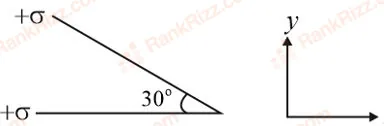
Two infinite planes each with uniform surface charge density +σ+\sigma are kept in such a way that the angle between them is 30∘^\circ. The electric field in the region shown between them is given by:

Figure for JEE Main 2020 Physics question on Electric field of continuous charge distributions
  1. A

    σ2ε0[(1+3)y^−x^2]\frac{\sigma}{2\varepsilon_0}\left[\left(1+\sqrt{3}\right)\hat{y} - \frac{\hat{x}}{2}\right]

  2. B

    σε0[(1+32)y^+x^2]\frac{\sigma}{\varepsilon_0}\left[\left(1+\frac{\sqrt{3}}{2}\right)\hat{y} + \frac{\hat{x}}{2}\right]

  3. C

    σ2ε0[(1+3)y^+x^2]\frac{\sigma}{2\varepsilon_0}\left[\left(1+\sqrt{3}\right)\hat{y} + \frac{\hat{x}}{2}\right]

  4. D

    σ2ε0[(1−32)y^−x^2]\frac{\sigma}{2\varepsilon_0}\left[\left(1-\frac{\sqrt{3}}{2}\right)\hat{y} - \frac{\hat{x}}{2}\right]

JEE MAIN 2019 · 12 APR S1Electric dipole and dipole in external field

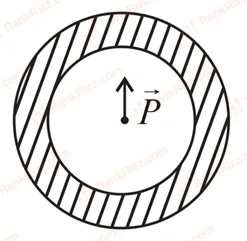
Shown in the figure is a shell made of a conductor. It has inner radius a and outer radius b, and carries charge Q. At its centre a dipole p⃗\vec{p} is placed as shown then:

Figure for JEE Main 2019 Physics question on Electric dipole and dipole in external field
  1. A

    Surface charge density on the inner surface of the shell is zero everywhere.

  2. B

    Electric field outside the shell is the same as that of a point charge at the centre of the shell.

  3. C

    Surface charge density on the inner surface is uniform and equal to (Q/2)4πa2\frac{(Q/2)}{4\pi a^2}.

  4. D

    Surface charge density on the outer surface depends on p⃗\vec{p}.

JEE MAIN 2019 · 12 APR S1Electric dipole and dipole in external field

A Point dipole p⃗=−p0x^\vec{p} = -p_0\hat{x} is kept at the origin. The potential and electric field due to this dipole on the y-axis at a distance d are, respectively: (Taken V = 0 at infinity)

  1. A

    ∣p⃗∣4πε0d2\frac{|\vec{p}|}{4\pi\varepsilon_0 d^2}, −p⃗4πε0d3\frac{-\vec{p}}{4\pi\varepsilon_0 d^3}

  2. B

    00, ∣p⃗∣4πε0d3\frac{|\vec{p}|}{4\pi\varepsilon_0 d^3}

  3. C

    ∣p⃗∣4πε0d3\frac{|\vec{p}|}{4\pi\varepsilon_0 d^3}, p⃗4πε0d3\frac{\vec{p}}{4\pi\varepsilon_0 d^3}

  4. D

    00, −p⃗4πε0d3\frac{-\vec{p}}{4\pi\varepsilon_0 d^3}

JEE MAIN 2019 · 12 APR S2Electric flux and Gauss's law

Let a total charge 2Q be distributed in a sphere of radius R, with the charge density given by ρ(r)=kr\rho(r) = kr, where r is the distance from the centre. Two charges A and B, of -Q each, are placed on diametrically opposite points, at equal distance, a, from the centre. If A and B do not experience any force, then:

  1. A

    a = 3R214\frac{3R}{2^{\frac{1}{4}}}

  2. B

    a = R3\frac{R}{\sqrt{3}}

  3. C

    a = 2−14R2^{\frac{-1}{4}}R

  4. D

    a = 8−14R8^{\frac{-1}{4}}R

JEE MAIN 2019 · 10 APR S1Electric potential and potential energy

A uniformly charged ring of radius 3a and total charge q is placed in x-y plane centred at origin. A point charge q is moving towards the ring along the z-axis and has speed v at z = 4a. The minimum value of v such that it crosses the origin is:

  1. A

    2m(115⋅q24πε0a)1/2\sqrt{\frac{2}{m}}\left(\frac{1}{15}\cdot\frac{q^2}{4\pi\varepsilon_0 a}\right)^{1/2}

  2. B

    2m(415⋅q24πε0a)1/2\sqrt{\frac{2}{m}}\left(\frac{4}{15}\cdot\frac{q^2}{4\pi\varepsilon_0 a}\right)^{1/2}

  3. C

    2m(15⋅q24πε0a)1/2\sqrt{\frac{2}{m}}\left(\frac{1}{5}\cdot\frac{q^2}{4\pi\varepsilon_0 a}\right)^{1/2}

  4. D

    2m(215⋅q24πε0a)1/2\sqrt{\frac{2}{m}}\left(\frac{2}{15}\cdot\frac{q^2}{4\pi\varepsilon_0 a}\right)^{1/2}

JEE MAIN 2019 · 10 APR S2Electric potential and potential energy

In free space, a particle A of charge 1 μC is held fixed at point P. Another particle B of the same charge and mass 4 μg is kept at a distance of 1 mm from P. If B is released, then its velocity at a distance of 9 mm from P is:
[Take 14πε0=9×10⁹\frac{1}{4\pi\varepsilon_0} = 9 \times 10^9 N m2^2 C−2^{-2}]

  1. A

    1.0 m s−1^{-1}

  2. B

    1.5×1021.5 \times 10^2 m s−1^{-1}

  3. C

    2.0×1032.0 \times 10^3 m s−1^{-1}

  4. D

    3.0×1043.0 \times 10^4 m s−1^{-1}

JEE MAIN 2019 · 09 APR S1Electric potential and potential energy

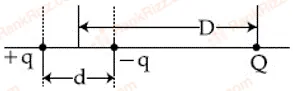
A system of three charges are placed as shown in the figure:

Figure for JEE Main 2019 Physics question on Electric potential and potential energy


If D>>dD >> d, the potential energy of the system is best given by:

  1. A

    14πε0[−q2d−qQdD2]\frac{1}{4\pi\varepsilon_0}\left[-\frac{q^2}{d} - \frac{qQd}{D^2}\right]

  2. B

    14πε0[+q2d+qQdD2]\frac{1}{4\pi\varepsilon_0}\left[+\frac{q^2}{d} + \frac{qQd}{D^2}\right]

  3. C

    14πε0[−q2d−qQd2D2]\frac{1}{4\pi\varepsilon_0}\left[-\frac{q^2}{d} - \frac{qQd}{2D^2}\right]

  4. D

    14πε0[−q2d+2qQdD2]\frac{1}{4\pi\varepsilon_0}\left[-\frac{q^2}{d} + \frac{2qQd}{D^2}\right]

JEE MAIN 2019 · 09 APR S2Electric field of continuous charge distributions

Four point charges -q, +q, +q and -q are placed on y-axis at y = -2d, y = -d, and y = +2d, respectively. The magnitude of the electric field E at a point on the x-axis at x = D, with D >> d, will behave as:

  1. A

    E∝1D4E \propto \frac{1}{D^4}

  2. B

    E∝1DE \propto \frac{1}{D}

  3. C

    E∝1D3E \propto \frac{1}{D^3}

  4. D

    E∝1D2E \propto \frac{1}{D^2}

JEE MAIN 2019 · 08 APR S1Electric field due to point charges and superposition

The bob of a simple pendulum has mass 2 g and a charge of 5.0 μ\muC. It is at rest in a uniform horizontal electric field of intensity 2000 V/m. At equilibrium, the angle that the pendulum makes with the vertical is: (take g = 10 m/s2^{2})

  1. A

    tan⁡−1(0.2)\tan^{-1}(0.2)

  2. B

    tan⁡−1(2.0)\tan^{-1}(2.0)

  3. C

    tan⁡−1(0.5)\tan^{-1}(0.5)

  4. D

    tan⁡−1(5.0)\tan^{-1}(5.0)

JEE MAIN 2019 · 08 APR S1Electric potential and potential energy

A solid conducting sphere, having a charge Q, is surrounded by an uncharged conducting hollow spherical shell. Let the potential difference between the surface of the solid sphere and that of the outer surface of the hollow shell be V. If the shell is now given a charge of -4Q, the new potential difference between the same two surfaces is:

  1. A

    -2V

  2. B

    2 V

  3. C

    V

  4. D

    4 V

JEE MAIN 2019 · 08 APR S2Electric potential and potential energy

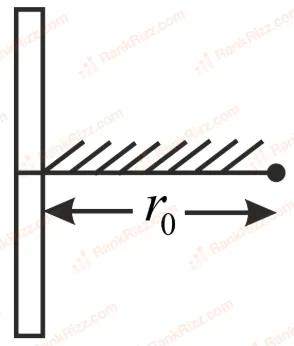
A positive point charge is released from rest at a distance r0r_0 from a positive line charge with uniform charge density. The speed (v) of the point charge, as a function of instantaneous distance r from line charge, is proportional to:

Figure for JEE Main 2019 Physics question on Electric potential and potential energy
  1. A

    v∝rr0v \propto \frac{r}{r_0}

  2. B

    v∝ln⁡rr0v \propto \sqrt{\ln\frac{r}{r_0}}

  3. C

    v∝ln⁡rr0v \propto \ln\frac{r}{r_0}

  4. D

    v∝e+r/r0v \propto e^{+r/r_0}

JEE MAIN 2019 · 08 APR S2Electric dipole and dipole in external field

An electric dipole is formed by two equal and opposite charges q with separation d. The charges have same mass m. It is kept in a uniform electric field E. If it is slightly rotated from its equilibrium orientation, then its angular frequency ω\omega is:

  1. A

    2qEmd2\sqrt{\frac{qE}{md}}

  2. B

    2qEmd\sqrt{\frac{2qE}{md}}

  3. C

    qE2md\sqrt{\frac{qE}{2md}}

  4. D

    qEmd\sqrt{\frac{qE}{md}}

JEE MAIN 2019 · 08 APR S2Electric potential and potential energy

The electric field in a region is given by E⃗=(Ax+B)i^\vec{E} = (Ax + B)\hat{i}, where E is in NC−1^{-1} and xx is in metres. The values of constants are A = 20 SI unit and B = 10 SI unit. If the potential at x=1x = 1 is V1V_1 and that at x=−5x = -5 is V2V_2, then V1−V2V_1 - V_2 is:

  1. A

    320 V

  2. B

    -520 V

  3. C

    180 V

  4. D

    -48 V

JEE MAIN 2019 · 12 JAN S1Electric dipole and dipole in external field

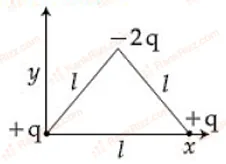
Determine the electric dipole moment of the system of three charges, placed on the vertices of an equilateral triangle, as shown in the figure:

Figure for JEE Main 2019 Physics question on Electric dipole and dipole in external field
  1. A

    3qli^−j^2\sqrt{3}ql\frac{\hat{i}-\hat{j}}{\sqrt{2}}

  2. B

    −3qlj^-\sqrt{3}ql\hat{j}

  3. C

    2qlj^2ql\hat{j}

  4. D

    (ql)i^+j^2(ql)\frac{\hat{i}+\hat{j}}{\sqrt{2}}

JEE MAIN 2019 · 12 JAN S1Electric potential and potential energy

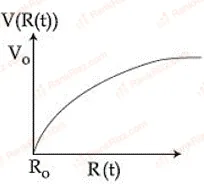
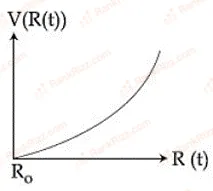
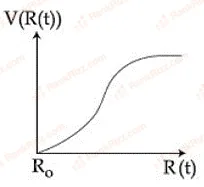
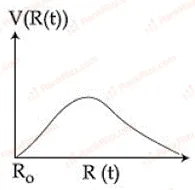
There is a uniform spherically symmetric surface charge density at a distance R0R_0 from the origin. The charge distribution is initially at rest and starts expanding because of mutual repulsion. The figure that represents best the speed V(R(t))V(R(t)) of the distribution as a function of its instantaneous radius R(t)R(t) is:

  1. A
    Figure for JEE Main 2019 Physics question on Electric potential and potential energy
  2. B
    Figure for JEE Main 2019 Physics question on Electric potential and potential energy
  3. C
    Figure for JEE Main 2019 Physics question on Electric potential and potential energy
  4. D
    Figure for JEE Main 2019 Physics question on Electric potential and potential energy