The rain drop of mass 1 g, starts with zero velocity from a height of 1 km. It hits the ground with a speed of 5 m/s. The work done by the unknown resistive force is _______ J.
(take g = 10 m/s)
- A
- B
- C
- D
Work, Energy & Power has been asked in 21 of the 23 JEE Main years from 2004 to 2026: 160 questions in all. In 2026 it averaged 0.6 questions per paper (12 across 19 papers), 2.5% of Physics questions, down from 2.7% in 2025. Across the last 20 papers it carried 2.6% of Physics marks. By type: 118 MCQs and 42 numerical-answer questions. Of the 138 with a difficulty tag, 47% are easy, 52% medium and 1% hard. Most asked: Conservation of mechanical energy (60, 38%), Work done by constant and variable forces (40, 25%) and Power (26, 16%).
DATA UPDATED
Questions
160
Distinct ideas
5
Share of marks
2.6%
Difficulty
MEDIUM
The share of each year’s Physics questions that came from Work, Energy & Power, counted from the 168 papers we hold for the last 10 years, and session by session inside a year.
Steady: 2.8% of Physics questions in 2024–2026 against 2.5% in 2017–2023, and between 1.3% and 3.3% in every year shown.
| YEAR | QS | PER PAPER | SHARE OF PHYSICS | CHANGE | |
|---|---|---|---|---|---|
| 2026 | 12 / 475 | 0.6 | 2.5% | −0.2 pts | JAN 2.4%APR 2.7% |
| 2025 | 13 / 475 | 0.7 | 2.7% | −0.3 pts | JAN 2.8%APR 2.7% |
| 2024 | 18 / 600 | 0.9 | 3.0% | −0.3 pts | JAN 2.3%APR 3.7% |
| 2023 | 25 / 750 | 1.0 | 3.3% | +0.6 pts | JAN 2.8%APR 3.9% |
| 2022 | 18 / 660 | 0.8 | 2.7% | +0.5 pts | JUN 3.1%JUL 2.3% |
| 2021 | 16 / 720 | 0.7 | 2.2% | −0.6 pts | FEB 1.3%MAR 1.3%JUL 3.8%AUG 1.9% |
| 2020 | 11 / 400 | 0.7 | 2.8% | +1.5 pts | JAN 2.7%SEP 2.8% |
| 2019 | 6 / 480 | 0.4 | 1.3% | −2.0 pts | JAN 1.7%APR 0.8% |
| 2018 | 4 / 120 | 1.0 | 3.3% | +1.1 pts | 4 PAPERS, ONE SESSION |
| 2017 | 2 / 90 | 0.7 | 2.2% | — | 3 PAPERS, ONE SESSION |
“QS” is Work, Energy & Power questions out of all Physics questions that year; “per paper” is that count over the year’s papers, and “change” is the share against the year before. A year with more sittings asks more questions, which is why the share, not the count, is the number to compare.
How Work, Energy & Power compares: every Physics chapter by weightage · most repeated JEE Main topics
A chapter is not one subject — it is a handful of procedures the examiner reuses. These are the ones Work, Energy & Power questions actually test.
Every JEE Main Work, Energy & Power question we hold, newest first inside each topic. Open one for its options, answer key and solution.
FREE PDF
All 160 questions on A4, by topic, with the answer key at the end. No sign-up, no email: your browser saves it as a PDF.
Download free PDFUNIQUE CONCEPTS
5 ideas, each with the latest past question that tested it, drawn from 176 JEE Main and Advanced questions.
Work, Energy & Power Unique Concepts sheet →JEE ADVANCED
JEE Advanced has set 17 Work, Energy & Power questions, 2007–2020.
Work, Energy & Power JEE Advanced PYQs →Not every year. It has been asked in 21 of the 23 JEE Main years from 2004 to 2026; the years without a Work, Energy & Power question were 2009 and 2011.
Conservation of mechanical energy: 60 of the 160 questions (38%). Next come Work done by constant and variable forces (40) and Power (26).
About 2.6% across the last 20 papers. Every JEE Main question carries the same marks, so that is also its share of Physics questions. In 2026 it was 2.5% (12 of 475 Physics questions).
In JEE Main 06 Apr 2026, Shift 2, the latest sitting with a Work, Energy & Power question.
160 from 2004 to 2026, across 5 topics. Every one is listed on this page by topic and links to its own page, with the answer key and solution wherever we have them. Free, no sign-up.
1–20 OF 160 · NEWEST FIRST
The rain drop of mass 1 g, starts with zero velocity from a height of 1 km. It hits the ground with a speed of 5 m/s. The work done by the unknown resistive force is _______ J.
(take g = 10 m/s)
A body of mass 1 kg moves along a straight line with a velocity . The work done by the body during displacement from to 5 m is __________ J.
0
250
1250
1000
A mass of 1 kg is kept on a inclined plane with 30° inclination with respect to horizontal plane and it is at rest initially. Then the whole assembly is moved up with constant velocity of 4 m/s. The work done by the frictional force in time 2 s is ________ J. (Take g = 10 m/s²)
J
J
J
J
A 1 kg block subjected to two simultaneous forces N and N is moved a distance of 25 m along direction. The work done in this process is _____ J.
A body of mass 2 kg begins to move under the influence of time dependent force N, where and are unit vectors along and -axis respectively. The power produced by the force at s is _____ W.
A spherical ball of mass 2 kg falls from a height of 10 m and is brought to rest after penetrating 10 cm into sand. The average force exerted by sand on the ball is ______ N.
(Take g=10 m/)
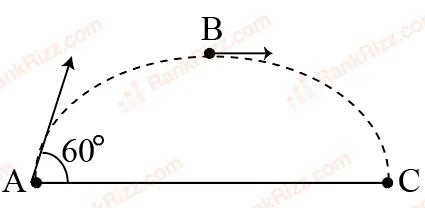
An object is projected with kinetic energy K from a point A at an angle 60° with the horizontal The ratio of the difference in kinetic energies at points B and C to that at point A (see figure), in the absence of air friction is :

3:4
1:4
2:3
1:2
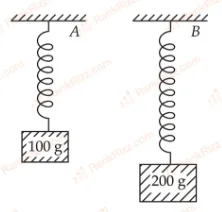
Two blocks with masses 100 g and 200 g are attached to the ends of springs A and B as shown in figure. the energy stored in A is E. The energy stored in B, when spring constants of A and B, respectively satisfy the relation is:

3E
4E
2E
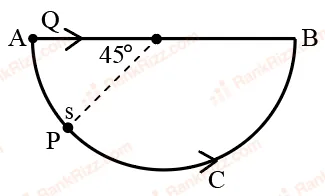
A bead sliding on a frictionless semi-circular string () and it is at point at and at this instant the horizontal component of its velocity is . Another bead of the same mass as is ejected from point at along the horizontal string , with the speed , friction between the beads and the respective strings may be neglected in both cases. Let and be the respective times taken by beads P and Q to reach the point B, then the relation between and is

Given below are two statements:
Statement I : An object moves from position to position under a conservative force field .
The work done by the force is W =
Statement II: Any object moving from one location to another location can follow infinite number of paths. Therefore, the amount of work done by the object changes with the path it follows for a conservative force.
In the light of the above statements, choose the correct answer from the options given below :
Both Statement I and Statement II are true
Statement I is true but Statement II is false
Statement I is false but Statement II is true
Both Statement I and Statement II are false
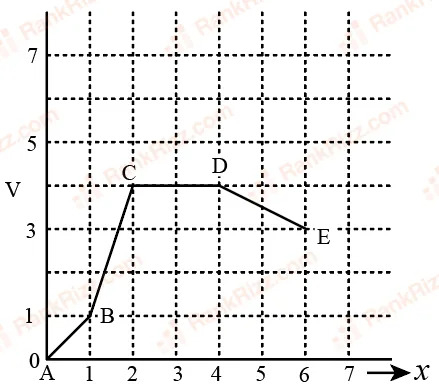
Potential energy (V) versus distance (x) is given by the graph. Rank various regions as per the magnitudes of the force (F) acting on a particle from high lo low.

A body of mass 2 kg is moving along x-direction such that its displacement as function of time is given by x(t) = , where and y=1m. The work done on the body during the time interval t = 2 s to t = 3 s, is _________ J.
12
24
42
49
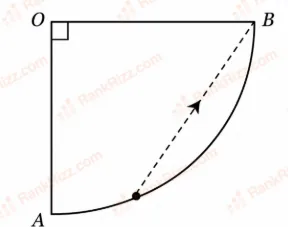
is a quarter of a smooth circular track of radius as shown in figure. A particle of mass moves along the track from under the action of a force which always directed toward point and has magnitude . Find the work done by force in moving the object from .

A block of mass 2 kg is attached to one end of a massless spring whose other end is fixed at a wall. The spring-mass system moves on a frictionless horizontal table. The spring's natural length is 2 m and spring constant is 200 N/m. The block is pushed such that the length of the spring becomes 1 m and then released. At distance x m (x < 2) from the wall, the speed of the block will be :
m/s
m/s
m/s
m/s
An object of mass 1000 g experiences a time dependent force N. The power generated by the force at time t is :
W
W
W
W
Which one of the following forces cannot be expressed in terms of potential energy?
Coulomb's force
Gravitational force
Frictional force
Restoring force
A block of mass 25 kg is pulled along a horizontal surface by a force at an angle 45 degrees with the horizontal such that it moves steadily. The friction coefficient between the block and the surface is 0.25. The work done by force for a displacement of 5 m of the block is : (Take g=)
970 J
735 J
245 J
490 J
A particle is released from height S above the surface of the earth. At a certain height its kinetic energy is three times its potential energy. The height from the surface of the earth and the speed of the particle at that instant are respectively.
A block of mass 1 kg, moving along x with speed m/s enters a rough region ranging from m to m. The retarding force acting on the block in this range is N, with N/m. Then the final speed of the block as it crosses rough region is
10 m/s
4 m/s
6 m/s
8 m/s
A sand dropper drops sand of mass m(t) on a conveyer belt at a rate proportional to the square root of speed (v)of the belt, i.e. . If P is the power delivered to run the belt at constant speed then which of the following relationship is true?
OTHER PHYSICS CHAPTERS