RankRizz

Electrostatics — JEE Main Previous Year Questions

Every Electrostatics question JEE Main has set from 2004–2026, grouped by the idea it tests rather than the order of the syllabus. 294 questions across 9 distinct ideas. Free to read, answer key on every one.

DATA UPDATED

Questions

294

Distinct ideas

9

Share of marks

6%

Difficulty

MEDIUM

The ideas inside Electrostatics

A chapter is not one subject — it is a handful of procedures the examiner reuses. These are the ones Electrostatics questions actually test.

Every Electrostatics question

21–40 OF 294 · NEWEST FIRST

JEE MAIN 2026 · 22 JAN S1Electric field due to point charges and superposition

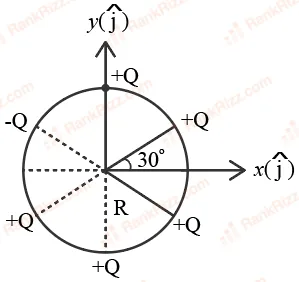
Six point charges are kept 60o60^{o} apart from each other on the circumference of a
circle of radius RR as shown in figure . The net electric field at the center of the circle is______.
( ϵo\epsilon_{o} is permittivity of free space)

Screenshot_34
  1. A

    −Q4πϵoR2(3i^−j^)-\frac{Q}{4\pi\epsilon_{o}R^{2}}\left(\sqrt{3}\widehat{i}- \widehat{j} \right)

  2. B

    −5Q8πϵoR2(i^+3j^)-\frac{5Q}{8\pi\epsilon_{o}R^{2}}\left(\widehat{i}+ \sqrt{3}\widehat{j} \right)

  3. C

    −(5Q8πϵoR2)(i^−3j^)-\left(\frac{5Q}{8\pi\epsilon_{o}R^{2}}\right)\left(\widehat{i}- \sqrt{3}\widehat{j} \right)

  4. D

    Q4πϵoR2(3i^−j^)\frac{Q}{4\pi\epsilon_{o}R^{2}}\left(\sqrt{3}\widehat{i}- \widehat{j} \right)

JEE MAIN 2026 · 22 JAN S1Electric field of continuous charge distributions

A simple pendulum has a bob with mass mm and charge qq. The pendulum string has negligible mass. When a uniform and horizontal electric field it is applied, the tension in the string changes. The final tension in the string, when pendulum attains an equilibrium position is ______.
(gg: acceleration due to gravity)

  1. A

    m2g2+q2E2\sqrt{m^{2}g^{2}+q^{2}E^{2}}

  2. B

    mg−qEmg-qE

  3. C

    m2g2−q2E2\sqrt{m^{2}g^{2}-q^{2}E^{2}}

  4. D

    mg+qEmg+qE

JEE MAIN 2026 · 22 JAN S2Electric potential and potential energy

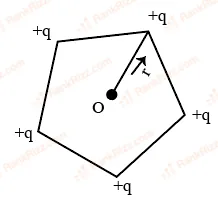
Five positive charges each having charge q are placed at the vertices of a pentagon as shown in the figure. The electric potential (V) and the electric field (E→)(\overrightarrow{E}) at the center O of the pentagon due to these five positive charges are:

Figure for JEE Main 2026 Physics question on Electric potential and potential energy
  1. A

    V=5q4πϵ0rV= \frac{5q}{4 \pi \epsilon_{0}r} and E→=0\overrightarrow{E} = 0

  2. B

    V=5q4πϵ0rV= \frac{5q}{4 \pi \epsilon_{0}r} and E→=5q4πϵ0r2r^\overrightarrow{E} = \frac{5q}{4\pi \epsilon_{0}r^{2}} \widehat{r}

  3. C

    V=5q4πϵ0rV= \frac{5q}{4 \pi \epsilon_{0}r} and E→=53q8πϵ0r2r^\overrightarrow{E} = \frac{5\sqrt{3}q}{8\pi \epsilon_{0}r^{2}} \widehat{r}

  4. D

    V = 0 and E→=0\overrightarrow{E} = 0

JEE MAIN 2026 · 22 JAN S2Electric potential and potential energy

Three small identical drops of water having same charge on each coalesce to form a bigger drop. Then the ratio of the potentials on one initial drop and that on the resultant bigger drop is :

  1. A

    323:13^{ \frac{2}{3}} : 1

  2. B

    1:3231: 3^{\frac{2}{3}}

  3. C

    1:2231: 2^{\frac{2}{3}}

  4. D

    1:3131: 3^{\frac{1}{3}}

JEE MAIN 2026 · 21 JAN S1Relation between field and potential, equipotential surfaces

A point charge of 10−810^{-8} is placed at origin. The work done in moving a point charge 2μC2 \mu C from point A(4, 4, 2) m to B(2, 2, 1) m is _____J (14πϵ0=9×10⁹in SI units)\left(\frac{1}{4\pi\epsilon _{0}}=9\times10^{9} \text{in SI units}\right)

  1. A

    15×10−615\times10^{-6}

  2. B

    30×10−630\times10^{-6}

  3. C

    0

  4. D

    45×10−645\times10^{-6}

JEE MAIN 2026 · 21 JAN S2Relation between field and potential, equipotential surfaces

Consider two identical metallic spheres of radius R each having charge Q and mass m. Their centers have an initial separation of 4R. Both the spheres are given an initial speed of u towards each other. The minimum value of u, so that they can just touch each other is :
(Take k=14πϵ0k= \frac{1}{4\pi \epsilon_{0}} and assume kQ2kQ^{2} > Gm2Gm^{2} where G is the Gravitational constant)

  1. A

    kQ22mR(1−Gm22kQ2)\sqrt{\frac{kQ^{2}}{2mR} \left(1-\frac{Gm^{2}}{2kQ^{2}} \right)}

  2. B

    kQ24mR(1+Gm2kQ2)\sqrt{\frac{kQ^{2}}{4mR} \left(1+\frac{Gm^{2}}{kQ^{2}} \right)}

  3. C

    kQ22mR(1−Gm2kQ2)\sqrt{\frac{kQ^{2}}{2mR} \left(1-\frac{Gm^{2}}{kQ^{2}} \right)}

  4. D

    kQ24mR(1−Gm2kQ2)\sqrt{\frac{kQ^{2}}{4mR} \left(1-\frac{Gm^{2}}{kQ^{2}} \right)}

JEE MAIN 2026Electric potential and potential energy

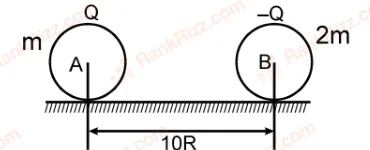
Two smooth spherical non conducting shells each of radius RR having uniformly distributed charge QQ & −Q-Q on their surfaces are released on a smooth non-conducting surface when the distance between their centers is 10R10R. The mass of A is mm and that of B is 2m2m. The speed of A just before A and B collide is: [Neglect gravitational interaction]

Figure for JEE Main 2026 Physics question on Electric potential and potential energy
  1. A

    Q2K15mR Q\sqrt{\frac{2K}{15mR}\ }

  2. B

    Q4K15mR Q\sqrt{\frac{4K}{15mR}\ }

  3. C

    Q8K15mR Q\sqrt{\frac{8K}{15mR}\ }

  4. D

    Q16K15mR Q\sqrt{\frac{16K}{15mR}\ }

JEE MAIN 2025 · 08 APR S2Relation between field and potential, equipotential surfaces

Given below are two statements: one is labelled as Assertion A and the other is labelled as Reason R
Assertion A :
Work done in moving a test charge between two points inside a uniformly charged spherical shell is zero, no matter which path is chosen.
Reason R : Electrostatic potential inside a uniformly charged spherical shell is constant and is same as that on the surface of the shell.
Choose the correct answer :

  1. A

    A is true but R is false

  2. B

    Both A and R are true and R is the correct explanation of A

  3. C

    A is false but R is true

  4. D

    Both A and R are true but R is NOT the correct explanation of A

JEE MAIN 2025 · 08 APR S2Conductors, concentric shells and earthing

Electric charge is transferred to an irregular metallic disk as shown in figure. If σ1\sigma_1, σ2\sigma_2, σ3\sigma_3 and σ4\sigma_4 are charge densities at given points then, choose the correct answer from the options given below :
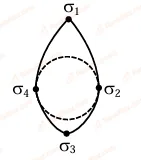
Figure for JEE Main 2025 Physics question on Conductors, concentric shells and earthing

(A) σ1>σ3  ;  σ2=σ4\sigma_1 > \sigma_3 \; ; \; \sigma_2 = \sigma_4             (B) σ1>σ2  ;  σ3>σ4\sigma_1 > \sigma_2 \; ; \; \sigma_3 > \sigma_4

(C) σ1>σ3>σ2=σ4\sigma_1 > \sigma_3 > \sigma_2 = \sigma_4                   (D) σ1=σ2=σ3=σ4\sigma_1 = \sigma_2 = \sigma_3 = \sigma_4

(E) σ1=σ2>σ3=σ4\sigma_1 = \sigma_2 > \sigma_3 = \sigma_4

  1. A

    A, B and C Only

  2. B

    A and C Only

  3. C

    D and E Only

  4. D

    B and C Only

JEE MAIN 2025 · 08 APR S2Electric flux and Gauss's law

An infinitely long wire has uniform linear charge density λ=2\lambda = 2 nC/m. The net flux through a Gaussian cube of side length 3\sqrt{3} cm, if the wire passes through two corners of the cube that are maximally displaced from each other, would be xx   Nm2^2C−1^{-1}, where x is :
[Neglect any edge effects and use 14πϵ0=9×10⁹\frac{1}{4\pi\epsilon_0}= 9\times10^{9} SI units]

  1. A

    0.72π0.72\pi

  2. B

    1.44π1.44\pi

  3. C

    6.48π6.48\pi

  4. D

    2.16π2.16\pi

JEE MAIN 2025 · 08 APR S2Conductors, concentric shells and earthing

Two metal spheres of radius R and 3R have same surface charge density σ\sigma. If they are brought in contact and then separated, the surface charge density on smaller and bigger sphere becomes σ1\sigma_1 and σ2\sigma_2, respectively. The ratio σ1σ2\frac{\sigma_1}{\sigma_2} is :

  1. A

    19\frac{1}{9}

  2. B

    9

  3. C

    13\frac{1}{3}

  4. D

    3

JEE MAIN 2025 · 07 APR S1Electric potential and potential energy

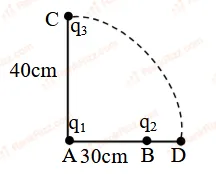
Two charges q1q_1 and q2q_2 are separated by a distance of 30 cm. A third charge q3q_3 initially at 'C' as shown in the figure, is moved along the circular path of radius 40 cm from C to D. If the difference in potential energy due to movement of q3q_3 from C to D is given by q3K4πϵ0\frac{q_3 K}{4\pi\epsilon_0}, the value of K is :

Figure for JEE Main 2025 Physics question on Electric potential and potential energy
  1. A

    8q28q_2

  2. B

    6q26q_2

  3. C

    8q18q_1

  4. D

    6q16q_1

JEE MAIN 2025 · 07 APR S2Electric flux and Gauss's law

Given below are two statements : one is labelled as Assertion (A) and the other is labelled as Reason (R).
Assertion (A) : The outer body of an air craft is made of metal which protects persons sitting inside from lightning-strikes.
Reason (R) : The electric field inside the cavity enclosed by a conductor is zero.
In the light of the above statements, choose the most appropriate answer from the options given below :

  1. A

    Both (A) and (R) are correct and (R) is the correct explanation of (A)

  2. B

    (A) is correct but (R) is not correct

  3. C

    Both (A) and (R) are correct but (R) is not correct explanation of (A)

  4. D

    (A) is not correct but (R) is correct

JEE MAIN 2025 · 07 APR S2Electric dipole and dipole in external field

A dipole with two electric charges of 2 μ\muC magnitude each, with separation distance 0.5 μ\mum, is placed between the plates of a capacitor such that its axis is parallel to an electric field established between the plates when a potential difference of 5 V is applied. Separation between the plates is 0.5 mm. If the dipole is rotated by 30° from the axis, the value of the torque is :

  1. A

    5×10−95 \times 10^{-9} Nm

  2. B

    5×10⁻³⁵ \times 10^{-3} Nm

  3. C

    2.5×10−122.5 \times 10^{-12} Nm

  4. D

    2.5×10−92.5 \times 10^{-9} Nm

JEE MAIN 2025 · 07 APR S2Electric flux and Gauss's law

The electric field in a region is given by E⃗=(2i^+4j^+6k^)×103\vec{E} = (2\hat{i} + 4\hat{j} + 6\hat{k}) \times 10^3 N/C. The flux of the field through a rectangular surface parallel to x-z plane is 6.0 Nm2^2C−1^{-1}. The area of the surface is _____ cm2^2.

JEE MAIN 2025 · 04 APR S1Electric flux and Gauss's law

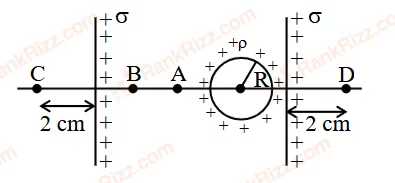
Two infinite identical charged sheets and a charged spherical body of charge density 'ρ\rho' are arranged as shown in figure. Then the correct relation between the electrical fields at A, B, C and D points is:

Figure for JEE Main 2025 Physics question on Electric flux and Gauss's law
  1. A

    E⃗A=E⃗B;E⃗C=E⃗D\vec{E}_A = \vec{E}_B; \vec{E}_C = \vec{E}_D

  2. B

    E⃗A>E⃗B;E⃗C=E⃗D\vec{E}_A \gt \vec{E}_B; \vec{E}_C = \vec{E}_D

  3. C

    E⃗C≠E⃗D;E⃗A>E⃗B\vec{E}_C \neq \vec{E}_D; \vec{E}_A \gt \vec{E}_B

  4. D

    ∣E⃗A∣=∣E⃗B∣;E⃗C>E⃗D|\vec{E}_A| = |\vec{E}_B|; \vec{E}_C \gt \vec{E}_D

JEE MAIN 2025 · 04 APR S1Electric dipole and dipole in external field

Two small spherical balls of mass 10g each with charges −2μC-2\mu C and 2μC2\mu C, are attached to two ends of very light rigid rod of length 20 cm. The arrangement is now placed near an infinite non-conducting charge sheet with uniform charge density 100μC/m2100 \mu C/m^2 such that length of rod makes an angle of 30° with electric field generated by charge sheet. Net torque acting on the rod is: (Take ε0:8.85×10⁻¹²C2/Nm2\varepsilon_0 : 8.85 \times 10^{-12} C^2/Nm^2)

  1. A

    112 Nm

  2. B

    1.12 Nm

  3. C

    2.24 Nm

  4. D

    11.2 Nm

JEE MAIN 2025 · 04 APR S2Electric field of continuous charge distributions

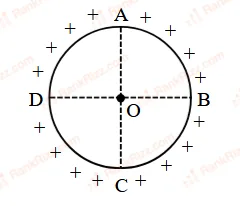
A metallic ring is uniformly charged as shown in figure. AC and BD are two mutually perpendicular diameters. Electric field due to arc AB to 'O' is 'E' is magnitude. What would be the magnitude of electric field at 'O' due to arc ABC?

Figure for JEE Main 2025 Physics question on Electric field of continuous charge distributions
  1. A

    2E2E

  2. B

    2E\sqrt{2}E

  3. C

    E/2E/2

  4. D

    Zero

JEE MAIN 2025 · 03 APR S1Electric potential and potential energy

The electrostatic potential on the surface of uniformly charged spherical shell of radius R = 10 cm is 120 V. The potential at the centre of shell, at a distance r = 5 cm from centre, and at a distance r = 15 cm from the centre of the shell, respectively, are :

  1. A

    120V, 120V, 80V

  2. B

    40V, 40V, 80V

  3. C

    0V, 0V, 80V

  4. D

    0V, 120V, 40V

JEE MAIN 2025 · 02 APR S1Electric field of continuous charge distributions

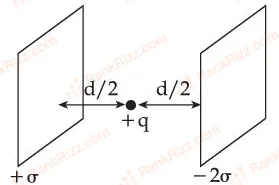
Consider two infinitely large plane parallel conducting plates as shown below. The plates are uniformly charged with a surface charge density +σ+\sigma and −2σ-2\sigma. The force experienced by a point charge +q+q placed at the mid point between two plates will be:

Figure for JEE Main 2025 Physics question on Electric field of continuous charge distributions
  1. A

    σq4ϵ0\frac{\sigma q}{4 \epsilon_0}

  2. B

    3σq2ϵ0\frac{3\sigma q}{2 \epsilon_0}

  3. C

    3σq4ϵ0\frac{3\sigma q}{4 \epsilon_0}

  4. D

    σq2ϵ0\frac{\sigma q}{2 \epsilon_0}