RankRizz

Electrostatics — JEE Main Previous Year Questions

Every Electrostatics question JEE Main has set from 2004–2026, grouped by the idea it tests rather than the order of the syllabus. 294 questions across 9 distinct ideas. Free to read, answer key on every one.

DATA UPDATED

Questions

294

Distinct ideas

9

Share of marks

6%

Difficulty

MEDIUM

The ideas inside Electrostatics

A chapter is not one subject — it is a handful of procedures the examiner reuses. These are the ones Electrostatics questions actually test.

Every Electrostatics question

141–160 OF 294 · NEWEST FIRST

JEE MAIN 2022 · 29 JUN S2Electric charge and Coulomb's law

Two point charges QQ each are placed at a distance dd apart. A third point charge qq is placed at a distance xx from mid-point on the perpendicular bisector. The value of xx at which charge qq will experience the maximum Coulomb's force is:

  1. A

    dd

  2. B

    d2\frac{d}{2}

  3. C

    d2\frac{d}{\sqrt{2}}

  4. D

    d22\frac{d}{2\sqrt{2}}

JEE MAIN 2022 · 29 JUN S2Electric potential and potential energy

If the electric potential at any point (x,y,z)(x, y, z) m in space is given by V=3x2V = 3x^2 volt. The electric field at the point (1,0,3)(1, 0, 3) m will be:

  1. A

    3 Vm−1^{-1}, directed along positive xx-axis.

  2. B

    3 Vm−1^{-1}, directed along negative xx-axis.

  3. C

    6 Vm−1^{-1}, directed along negative xx-axis.

  4. D

    6 Vm−1^{-1}, directed along positive xx-axis.

JEE MAIN 2022 · 28 JUN S1Electric field of continuous charge distributions

Statement-I : A point charge is brought in an electric field. The value of electric field at a point near to the charge may increase if the charge is positive.
Statement-II : An electric dipole is placed in a uniform electric field. The net electric force on the dipole will not be zero.

  1. A

    Both statement-I and statement-II are true.

  2. B

    Both statement-I and statement-II are false.

  3. C

    Statement-I is true but statement-II is false.

  4. D

    Statement-I is false but statement-II is true.

JEE MAIN 2022 · 28 JUN S1Electric field of continuous charge distributions

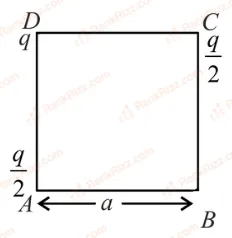
The three charges q2,q\frac{q}{2}, q and q2\frac{q}{2} are placed at the corners A,DA, D and CC of a square of side aa as shown in figure. The magnitude of electric field (EE) at the corner BB of the square, is

Figure for JEE Main 2022 Physics question on Electric field of continuous charge distributions
  1. A

    q4πε0a2(12+12)\frac{q}{4\pi\varepsilon_0 a^2}\left(\frac{1}{\sqrt{2}} + \frac{1}{2}\right)

  2. B

    q4πε0a2(1+12)\frac{q}{4\pi\varepsilon_0 a^2}\left(1 + \frac{1}{\sqrt{2}}\right)

  3. C

    q4πε0a2(1−12)\frac{q}{4\pi\varepsilon_0 a^2}\left(1 - \frac{1}{\sqrt{2}}\right)

  4. D

    q4πε0a2(12−12)\frac{q}{4\pi\varepsilon_0 a^2}\left(\frac{1}{\sqrt{2}} - \frac{1}{2}\right)

JEE MAIN 2022 · 28 JUN S2Electric field due to point charges and superposition

Two point charges AA and BB of magnitude +8×10⁻⁶+8 \times 10^{-6}C and −8×10⁻⁶-8 \times 10^{-6}C respectively are placed at a distance dd apart. The electric field at the middle point OO between the charges is 6.4×1046.4 \times 10^4 N C−1^{-1}. The distance 'dd' between the point charges AA and BB is

  1. A

    2 m

  2. B

    3 m

  3. C

    1 m

  4. D

    4 m

JEE MAIN 2022 · 27 JUN S2Electric flux and Gauss's law

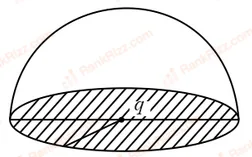
If a charge qq is placed at the centre of a closed hemispherical non-conducting surface, the total flux passing through the flat surface would be

Figure for JEE Main 2022 Physics question on Electric flux and Gauss's law
  1. A

    qε0\frac{q}{\varepsilon_0}

  2. B

    q2ε0\frac{q}{2\varepsilon_0}

  3. C

    q4ε0\frac{q}{4\varepsilon_0}

  4. D

    q2πε0\frac{q}{2\pi\varepsilon_0}

JEE MAIN 2022 · 27 JUN S2Electric charge and Coulomb's law

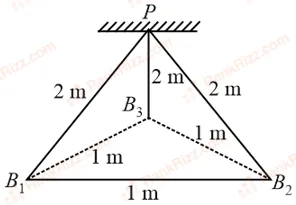
Three identical charged balls each of charge 2C2C are suspended from a common point PP by silk threads of 22 m each (as shown in figure). They form an equilateral triangle of side 11 m. The ratio of net force on a charged ball to the force between any two charged balls will be

Figure for JEE Main 2022 Physics question on Electric charge and Coulomb's law
  1. A

    3:1\sqrt{3} : 1

  2. B

    3:2\sqrt{3} : 2

  3. C

    1:11 : 1

  4. D

    1:41 : 4

JEE MAIN 2022 · 26 JUN S1Electric dipole and dipole in external field

Given below two statements : One is labelled as Assertion (A) and other is labelled as Reason (R).
Assertion (A): Non-polar materials do not have any permanent dipole moment.
Reason (R): When a non-polar material is placed in an electric field, the centre of the positive charge distribution of it's individual atom or molecule coincides with the centre of the negative charge distribution.
In the light of above statements, choose the most appropriate answer from the options given below.

  1. A

    Both (A) and (R) are correct and (R) is the correct explanation of (A).

  2. B

    Both (A) and (R) are correct and (R) is not the correct explanation of (A).

  3. C

    (A) is correct but (R) is not correct.

  4. D

    (A) is not correct but (R) is correct.

JEE MAIN 2022 · 26 JUN S2Relation between field and potential, equipotential surfaces

Sixty four conducting drops each of radius 0.020.02 m and each carrying a charge of 55 μ\muC are combined to form a bigger drop. The ratio of surface charge density of bigger drop to the smaller drop will be

  1. A

    1:41 : 4

  2. B

    4:14 : 1

  3. C

    1:81 : 8

  4. D

    8:18 : 1

JEE MAIN 2022 · 25 JUN S1Electric field due to point charges and superposition

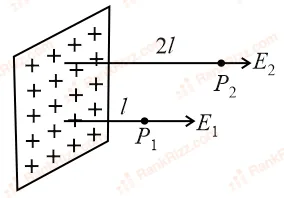
In the figure, a very large plane sheet of positive charge is shown. P1P_1 and P2P_2 are two points at distance ll and 2l2l from the charge distribution. If σ\sigma is the surface charge density, then the magnitude of electric fields E1E_1 and E2E_2 at P1P_1 and P2P_2 respectively are

Figure for JEE Main 2022 Physics question on Electric field due to point charges and superposition
  1. A

    E1=σε0,E2=σ2ε0E_1 = \frac{\sigma}{\varepsilon_0}, E_2 = \frac{\sigma}{2\varepsilon_0}

  2. B

    E1=2σε0,E2=σε0E_1 = \frac{2\sigma}{\varepsilon_0}, E_2 = \frac{\sigma}{\varepsilon_0}

  3. C

    E1=E2=σ2ε0E_1 = E_2 = \frac{\sigma}{2\varepsilon_0}

  4. D

    E1=E2=σε0E_1 = E_2 = \frac{\sigma}{\varepsilon_0}

JEE MAIN 2022 · 25 JUN S2Electric potential and potential energy

2727 identical drops are charged at 2222 V each. They combine to form a bigger drop. The potential of the bigger drop will be ______ V.

JEE MAIN 2022 · 24 JUN S1Electric field of continuous charge distributions

A vertical electric field of magnitude 4.9×1054.9 \times 10^{5} N C−1^{-1} just prevents a water droplet of a mass 0.10.1 g from falling. The value of charge on the droplet will be : (Given g=9.8g = 9.8 m s−2^{-2})

  1. A

    1.6×10−91.6 \times 10^{-9} C

  2. B

    2.0×10−92.0 \times 10^{-9} C

  3. C

    3.2×10−93.2 \times 10^{-9} C

  4. D

    0.5×10−90.5 \times 10^{-9} C

JEE MAIN 2022 · 24 JUN S2Electric charge and Coulomb's law

Two identical charged particles each having a mass 1010 g and charge 2.0×10−72.0 \times 10^{-7} C are placed on a horizontal table with a separation of LL between them such that they stay in limited equilibrium. If the coefficient of friction between each particle and the table is 0.250.25, find the value of LL. [Use g=10g = 10 ms−2^{-2}]

  1. A

    12 cm

  2. B

    10 cm

  3. C

    8 cm

  4. D

    5 cm

JEE MAIN 2022 · 24 JUN S2Electric flux and Gauss's law

A long cylindrical volume contains a uniformly distributed charge of density ρ\rho. The radius of cylindrical volume is RR. A charge particle (qq) revolves around the cylinder in a circular path. The kinetic energy of the particle is :

  1. A

    ρqR24ε0\frac{\rho q R^2}{4\varepsilon_0}

  2. B

    ρqR22ε0\frac{\rho q R^2}{2\varepsilon_0}

  3. C

    qρ4ε0R2\frac{q\rho}{4\varepsilon_0 R^2}

  4. D

    4ε0R2qρ\frac{4\varepsilon_0 R^2}{q\rho}

JEE MAIN 2021 · 01 SEP S2Electric flux and Gauss's law

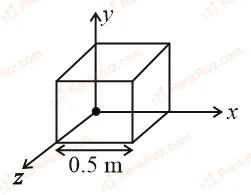
A cube is placed inside an electric field, E⃗=150y2j^\vec{E} = 150y^2\hat{j}. The side of the cube is 0.5 m and is placed in the field as shown in the given figure. The charge inside the cube is:

Figure for JEE Main 2021 Physics question on Electric flux and Gauss's law
  1. A

    8.3×10−118.3 \times 10^{-11} C

  2. B

    3.8×10−113.8 \times 10^{-11} C

  3. C

    3.8×10−123.8 \times 10^{-12} C

  4. D

    8.3×10−128.3 \times 10^{-12} C

JEE MAIN 2021 · 31 AUG S1Electric field due to point charges and superposition

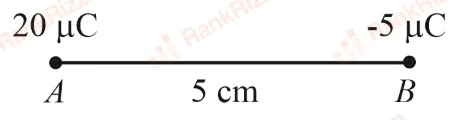
Two particles AA and BB having charges 20 μ\muC and −5-5 μ\muC respectively are held fixed with a separation of 5 cm. At what position a third charged particle should be placed so that it does not experience a net electric force?

Figure for JEE Main 2021 Physics question on Electric field due to point charges and superposition
  1. A

    At 5 cm from −5-5 μ\muC on the right side

  2. B

    At 5 cm from 20 μ\muC on the left side of system

  3. C

    At 1.25 cm from −5-5 μ\muC between two charges

  4. D

    At midpoint between two charges

JEE MAIN 2021 · 31 AUG S2Electric flux and Gauss's law

Choose the incorrect statement:
(a) The electric lines of force entering into a Gaussian surface provide negative flux.
(b) A charge qq is placed at the centre of a cube. The flux through all the faces will be the same.
(c) In a uniform electric field net flux through a closed Gaussian surface containing no net charge, is zero.
(d) When an electric field is parallel to a Gaussian surface, it provides a finite non-zero flux.
Choose the most appropriate answer from the options given below:

  1. A

    (b) and (d) Only

  2. B

    (c) and (d) Only

  3. C

    (a) and (c) Only

  4. D

    (d) Only

JEE MAIN 2021 · 27 AUG S1Electric field due to point charges and superposition

A uniformly charged disc of radius RR having surface charge density σ\sigma is placed in the xyxy plane with its center at the origin. Find the electric field intensity along the zz-axis at a distance ZZ from origin:

  1. A

    E=2ε0σ(1(Z2+R2)1/2+Z)E = \frac{2\varepsilon_0}{\sigma}\left(\frac{1}{(Z^2+R^2)^{1/2}} + Z\right)

  2. B

    E=σ2ε0(1+Z(Z2+R2)1/2)E = \frac{\sigma}{2\varepsilon_0}\left(1 + \frac{Z}{(Z^2+R^2)^{1/2}}\right)

  3. C

    E=σ2ε0(1−Z(Z2+R2)1/2)E = \frac{\sigma}{2\varepsilon_0}\left(1 - \frac{Z}{(Z^2+R^2)^{1/2}}\right)

  4. D

    E=σ2ε0(1(Z2+R2)+1Z2)E = \frac{\sigma}{2\varepsilon_0}\left(\frac{1}{(Z^2+R^2)} + \frac{1}{Z^2}\right)

JEE MAIN 2021 · 27 AUG S2Electric field of continuous charge distributions

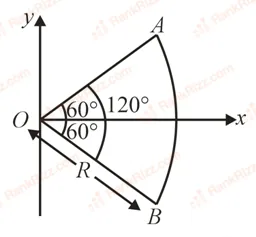
Figure shows a rod ABAB, which is bent in a 120° circular arc of radius RR. A charge (−Q)(-Q) is uniformly distributed over rod AB. What is the electric field E⃗\vec{E} at the centre of curvature O?

Figure for JEE Main 2021 Physics question on Electric field of continuous charge distributions
  1. A

    33Q8π2ε0R2i^\frac{3\sqrt{3}Q}{8\pi^2 \varepsilon_0 R^2} \hat{i}

  2. B

    33Q8πε0R2i^\frac{3\sqrt{3}Q}{8\pi \varepsilon_0 R^2} \hat{i}

  3. C

    −33Q8π2ε0R2i^\frac{-3\sqrt{3}Q}{8\pi^2 \varepsilon_0 R^2} \hat{i}

  4. D

    33Q16π2ε0R2i^\frac{3\sqrt{3}Q}{16\pi^2 \varepsilon_0 R^2} \hat{i}

JEE MAIN 2021 · 26 AUG S1Electric field of continuous charge distributions

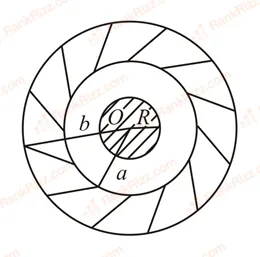
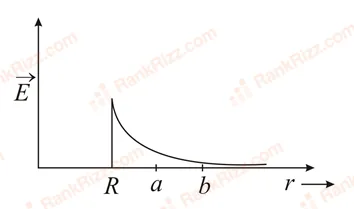
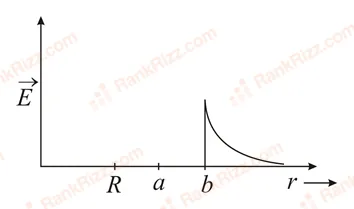
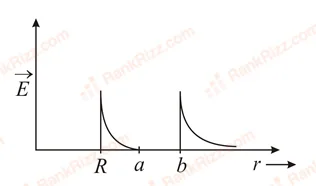
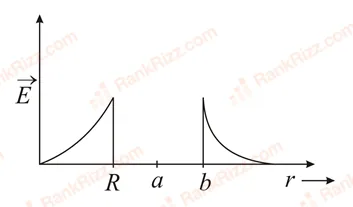
A solid metal sphere of radius RR having charge qq is enclosed inside the concentric spherical shell of inner radius aa and outer radius bb as shown in the figure. The approximate variation electric field E⃗\vec{E}, as a function of distance rr, from centre OO, is given by:

Figure for JEE Main 2021 Physics question on Electric field of continuous charge distributions
  1. A
    Figure for JEE Main 2021 Physics question on Electric field of continuous charge distributions
  2. B
    Figure for JEE Main 2021 Physics question on Electric field of continuous charge distributions
  3. C
    Figure for JEE Main 2021 Physics question on Electric field of continuous charge distributions
  4. D
    Figure for JEE Main 2021 Physics question on Electric field of continuous charge distributions