RankRizz

Batteries, fuel cells and corrosion — JEE Main Previous Year Questions

Batteries, fuel cells and corrosion has been asked 17 times in JEE Main, in 9 different years between 2004 and 2026, and in all of the last five exam years (2022–2026), 12 questions in all. That is 7% of Electrochemistry, one of its three most-asked topics. Last asked in JEE Main 02 Apr 2026, Shift 2. 16 are multiple choice and 1 numerical-value; 10 easy, 4 medium and 1 hard by our difficulty labels. All of them are below, newest first, free to read.

Questions

17

Years asked

9

Since

2004

Of the chapter

7%

When JEE Main asked it

Questions on Batteries, fuel cells and corrosion in every year it was asked, newest first.

JEE Main questions on Batteries, fuel cells and corrosion by year, 2004–2026
YearRelative frequencyQuestions
20261
20254
20245
20231
20221
20162
20141
20091
20041
Total17

Every Batteries, fuel cells and corrosion question

1–17 OF 17 · NEWEST FIRST

JEE MAIN 2026 · 02 APR S2Batteries, fuel cells and corrosion

Consider the following two half-cell reactions along with the standard reduction potential given : 

Figure for JEE Main 2026 Chemistry question on Batteries, fuel cells and corrosion

A fuel cell was set up using the above two reactions such that the cell operates under the standard condition of 1 bar pressure and 298 K temperature. The fuel cell works with 80% efficiency. If the work derived from the cell using 1 mol of CH3_3OH is used to compress an ideal gas isothermally against a constant pressure of 1 kPa, then the change in the volume of the gas, ΔV=\Delta V = _____ m3^3. (nearest integer)
Given: F=96500F = 96500 C mol−1^{-1}

JEE MAIN 2025 · 04 APR S1Batteries, fuel cells and corrosion

On charging the lead storage battery, the oxidation state of lead changes from x1x_1 to y1y_1 at the anode and from x2x_2 to y2y_2 at the cathode. The values of x1,y1,x2,y2x_1, y_1, x_2, y_2 are respectively:

  1. A

    +4, +2, 0, +2

  2. B

    +2, 0, +2, +4

  3. C

    0, +2, +4, +2

  4. D

    +2, 0, 0, +4

JEE MAIN 2025 · 03 APR S2Batteries, fuel cells and corrosion

The standard cell potential (Ecell⊖E^\ominus_{\text{cell}}) of a fuel cell based on the oxidation of methanol in air that has been used to power television relay station is measured as 1.21 V. The standard half cell reduction potential for O2O_2 (EO2/H2O∘E^\circ_{O_2/H_2O}) is 1.229 V. Choose the correct statement:

  1. A

    The standard half cell reduction potential for the reduction of CO2CO_2 (ECO2/CH3OH∘E^\circ_{CO_2/CH_3OH}) is 19 mV

  2. B

    Oxygen is formed at the anode.

  3. C

    Reactants are fed at one go to each electrode.

  4. D

    Reduction of methanol takes place at the cathode.

JEE MAIN 2025 · 29 JAN S2Batteries, fuel cells and corrosion

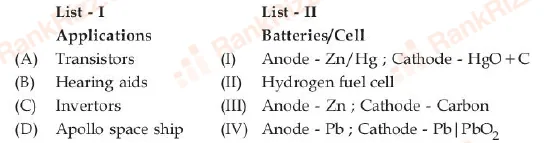
Match List - I with List - II :

page10_img5


Choose the correct answer from the options given below :

  1. A

    (A)-(III), (B)-(II), (C)-(IV), (D)-(I)

  2. B

    (A)-(II), (B)-(III), (C)-(IV), (D)-(I)

  3. C

    (A)-(III), (B)-(I), (C)-(IV), (D)-(II)

  4. D

    (A)-(IV), (B)-(III), (C)-(II), (D)-(I)

JEE MAIN 2025 · 22 JAN S2Batteries, fuel cells and corrosion

Given below are two statements : Statement (I) : Corrosion is an electrochemical phenomenon in which pure metal acts as an anode and impure metal as a cathode. Statement (II) : The rate of corrosion is more in alkaline medium than in acidic medium. In the light of the above statements, choose the correct answer from the options given below :

  1. A

    Both Statement I and Statement II are true

  2. B

    Statement I is false but Statement II is true

  3. C

    Statement I is true but Statement II is false

  4. D

    Both Statement I and Statement II are false

JEE MAIN 2024 · 09 APR S2Batteries, fuel cells and corrosion

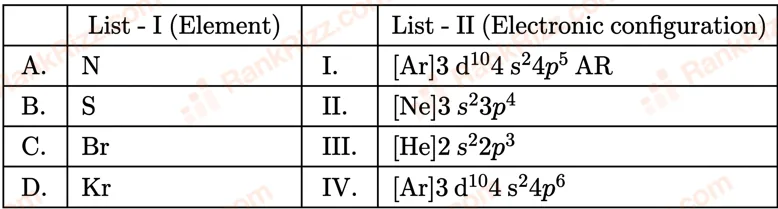
Match List I with List II:

Figure for JEE Main 2024 Chemistry question on Batteries, fuel cells and corrosion


Choose the correct answer from the options given below:

  1. A

    A-III, B-II, C-I, D-IV

  2. B

    A-II, B-I, C-IV, D-III

  3. C

    A-I, B-IV, C-III, D-II

  4. D

    A-IV, B-III, C-II, D-I

JEE MAIN 2024 · 05 APR S1Batteries, fuel cells and corrosion

The reaction at cathode in the cells commonly used in clocks involves.

  1. A

    reduction of Mn from +7 to +2

  2. B

    reduction of Mn from +4 to +3

  3. C

    oxidation of Mn from +3 to +4

  4. D

    oxidation of Mn from +2 to +7

JEE MAIN 2024 · 04 APR S2Batteries, fuel cells and corrosion

Fuel cell, using hydrogen and oxygen as fuels: A. has been used in spaceship, B. has an efficiency of 40% to produce electricity, C. uses aluminum as catalysts, D. is eco-friendly, E. is actually a type of Galvanic cell only. Choose the correct answer from the options given below:

  1. A

    A, B, D, E only

  2. B

    A, D, E only

  3. C

    A, B, D only

  4. D

    A, B, C only

JEE MAIN 2024 · 31 JAN S1Batteries, fuel cells and corrosion

The metals that are employed in the battery industries are A. Fe, B. Mn, C. Ni, D. Cr, E. Cd. Choose the correct answer from the options given below:

  1. A

    B, C and E only

  2. B

    A, B, C, D and E

  3. C

    A, B, C and D only

  4. D

    B, D and E only

JEE MAIN 2024 · 27 JAN S2Batteries, fuel cells and corrosion

Which of the following statements is not correct about rusting of iron?

  1. A

    Coating of iron surface by tin prevents rusting, even if the tin coating is peeling off.

  2. B

    When pH lies above 9 or 10, rusting of iron does not take place.

  3. C

    Dissolved acidic oxides SO2SO_2, NO2NO_2 in water act as catalyst in the process of rusting.

  4. D

    Rusting of iron is envisaged as setting up of electrochemical cell on the surface of iron object.

JEE MAIN 2023 · 12 APR S1Batteries, fuel cells and corrosion

For lead storage battery pick the correct statements
A. During charging of battery, PbSO4_4 on anode is converted into PbO2_2
B. During charging of battery, PbSO4_4 on cathode is converted into PbO2_2
C. Lead storage battery consists of grid of lead packed with PbO2_2 as anode
D. Lead storage battery has ~38% solution of sulphuric acid as an electrolyte
Choose the correct answer from the options given below:

  1. A

    A, B, D only

  2. B

    B, C, D only

  3. C

    B, C only

  4. D

    B, D only

JEE MAIN 2022 · 28 JUL S1Batteries, fuel cells and corrosion

Match List-I with List-II.

List-IList-II
A. Cd(s)+2Ni(OH)3(s)→CdO(s)+2Ni(OH)2(s)+H2O(l)Cd(s) + 2Ni(OH)_3(s) \to CdO(s) + 2Ni(OH)_2(s) + H_2O(l)I. Primary battery
B. Zn(Hg)+HgO(s)→ZnO(s)+Hg(l)Zn(Hg) + HgO(s) \to ZnO(s) + Hg(l)II. Discharging of secondary battery
C. 2PbSO4(s)+2H2O(l)→Pb(s)+PbO2(s)+2H2SO4(aq)2PbSO_4(s) + 2H_2O(l) \to Pb(s) + PbO_2(s) + 2H_2SO_4(aq)III. Fuel cell
D. 2H2(g)+O2(g)→2H2O(l)2H_2(g) + O_2(g) \to 2H_2O(l)IV. Charging of secondary battery
  1. A

    A-I, B-II, C-III, D-IV

  2. B

    A-IV, B-I, C-IV, D-III

  3. C

    A-II, B-I, C-IV, D-III

  4. D

    A-II, B-I, C-III, D-IV

JEE MAIN 2016 · 10 APR ONLINEBatteries, fuel cells and corrosion

Identify the correct statement:

  1. A

    Corrosion of iron can be minimised by forming a contact with another metal with a higher reduction potential

  2. B

    Iron corrodes in oxygen-free water

  3. C

    Corrosion of iron can be minimised by forming an impermeable barrier at its surface

  4. D

    Iron corrodes more rapidly in salt water because its electrochemical potential is higher

JEE MAIN 2016 · 03 APR OFFLINEBatteries, fuel cells and corrosion

Galvanization is applying a coating of:

  1. A

    Cu

  2. B

    Zn

  3. C

    Pb

  4. D

    Cr

JEE MAIN 2014 · 12 APR ONLINEBatteries, fuel cells and corrosion

Copper becomes green when exposed to moist air for a long period. This is due to:

  1. A

    the formation of a layer of cupric oxide on the surface of copper.

  2. B

    the formation of a layer of basic carbonate of copper on the surface of copper.

  3. C

    the formation of a layer of cupric hydroxide on the surface of copper.

  4. D

    the formation of basic copper sulphate layer on the surface of the metal.

JEE MAIN 2009Batteries, fuel cells and corrosion

In a fuel cell methanol is used as fuel and oxygen gas is used as an oxidizer. The reaction is CH3OH(ℓ)+32O2(g)→CO2(g)+2H2O(ℓ)CH_3OH(\ell) + \frac{3}{2}O_2(g) \to CO_2(g) + 2H_2O(\ell) At 298298 K standard Gibb's energies of formation for CH3OH(ℓ),H2O(ℓ)CH_3OH(\ell), H_2O(\ell) and CO2(g)CO_2(g) are −166.2,−237.2-166.2, -237.2 and −394.4-394.4 kJ mol−1^{-1} respectively. If standard enthalpy of combustion of methanol is −726-726 kJ mol−1^{-1}, efficiency of the fuel cell will be

  1. A

    80%80\%

  2. B

    87%87\%

  3. C

    90%90\%

  4. D

    97%97\%

JEE MAIN 2004Batteries, fuel cells and corrosion

In hydrogen-oxygen fuel cell, combustion of hydrogen occurs to

  1. A

    generate heat

  2. B

    remove adsorbed oxygen from electrode surfaces

  3. C

    produce high purity water

  4. D

    create potential difference between the two electrodes

Batteries, fuel cells and corrosion: common questions

How many Batteries, fuel cells and corrosion questions have come in JEE Main?
Batteries, fuel cells and corrosion has been asked 17 times in JEE Main, in 9 different years between 2004 and 2026. It came up in all of the last five exam years (2022–2026), 12 questions in all.
Is Batteries, fuel cells and corrosion important for JEE Main?
It is one of the three most-asked topics in Electrochemistry: 17 of the chapter's 227 JEE Main questions (7%). It came up in all of the last five exam years (2022–2026), 12 questions in all.
When was Batteries, fuel cells and corrosion last asked in JEE Main?
Most recently in JEE Main 02 Apr 2026, Shift 2. Questions on this page are newest first, so the latest ones are at the top.
What kind of Batteries, fuel cells and corrosion questions does JEE Main ask?
16 are multiple choice and 1 numerical-value; 10 easy, 4 medium and 1 hard by our difficulty labels. Each question shows its answer key and worked solution where we have them.