JEE MAIN 2023 · 24 JAN S1Electrode potentials, electrochemical series and cell EMF
At 298 K, a 1 litre solution containing 10 mmol of Cr2O72− and 100 mmol of Cr3+ shows a pH of 3.0. Given : Cr2O72−→Cr3+; E0=1.330 V and F2.303RT=0.059 V. The potential for the half cell reaction is x×10−3 V. The value of x is _____.
JEE MAIN 2023 · 24 JAN S1Electrode potentials, electrochemical series and cell EMF
At 298 K, a 1 litre solution containing 10 mmol of Cr2O72− and 100 mmol of Cr3+ shows a pH of 3.0. Given: Cr2O72−→ Cr3+; E0=1.330 V and F2.303RT=0.059 V. The potential for the half cell reaction is x×10−3 V. The value of x is _____.
JEE MAIN 2023 · 24 JAN S2Conductance, conductivity and molar conductivity
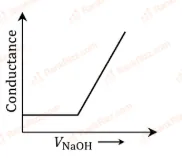
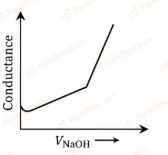
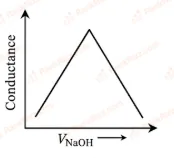
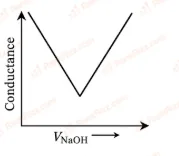
Choose the correct representation of conductometric titration of benzoic acid vs sodium hydroxide.
- A
- B
- C
- D
JEE MAIN 2022 · 29 JUL S1Conductance, conductivity and molar conductivity
Resistance of a conductivity cell (cell constant 129 m−1) filled with 74.5 ppm solution of KCl is 100 Ω (labelled as solution 1). When the same cell is filled with KCl 149 ppm solution of KCl, the resistance is 50 Ω (labelled as solution 2). The ratio of molar conductivity of solution 1 and solution 2 is i.e. Λ2Λ1=x×10−3. The value of x is _____ (Given, molar mass of KCl is 74.5 g mol−1)
JEE MAIN 2022 · 29 JUL S2Electrode potentials, electrochemical series and cell EMF
For a cell, Cu(s)∣Cu2+(0.001M)∣∣Ag+(0.01M)∣Ag(s), the cell potential is found to be 0.43 V at 298 K. The magnitude of standard electrode potential for Cu2+∣Cu is _____ ×10−2 V. Given: EAg+/Agθ=0.80 V and F2.303RT=0.06 V
JEE MAIN 2022 · 28 JUL S1Batteries, fuel cells and corrosion
Match List-I with List-II.
| List-I | List-II |
|---|
| A. Cd(s)+2Ni(OH)3(s)→CdO(s)+2Ni(OH)2(s)+H2O(l) | I. Primary battery |
| B. Zn(Hg)+HgO(s)→ZnO(s)+Hg(l) | II. Discharging of secondary battery |
| C. 2PbSO4(s)+2H2O(l)→Pb(s)+PbO2(s)+2H2SO4(aq) | III. Fuel cell |
| D. 2H2(g)+O2(g)→2H2O(l) | IV. Charging of secondary battery |
- A
- B
- C
- D
JEE MAIN 2022 · 27 JUL S2Conductance, conductivity and molar conductivity
Given below are two statements:
Statement I: For KI, molar conductivity increases steeply with dilution.
Statement II: For carbonic acid, molar conductivity increases slowly with dilution.
In the light of the above statements, choose the correct answer from the options given below:
- A
Statement I is correct and Statement II is incorrect
- B
Both Statement I and Statement II are false
- C
Statement I is true but Statement II is false
- D
Statement I is false but Statement II is true
JEE MAIN 2022 · 26 JUL S1Electrolysis and Faraday's laws
The amount of charge in F (Faraday) required to obtain one mole of iron from Fe3O4 is ______. (Round off to the nearest integer)
JEE MAIN 2022 · 25 JUL S1Electrode potentials, electrochemical series and cell EMF
The cell potential for Zn∣Zn2+(aq)∣∣Snx+∣Sn is 0.801 V at 298 K. The reaction quotient for the above reaction is 10−2. The number of electrons involved in the given electrochemical cell reaction is ______.
(Given EZn2+∣Zn0=−0.763 V, ESnx+∣Sn0=+0.008 V and F2.303RT=0.06 V)
JEE MAIN 2022 · 25 JUL S2Conductance, conductivity and molar conductivity
The molar conductivity of a conductivity cell filled with 10 moles of 20 mL NaCl solution is Λm1 and that of 20 moles of another identical cell having 80 mL NaCl solution is Λm2. The conductivities exhibited by these two cells are same. The relationship between Λm2 and Λm1 is
- A
Λm2=2Λm1
- B
Λm2=2Λm1
- C
Λm2=Λm1
- D
Λm2=4Λm1
JEE MAIN 2022 · 29 JUN S1Conductance, conductivity and molar conductivity
A dilute solution of sulphuric acid is electrolysed using a current of 0.10 A for 2 hours to produce hydrogen and oxygen gas. The total volume of gases produced at STP is ______ cm3. (Nearest integer) [Given: Faraday constant F = 96500 C mol−1 at STP, molar volume of an ideal gas is 22.7 L mol−1]
JEE MAIN 2022 · 29 JUN S2Electrode potentials, electrochemical series and cell EMF
The cell potential for the given cell at 298 K Pt|H2(g, 1 bar)|H+(aq)||Cu2+(aq)|Cu(s) is 0.31 V. The pH of the acidic solution is found to be 3, whereas the concentration of Cu2+ is 10x M. The value of x is ______.
(Given: ECu2+/Cu⊖=0.34 V and F2.303RT=0.06 V)
JEE MAIN 2022 · 28 JUN S1Conductance, conductivity and molar conductivity
The solubility product of a sparingly soluble salt A2X3 is 1.1×10⁻²³. If specific conductance of the solution is x×10−3 S m2 mol−1. The value of x is ______
JEE MAIN 2022 · 28 JUN S1Conductance, conductivity and molar conductivity
The quantity of electricity in Faraday needed to reduce 1 mol of Cr2O72− to Cr3+ is ______
JEE MAIN 2022 · 28 JUN S2Electrode potentials, electrochemical series and cell EMF
For the given reactions
Sn2++2e−→Sn
Sn4++4e−→Sn
the electrode potentials are; ESn2+/Sn∘=−0.140 V and ESn4+/Sn∘=0.010 V. The magnitude of standard electrode potential for Sn4+/Sn2+ i.e. ESn4+/Sn2+∘ is ______ ×10−2 V (Nearest integer)
JEE MAIN 2022 · 27 JUN S1Conductance, conductivity and molar conductivity
The limiting molar conductivities of NaI, NaNO3 and AgNO3 are 12.7,12.0 and 13.3 mS m2 mol−1, respectively (all at 25°C). The limiting molar conductivity of AgI at this temperature is ______ mS m2 mol−1.
JEE MAIN 2022 · 27 JUN S2Electrode potentials, electrochemical series and cell EMF
For the reaction taking place in the cell:
Pt(s)∣H2(g)∣H+(aq)∣∣Ag+(aq)∣Ag(s)
Ecell=+0.5332 V.
The value of ΔrG∘ is ______ kJ mol−1. (in nearest integer)
JEE MAIN 2022 · 26 JUN S1Electrode potentials, electrochemical series and cell EMF
The (∂T∂E)P of different types of half cells are as follows :
A: 1×10⁻⁴, B: 2×10⁻⁴, C: 0.1×10⁻⁴, D: 0.2×10⁻⁴
(Where E is the electromotive force). Which of the above half cells would be preferred to be used as reference electrode
- A
- B
- C
- D
JEE MAIN 2022 · 26 JUN S2Electrode potentials, electrochemical series and cell EMF
Cu(s)+Sn2+(0.001M)→Cu2+(0.01M)+Sn(s)
The Gibbs free energy change for the above reaction at 298 K is x×10−1 kJ mol−1. The value of x is ______ [nearest integer]
[Given : ECu2+/Cu∘=0.34 V; ESn2+/Sn∘=−0.14 V; F=96500 C mol−1]
JEE MAIN 2022 · 25 JUN S1Electrode potentials, electrochemical series and cell EMF
In a cell, the following reactions take place
Fe2+→Fe3++e− EFe3+/Fe2+∘=0.77 V
2I−→I2+2e− EI2/I−∘=0.54 V
The standard electrode potential for the spontaneous reaction in the cell is x×10−2 V at 298 K. The value of x is ______ (Nearest Integer)