JEE MAIN 2017 · 02 APR OFFLINEElectrode potentials, electrochemical series and cell EMF
Given
E° = 1.36 V, E° = -0.74 V
E° = 1.33 V, E° = 1.51 V
Among the following, the strongest reducing agent is:
- A
Mn
- B
Cr
- C
Cl
- D
Cr
Every Electrochemistry question JEE Main has set from 2004–2026, grouped by the idea it tests rather than the order of the syllabus. 227 questions across 8 distinct ideas. Free to read, answer key on every one.
DATA UPDATED
Questions
227
Distinct ideas
8
Share of marks
4.4%
Difficulty
MEDIUM
A chapter is not one subject — it is a handful of procedures the examiner reuses. These are the ones Electrochemistry questions actually test.
181–200 OF 227 · NEWEST FIRST
Given
E° = 1.36 V, E° = -0.74 V
E° = 1.33 V, E° = 1.51 V
Among the following, the strongest reducing agent is:
Mn
Cr
Cl
Cr
Oxidation of succinate ion produces ethylene and carbon dioxide gases. On passing 0.2 Faraday electricity through an aqueous solution of potassium succinate, what is the total volume of gases (at both cathode and anode) at STP (1 atm and 273 K)?
8.96 L
4.48 L
6.72 L
2.24 L
Identify the correct statement:
Corrosion of iron can be minimised by forming a contact with another metal with a higher reduction potential
Iron corrodes in oxygen-free water
Corrosion of iron can be minimised by forming an impermeable barrier at its surface
Iron corrodes more rapidly in salt water because its electrochemical potential is higher
What will happen when a block of copper metal is dropped into a beaker containing a solution of 1 M ?
The copper metal will dissolve with evolution of oxygen gas.
The copper metal will dissolve with evolution of hydrogen gas.
No reaction will occur.
The copper metal will dissolve and zinc metal will be deposited.
Galvanization is applying a coating of:
Cu
Zn
Pb
Cr
A 2 V battery is connected across AB as shown in the figure. The value of the current supplied by the battery when in first case battery's positive terminal is connected to A and in second case when positive terminal of battery is connected to B will respectively be:
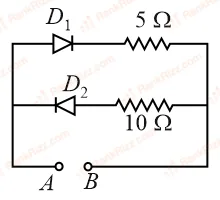
0.2 A and 0.1 A
0.1 A and 0.2 A
0.2 A and 0.4 A
0.4 A and 0.2 A
At 298 K, the standard reduction potentials are 1.51 V for , 1.36 V for , 1.07 V for , 0.54 V for . At pH = 3, permanganate is expected to oxidize:
and
and
only
, and
A variable, the opposite external potential is applied to the cell Zn | Zn (1M) || Cu (1M) | Cu, of potential 1.1 V. When V and V, respectively electrons flow from
anode to cathode in both the cases.
anode to cathode and cathode to anode.
cathode to anode and anode to cathode.
cathode to anode in both cases.
Two Faraday of electricity is passed through a solution of . The mass of copper deposited at the cathode is: (Atomic mass of Cu = 63.5 amu)
127 g
0 g
63.5 g
2 g
How many electrons would be required to deposit 6.35 g of copper at the cathode during the electrolysis of an aqueous solution of copper sulphate? (Atomic mass of copper = 63.5u, N = Avogadro's constant):
Copper becomes green when exposed to moist air for a long period. This is due to:
the formation of a layer of cupric oxide on the surface of copper.
the formation of a layer of basic carbonate of copper on the surface of copper.
the formation of a layer of cupric hydroxide on the surface of copper.
the formation of basic copper sulphate layer on the surface of the metal.
Given:
Fe(aq) + e Fe(aq); E = +0.77 V
Al(aq) + 3e Al(s); E = V
Br(aq) + 2e 2Br; E = +1.09 V
Considering the electrode potentials, which of the following represents the correct order of reducing power?
Fe < Al < Br
Br < Fe < Al
Al < Br < Fe
Al < Fe < Br
A current of 10.0 A flows for 2.00 h through an electrolytic cell containing a molten salt of metal X. This results in the decomposition of 0.250 mol of metal X at the cathode. The oxidation state of X in the molten salt is: (F = 96,500 C)
1+
4+
3+
2+
The standard electrode potentials () of four metals A, B, C and D are V, 0.6 V, 0.85 V and V, respectively. The sequence of deposition of metals on applying potential is:
B > D > C > A
A > C > B > D
C > B > D > A
D > A > B > C
Resistance of 0.2 M solution of an electrolyte is 50 . The specific conductance of the solution is 1.4 S m. The resistance of 0.5 M solution of the same electrolyte is 280 . The molar conductivity of 0.5 M solution of the electrolyte in S m mol is:
The equivalent conductance of NaCl at concentration C and at infinite dilution are and , respectively. The correct relationship between and is given as: (where the constant B is positive)
Given below are the half-cell reactions:
; V
; V
The for will be:
V; the reaction will not occur
V; the reaction will occur
V; the reaction will not occur
V; the reaction will occur
The Gibbs energy for the decomposition of at 500°C is as follows :
, kJ mol
The potential difference needed for the electrolytic reduction of aluminium oxide at 500°C should be at least :
4.5 V
3.0 V
5.0 V
2.5 V
A solution of copper sulphate (CuSO) is electrolysed for 10 minutes with a current of 1.5 amperes. The mass of copper deposited at the cathode (at. mass of Cu = 63u) is :
0.3892 g
0.2938 g
0.2398 g
0.3928 g
Given :
V, V
V, V
The correct order of reducing power of the species (Cr, Cr, Mn and Cl) will be:
Mn < Cl < Cr < Cr
Mn < Cl < Cl < Cr
Cr < Cl < Mn < Cr
Cr < Cl < Cr < Mn
JEE Advanced has set 32 Electrochemistry questions too. Electrochemistry JEE Advanced PYQs →
OTHER CHEMISTRY CHAPTERS