Electrochemistry JEE Main PYQs with answer key
CHEMISTRY · 227 PAST QUESTIONS · 8 TOPICS · 2004–2026
HOW TO USE THIS SHEET
Every JEE Main Electrochemistry question we hold, grouped by topic, most-asked topic first and newest first inside each. The answer key is at the end (220 of 227 questions have a checked key); the worked solution is on each question’s page, printed beside it.
Electrode potentials, electrochemical series and cell EMF 106
Given at 298 K :
Volt
Volt
The in Volt at 298 K is given by :- (A)
- (B)
- (C)
- (D)
rr2.rankrizz.com/jee-main/chemistry/electrochemistry/q/8-apr-2026-s2-q56
- (A)
For a general redox reaction
Anode:
Cathode:
Which of the following statement is **incorrect** ?
- (A)
The overall reaction can be written as
- (B)
The electrons do not appear in the overall reaction because electrons produced at the anode are consumed at the cathode.
- (C)
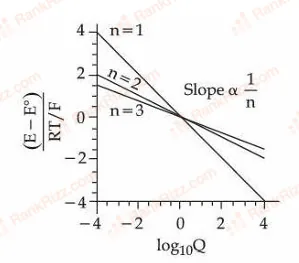
Here n is the number of electrons transferred in redox reaction.
- (D)
If the reaction is carried out reversibly, the electrical work done is equal to the ratio of charge and potential difference through which charge is moved.
rr2.rankrizz.com/jee-main/chemistry/electrochemistry/q/6-apr-2026-s2-q57
- (A)
One half cell in a voltaic cell is constructed by dipping silver rod in solution of unknown concentration, other half cell is Zn rod dipped in 1 molar solution of . A voltage of is measured at for this cell. What is the concentration of ions used in terms of ?
- (A)
- (B)
- (C)
- (D)
rr2.rankrizz.com/jee-main/chemistry/electrochemistry/q/5-apr-2026-s2-q57
- (A)
An electrochemical cell, consist of the following two redox couples, M(aq)/M(s) [ V] and Fe(aq)/Fe(s) [ V]. The cell EMF (E) is recorded to be 0.2057 V. If the reaction quotient of the electrochemical reaction is found to be , then the value of is __________. (Nearest integer)
[Given: M is a p-block metal and V]
Answer: ____________
rr2.rankrizz.com/jee-main/chemistry/electrochemistry/q/4-apr-2026-s2-q73
An electrochemical cell is constructed using half cells in the direction of spontaneous change
Fe(OH)(s) + 2e Fe(s) + 2OH(aq) E = −0.88 V
and AgBr(s) + e Ag(s) + Br(aq) E = +0.07 V
Which of the following option is correct?- (A)
Overall reaction Fe(s)+2OH(aq)+2AgBr(s) Fe(OH)(s)+2Ag(s)+2Br(aq)
- (B)
V
- (C)
Fe is reduced in the electrochemical cell
- (D)
is an extensive property
rr2.rankrizz.com/jee-main/chemistry/electrochemistry/q/2-apr-2026-s1-q57
- (A)
Consider the following redox reaction taking place in acidic medium
If the Nerst equation for the above balanced reaction is , then the value of n is______.(Nearest integer)Answer: ____________
rr2.rankrizz.com/jee-main/chemistry/electrochemistry/q/28-jan-2026-s1-q75
A volume of x mL of 5 M solution was mixed with 10 mL of 2 M solution to make an electrolytic buffer. If the same buffer was used in the following electrochemical cell to record a cell potential of 235.3 mV, then the value of x=_______ mL (nearest integer).
Consider upto one place of decimal for intermediate calculations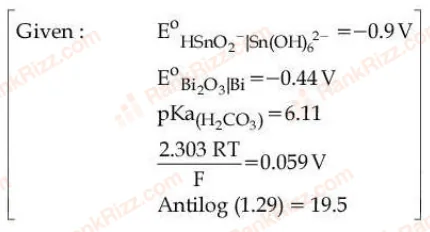
Answer: ____________
rr2.rankrizz.com/jee-main/chemistry/electrochemistry/q/28-jan-2026-s2-q71
In the given electrochemical cell, , at298 K, theceU potential will increase when:
A. Concentration of is increased.
B. Concentration of is decreased.
C. Concentration of is decreased.
D. Concentration of is increased.
E. Concentration of is increased.
Choose the correct answer from the options given below :- (A)
B Only
- (B)
A and B Only
- (C)
C, D and E Only
- (D)
A and E Only
rr2.rankrizz.com/jee-main/chemistry/electrochemistry/q/23-jan-2026-s1-q69
- (A)
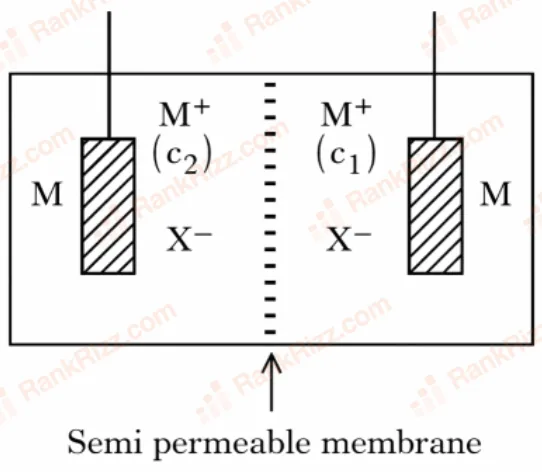
Consider the above electrochemical cell where a metal electrode (M) is undergoing redox reaction by forming . The cation is present in two different concentrations and as shown above. which of the following statement is correct for generating a positive cell potential?
- (A)
If is present at anode, then .
- (B)
If is present at cathode, then .
- (C)
If is present at cathode, then .
- (D)
If is present at anode then .
rr2.rankrizz.com/jee-main/chemistry/electrochemistry/q/23-jan-2026-s2-q64
- (A)
Consider the following electrochemical cell at 298K
.
If the reaction quotient at a given time is , then the cell is _____ (Nearest integer).
Given the standard half-cell reduction potential as
Answer: ____________
rr2.rankrizz.com/jee-main/chemistry/electrochemistry/q/22-jan-2026-s1-q73
Consider the following reduction processes :
The tendency to act as reducing agent decreases in the order :- (A)
- (B)
- (C)
- (D)
rr2.rankrizz.com/jee-main/chemistry/electrochemistry/q/22-jan-2026-s2-q62
- (A)
Consider the following electrochemical cell : ,
The pH above which , oxygen gas would start to evolve at anode is ____ (nearest integer).
[Given: , are standard reduction potential and at the given condition]Answer: ____________
rr2.rankrizz.com/jee-main/chemistry/electrochemistry/q/22-jan-2026-s2-q71
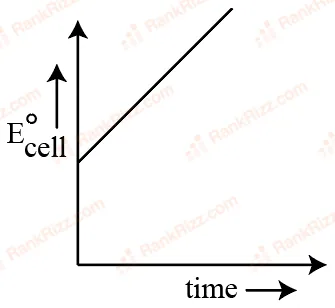
For a closed circuit Daniell cell, which of the following plots is the accurate one at a given temperature?
- (A)
- (B)
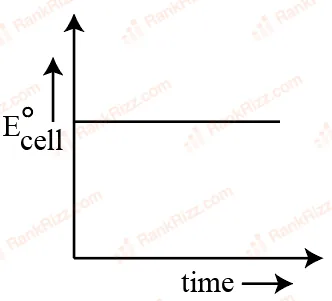
- (C)
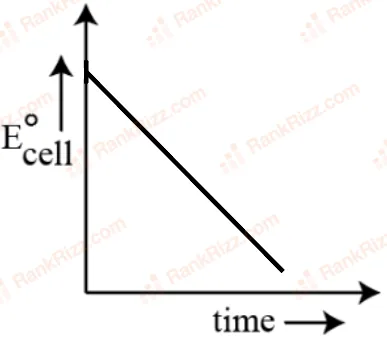
- (D)
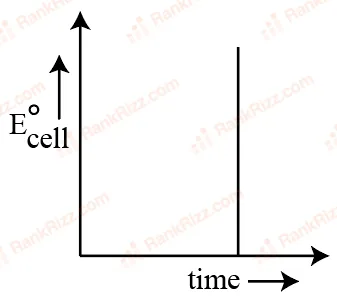
rr2.rankrizz.com/jee-main/chemistry/electrochemistry/q/21-jan-2026-s2-q56
- (A)
MX is a sparingly soluble salt that follows the given solubility equilibrium at 298 K.
If the standard reduction potential for and , then the value of the standard reduction potential for the metal/metal insoluble salt electrode is __________mV.(nearest integer)
[Given : ]Answer: ____________
rr2.rankrizz.com/jee-main/chemistry/electrochemistry/q/21-jan-2026-s2-chemistry-q24
Consider the following half cell reaction: . The reaction was conducted with the ratio of . The pH value at which the EMF of the half cell will become zero is _____ . (nearest integer value) [Given : standard half cell reduction potential V, V]
Answer: ____________
rr2.rankrizz.com/jee-main/chemistry/electrochemistry/q/2025-apr-8-s2-q75
1 Faraday electricity was passed through (1.5 M, 1 L)/Cu and 0.1 Faraday was passed through (0.2 M, 1 L)/Ag electrolytic cells. After this the two cells were connected as shown below to make an electrochemical cell. The emf of the cell thus formed at 298 K is ______. (Given: V, V, V)
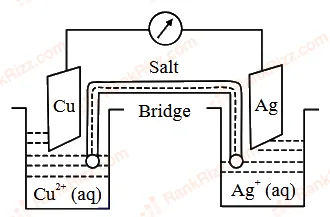
Answer: ____________
rr2.rankrizz.com/jee-main/chemistry/electrochemistry/q/2025-apr-7-s1-q73
Consider the following electrochemical cell at standard condition.
The couple represents quinhydrone electrode, the half cell reaction is given below:
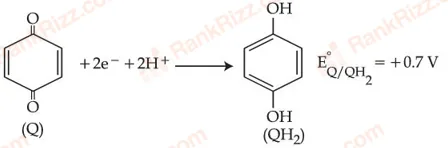
[Given: and ]
The value of the ammonium halide salt () used here is ______. (nearest integer)
Answer: ____________
rr2.rankrizz.com/jee-main/chemistry/electrochemistry/q/2025-apr-02-s1-q72
The standard reduction potential values of some of the p-block ions are given below. Predict the one with the strongest oxidising capacity.
- (A)
- (B)
- (C)
- (D)
rr2.rankrizz.com/jee-main/chemistry/electrochemistry/q/29-jan-2025-s1-q60
- (A)
For a the correct Nernst Equation is :
- (A)
- (B)
- (C)
- (D)
rr2.rankrizz.com/jee-main/chemistry/electrochemistry/q/29-jan-2025-s1-q68
- (A)
For the given cell the standard cell potential of the above reaction is Given:
- (A)
- (B)
- (C)
- (D)
rr2.rankrizz.com/jee-main/chemistry/electrochemistry/q/24-jan-2025-s1-q67
- (A)
Based on the data given below: the strongest reducing agent is:
- (A)
- (B)
- (C)
- (D)
rr2.rankrizz.com/jee-main/chemistry/electrochemistry/q/24-jan-2025-s2-q57
- (A)
In the above diagram, the standard electrode potentials are given in volts (over the arrow). The value of is
- (A)
2.1 V
- (B)
1.7 V
- (C)
1.4 V
- (D)
1.2 V
rr2.rankrizz.com/jee-main/chemistry/electrochemistry/q/23-jan-2025-s1-q53
- (A)
Standard electrode potentials for a few half cells are mentioned below :
Which one of the following cells gives the most negative value of ?- (A)
- (B)
- (C)
- (D)
rr2.rankrizz.com/jee-main/chemistry/electrochemistry/q/23-jan-2025-s2-q58
- (A)
The standard reduction potentials at K for the following half cells are given below :
, V
, V
, V
, V
, V
Consider the given electrochemical reactions, The number of metal(s) which will be oxidized by , in aqueous solution is ______Answer: ____________
rr2.rankrizz.com/jee-main/chemistry/electrochemistry/q/9-apr-2024-s1-q56
The emf of cell

It could be increased by :
- (A)
decreasing concentration of both and ions
- (C)
increasing concentration of ions
- (D)
increasing concentration of both and ions
rr2.rankrizz.com/jee-main/chemistry/electrochemistry/q/8-apr-2024-s2-q40
- (A)
The reaction; occurs in which of the following galvanic cell :
- (A)
- (B)
- (C)
- (D)
rr2.rankrizz.com/jee-main/chemistry/electrochemistry/q/8-apr-2024-s2-q41
- (A)
How can an electrochemical cell be converted into an electrolytic cell?
- (A)
Applying an external opposite potential lower than cell.
- (B)
Reversing the flow of ions in salt bridge.
- (C)
Applying an external opposite potential greater than cell.
- (D)
Exchanging the electrodes at anode and cathode.
rr2.rankrizz.com/jee-main/chemistry/electrochemistry/q/6-apr-2024-s2-q38
- (A)
For the electrochemical cell, if V and V. Which of the following is correct?
- (A)
is a spontaneous reaction
- (B)
V
- (C)
V
- (D)
is a spontaneous reaction
rr2.rankrizz.com/jee-main/chemistry/electrochemistry/q/05-apr-2024-s2-q42
- (A)
What pressure (bar) of H₂ would be required to make emf of hydrogen electrode zero in pure water at 25°C?
- (A)
- (B)
- (C)
- (D)
rr2.rankrizz.com/jee-main/chemistry/electrochemistry/q/04-apr-2024-s1-q40
- (A)
One of the commonly used electrode is calomel electrode. Under which of the following categories, calomel electrode comes?
- (A)
Oxidation-Reduction electrodes
- (B)
Metal ion-Metal electrodes
- (C)
Gas-Ion electrodes
- (D)
Metal-Insoluble Salt-Anion electrodes
rr2.rankrizz.com/jee-main/chemistry/electrochemistry/q/04-apr-2024-s1-q41
- (A)
The potential for the given half cell at 298K is V.
, M, atm.
(Given V, ). The value of is:Answer: ____________
rr2.rankrizz.com/jee-main/chemistry/electrochemistry/q/01-feb-2024-s1-q57
Consider the following redox reaction:
The standard reduction potentials are given as below:
V; V
If the equilibrium constant of the above reaction is given as , then the value of = ______ (nearest integer)Answer: ____________
rr2.rankrizz.com/jee-main/chemistry/electrochemistry/q/01-feb-2024-s2-q57
Reduction potential of ions are given below:
: V; : V; : V
The correct order of their oxidising power is:- (A)
- (B)
- (C)
- (D)
rr2.rankrizz.com/jee-main/chemistry/electrochemistry/q/30-jan-2024-s2-q40
- (A)
The hydrogen electrode is dipped in a solution of pH = 3 at 25°C. The potential of the electrode will be _____ V.
V. Round off the answer to the nearest integer.Answer: ____________
rr2.rankrizz.com/jee-main/chemistry/electrochemistry/q/27-jan-2024-s2-q58
At 298 K, the standard reduction potential for Cu/Cu electrode is 0.34 V. Given :
KCu(OH) . Take V. The reduction potential at pH = 14 for the above couple is V. The value of x is _____.Answer: ____________
rr2.rankrizz.com/jee-main/chemistry/electrochemistry/q/13-apr-2023-s2-q59
In an electrochemical reaction of lead, at standard temperature, if Volt and Volt, then the value of is given by . The value of x is _______ (Nearest integer).
Answer: ____________
rr2.rankrizz.com/jee-main/chemistry/electrochemistry/q/11-apr-2023-s1-q57
The number of correct statements from the following is _______
A. E is an intensive parameter
B. A negative E means that the redox couple is a stronger reducing agent than the H/H couple.
C. The amount of electricity required for oxidation or reduction depends on the stoichiometry of the electrode reaction.
D. The amount of chemical reaction which occurs at any electrode during electrolysis by a current is proportional to the quantity of electricity passed through the electrolyte.Answer: ____________
rr2.rankrizz.com/jee-main/chemistry/electrochemistry/q/11-apr-2023-s2-q58
is V. The value of x is _______.Answer: ____________
rr2.rankrizz.com/jee-main/chemistry/electrochemistry/q/10-apr-2023-s1-q54
The reaction occurs in which of the given galvanic cell?
- (A)
Pt |H(g)| HCl(sol) |AgCl(s)| Ag
- (B)
Ag |AgCl(s)| KCl(sol) |AgNO |Ag
- (C)
Pt |H(g)| HCl(sol) |AgNO(sol) |Ag
- (D)
Pt |H(g)| KCl(sol) |AgCl(s) |Ag
rr2.rankrizz.com/jee-main/chemistry/electrochemistry/q/8-apr-2023-s1-q37
- (A)
The incorrect statements from the following is:
A. The electrical work that a reaction can perform at constant pressure and temperature is equal to the reaction Gibbs energy.
B. is dependent on the pressure.
C.
D. A cell is operating reversibly if the cell potential is exactly balanced by an opposing source of potential difference.Answer: ____________
rr2.rankrizz.com/jee-main/chemistry/electrochemistry/q/08-apr-2023-s2-q36
The standard electrode potential of M/M in aqueous solution does not depend on
- (A)
Hydration of a gaseous metal ion
- (B)
Sublimation of a solid metal
- (C)
Ionisation of a solid metal atom
- (D)
Ionisation of a gaseous metal atom
rr2.rankrizz.com/jee-main/chemistry/electrochemistry/q/6-apr-2023-s1-q39
- (A)
The standard reduction potentials at 295 K for the following half cells are given below:
NO + 4H + 3e NO(g) + 2HO E° = 0.97 V
V(aq) + 2e V(s) E° = -1.19 V
Fe(aq) + 3e Fe(s) E° = -0.04 V
Ag(aq) + e Ag(s) E° = 0.80 V
Au(aq) + 3e Au(s) E° = 1.40 V
The number of metal(s) which will be oxidised by NO in aqueous solution is ______.Answer: ____________
rr2.rankrizz.com/jee-main/chemistry/electrochemistry/q/6-apr-2023-s2-q57
At what pH, given half cell MnO(0.1M) | Mn(0.001 M) will have electrode potential of 1.282 V? (Nearest Integer)
Given E = 1.54 V, = 0.059 VAnswer: ____________
rr2.rankrizz.com/jee-main/chemistry/electrochemistry/q/01-feb-2023-s1-q57
The logarithm of equilibrium constant for the reaction is (Nearest integer)
Given: V
V
E^o = 0.65$$ VAnswer: ____________
rr2.rankrizz.com/jee-main/chemistry/electrochemistry/q/31-jan-2023-s1-q57
Consider the cell
Pt, H(g, 1 atm) | H aq, 1M | Fe aq, Fe aq | Pt s
When the potential of the cell is 0.712 V at 298 K, the ratio Fe/Fe is ______ (Nearest integer)
Given: Fe + e = Fe, E° Fe, Fe Pt = 0.771, VAnswer: ____________
rr2.rankrizz.com/jee-main/chemistry/electrochemistry/q/30-jan-2023-s1-q57
The electrode potential of the following half cell at 298 K
X|X(0.001M)||Y(0.01M)|Y is ______ V (Nearest integer)
Given: E V
E V
VAnswer: ____________
rr2.rankrizz.com/jee-main/chemistry/electrochemistry/q/30-jan-2023-s2-q56
The standard electrode potential (M/M) for V, Cr, Mn & Co are V, V, V and V, respectively. The metal ions which can liberate H from a dilute acid are
- (A)
V and Mn
- (B)
Cr and Co
- (C)
V and Cr
- (D)
Mn and Co
rr2.rankrizz.com/jee-main/chemistry/electrochemistry/q/29-jan-2023-s1-q40
- (A)
The equilibrium constant for the reaction Zn(s) + Sn(aq) Zn(aq) + Sn(s) is at 298 K. The magnitude of standard electrode potential of Sn/Sn if E V is ______ V. (Nearest integer)
Given: VAnswer: ____________
rr2.rankrizz.com/jee-main/chemistry/electrochemistry/q/29-jan-2023-s2-q57
Consider the cell Pt(s)|H(s)(1atm)|H(aq, [H] = 1)||Fe(aq), Fe(aq)|Pt(s)
Given: E = 0.771 V and E = 0 V, T = 298 K
If the potential of the cell is 0.712 V the ratio of concentration of Fe to Fe is _____ (Nearest integer)Answer: ____________
rr2.rankrizz.com/jee-main/chemistry/electrochemistry/q/25-jan-2023-s1-q56
Pt(s)|H(g)(1 bar)|H(aq)(1M)||M(aq), M(aq)|Pt(s)
The E for the given cell is 0.1115 V at 298 K
When
The value of a is _____
Given: E = 0.2 V
= 0.059 VAnswer: ____________
rr2.rankrizz.com/jee-main/chemistry/electrochemistry/q/25-jan-2023-s2-q55
At 298 K, a 1 litre solution containing 10 mmol of and 100 mmol of shows a pH of 3.0. Given : ; V and V. The potential for the half cell reaction is V. The value of x is _____.
Answer: ____________
rr2.rankrizz.com/jee-main/chemistry/electrochemistry/q/24-jan-2023-s1-q57
At 298 K, a 1 litre solution containing 10 mmol of CrO and 100 mmol of Cr shows a pH of 3.0. Given: CrO Cr; E V and V. The potential for the half cell reaction is V. The value of is _____.
Answer: ____________
rr2.rankrizz.com/jee-main/chemistry/electrochemistry/q/24-jan-2023-s1-q57-494073
For a cell, , the cell potential is found to be 0.43 V at 298 K. The magnitude of standard electrode potential for is _____ V. Given: V and V
Answer: ____________
rr2.rankrizz.com/jee-main/chemistry/electrochemistry/q/29-jul-2022-s2-q55
The cell potential for is at . The reaction quotient for the above reaction is . The number of electrons involved in the given electrochemical cell reaction is ______.
(Given , and )Answer: ____________
rr2.rankrizz.com/jee-main/chemistry/electrochemistry/q/25-jul-2022-s1-q56
The cell potential for the given cell at 298 K Pt|H(g, 1 bar)|H(aq)||Cu(aq)|Cu(s) is 0.31 V. The pH of the acidic solution is found to be 3, whereas the concentration of Cu is M. The value of x is ______.
(Given: V and V)Answer: ____________
rr2.rankrizz.com/jee-main/chemistry/electrochemistry/q/29-jun-2022-s2-q56
For the given reactions
the electrode potentials are; V and V. The magnitude of standard electrode potential for i.e. is ______ V (Nearest integer)Answer: ____________
rr2.rankrizz.com/jee-main/chemistry/electrochemistry/q/28-jun-2022-s2-q55
For the reaction taking place in the cell:
V.
The value of is ______ kJ mol. (in nearest integer)Answer: ____________
rr2.rankrizz.com/jee-main/chemistry/electrochemistry/q/27-jun-2022-s2-q58
The of different types of half cells are as follows :
A: , B: , C: , D:
(Where E is the electromotive force). Which of the above half cells would be preferred to be used as reference electrode- (A)
A
- (B)
B
- (C)
C
- (D)
D
rr2.rankrizz.com/jee-main/chemistry/electrochemistry/q/26-jun-2022-s1-q38
- (A)
The Gibbs free energy change for the above reaction at K is kJ mol. The value of is ______ [nearest integer]
[Given : V; V; C mol]Answer: ____________
rr2.rankrizz.com/jee-main/chemistry/electrochemistry/q/26-jun-2022-s2-q58
In a cell, the following reactions take place
V
V
The standard electrode potential for the spontaneous reaction in the cell is V at K. The value of is ______ (Nearest Integer)Answer: ____________
rr2.rankrizz.com/jee-main/chemistry/electrochemistry/q/25-jun-2022-s1-q58
The correct order of reduction potentials of the following pairs is
A.
B.
C.
D.
E.
Choose the correct answer from the options given below.- (A)
- (B)
- (C)
- (D)
rr2.rankrizz.com/jee-main/chemistry/electrochemistry/q/25-jun-2022-s2-q40
- (A)
The cell potential for the following cell is V at K. The pH of the solution is (Nearest integer) ______
(Given : V and V)Answer: ____________
rr2.rankrizz.com/jee-main/chemistry/electrochemistry/q/24-jun-2022-s1-q57
Consider the following cell reaction Cd + HgSO(s) + HO CdSO.HO + 2Hg.
The value of E is 4.315 V at 25°C. If = -825.2 kJ mol, the standard entropy change in J K is _________. (Nearest integer)
[Given : Faraday constant = 96487 C mol]Answer: ____________
rr2.rankrizz.com/jee-main/chemistry/electrochemistry/q/31-aug-2021-s1-q56
These are physical properties of an element:
(A) Sublimation enthalpy
(B) Ionisation enthalpy
(C) Hydration enthalpy
(D) Electron gain enthalpy
The total number of above properties that affect the reduction potential is _________ (Integer answer)Answer: ____________
rr2.rankrizz.com/jee-main/chemistry/electrochemistry/q/26-aug-2021-s1-q57
For the galvanic cell,
Zn(s) + Cu(0.02M) Zn(0.04M) + Cu(s)
E = _________ V (Nearest integer)
[Use: E Cu/Cu = V, E = +0.76 V, = 0.059 V]Answer: ____________
rr2.rankrizz.com/jee-main/chemistry/electrochemistry/q/26-aug-2021-s2-q58
For the cell Cu(s)|Cu(aq)(0.1M)||Ag(aq)(0.01M)|Ag(s) the cell potential E = 0.3095 V. For the cell Cu(s)|Cu(aq)(0.01M)||Ag(aq)(0.001M)|Ag(s) the cell potential = V. Find value of x.
(Round off to the Nearest Integer).
[Use: J]Answer: ____________
rr2.rankrizz.com/jee-main/chemistry/electrochemistry/q/27-jul-2021-s2-q58
Consider the cell at 25C
Zn|Zn aq, 1 M || Fe(aq), Feaq|Pt
The fraction of total iron present as Fe ion at the cell potential of 1.500 V is . The value of x is ___.
(Nearest integer)
Given: E = 0.77V, E = -0.76VAnswer: ____________
rr2.rankrizz.com/jee-main/chemistry/electrochemistry/q/25-jul-2021-s1-q59
Assume a cell with the following reaction Cu + 2Ag(1 M) Cu(0.250M) + 2Ag
E = 2.97 V
E for the above reaction is ___ V.
(Nearest integer)
[Given : log 2.5 = 0.3979, T = 298 K]Answer: ____________
rr2.rankrizz.com/jee-main/chemistry/electrochemistry/q/22-jul-2021-s1-q58
Emf of the following cell at 298 K in V is
The value of is ______ (Rounded off to the nearest integer)
[Given: V; V; ]Answer: ____________
rr2.rankrizz.com/jee-main/chemistry/electrochemistry/q/26-feb-2021-s2-q58
Copper reduces into NO and depending upon the concentration of in solution. (Assuming fixed and ), the concentration at which the thermodynamic tendency for reduction of into NO and by copper is same is M. The value of is ______. (Rounded-off to the nearest integer)
[Given, V, V, V and at 298 K, ]Answer: ____________
rr2.rankrizz.com/jee-main/chemistry/electrochemistry/q/25-feb-2021-s2-q57
The magnitude of the change in oxidising power of the couple is V if the concentration is decreased from 1 M to M at 25°C. (Assume concentration of and to be same on change in concentration). The value of x is ______. (Rounded off to the nearest integer)
[Given: ]Answer: ____________
rr2.rankrizz.com/jee-main/chemistry/electrochemistry/q/24-feb-2021-s2-q57
For the given cell;
change in Gibbs energy is negative, it:- (A)
- (B)
- (C)
- (D)
rr2.rankrizz.com/jee-main/chemistry/electrochemistry/q/6-sep-2020-s2-q35
- (A)
An oxidation-reduction reaction in which 3 electrons are transferred has a of at . The value of (in V) is __________ . ()
Answer: ____________
rr2.rankrizz.com/jee-main/chemistry/electrochemistry/q/5-sep-2020-s1-q48
Identify the incorrect statement from the options below for the above cell:
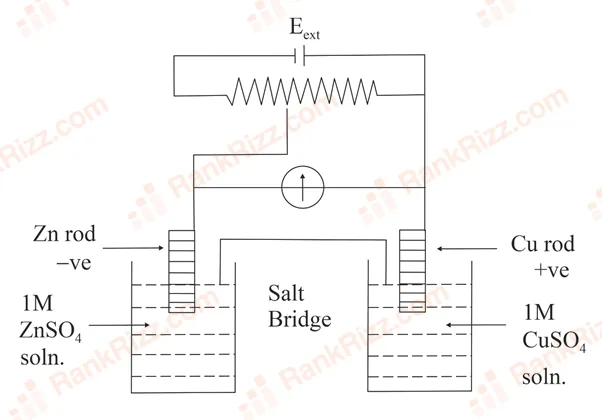
V,
V- (A)
If V, e flow from Cu to Zn
- (B)
If V, Zn dissolves at Zn electrode and Cu deposits at Cu electrode
- (C)
If V, Zn dissolves at anode and Cu deposits at cathode
- (D)
If V, no flow of e or current occurs
rr2.rankrizz.com/jee-main/chemistry/electrochemistry/q/4-sep-2020-s1-q35
- (A)
The photoelectric current from Na (work function, eV) is stopped by the output voltage of the cell
Pt(s)|H(g, 1 bar)|HCl(aq, pH = 1)|AgCl(s)|Ag(s)
The pH of aq. HCl required to stop the photoelectric current from K( eV), all other conditions remaining the same, is ......... (to the nearest integer).
Given V; VAnswer: ____________
rr2.rankrizz.com/jee-main/chemistry/electrochemistry/q/3-sep-2020-s1-q50
The Gibbs energy change (in J) for the given reaction at M and 298 K is:
;Answer: ____________
rr2.rankrizz.com/jee-main/chemistry/electrochemistry/q/2-sep-2020-s1-q46
For the disproportionation reaction at 298K, ln K (where K is the equilibrium constant) is ___________ .
Given:Answer: ____________
rr2.rankrizz.com/jee-main/chemistry/electrochemistry/q/2-sep-2020-s2-q50
What would be the electrode potential for the given half-cell reaction at pH = 5?
2HO O + 4H + 4e; E V
(R = 8.314 J mol K; Temp = 298K; oxygen under standard atm. pressure of 1 bar)Answer: ____________
rr2.rankrizz.com/jee-main/chemistry/electrochemistry/q/8-jan-2020-s1-q49
For an electrochemical cell Sn(s)|Sn(aq, 1M)||Pb(aq, 1M)|Pb(s) the ratio when this cell attains equilibrium is __________.
(Given: E V, E V, )Answer: ____________
rr2.rankrizz.com/jee-main/chemistry/electrochemistry/q/8-jan-2020-s2-q49
Given that the standard potentials (E) of Cu/Cu and Cu/Cu are 0.34V and 0.522V respectively, the E of Cu/Cu is:
- (A)
0.182V
- (B)
+0.158V
- (C)
-0.182V
- (D)
-0.158V
rr2.rankrizz.com/jee-main/chemistry/electrochemistry/q/7-jan-2020-s1-q37
- (A)
Given:
Co + e Co; E° = +1.81V
Pb + 2e Pb; E° = +1.67V
Ce + e Ce; E° = +1.61V
Bi + 3e Bi; E° = +0.20V
Oxidizing power of the species will increase in the order:- (A)
Co < Ce < Bi < Pb
- (B)
Bi < Ce < Pb < Co
- (C)
Co < Pb < Ce < Bi
- (D)
Ce < Pb < Bi < Co
rr2.rankrizz.com/jee-main/chemistry/electrochemistry/q/12-apr-2019-s1-q39
- (A)
The standard Gibbs energy for the given cell reaction in kJ mol at 298 K is:
Zn(s) + Cu(aq) Zn(aq) + Cu(s),
E = 2 V at 298 K
(Faraday's constant, F = 96000 C mol)- (A)
-192
- (B)
192
- (C)
384
- (D)
-384
rr2.rankrizz.com/jee-main/chemistry/electrochemistry/q/9-apr-2019-s1-q46
- (A)
Given that,
V;
V;
V;
V
The strongest oxidizing agent is:- (A)
- (B)
- (C)
- (D)
rr2.rankrizz.com/jee-main/chemistry/electrochemistry/q/8-apr-2019-s1-q37
- (A)
Calculate the standard cell potential (in V) of the cell in which the following reaction takes place:
Fe(aq) + Ag(aq) Fe(aq) + Ag(s)
Given that V, V, V- (A)
- (B)
- (C)
- (D)
rr2.rankrizz.com/jee-main/chemistry/electrochemistry/q/8-apr-2019-s2-q46
- (A)
The standard electrode potential E° and its temperature coefficient for a cell are 2 V and V K at 300 K, respectively. The reaction is Zn(s) + Cu(aq) Zn(aq) + Cu(s). The standard reaction enthalpy at 300 K in mol is [Use R = 8 J K mol and F = 96,500 C mol]
- (A)
- (B)
206.4
- (C)
- (D)
192.0
rr2.rankrizz.com/jee-main/chemistry/electrochemistry/q/12-jan-2019-s1-q47
- (A)
For the cell , different half cells and their standard electrode potentials are given below:
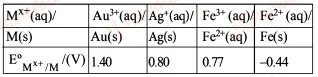
If V, which cathode will give a maximum value of per electron transferred?
- (A)
- (B)
- (C)
- (D)
rr2.rankrizz.com/jee-main/chemistry/electrochemistry/q/11-jan-2019-s1-q47
- (A)
Given the equilibrium constant: of the reaction: is . Calculate the of this reaction at 298 K. [ at 298 K = 0.059 V]
- (A)
0.04736 mV
- (B)
0.4736 mV
- (C)
0.4736 V
- (D)
0.04736 V
rr2.rankrizz.com/jee-main/chemistry/electrochemistry/q/11-jan-2019-s2-q46
- (A)
Consider the following reduction processes:
V
V
V
V
The reducing power of the metals increases in the order:- (A)
Ca < Mg < Zn < Ni
- (B)
Zn < Mg < Ni < Ca
- (C)
Ni < Zn < Mg < Ca
- (D)
Ca < Zn < Ni < Mg
rr2.rankrizz.com/jee-main/chemistry/electrochemistry/q/10-jan-2019-s1-q48
- (A)
In the cell, Pt(s)|H(g, 1 bar)|HCl(aq)|AgCl(s)|Ag(s)|Pt(s), the cell potential is 0.92 V when a molar HCl solution is used. The standard electrode potential of Ag|AgCl|Cl electrode is: (Given, V at 298 K)
- (A)
0.76 V
- (B)
0.20 V
- (C)
0.40 V
- (D)
0.94 V
rr2.rankrizz.com/jee-main/chemistry/electrochemistry/q/10-jan-2019-s2-q44
- (A)
If the standard electrode potential for a cell is 2 V at 300 K, the equilibrium constant (K) for the reaction.
at 300 K is approximately: ( J K mol, C mol)- (A)
- (B)
- (C)
- (D)
rr2.rankrizz.com/jee-main/chemistry/electrochemistry/q/9-jan-2019-s2-q43
- (A)
To find the standard potential of M/M electrode, the following cell is constituted:
Pt | M/M (0.001 mol L) / Ag (0.01 mol L) / Ag
The emf of the cell is found to be 0.421 volt at 298 K. The standard potential of half-reaction M + 3e M at 298 K will be:
(Given: at 298 K = 0.80 volt)- (A)
0.38 volt
- (B)
1.28 volt
- (C)
0.32 volt
- (D)
0.66 volt
rr2.rankrizz.com/jee-main/chemistry/electrochemistry/q/9-apr-2017-online-q49
- (A)
Consider the following standard electrode potentials ( in volts) in aqueous solution:
Element Al Tl
Based on these data, which of the following statements is correct?- (A)
is more stable than
- (B)
is more stable than
- (C)
is more stable than
- (D)
is more stable than
rr2.rankrizz.com/jee-main/chemistry/electrochemistry/q/8-apr-2017-online-q48
- (A)
What is the standard reduction potential () for ?
Given that:
; V
; V- (A)
V
- (B)
V
- (C)
V
- (D)
V
rr2.rankrizz.com/jee-main/chemistry/electrochemistry/q/8-apr-2017-online-q49
- (A)
Given
E° = 1.36 V, E° = -0.74 V
E° = 1.33 V, E° = 1.51 V
Among the following, the strongest reducing agent is:- (A)
Mn
- (B)
Cr
- (C)
Cl
- (D)
Cr
rr2.rankrizz.com/jee-main/chemistry/electrochemistry/q/2-apr-2017-offline-q45
- (A)
What will happen when a block of copper metal is dropped into a beaker containing a solution of 1 M ?
- (A)
The copper metal will dissolve with evolution of oxygen gas.
- (B)
The copper metal will dissolve with evolution of hydrogen gas.
- (C)
No reaction will occur.
- (D)
The copper metal will dissolve and zinc metal will be deposited.
rr2.rankrizz.com/jee-main/chemistry/electrochemistry/q/9-apr-2016-online-q46
- (A)
Given:
Fe(aq) + e Fe(aq); E = +0.77 V
Al(aq) + 3e Al(s); E = V
Br(aq) + 2e 2Br; E = +1.09 V
Considering the electrode potentials, which of the following represents the correct order of reducing power?- (A)
Fe < Al < Br
- (B)
Br < Fe < Al
- (C)
Al < Br < Fe
- (D)
Al < Fe < Br
rr2.rankrizz.com/jee-main/chemistry/electrochemistry/q/11-apr-2014-online-q48
- (A)
The standard electrode potentials () of four metals A, B, C and D are V, 0.6 V, 0.85 V and V, respectively. The sequence of deposition of metals on applying potential is:
- (A)
B > D > C > A
- (B)
A > C > B > D
- (C)
C > B > D > A
- (D)
D > A > B > C
rr2.rankrizz.com/jee-main/chemistry/electrochemistry/q/9-apr-2014-online-q44
- (A)
Given below are the half-cell reactions:
; V
; V
The for will be:- (A)
V; the reaction will not occur
- (B)
V; the reaction will occur
- (C)
V; the reaction will not occur
- (D)
V; the reaction will occur
rr2.rankrizz.com/jee-main/chemistry/electrochemistry/q/6-apr-2014-offline-q47
- (A)
The Gibbs energy for the decomposition of at 500°C is as follows :
, kJ mol
The potential difference needed for the electrolytic reduction of aluminium oxide at 500°C should be at least :- (A)
4.5 V
- (B)
3.0 V
- (C)
5.0 V
- (D)
2.5 V
rr2.rankrizz.com/jee-main/chemistry/electrochemistry/q/25-apr-2013-online-q48
- (A)
Given :
V, V
V, V
The correct order of reducing power of the species (Cr, Cr, Mn and Cl) will be:- (A)
Mn < Cl < Cr < Cr
- (B)
Mn < Cl < Cl < Cr
- (C)
Cr < Cl < Mn < Cr
- (D)
Cr < Cl < Cr < Mn
rr2.rankrizz.com/jee-main/chemistry/electrochemistry/q/23-apr-2013-online-q45
- (A)
Electrode potentials (E°) are given below :
V,
V,
V,
V.
Based on the above potentials, strongest oxidizing agent will be :- (A)
- (B)
- (C)
- (D)
rr2.rankrizz.com/jee-main/chemistry/electrochemistry/q/9-apr-2013-online-q47
- (A)
Given:
V; V
V; V
Based on the data given above, strongest oxidising agent will be:- (A)
Mn
- (B)
MnO
- (C)
Cl
- (D)
Cr
rr2.rankrizz.com/jee-main/chemistry/electrochemistry/q/7-apr-2013-offline-q54
- (A)
The standard reduction potentials for , , and are , and V respectively. The reaction will be spontaneous when:
- (A)
- (B)
- (C)
- (D)
rr2.rankrizz.com/jee-main/chemistry/electrochemistry/q/2012-chemistry-499065
- (A)
Given V, V. Standard electrode potential for the half cell is
- (A)
0.38 V
- (B)
0.53 V
- (C)
0.19 V
- (D)
0.49 V
rr2.rankrizz.com/jee-main/chemistry/electrochemistry/q/2012-chemistry-499245
- (A)
Given : V, V. The value of standard electrode potential for the change, will be :
- (A)
V
- (B)
V
- (C)
V
- (D)
V
rr2.rankrizz.com/jee-main/chemistry/electrochemistry/q/2009-chemistry-499606
- (A)
Consider the following values: V; V. Under standard conditions the potential for the reaction is
- (A)
V
- (B)
V
- (C)
V
- (D)
V
rr2.rankrizz.com/jee-main/chemistry/electrochemistry/q/2004-chemistry-500379
- (A)
Conductance, conductivity and molar conductivity 70
Consider the following data.
Electrolyte (S cm mol) BaCl HSO HCl
BaSO is sparingly soluble in water. If the conductivity of the saturated BaSO solution is S cm then the solubility product of BaSO can be given as
(Here )- (A)
- (B)
- (C)
- (D)
rr2.rankrizz.com/jee-main/chemistry/electrochemistry/q/6-apr-2026-s1-q58
- (A)
At 298 K, the molar conductivity of an (w/w) MX solution is 123.5 S cm. The conductance of same solution is . The value of x is ______ .
(Given: Cell constant = 1.3 cm, molar mass of MX = 75 , density of aqueous solution of at 298 K is 1.0 )Answer: ____________
rr2.rankrizz.com/jee-main/chemistry/electrochemistry/q/5-apr-2026-s2-q74
For strong electrolyte increases slowly with dilution and can be represented by the equation
Molar conductivity values of the solutions of strong electrolyte AB at 18°C are given below: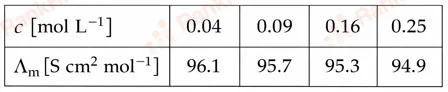
The value of constant A based on the above data [in S ]unit is_______.Answer: ____________
rr2.rankrizz.com/jee-main/chemistry/electrochemistry/q/28-jan-2026-s2-q73
Electricity is passed through an acidic solution of till all the Cu2+ was exhausted, leading to the deposition of 300 mg of Cu metal. However, a current of 600 mA was continued to pass through the same solution for another 28 minutes by keeping the total volume of the solution fixed at 200 mL. The total volume of oxygen evolved at STP during the entire process is __ mL. (Nearest integer)
[Given:
Molar mass of Cu= 63.54 g
Molar mass of = 32 g
Farnday Constant = 96500 C
Molar volume at STP = 22.4 L]Answer: ____________
rr2.rankrizz.com/jee-main/chemistry/electrochemistry/q/24-jan-2026-s1-q74
Molar conductivity of a weak acid HQ of concentration 0.18 M was found to be 1/30 of the molar conductivity of another weak acid HZ with concentration of 0.02M. If happened to be equal with , then the difference of the values of the two weak acids is ___ (Nearest integer).
[Given: degree of dissociation () << 1 for both weak acids, : limiting molar conductivity of ions]Answer: ____________
rr2.rankrizz.com/jee-main/chemistry/electrochemistry/q/24-jan-2026-s2-q72
The pH and conductance of a weak acid (HX) was found to be 5 and . respectively. The conductance was measured under standard condition using a cell where the electrode plates having a surface area of 1 were at a distance of 15 cm apart. The value of the limiting molar conductivity is ______ S (nearest integer)
(Given : degree of dissociation of the weak acid () < < 1)Answer: ____________
rr2.rankrizz.com/jee-main/chemistry/electrochemistry/q/21-jan-2026-s1-q75
Given below are two statements :
1 M aqueous solution of each of , , ; are electrolysed using inert electrodes.
Given :
and
Statement (I) : With increasing voltage, the sequence of deposition of metals on the cathode will be Ag, Hg and Cu
Statement (II) : Magnesium will not be deposited at cathode instead oxygen gas will be evolved at the cathode.
In the light of the above statement, choose the most appropriate answer from the options given below :- (A)
Both statement I and statement II are incorrect
- (B)
Statement I is correct but Statement II is incorrect
- (C)
Both statement I and statement II are correct
- (D)
Statement I is incorrect but Statement II is correct
rr2.rankrizz.com/jee-main/chemistry/electrochemistry/q/2025-apr-7-s2-q70
- (A)
Correct order of limiting molar conductivity for cations in water at 298 K is :
- (A)
- (B)
- (C)
- (D)
rr2.rankrizz.com/jee-main/chemistry/electrochemistry/q/2025-apr-03-s1-q69
- (A)
40 mL of a mixture of and HCl (aqueous solution) is titrated against 0.1 M NaOH conductometrically. Which of the following statement is correct?
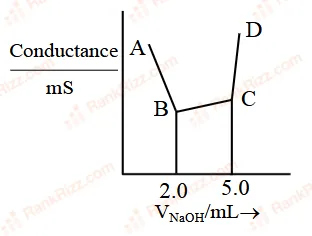
- (A)
The concentration of in the original mixture is 0.005 M
- (B)
The concentration of HCl in the original mixture is 0.005 M
- (C)
is neutralised first followed by neutralisation of HCl
- (D)
Point 'C' indicates the complete neutralisation of HCl
rr2.rankrizz.com/jee-main/chemistry/electrochemistry/q/2025-apr-3-s2-q51
- (A)
0.2 % (w/v) solution of NaOH is measured to have resistivity 870.0 m m. The molar conductivity of the solution will be _________ mS dm mol.
(Nearest integer)Answer: ____________
rr2.rankrizz.com/jee-main/chemistry/electrochemistry/q/2025-apr-02-s2-q72
The molar conductivity of a weak electrolyte when plotted against the square root of its concentration, which of the following is expected to be observed ?
- (A)
A small decrease in molar conductivity is observed at infinite dilution.
- (B)
Molar conductivity decreases sharply with increase in concentration.
- (C)
A small increase in molar conductivity is observed at infinite dilution.
- (D)
Molar conductivity increases sharply with increase in concentration.
rr2.rankrizz.com/jee-main/chemistry/electrochemistry/q/29-jan-2025-s1-q59
- (A)
gas will be evolved as a product of electrolysis of : (A) an aqueous solution of using silver electrodes. (B) an aqueous solution of using platinum electrodes. (C) a dilute solution of using platinum electrodes. (D) a high concentration solution of using platinum electrodes. Choose the correct answer from the options given below :
- (A)
(A) and (C) only
- (B)
(B) and (C) only
- (C)
(A) and (D) only
- (D)
(B) and (D) only
rr2.rankrizz.com/jee-main/chemistry/electrochemistry/q/29-jan-2025-s2-q53
- (A)
Given below is the plot of the molar conductivity vs for KCl in aqueous solution.
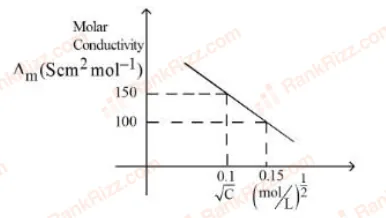
If, for the higher concentration of KCl solution, the resistance of the conductivity cell is 100Ω, then the resistance of the same cell with the dilute solution is Ω The value of is __________ (Nearest integer)Answer: ____________
rr2.rankrizz.com/jee-main/chemistry/electrochemistry/q/28-jan-2025-s1-q75
Electrolysis of 600 mL aqueous solution of NaCl for 5 min changes the pH of the solution to 12 . The current in Amperes used for the given electrolysis is ____. (Nearest integer).
Answer: ____________
rr2.rankrizz.com/jee-main/chemistry/electrochemistry/q/28-jan-2025-s2-q71
Which of the following electrolyte can be used to obtain by the process of electrolysis?
- (A)
Dilute solution of sodium sulphate.
- (B)
Acidified dilute solution of sodium sulphate.
- (C)
Dilute solution of sulphuric acid
- (D)
Concentrated solution of sulphuric acid
rr2.rankrizz.com/jee-main/chemistry/electrochemistry/q/22-jan-2025-s1-q58
- (A)
The molar conductivity for electrolytes A and B are plotted against as shown below. Electrolytes A and B respectively are
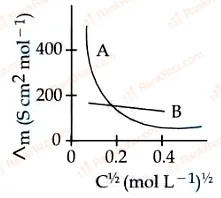
- (A)
A: strong electrolyte ; B: weak electrolyte
- (B)
A: weak electrolyte ; B: weak electrolyte
- (C)
A: weak electrolyte ; B: strong electrolyte
- (D)
A: strong electrolyte ; B: strong electrolyte
rr2.rankrizz.com/jee-main/chemistry/electrochemistry/q/9-apr-2024-s1-q40
- (A)
Which out of the following is a correct equation to show change in molar conductivity with respect to concentration for a weak electrolyte, if the symbols carry their usual meaning :
- (A)
- (B)
- (C)
- (D)
rr2.rankrizz.com/jee-main/chemistry/electrochemistry/q/9-apr-2024-s2-q40
- (A)
A conductivity cell with two electrodes (dark side) are half filled with infinitely dilute aqueous solution of a weak electrolyte. If volume is doubled by adding more water at constant temperature, the molar conductivity of the cell will -
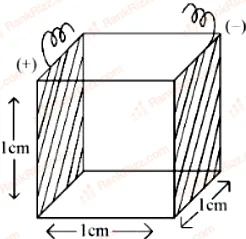
- (A)
decrease sharply
- (B)
increase sharply
- (C)
remain same or can not be measured accurately
- (D)
depend upon type of electrolyte
rr2.rankrizz.com/jee-main/chemistry/electrochemistry/q/6-apr-2024-s1-q42
- (A)
Molar ionic conductivities of divalent cation and anion are and respectively. The molar conductivity of solution of an electrolyte with the above cation and anion will be :
- (A)
- (B)
- (C)
- (D)
rr2.rankrizz.com/jee-main/chemistry/electrochemistry/q/5-apr-2024-s1-q43
- (A)
For a strong electrolyte, a plot of molar conductivity against (concentration) is a straight line, with a negative slope, the correct unit for the slope is:
- (A)
S cm mol L
- (B)
S cm mol L
- (C)
S cm mol L
- (D)
S cm mol L
rr2.rankrizz.com/jee-main/chemistry/electrochemistry/q/04-apr-2024-s2-q42
- (A)
Identify the factor from the following that does not affect electrolytic conductance of a solution.
- (A)
The nature of the electrolyte added.
- (B)
The nature of the electrode used.
- (C)
Concentration of the electrolyte.
- (D)
The nature of solvent used.
rr2.rankrizz.com/jee-main/chemistry/electrochemistry/q/31-jan-2024-s1-q42
- (A)
One Faraday of electricity liberates gram atom of copper from copper sulphate, is ______.
Answer: ____________
rr2.rankrizz.com/jee-main/chemistry/electrochemistry/q/31-jan-2024-s1-q56
The values of conductivity of some materials at 298.15 K in S m are , , , , , , . The number of conductors among the materials is
Answer: ____________
rr2.rankrizz.com/jee-main/chemistry/electrochemistry/q/31-jan-2024-s2-q55
The mass of zinc produced by the electrolysis of zinc sulphate solution with a steady current of A for minutes is _______ g. (Atomic mass of zinc amu)
Answer: ____________
rr2.rankrizz.com/jee-main/chemistry/electrochemistry/q/29-jan-2024-s1-q58
The mass of silver (Molar mass of Ag : ) displaced by a quantity of electricity which displaces mL of at S.T.P. will be ______ g.
Answer: ____________
rr2.rankrizz.com/jee-main/chemistry/electrochemistry/q/27-jan-2024-s1-q58
The number of correct statements from the following is _____
(A) Conductivity always decreases with decrease in concentration for both strong and weak electrolytes.
(B) The number of ions per unit volume that carry current in a solution increases on dilution.
(C) Molar conductivity increases with decrease in concentration.
(D) The variation in molar conductivity is different for strong and weak electrolytes.
(E) For weak electrolytes, the change in molar conductivity with dilution is due to decrease in degree of dissociation.Answer: ____________
rr2.rankrizz.com/jee-main/chemistry/electrochemistry/q/15-apr-2023-s1-q55
A metal surface of cm area has to be coated with nickel layer of thickness mm. A current of 2A was passed through a solution of Ni(NO) for 'x' seconds to coat the desired layer. The value of x is _____. (Nearest integer)
(Ni (density of Nickel) is g mL, Molar mass of Nickel is g mol, F C mol)Answer: ____________
rr2.rankrizz.com/jee-main/chemistry/electrochemistry/q/13-apr-2023-s1-q58
The specific conductance of 0.0025M acetic acid is S cm at a certain temperature. The dissociation constant of acetic acid is _______ . (Nearest integer)
Consider limiting molar conductivity of CHCOOH as 400 S cm molAnswer: ____________
rr2.rankrizz.com/jee-main/chemistry/electrochemistry/q/10-apr-2023-s2-q58
M AgNO is added to L of saturated solution of AgBr. The conductivity of this solution at 298 K is _______ S m.
[Given: K(AgBr) at 298 K, Sm mol, Sm mol, Sm mol]Answer: ____________
rr2.rankrizz.com/jee-main/chemistry/electrochemistry/q/01-feb-2023-s2-q56
Which one of the following statements is correct for electrolysis of brine solution?
- (A)
Cl is formed at cathode
- (B)
O is formed at cathode
- (C)
H is formed at anode
- (D)
OH is formed at cathode
rr2.rankrizz.com/jee-main/chemistry/electrochemistry/q/31-jan-2023-s1-q37
- (A)
The resistivity of a 0.8M solution of an electrolyte is cm. Its molar conductivity is cm mol. (Nearest integer)
Answer: ____________
rr2.rankrizz.com/jee-main/chemistry/electrochemistry/q/31-jan-2023-s2-q57
Following figure shows dependence of molar conductance of two electrolytes on concentration. is the limiting molar conductivity.
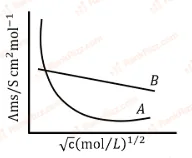
The number of Incorrect statement(s) from the following is ______
(A) for electrolyte A is obtained by extrapolation
(B) For electrolyte B, Vs graph is a straight line with intercept equal to
(C) At infinite dilution, the value of degree of dissociation approach zero for electrolyte B.
(D) for any electrolyte A or B can be calculated using for individual ions.Answer: ____________
rr2.rankrizz.com/jee-main/chemistry/electrochemistry/q/29-jan-2023-s1-q41
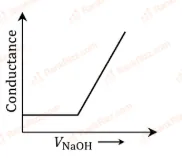
Choose the correct representation of conductometric titration of benzoic acid vs sodium hydroxide.
- (A)
- (B)
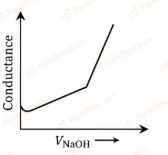
- (C)
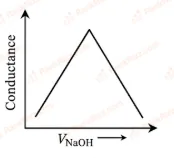
- (D)
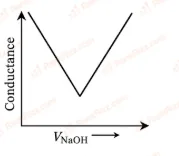
rr2.rankrizz.com/jee-main/chemistry/electrochemistry/q/24-jan-2023-s2-q32
- (A)
Resistance of a conductivity cell (cell constant 129 m) filled with 74.5 ppm solution of KCl is 100 (labelled as solution 1). When the same cell is filled with KCl 149 ppm solution of KCl, the resistance is 50 (labelled as solution 2). The ratio of molar conductivity of solution 1 and solution 2 is i.e. . The value of x is _____ (Given, molar mass of KCl is 74.5 g mol)
Answer: ____________
rr2.rankrizz.com/jee-main/chemistry/electrochemistry/q/29-jul-2022-s1-q57
Given below are two statements:
Statement I: For KI, molar conductivity increases steeply with dilution.
Statement II: For carbonic acid, molar conductivity increases slowly with dilution.
In the light of the above statements, choose the correct answer from the options given below:- (A)
Statement I is correct and Statement II is incorrect
- (B)
Both Statement I and Statement II are false
- (C)
Statement I is true but Statement II is false
- (D)
Statement I is false but Statement II is true
rr2.rankrizz.com/jee-main/chemistry/electrochemistry/q/27-jul-2022-s2-q39
- (A)
The molar conductivity of a conductivity cell filled with moles of solution is and that of moles of another identical cell having solution is . The conductivities exhibited by these two cells are same. The relationship between and is
- (A)
- (B)
- (C)
- (D)
rr2.rankrizz.com/jee-main/chemistry/electrochemistry/q/25-jul-2022-s2-q41
- (A)
A dilute solution of sulphuric acid is electrolysed using a current of 0.10 A for 2 hours to produce hydrogen and oxygen gas. The total volume of gases produced at STP is ______ cm. (Nearest integer) [Given: Faraday constant F = 96500 C mol at STP, molar volume of an ideal gas is 22.7 L mol]
Answer: ____________
rr2.rankrizz.com/jee-main/chemistry/electrochemistry/q/29-jun-2022-s1-q56
The solubility product of a sparingly soluble salt is . If specific conductance of the solution is S m mol. The value of is ______
Answer: ____________
rr2.rankrizz.com/jee-main/chemistry/electrochemistry/q/28-jun-2022-s1-q57
The quantity of electricity in Faraday needed to reduce mol of to is ______
Answer: ____________
rr2.rankrizz.com/jee-main/chemistry/electrochemistry/q/28-jun-2022-s1-q58
The limiting molar conductivities of NaI, and are and mS m mol, respectively (all at C). The limiting molar conductivity of AgI at this temperature is ______ mS m mol.
Answer: ____________
rr2.rankrizz.com/jee-main/chemistry/electrochemistry/q/27-jun-2022-s1-q57
A solution of is electrolyzed for '' min with a current of A to deposit g of Fe. The value of is ______ [nearest integer]
Given : C mol. Atomic mass of Fe g molAnswer: ____________
rr2.rankrizz.com/jee-main/chemistry/electrochemistry/q/25-jun-2022-s2-q55
The resistance of a conductivity cell containing MKCl solution at K is . If the conductivity of MKCl solution at K is S cm, then the cell constant of the conductivity cell is ______ cm
Answer: ____________
rr2.rankrizz.com/jee-main/chemistry/electrochemistry/q/24-jun-2022-s2-q56
If the conductivity of mercury at 0°C is S m and the resistance of a cell containing mercury is 0.243, then the cell constant of the cell is m. The value of x is _________. (Nearest integer)
Answer: ____________
rr2.rankrizz.com/jee-main/chemistry/electrochemistry/q/1-sep-2021-s2-q58
Match List - I with List - II:
List - I (Parameter) List - II (Unit)
(a) Cell constant (i) S cm mol
(b) Molar conductivity (ii) Dimensionless
(c) Conductivity (iii) m
(d) Degree of dissociation of electrolyte (iv) m
Choose the most appropriate answer:- (A)
(a)-(iii), (b)-(i), (c)-(iv), (d)-(ii)
- (B)
(a)-(iii), (b)-(i), (c)-(ii), (d)-(iv)
- (C)
(a)-(iii), (b)-(iv), (c)-(i), (d)-(ii)
- (D)
(a)-(ii), (b)-(i), (c)-(iii), (d)-(iv)
rr2.rankrizz.com/jee-main/chemistry/electrochemistry/q/31-aug-2021-s2-q40
- (A)
The resistance of conductivity cell with cell constant 1.14 cm, containing 0.001M KCl at 298 K is 1500. The molar conductivity of 0.001M KCl solution at 298 K in S cm mol is _________. (Integer answer)
Answer: ____________
rr2.rankrizz.com/jee-main/chemistry/electrochemistry/q/27-aug-2021-s2-q58
Given below are two statements:
Statement I : The limiting molar conductivity of KCl (strong electrolyte) is higher compared to that of CHCOOH (weak electrolyte).
Statement II : Molar conductivity decreases with decrease in concentration of electrolyte.
In the light of the above statements, choose the most appropriate answer from the options given below:- (A)
Statement I is false but Statement II is true
- (B)
Both Statement I and Statement II are true
- (C)
Statement I is true but Statement II is false
- (D)
Both Statement I and Statement II are false
rr2.rankrizz.com/jee-main/chemistry/electrochemistry/q/26-aug-2021-s1-q40
- (A)
The conductivity of a weak acid HA of concentration 0.001 mol L is S cm. If S cm mol, the ionization constant (K) of HA is equal to _________ (Round off to the Nearest Integer)
Answer: ____________
rr2.rankrizz.com/jee-main/chemistry/electrochemistry/q/27-jul-2021-s1-q58
Potassium chlorate is prepared by electrolysis of KCl in basic solution as shown by following equation.
6 OH + Cl ClO + 3HO + 6e
A current of xA has to be passed for 10 h to produce 10.0 g of potassium chlorate. The value of x is ___. (Nearest integer)
(Molar mass of KClO = 122.6 g mol, F = 96500 C)Answer: ____________
rr2.rankrizz.com/jee-main/chemistry/electrochemistry/q/20-jul-2021-s2-q57
A KCl solution of conductivity 0.14 S m shows a resistance of 4.19 in a conductivity cell. If the same cell is filled with an HCl solution, the resistance drops to 1.03. The conductivity of the HCl solution is ________ S m. (Round off to the Nearest Integer).
Answer: ____________
rr2.rankrizz.com/jee-main/chemistry/electrochemistry/q/17-mar-2021-s2-q57
A 5.0 m mol dm aqueous solution of KCl has a conductance of 0.55 mS when measured in a cell constant 1.3 cm. The molar conductivity of this solution is ________ mS m mol. (Round off to the Nearest Integer)
Answer: ____________
rr2.rankrizz.com/jee-main/chemistry/electrochemistry/q/16-mar-2021-s2-q58
Potassium chlorate is prepared by the electrolysis of KCl in basic solution
. If only 60% of the current is utilized in the reaction, the time (rounded to the nearest hour) required to produce of using a current of is........ (Given: F = 96,500 C/mol; molar mass of = 122 g mol)Answer: ____________
rr2.rankrizz.com/jee-main/chemistry/electrochemistry/q/6-sep-2020-s1-q49
The variation of molar conductivity with concentration of an electrolyte (X) in aqueous solution is shown in the given figure.
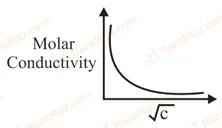
The electrolyte X is:- (A)
HCl
- (B)
- (C)
- (D)
rr2.rankrizz.com/jee-main/chemistry/electrochemistry/q/5-sep-2020-s2-q37
- (A)
250 mL of a waste solution obtained from the workshop of a goldsmith contains 0.1 M AgNO and 0.1 M AuCl. The solution was electrolyzed at 2 V by passing a current of 1 A for 15 minutes. The metal/metals electrodeposited will be:
- (A)
only gold
- (B)
silver and gold in proportion to their atomic weights
- (C)
only silver
- (D)
silver and gold in equal mass proportion
rr2.rankrizz.com/jee-main/chemistry/electrochemistry/q/4-sep-2020-s2-q36
- (A)
Let and , be the conductances (in S) measured for saturated aqueous solutions of NaCl and respectively, at a temperature T. Which of the following is false?
- (A)
Ionic mobilities of ions from both salts increase with T
- (B)
for
- (C)
for
- (D)
at given T
rr2.rankrizz.com/jee-main/chemistry/electrochemistry/q/3-sep-2020-s1-q36
- (A)
An acidic solution of dichromate is electrolyzed for 8 minutes using 2 A current. As per the following equation
The amount of obtained was 0.104g. The efficiency of the process (in %) is (Take: F = 960000C, At. mass of chromium = 52)Answer: ____________
rr2.rankrizz.com/jee-main/chemistry/electrochemistry/q/3-sep-2020-s2-q48
108 g of silver (molar mass 108 ) is deposited at cathode from solution by a certain quantity of electricity. The volume (in L) of oxygen gas produced at 273 K and 1 bar pressure from water by the same quantity of electricity is ___________.
Answer: ____________
rr2.rankrizz.com/jee-main/chemistry/electrochemistry/q/9-jan-2020-s1-q49
The equation that is incorrect is:
- (A)
- (B)
- (C)
- (D)
rr2.rankrizz.com/jee-main/chemistry/electrochemistry/q/7-jan-2020-s2-q35
- (A)
The decreasing order of electrical conductivity of the following aqueous solutions is:
(A) 0.1 M Formic acid,
(B) 0.1 M Acetic acid,
(C) 0.1 M Benzoic acid.- (A)
(A) > (B) > (C)
- (B)
(A) > (C) > (B)
- (C)
(C) > (B) > (A)
- (D)
(C) > (A) > (B)
rr2.rankrizz.com/jee-main/chemistry/electrochemistry/q/12-apr-2019-s2-q47
- (A)
Consider the statements S1 and S2:
S1: Conductivity always increases with decreases in the concentration of electrolyte.
S2: Molar conductivity always increases with decreases in the concentration of electrolyte.
The correct option among the following- (A)
S1 is wrong and S2 is correct
- (B)
S1 is correct and S2 is wrong
- (C)
Both S1 and S2 are correct
- (D)
Both S1 and S2 are wrong
rr2.rankrizz.com/jee-main/chemistry/electrochemistry/q/10-apr-2019-s1-q45
- (A)
Which one of the following graphs between molar conductivity versus is correct?
- (A)
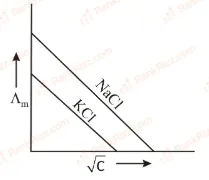
- (B)
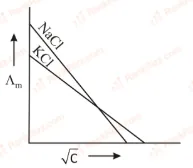
- (C)
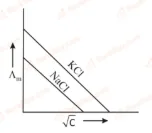
- (D)
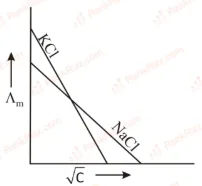
rr2.rankrizz.com/jee-main/chemistry/electrochemistry/q/10-apr-2019-s2-q48
- (A)
A solution of Ni(NO) is electrolyzed between platinum electrode 0.1 Faraday electricity. How many mole of Ni will be deposited at the cathode?
- (A)
0.10
- (B)
0.15
- (C)
0.05
- (D)
0.20
rr2.rankrizz.com/jee-main/chemistry/electrochemistry/q/9-apr-2019-s2-q42
- (A)
for NaCl, HCl and NaA are 126.4, 425.9 and 100.5 S cm mol respectively. If the conductivity of 0.001 M HA is S cm, degree of dissociation of HA is
- (A)
0.125
- (B)
0.75
- (C)
0.25
- (D)
0.50
rr2.rankrizz.com/jee-main/chemistry/electrochemistry/q/12-jan-2019-s2-q46
- (A)
When 9.65 ampere current was passed for 1.0 hour into nitrobenzene in acidic medium, the amount of p-aminophenol produced is:
- (A)
109.0 g
- (B)
98.1 g
- (C)
9.81 g
- (D)
10.9 g
rr2.rankrizz.com/jee-main/chemistry/electrochemistry/q/16-apr-2018-online-q44
- (A)
When an electric current is passes through acidified water, 112 mL of hydrogen gas at N.T.P. was collected at the cathode in 965 seconds. The current passed, in ampere, is:
- (A)
2.0
- (B)
0.1
- (C)
0.5
- (D)
1.0
rr2.rankrizz.com/jee-main/chemistry/electrochemistry/q/15-apr-2018-s1-q51
- (A)
Oxidation of succinate ion produces ethylene and carbon dioxide gases. On passing 0.2 Faraday electricity through an aqueous solution of potassium succinate, what is the total volume of gases (at both cathode and anode) at STP (1 atm and 273 K)?
- (A)
8.96 L
- (B)
4.48 L
- (C)
6.72 L
- (D)
2.24 L
rr2.rankrizz.com/jee-main/chemistry/electrochemistry/q/10-apr-2016-online-q45
- (A)
Two Faraday of electricity is passed through a solution of . The mass of copper deposited at the cathode is: (Atomic mass of Cu = 63.5 amu)
- (A)
127 g
- (B)
0 g
- (C)
63.5 g
- (D)
2 g
rr2.rankrizz.com/jee-main/chemistry/electrochemistry/q/4-apr-2015-offline-q44
- (A)
Resistance of 0.2 M solution of an electrolyte is 50 . The specific conductance of the solution is 1.4 S m. The resistance of 0.5 M solution of the same electrolyte is 280 . The molar conductivity of 0.5 M solution of the electrolyte in S m mol is:
- (A)
- (B)
- (C)
- (D)
rr2.rankrizz.com/jee-main/chemistry/electrochemistry/q/6-apr-2014-offline-q44
- (A)
The equivalent conductance of NaCl at concentration C and at infinite dilution are and , respectively. The correct relationship between and is given as: (where the constant B is positive)
- (A)
- (B)
- (C)
- (D)
rr2.rankrizz.com/jee-main/chemistry/electrochemistry/q/6-apr-2014-offline-q45
- (A)
Resistance of a conductivity cell filled with a solution of an electrolyte of concentration is . The conductivity of this solution is . Resistance of the same cell when filled with of the same solution is . The molar conductivity of solution of the electrolyte will be
- (A)
- (B)
- (C)
- (D)
rr2.rankrizz.com/jee-main/chemistry/electrochemistry/q/2006-chemistry-500055
- (A)
The highest electrical conductivity of the following aqueous solutions is of
- (A)
M acetic acid
- (B)
M chloroacetic acid
- (C)
M fluoroacetic acid
- (D)
M difluoroacetic acid
rr2.rankrizz.com/jee-main/chemistry/electrochemistry/q/2005-chemistry-500336
- (A)
Batteries, fuel cells and corrosion 17
Consider the following two half-cell reactions along with the standard reduction potential given :

A fuel cell was set up using the above two reactions such that the cell operates under the standard condition of 1 bar pressure and 298 K temperature. The fuel cell works with 80% efficiency. If the work derived from the cell using 1 mol of CHOH is used to compress an ideal gas isothermally against a constant pressure of 1 kPa, then the change in the volume of the gas, _____ m. (nearest integer)
Given: C molAnswer: ____________
rr2.rankrizz.com/jee-main/chemistry/electrochemistry/q/2-apr-2026-s2-q73
On charging the lead storage battery, the oxidation state of lead changes from to at the anode and from to at the cathode. The values of are respectively:
- (A)
+4, +2, 0, +2
- (B)
+2, 0, +2, +4
- (C)
0, +2, +4, +2
- (D)
+2, 0, 0, +4
rr2.rankrizz.com/jee-main/chemistry/electrochemistry/q/2025-apr-4-s1-q61
- (A)
The standard cell potential () of a fuel cell based on the oxidation of methanol in air that has been used to power television relay station is measured as 1.21 V. The standard half cell reduction potential for () is 1.229 V. Choose the correct statement:
- (A)
The standard half cell reduction potential for the reduction of () is 19 mV
- (B)
Oxygen is formed at the anode.
- (C)
Reactants are fed at one go to each electrode.
- (D)
Reduction of methanol takes place at the cathode.
rr2.rankrizz.com/jee-main/chemistry/electrochemistry/q/2025-apr-3-s2-q59
- (A)
Match List - I with List - II :
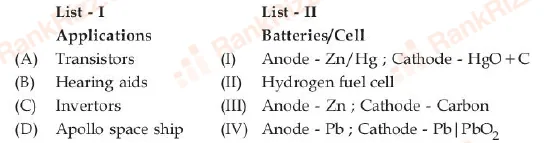
Choose the correct answer from the options given below :- (A)
(A)-(III), (B)-(II), (C)-(IV), (D)-(I)
- (B)
(A)-(II), (B)-(III), (C)-(IV), (D)-(I)
- (C)
(A)-(III), (B)-(I), (C)-(IV), (D)-(II)
- (D)
(A)-(IV), (B)-(III), (C)-(II), (D)-(I)
rr2.rankrizz.com/jee-main/chemistry/electrochemistry/q/29-jan-2025-s2-q57
- (A)
Given below are two statements : Statement (I) : Corrosion is an electrochemical phenomenon in which pure metal acts as an anode and impure metal as a cathode. Statement (II) : The rate of corrosion is more in alkaline medium than in acidic medium. In the light of the above statements, choose the correct answer from the options given below :
- (A)
Both Statement I and Statement II are true
- (B)
Statement I is false but Statement II is true
- (C)
Statement I is true but Statement II is false
- (D)
Both Statement I and Statement II are false
rr2.rankrizz.com/jee-main/chemistry/electrochemistry/q/22-jan-2025-s2-q54
- (A)
Match List I with List II:
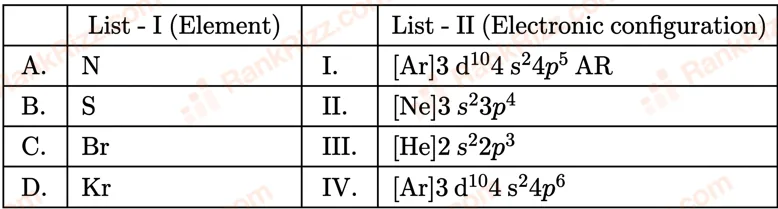
Choose the correct answer from the options given below:- (A)
A-III, B-II, C-I, D-IV
- (B)
A-II, B-I, C-IV, D-III
- (C)
A-I, B-IV, C-III, D-II
- (D)
A-IV, B-III, C-II, D-I
rr2.rankrizz.com/jee-main/chemistry/electrochemistry/q/9-apr-2024-s2-q33
- (A)
The reaction at cathode in the cells commonly used in clocks involves.
- (A)
reduction of Mn from +7 to +2
- (B)
reduction of Mn from +4 to +3
- (C)
oxidation of Mn from +3 to +4
- (D)
oxidation of Mn from +2 to +7
rr2.rankrizz.com/jee-main/chemistry/electrochemistry/q/5-apr-2024-s1-q42
- (A)
Fuel cell, using hydrogen and oxygen as fuels: A. has been used in spaceship, B. has an efficiency of 40% to produce electricity, C. uses aluminum as catalysts, D. is eco-friendly, E. is actually a type of Galvanic cell only. Choose the correct answer from the options given below:
- (A)
A, B, D, E only
- (B)
A, D, E only
- (C)
A, B, D only
- (D)
A, B, C only
rr2.rankrizz.com/jee-main/chemistry/electrochemistry/q/04-apr-2024-s2-q43
- (A)
The metals that are employed in the battery industries are A. Fe, B. Mn, C. Ni, D. Cr, E. Cd. Choose the correct answer from the options given below:
- (A)
B, C and E only
- (B)
A, B, C, D and E
- (C)
A, B, C and D only
- (D)
B, D and E only
rr2.rankrizz.com/jee-main/chemistry/electrochemistry/q/31-jan-2024-s1-q41
- (A)
Which of the following statements is not correct about rusting of iron?
- (A)
Coating of iron surface by tin prevents rusting, even if the tin coating is peeling off.
- (B)
When pH lies above 9 or 10, rusting of iron does not take place.
- (C)
Dissolved acidic oxides , in water act as catalyst in the process of rusting.
- (D)
Rusting of iron is envisaged as setting up of electrochemical cell on the surface of iron object.
rr2.rankrizz.com/jee-main/chemistry/electrochemistry/q/27-jan-2024-s2-q39
- (A)
For lead storage battery pick the correct statements
A. During charging of battery, PbSO on anode is converted into PbO
B. During charging of battery, PbSO on cathode is converted into PbO
C. Lead storage battery consists of grid of lead packed with PbO as anode
D. Lead storage battery has ~38% solution of sulphuric acid as an electrolyte
Choose the correct answer from the options given below:- (A)
A, B, D only
- (B)
B, C, D only
- (C)
B, C only
- (D)
B, D only
rr2.rankrizz.com/jee-main/chemistry/electrochemistry/q/12-apr-2023-s1-q42
- (A)
Match List-I with List-II.
List-I List-II A. I. Primary battery B. II. Discharging of secondary battery C. III. Fuel cell D. IV. Charging of secondary battery - (A)
A-I, B-II, C-III, D-IV
- (B)
A-IV, B-I, C-IV, D-III
- (C)
A-II, B-I, C-IV, D-III
- (D)
A-II, B-I, C-III, D-IV
rr2.rankrizz.com/jee-main/chemistry/electrochemistry/q/28-jul-2022-s1-q42
- (A)
Identify the correct statement:
- (A)
Corrosion of iron can be minimised by forming a contact with another metal with a higher reduction potential
- (B)
Iron corrodes in oxygen-free water
- (C)
Corrosion of iron can be minimised by forming an impermeable barrier at its surface
- (D)
Iron corrodes more rapidly in salt water because its electrochemical potential is higher
rr2.rankrizz.com/jee-main/chemistry/electrochemistry/q/10-apr-2016-online-q46
- (A)
Galvanization is applying a coating of:
- (A)
Cu
- (B)
Zn
- (C)
Pb
- (D)
Cr
rr2.rankrizz.com/jee-main/chemistry/electrochemistry/q/3-apr-2016-offline-q45
- (A)
Copper becomes green when exposed to moist air for a long period. This is due to:
- (A)
the formation of a layer of cupric oxide on the surface of copper.
- (B)
the formation of a layer of basic carbonate of copper on the surface of copper.
- (C)
the formation of a layer of cupric hydroxide on the surface of copper.
- (D)
the formation of basic copper sulphate layer on the surface of the metal.
rr2.rankrizz.com/jee-main/chemistry/electrochemistry/q/12-apr-2014-online-q52
- (A)
In a fuel cell methanol is used as fuel and oxygen gas is used as an oxidizer. The reaction is At K standard Gibb's energies of formation for and are and kJ mol respectively. If standard enthalpy of combustion of methanol is kJ mol, efficiency of the fuel cell will be
- (A)
- (B)
- (C)
- (D)
rr2.rankrizz.com/jee-main/chemistry/electrochemistry/q/2009-chemistry-499605
- (A)
In hydrogen-oxygen fuel cell, combustion of hydrogen occurs to
- (A)
generate heat
- (B)
remove adsorbed oxygen from electrode surfaces
- (C)
produce high purity water
- (D)
create potential difference between the two electrodes
rr2.rankrizz.com/jee-main/chemistry/electrochemistry/q/2004-chemistry-500377
- (A)
Electrolysis and Faraday's laws 16
A solution of aluminium chloride is electrolysed for 30 minutes using a current of 2 A . The amount of the aluminium deposited at the cathode is [Given : molar mass of aluminium and chlorine are 27g and 35.5 g respectively. Faraday constant ]
- (A)
1.660 g
- (B)
0.336 g
- (C)
0.441 g
- (D)
1.007 g
rr2.rankrizz.com/jee-main/chemistry/electrochemistry/q/22-jan-2025-s1-q66
- (A)
The quantity of silver deposited when one coulomb charge is passed through solution :
- (A)
1 g of silver
- (B)
1 electrochemical equivalent of silver
- (C)
1 chemical equivalent of silver
- (D)
0.1 g atom of silver
rr2.rankrizz.com/jee-main/chemistry/electrochemistry/q/05-apr-2024-s2-q41
- (A)
The amount of electricity in Coulomb required for the oxidation of 1 mol of to is ______ C.
Answer: ____________
rr2.rankrizz.com/jee-main/chemistry/electrochemistry/q/01-feb-2024-s2-q56
A constant current was passed through a solution of ion between gold electrodes. After a period of minutes, the increase in mass of cathode was g. The total charge passed through the solution is ______ F. (Given atomic mass of Au = 197)
Answer: ____________
rr2.rankrizz.com/jee-main/chemistry/electrochemistry/q/29-jan-2024-s2-q58
The amount of charge in F (Faraday) required to obtain one mole of iron from is ______. (Round off to the nearest integer)
Answer: ____________
rr2.rankrizz.com/jee-main/chemistry/electrochemistry/q/26-jul-2022-s1-q58
The anodic half-cell of lead-acid battery is recharged using electricity of 0.05 Faraday. The amount of electrolyzed in g during the process is: (Molar mass of g mol)
- (A)
22.8
- (B)
15.2
- (C)
11.4
- (D)
7.6
rr2.rankrizz.com/jee-main/chemistry/electrochemistry/q/9-jan-2019-s1-q48
- (A)
How long (approximate) should water be electrolysed by passing through 100 amperes current so that the oxygen released can completely burn 27.66 g of diborane? (Atomic weight of B = 10.8 u)
- (A)
1.6 hours
- (B)
6.4 hours
- (C)
0.8 hours
- (D)
3.2 hours
rr2.rankrizz.com/jee-main/chemistry/electrochemistry/q/8-apr-2018-offline-q49
- (A)
A 2 V battery is connected across AB as shown in the figure. The value of the current supplied by the battery when in first case battery's positive terminal is connected to A and in second case when positive terminal of battery is connected to B will respectively be:
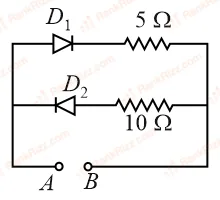
- (A)
0.2 A and 0.1 A
- (B)
0.1 A and 0.2 A
- (C)
0.2 A and 0.4 A
- (D)
0.4 A and 0.2 A
rr2.rankrizz.com/jee-main/chemistry/electrochemistry/q/11-apr-2015-online-q31
- (A)
How many electrons would be required to deposit 6.35 g of copper at the cathode during the electrolysis of an aqueous solution of copper sulphate? (Atomic mass of copper = 63.5u, N = Avogadro's constant):
- (A)
- (B)
- (C)
- (D)
rr2.rankrizz.com/jee-main/chemistry/electrochemistry/q/12-apr-2014-online-q48
- (A)
A current of 10.0 A flows for 2.00 h through an electrolytic cell containing a molten salt of metal X. This results in the decomposition of 0.250 mol of metal X at the cathode. The oxidation state of X in the molten salt is: (F = 96,500 C)
- (A)
1+
- (B)
4+
- (C)
3+
- (D)
2+
rr2.rankrizz.com/jee-main/chemistry/electrochemistry/q/9-apr-2014-online-q43
- (A)
A solution of copper sulphate (CuSO) is electrolysed for 10 minutes with a current of 1.5 amperes. The mass of copper deposited at the cathode (at. mass of Cu = 63u) is :
- (A)
0.3892 g
- (B)
0.2938 g
- (C)
0.2398 g
- (D)
0.3928 g
rr2.rankrizz.com/jee-main/chemistry/electrochemistry/q/25-apr-2013-online-q49
- (A)
A battery is constructed of Cr and . The unbalanced chemical equation when such a battery discharges is following: $ removed from the solution is
- (A)
- (B)
- (C)
- (D)
rr2.rankrizz.com/jee-main/chemistry/electrochemistry/q/2012-chemistry-499163
- (A)
The standard potentials of Ag/Ag, Hg/2Hg, Cu/Cu and Mg/Mg electrodes are and V, respectively. An aqueous solution which contains one mole per litre of the salts of each of the four metals is electrolyzed. With increasing voltage, the correct sequence of deposition of the metals at the cathode is
- (A)
Ag, Hg, Cu, Mg
- (B)
Cu, Hg, Ag only
- (C)
Ag, Hg, Cu only
- (D)
Mg, Cu, Hg, Ag
rr2.rankrizz.com/jee-main/chemistry/electrochemistry/q/2012-chemistry-499336
- (A)
Two voltameters one of copper and another of silver, are joined in parallel. When a total charge flows through the voltameters, equal amount of metals are deposited. If the electrochemical equivalents of copper and silver are and respectively the charge which flows through the silver voltameter is
- (A)
- (B)
- (C)
- (D)
rr2.rankrizz.com/jee-main/chemistry/electrochemistry/q/2005-chemistry-500188
- (A)
Aluminium oxide may be electrolysed at C to furnish aluminium metal (Atomic mass amu; Faraday Coulombs). The cathode reaction is . To prepare kg of aluminium metal by this method would require
- (A)
C of electricity
- (B)
C of electricity
- (C)
C of electricity
- (D)
C of electricity
rr2.rankrizz.com/jee-main/chemistry/electrochemistry/q/2005-chemistry-500338
- (A)
The electrochemical equivalent of a metal is kg per coulomb. The mass of the metal liberated at the cathode when a A current is passed for seconds will be
- (A)
kg
- (B)
kg
- (C)
kg
- (D)
kg
rr2.rankrizz.com/jee-main/chemistry/electrochemistry/q/2004-chemistry-500236
- (A)
Kohlrausch's law and its applications 8
Equivalent conductivity of , and are and at infinite dilution. If the conductivity of saturated solution is , then of is:
- (A)
- (B)
- (C)
- (D)
rr2.rankrizz.com/jee-main/chemistry/electrochemistry/q/2026-chemistry-516677
- (A)
Given below are two statements :
Statement I : Mohr's salt is composed of only three types of ions-ferrous, ammonium and sulphate.
Statement II : If the molar conductance at infinite dilution of ferrous, ammonium and sulphate ions are , and S cm mol, respectively then the molar conductance for Mohr's salt solution at infinite dilution would be given by
In the light of the given statements, choose the correct answer from the options given below :- (A)
Both Statement I and Statement II are false
- (B)
Statement I is false but Statement II is true
- (C)
Statement I is true but Statement II are false
- (D)
Both Statement I and Statement II are true
rr2.rankrizz.com/jee-main/chemistry/electrochemistry/q/2025-apr-7-s1-q60
- (A)
The molar conductance of an infinitely dilute solution of ammonium chloride was found to be 185 S cm mol and the ionic conductance of hydroxyl and chloride ions are 170 and 70 S cm mol, respectively. If molar conductance of 0.02 M solution of ammonium hydroxide is 85.5 S cm mol, its degree of dissociation is given by . The value of x is ______. (Nearest integer)
Answer: ____________
rr2.rankrizz.com/jee-main/chemistry/electrochemistry/q/2025-apr-4-s2-q74
The molar conductivity at infinite dilution of barium chloride, sulphuric acid and hydrochloric acid are 280, 860, 426 Scmmol respectively. The molar conductivity at infinite dilution of barium sulphate is ___ Scm mol (Round off to the Nearest Integer).
Answer: ____________
rr2.rankrizz.com/jee-main/chemistry/electrochemistry/q/18-mar-2021-s2-q57
The equivalent conductances of two strong electrolytes at infinite dilution in (where ions move freely through a solution) at are given below: S /equiv S /equiv. What additional information/quantity one needs to calculate of an aqueous solution of acetic acid?
- (A)
of NaCl
- (B)
of
- (C)
The limiting equivalent conductance of ()
- (D)
of chloroacetic acid ()
rr2.rankrizz.com/jee-main/chemistry/electrochemistry/q/2007-chemistry-499809
- (A)
The molar conductivities and at infinite dilution in water at are and respectively. To calculate , the additional value required is
- (A)
- (B)
- (C)
- (D)
rr2.rankrizz.com/jee-main/chemistry/electrochemistry/q/2006-chemistry-500053
- (A)
Given the molar conductances at infinite dilution:
 Calculate using appropriate molar conductances of the electrolytes listed above at infinite dilution in HO at C
- (A)
- (B)
- (C)
- (D)
rr2.rankrizz.com/jee-main/chemistry/electrochemistry/q/2005-chemistry-500340
- (A)
The limiting molar conductivities for NaCl, KBr and KCl are and S cm mol respectively. The for NaBr is
- (A)
S cm mol
- (B)
S cm mol
- (C)
S cm mol
- (D)
S cm mol
rr2.rankrizz.com/jee-main/chemistry/electrochemistry/q/2004-chemistry-500383
- (A)
Relation of EMF with Gibbs energy and equilibrium constant 5
The Gibbs energy for the decomposition of at C is as follows: , kJ mol. The potential difference needed for electrolytic reduction of at C is at least
- (A)
V
- (B)
V
- (C)
V
- (D)
V
rr2.rankrizz.com/jee-main/chemistry/electrochemistry/q/2010-chemistry-499695
- (A)
The cell, ( V), was allowed to be completely discharged at 298 K. The relative concentration of to is
- (A)
antilog (24.08)
- (B)
37.3
- (C)
- (D)
rr2.rankrizz.com/jee-main/chemistry/electrochemistry/q/2007-chemistry-499808
- (A)
Given the data at , ; . What is the value of for ?
- (A)
- (B)
- (C)
- (D)
rr2.rankrizz.com/jee-main/chemistry/electrochemistry/q/2006-chemistry-500054
- (A)
For a spontaneous reaction the , equilibrium constant () and will be respectively
- (A)
-ve, >1, +ve
- (B)
+ve, >1, -ve
- (C)
-ve, <1, -ve
- (D)
-ve, >1, -ve
rr2.rankrizz.com/jee-main/chemistry/electrochemistry/q/2005-chemistry-500334
- (A)
The standard e.m.f of a cell, involving one electron change is found to be V at C. The equilibrium constant of the reaction is ( C mol; J K mol)
- (A)
- (B)
- (C)
- (D)
rr2.rankrizz.com/jee-main/chemistry/electrochemistry/q/2004-chemistry-500381
- (A)
Nernst equation and concentration cells 4
At 298 K, the standard reduction potentials are 1.51 V for , 1.36 V for , 1.07 V for , 0.54 V for . At pH = 3, permanganate is expected to oxidize:
- (A)
and
- (B)
and
- (C)
only
- (D)
, and
rr2.rankrizz.com/jee-main/chemistry/electrochemistry/q/11-apr-2015-online-q46
- (A)
The reduction potential of hydrogen half cell will be negative if:
- (A)
and
- (B)
and
- (C)
and
- (D)
and
rr2.rankrizz.com/jee-main/chemistry/electrochemistry/q/2011-chemistry-499517
- (A)
Given . The potential for the cell is
- (A)
0.26 V
- (B)
0.399 V
- (C)
V
- (D)
V
rr2.rankrizz.com/jee-main/chemistry/electrochemistry/q/2008-chemistry-499920
- (A)
In a cell that utilises the reaction addition of to cathode compartment, will
- (A)
lower the and shift equilibrium to the left
- (B)
increases the and shift equilibrium to the left
- (C)
increase the and shift equilibrium to the right
- (D)
Lower the and shift equilibrium to the right
rr2.rankrizz.com/jee-main/chemistry/electrochemistry/q/2004-chemistry-500385
- (A)
Galvanic cells, cell notation and salt bridge 1
A variable, the opposite external potential is applied to the cell Zn | Zn (1M) || Cu (1M) | Cu, of potential 1.1 V. When V and V, respectively electrons flow from
- (A)
anode to cathode in both the cases.
- (B)
anode to cathode and cathode to anode.
- (C)
cathode to anode and anode to cathode.
- (D)
cathode to anode in both cases.
rr2.rankrizz.com/jee-main/chemistry/electrochemistry/q/10-apr-2015-online-q46
- (A)
Answer key
- 01 B
- 02 D
- 03 B
- 04 2
- 05 A
- 06 24
- 07 78
- 08 C
- 09 B
- 10 4
- 11 A
- 12 4
- 13 B
- 14 200
- 15 10
- 16 400
- 17 6
- 18 A
- 19 B
- 20 C
- 21 A
- 22 B
- 23 A
- 24 3
- 25 C
- 26 C
- 27 C
- 28 D
- 29 D
- 30 D
- 31 1
- 32 338
- 33 B
- 34 18
- 35 25
- 36 2
- 37 4
- 38 1825
- 39 A
- 40 —
- 41 C
- 42 3
- 43 3
- 44 6
- 45 10
- 46 275
- 47 C
- 48 17
- 49 10
- 50 3
- 51 917
- 52 917
- 53 34
- 54 4
- 55 —
- 56 16
- 57 —
- 58 C
- 59 983
- 60 23
- 61 D
- 62 5
- 63 25
- 64 3
- 65 109
- 66 28
- 67 24
- 68 3
- 69 147
- 70 4
- 71 3776
- 72 D
- 73 -6
- 74 B
- 75 142
- 76 96500
- 77 144
- 78 —
- 79 —
- 80 B
- 81 B
- 82 D
- 83 B
- 84 A
- 85 A
- 86 C
- 87 C
- 88 C
- 89 B
- 90 C
- 91 C
- 92 D
- 93 A
- 94 D
- 95 C
- 96 B
- 97 C
- 98 A
- 99 —
- 100 A
- 101 C
- 102 B
- 103 D
- 104 B
- 105 C
- 106 C
- 107 A
- 108 15
- 109 4
- 110 111
- 111 2
- 112 6
- 113 B
- 114 B
- 115 B
- 116 23
- 117 B
- 118 B
- 119 150
- 120 2
- 121 D
- 122 C
- 123 B
- 124 C
- 125 C
- 126 B
- 127 B
- 128 5
- 129 4
- 130 46
- 131 108
- 132 3
- 133 161
- 134 66
- 135 13039
- 136 D
- 137 25
- 138 2
- 139 A
- 140 1000
- 141 B
- 142 A
- 143 127
- 144 3
- 145 6
- 146 14
- 147 20
- 148 266
- 149 26
- 150 A
- 151 760
- 152 D
- 153 12
- 154 1
- 155 57
- 156 14
- 157 11
- 158 D
- 159 A
- 160 A
- 161 60
- 162 —
- 163 A
- 164 B
- 165 A
- 166 C
- 167 C
- 168 A
- 169 C
- 170 D
- 171 A
- 172 C
- 173 A
- 174 C
- 175 D
- 176 D
- 177 560
- 178 B
- 179 A
- 180 C
- 181 C
- 182 A
- 183 B
- 184 B
- 185 A
- 186 A
- 187 D
- 188 C
- 189 C
- 190 B
- 191 B
- 192 D
- 193 D
- 194 B
- 195 B
- 196 2
- 197 2
- 198 3
- 199 D
- 200 D
- 201 D
- 202 C
- 203 C
- 204 B
- 205 D
- 206 C
- 207 B
- 208 A
- 209 A
- 210 C
- 211 C
- 212 3
- 213 288
- 214 A
- 215 D
- 216 C
- 217 A
- 218 C
- 219 C
- 220 D
- 221 A
- 222 C
- 223 B
- 224 B
- 225 A
- 226 C
- 227 B
“—” marks a question whose key we have not checked yet; its page shows the latest on it.
Past questions are reproduced with their sitting. Not affiliated with NTA or the IITs. Every question, online and free: rr2.rankrizz.com/jee-main/chemistry/electrochemistry