RankRizz

Electrochemistry — JEE Main Previous Year Questions

Every Electrochemistry question JEE Main has set from 2004–2026, grouped by the idea it tests rather than the order of the syllabus. 227 questions across 8 distinct ideas. Free to read, answer key on every one.

DATA UPDATED

Questions

227

Distinct ideas

8

Share of marks

4.4%

Difficulty

MEDIUM

The ideas inside Electrochemistry

A chapter is not one subject — it is a handful of procedures the examiner reuses. These are the ones Electrochemistry questions actually test.

Every Electrochemistry question

141–160 OF 227 · NEWEST FIRST

JEE MAIN 2021 · 25 FEB S2Electrode potentials, electrochemical series and cell EMF

Copper reduces NO3−NO_3^- into NO and NO2NO_2 depending upon the concentration of HNO3HNO_3 in solution. (Assuming fixed [Cu2+][Cu^{2+}] and PNO=PNO2P_{NO} = P_{NO_2}), the HNO3HNO_3 concentration at which the thermodynamic tendency for reduction of NO3−NO_3^- into NO and NO2NO_2 by copper is same is 10x10^x M. The value of 2x2x is ______. (Rounded-off to the nearest integer)
[Given, ECu2+/Cu∘=0.34E^\circ_{Cu^{2+}/Cu} = 0.34 V, ENO3−/NO∘=0.96E^\circ_{NO_3^-/NO} = 0.96 V, ENO3−/NO2∘=0.79E^\circ_{NO_3^-/NO_2} = 0.79 V and at 298 K, RTF(2.303)=0.059\frac{RT}{F}(2.303) = 0.059]

JEE MAIN 2021 · 24 FEB S2Electrode potentials, electrochemical series and cell EMF

The magnitude of the change in oxidising power of the MnO4−/Mn2+MnO_4^- / Mn^{2+} couple is x×10−4x \times 10^{-4} V if the H+H^+ concentration is decreased from 1 M to 10−410^{-4} M at 25°C. (Assume concentration of MnO4−MnO_4^- and Mn2+Mn^{2+} to be same on change in H+H^+ concentration). The value of x is ______. (Rounded off to the nearest integer)
[Given: 2.303RTF=0.059\frac{2.303RT}{F} = 0.059]

JEE MAIN 2020 · 06 SEP S1Conductance, conductivity and molar conductivity

Potassium chlorate is prepared by the electrolysis of KCl in basic solution
6OH−+Cl−→ClO3−+3H2O+6e−6\text{OH}^- + \text{Cl}^- \to \text{ClO}_3^- + 3\text{H}_2\text{O} + 6e^-. If only 60% of the current is utilized in the reaction, the time (rounded to the nearest hour) required to produce 10 g10\,\text{g} of KClO3\text{KClO}_3 using a current of 2 A2\,\text{A} is........ (Given: F = 96,500 C/mol; molar mass of KClO3\text{KClO}_3 = 122 g mol−1^{-1})

JEE MAIN 2020 · 06 SEP S2Electrode potentials, electrochemical series and cell EMF

For the given cell; Cu(s)∣Cu2+(C1 M)∣∣Cu2+(C2 M)∣Cu(s)\text{Cu}(s)|\text{Cu}^{2+}(C_1\,M)||\text{Cu}^{2+}(C_2\,M)|\text{Cu}(s)
change in Gibbs energy (ΔG)(\Delta G) is negative, it:

  1. A

    C1=C2C_1 = C_2

  2. B

    C2=C12C_2 = \frac{C_1}{\sqrt{2}}

  3. C

    C1=2C2C_1 = 2C_2

  4. D

    C2=2 C1C_2 = \sqrt{2}\,C_1

JEE MAIN 2020 · 05 SEP S1Electrode potentials, electrochemical series and cell EMF

An oxidation-reduction reaction in which 3 electrons are transferred has a ΔG0\Delta G^0 of 17.37 kJ mol−117.37\,\text{kJ mol}^{-1} at 25∘C25^\circ\text{C}. The value of Ecell0E^0_{\text{cell}} (in V) is __________ ×10−2\times 10^{-2}. (1F=96500 C mol−11\text{F} = 96500\,\text{C mol}^{-1})

JEE MAIN 2020 · 05 SEP S2Conductance, conductivity and molar conductivity

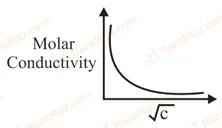
The variation of molar conductivity with concentration of an electrolyte (X) in aqueous solution is shown in the given figure.

Figure for JEE Main 2020 Chemistry question on Conductance, conductivity and molar conductivity


The electrolyte X is:

  1. A

    HCl

  2. B

    NaClNaCl

  3. C

    KNO3\text{KNO}_3

  4. D

    CH3COOH\text{CH}_3\text{COOH}

JEE MAIN 2020 · 04 SEP S1Electrode potentials, electrochemical series and cell EMF

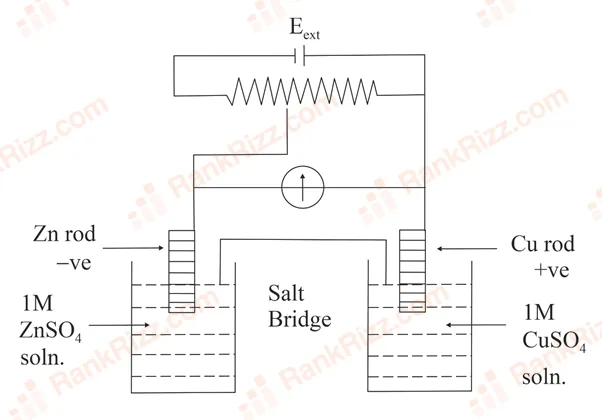
Identify the incorrect statement from the options below for the above cell:

Figure for JEE Main 2020 Chemistry question on Electrode potentials, electrochemical series and cell EMF

ECu2+∣Cu0=+0.34E^0_{Cu^{2+}|Cu} = +0.34 V,
EZn2+∣Zn0=−0.76E^0_{Zn^{2+}|Zn} = -0.76 V

  1. A

    If Eext>1.1E_{ext} > 1.1 V, e−^- flow from Cu to Zn

  2. B

    If Eext>1.1E_{ext} > 1.1 V, Zn dissolves at Zn electrode and Cu deposits at Cu electrode

  3. C

    If Eext<1.1E_{ext} < 1.1 V, Zn dissolves at anode and Cu deposits at cathode

  4. D

    If Eext=1.1E_{ext} = 1.1 V, no flow of e−^- or current occurs

JEE MAIN 2020 · 04 SEP S2Conductance, conductivity and molar conductivity

250 mL of a waste solution obtained from the workshop of a goldsmith contains 0.1 M AgNO3_3 and 0.1 M AuCl. The solution was electrolyzed at 2 V by passing a current of 1 A for 15 minutes. The metal/metals electrodeposited will be: (EAg+/Ag0=0.80V,EAu+/Au0=1.69V)\left(E^0_{Ag^+/Ag} = 0.80V, E^0_{Au^+/Au} = 1.69V\right)

  1. A

    only gold

  2. B

    silver and gold in proportion to their atomic weights

  3. C

    only silver

  4. D

    silver and gold in equal mass proportion

JEE MAIN 2020 · 03 SEP S1Conductance, conductivity and molar conductivity

Let CNaClC_{NaCl} and CBaSO4C_{BaSO_4}, be the conductances (in S) measured for saturated aqueous solutions of NaCl and BaSO4BaSO_4 respectively, at a temperature T. Which of the following is false?

  1. A

    Ionic mobilities of ions from both salts increase with T

  2. B

    CBaSO4(T2)>CBaSO4(T1)C_{BaSO_4}(T_2) > C_{BaSO_4}(T_1) for T2>T1T_2 > T_1

  3. C

    CNaCl(T2)>CNaCl(T1)C_{NaCl}(T_2) > C_{NaCl}(T_1) for T2>T1T_2 > T_1

  4. D

    CNaCl≫CBaSO4C_{NaCl} \gg C_{BaSO_4} at given T

JEE MAIN 2020 · 03 SEP S1Electrode potentials, electrochemical series and cell EMF

The photoelectric current from Na (work function, w0=2.3w_0 = 2.3 eV) is stopped by the output voltage of the cell
Pt(s)|H2_2(g, 1 bar)|HCl(aq, pH = 1)|AgCl(s)|Ag(s)
The pH of aq. HCl required to stop the photoelectric current from K(w0=2.25w_0 = 2.25 eV), all other conditions remaining the same, is ......... ×10−2\times 10^{-2} (to the nearest integer).
Given 2.303RTF=0.062.303\frac{RT}{F} = 0.06 V; EAgCl/Ag/Cl0=0.22E^0_{AgCl/Ag/Cl} = 0.22 V

JEE MAIN 2020 · 03 SEP S2Conductance, conductivity and molar conductivity

An acidic solution of dichromate is electrolyzed for 8 minutes using 2 A current. As per the following equation Cr2O72−+14H++6e−→2Cr3++7H2OCr_2O_7^{2-} + 14H^+ + 6e^- \to 2Cr^{3+} + 7H_2O
The amount of Cr3+Cr^{3+} obtained was 0.104g. The efficiency of the process (in %) is (Take: F = 960000C, At. mass of chromium = 52)

JEE MAIN 2020 · 02 SEP S1Electrode potentials, electrochemical series and cell EMF

The Gibbs energy change (in J) for the given reaction at [Cu2+]=[Sn2+]=1[Cu^{2+}] = [Sn^{2+}] = 1 M and 298 K is:
Cu(s)+Sn2+(aq.)→Cu2+(aq.)+Sn(s)Cu(s) + Sn^{2+}(aq.) \to Cu^{2+}(aq.) + Sn(s);
(ESn2+∣Sn0=−0.16  V,ECu2+∣Cu0=0.34  V,Take F=96500  C  mol−1)(E^0_{Sn^{2+}|Sn} = -0.16 \; V, E^0_{Cu^{2+}|Cu} = 0.34 \; V, \text{Take } F = 96500 \; C \; mol^{-1})

JEE MAIN 2020 · 02 SEP S2Electrode potentials, electrochemical series and cell EMF

For the disproportionation reaction 2Cu+(aq)⇌Cu(s)+Cu2+(aq)2Cu^+(aq) \rightleftharpoons Cu(s) + Cu^{2+}(aq) at 298K, ln K (where K is the equilibrium constant) is ___________ ×10−1\times 10^{-1}.
Given: (ECu2+/Cu+°=0.16V,ECu+/Cu°=0.52V,RTF=0.025)(E^°_{Cu^{2+}/Cu^+} = 0.16V, E^°_{Cu^+/Cu} = 0.52V, \frac{RT}{F} = 0.025)

JEE MAIN 2020 · 09 JAN S1Conductance, conductivity and molar conductivity

108 g of silver (molar mass 108 gmol−1gmol^{-1}) is deposited at cathode from AgNO3(aq)AgNO_3(aq) solution by a certain quantity of electricity. The volume (in L) of oxygen gas produced at 273 K and 1 bar pressure from water by the same quantity of electricity is ___________.

JEE MAIN 2020 · 08 JAN S1Electrode potentials, electrochemical series and cell EMF

What would be the electrode potential for the given half-cell reaction at pH = 5?
2H2_2O →\rightarrow O2_2 + 4H+^+ + 4e−^-; Ered0=1.23_{red}^0 = 1.23 V
(R = 8.314 J mol−1^{-1} K−1^{-1}; Temp = 298K; oxygen under standard atm. pressure of 1 bar)

JEE MAIN 2020 · 08 JAN S2Electrode potentials, electrochemical series and cell EMF

For an electrochemical cell Sn(s)|Sn2+^{2+}(aq, 1M)||Pb2+^{2+}(aq, 1M)|Pb(s) the ratio [Sn2+][Pb2+]\frac{[Sn^{2+}]}{[Pb^{2+}]} when this cell attains equilibrium is __________.
(Given: ESn2+∣Sn0=−0.14^0_{Sn^{2+}|Sn} = -0.14 V, EPb2+∣Pb0=−0.13^0_{Pb^{2+}|Pb} = -0.13 V, 2.303RTF=0.06\frac{2.303RT}{F} = 0.06)

JEE MAIN 2020 · 07 JAN S1Electrode potentials, electrochemical series and cell EMF

Given that the standard potentials (E∘^\circ) of Cu2+^{2+}/Cu and Cu+^+/Cu are 0.34V and 0.522V respectively, the E∘^\circ of Cu2+^{2+}/Cu+^+ is:

  1. A

    0.182V

  2. B

    +0.158V

  3. C

    -0.182V

  4. D

    -0.158V

JEE MAIN 2020 · 07 JAN S2Conductance, conductivity and molar conductivity

The equation that is incorrect is:

  1. A

    (Λm0)KBr−(Λm0)NaCl=(Λm0)KBr−(Λm0)KCl(\Lambda_m^0)_{\text{KBr}} - (\Lambda_m^0)_{\text{NaCl}} = (\Lambda_m^0)_{\text{KBr}} - (\Lambda_m^0)_{\text{KCl}}

  2. B

    (Λm0)KG−(Λm0)KQ=(Λm0)NaG−(Λm0)NaQ(\Lambda_m^0)_{\text{KG}} - (\Lambda_m^0)_{\text{KQ}} = (\Lambda_m^0)_{\text{NaG}} - (\Lambda_m^0)_{\text{NaQ}}

  3. C

    (Λm0)H2O=(Λm0)HCl+(Λm0)NaOH−(Λm0)NaCl(\Lambda_m^0)_{H_2O} = (\Lambda_m^0)_{\text{HCl}} + (\Lambda_m^0)_{\text{NaOH}} - (\Lambda_m^0)_{\text{NaCl}}

  4. D

    (Λm0)NaBr−(Λm0)NaI=(Λm0)KBr−(Λm0)KI(\Lambda_m^0)_{\text{NaBr}} - (\Lambda_m^0)_{\text{NaI}} = (\Lambda_m^0)_{\text{KBr}} - (\Lambda_m^0)_{\text{KI}}

JEE MAIN 2019 · 12 APR S1Electrode potentials, electrochemical series and cell EMF

Given:
Co3+^{3+} + e−^- →\to Co2+^{2+}; E° = +1.81V
Pb3+^{3+} + 2e−^- →\to Pb2+^{2+}; E° = +1.67V
Ce4+^{4+} + e−^- →\to Ce3+^{3+}; E° = +1.61V
Bi3+^{3+} + 3e−^- →\to Bi; E° = +0.20V
Oxidizing power of the species will increase in the order:

  1. A

    Co3+^{3+} < Ce4+^{4+} < Bi3+^{3+} < Pb4+^{4+}

  2. B

    Bi3+^{3+} < Ce4+^{4+} < Pb4+^{4+} < Co3+^{3+}

  3. C

    Co3+^{3+} < Pb4+^{4+} < Ce3+^{3+} < Bi4+^{4+}

  4. D

    Ce4+^{4+} < Pb4+^{4+} < Bi3+^{3+} < Co3+^{3+}

JEE MAIN 2019 · 12 APR S2Conductance, conductivity and molar conductivity

The decreasing order of electrical conductivity of the following aqueous solutions is:
(A) 0.1 M Formic acid,
(B) 0.1 M Acetic acid,
(C) 0.1 M Benzoic acid.

  1. A

    (A) > (B) > (C)

  2. B

    (A) > (C) > (B)

  3. C

    (C) > (B) > (A)

  4. D

    (C) > (A) > (B)