RankRizz

Electrode potentials, electrochemical series and cell EMF — JEE Main Previous Year Questions

Electrode potentials, electrochemical series and cell EMF has been asked 106 times in JEE Main, in 15 different years between 2004 and 2026, and in all of the last five exam years (2022–2026), 62 questions in all. That is 47% of Electrochemistry, its most-asked topic. Last asked in JEE Main 08 Apr 2026, Shift 2. 55 are multiple choice and 51 numerical-value; 25 easy, 72 medium and 5 hard by our difficulty labels. All of them are below, newest first, free to read.

Questions

106

Years asked

15

Since

2004

Of the chapter

47%

When JEE Main asked it

Questions on Electrode potentials, electrochemical series and cell EMF in every year it was asked, newest first.

JEE Main questions on Electrode potentials, electrochemical series and cell EMF by year, 2004–2026
YearRelative frequencyQuestions
202614
20259
202411
202318
202210
20219
20209
201910
20174
20161
20143
20134
20122
20091
20041
Total106

Every Electrode potentials, electrochemical series and cell EMF question

1–20 OF 106 · NEWEST FIRST

JEE MAIN 2026 · 08 APR S2Electrode potentials, electrochemical series and cell EMF

Given at 298 K :
EFe2+/Fe⊖=XE^\ominus_{\text{Fe}^{2+}/\text{Fe}} = X Volt
EFe3+/Fe⊖=YE^\ominus_{\text{Fe}^{3+}/\text{Fe}} = Y Volt
The EFe3+/Fe2+⊖E^\ominus_{\text{Fe}^{3+}/\text{Fe}^{2+}} in Volt at 298 K is given by :

  1. A

    2X−3Y2X - 3Y

  2. B

    3Y−2X3Y - 2X

  3. C

    3Y+2X3Y + 2X

  4. D

    Y+XY + X

JEE MAIN 2026 · 06 APR S2Electrode potentials, electrochemical series and cell EMF

For a general redox reaction

Anode: Red1→Ox1n1++n1e−\text{Red}_1 \to \text{Ox}_1^{n_1+} + n_1 e^-

Cathode: Ox2+n2e−→Red2n2−\text{Ox}_2 + n_2 e^- \to \text{Red}_2^{n_2-}

Which of the following statement is **incorrect** ?

  1. A

    The overall reaction can be written as n2Red1+n1Ox2=n2Ox1n1++n1Red2n2−n_2\text{Red}_1 + n_1\text{Ox}_2 = n_2\text{Ox}_1^{n_1+} + n_1\text{Red}_2^{n_2-}

  2. B

    The electrons do not appear in the overall reaction because electrons produced at the anode are consumed at the cathode.
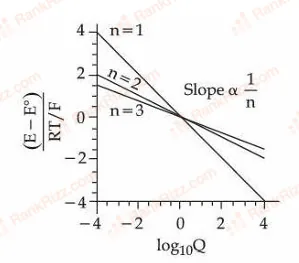
  3. C
    Figure for JEE Main 2026 Chemistry question on Electrode potentials, electrochemical series and cell EMF

    Here n is the number of electrons transferred in redox reaction.

  4. D

    If the reaction is carried out reversibly, the electrical work done is equal to the ratio of charge and potential difference through which charge is moved.

JEE MAIN 2026 · 05 APR S2Electrode potentials, electrochemical series and cell EMF

One half cell in a voltaic cell is constructed by dipping silver rod in AgNO3\text{AgNO}_3 solution of unknown concentration, other half cell is Zn rod dipped in 1 molar solution of ZnSO4\text{ZnSO}_4. A voltage of 1.60 V1.60\,\text{V} is measured at 298 K298\,\text{K} for this cell. What is the concentration of Ag+\text{Ag}^+ ions used in terms of log⁡x\log x (x=[Ag+])(x = [\text{Ag}^+])?

EZn2+/Zn⊖=−0.76 V,E^\ominus_{\text{Zn}^{2+}/\text{Zn}} = -0.76\,\text{V}, \quad EAg+/Ag⊖=+0.80 V,E^\ominus_{\text{Ag}^{+}/\text{Ag}} = +0.80\,\text{V}, \quad 2.303RTF=0.059 V\frac{2.303RT}{F} = 0.059\,\text{V}

  1. A

    23.9\frac{2}{3.9}

  2. B

    45.9\frac{4}{5.9}

  3. C

    2.92\frac{2.9}{2}

  4. D

    5.94\frac{5.9}{4}

JEE MAIN 2026 · 04 APR S2Electrode potentials, electrochemical series and cell EMF

An electrochemical cell, consist of the following two redox couples, Mx+^{x+}(aq)/M(s) [EredΘ=+0.15E_{red}^{\Theta} = +0.15 V] and Fe3+^{3+}(aq)/Fe(s) [EredΘ=−0.036E_{red}^{\Theta} = -0.036 V]. The cell EMF (Ecell_{cell}) is recorded to be 0.2057 V. If the reaction quotient of the electrochemical reaction is found to be 10−210^{-2}, then the value of xx is __________. (Nearest integer)

[Given: M is a p-block metal and 2.303RTF=0.059\frac{2.303RT}{F} = 0.059 V]

JEE MAIN 2026 · 02 APR S1Electrode potentials, electrochemical series and cell EMF

An electrochemical cell is constructed using half cells in the direction of spontaneous change
Fe(OH)2_2(s) + 2e−^- →\rightarrow Fe(s) + 2OH−^-(aq)       E0^0 = −0.88 V
and AgBr(s) + e−^- →\rightarrow Ag(s) + Br−^-(aq)                 E0^0 = +0.07 V
Which of the following option is correct?

  1. A

    Overall reaction Fe(s)+2OH−^-(aq)+2AgBr(s) ⇌\rightleftharpoons Fe(OH)2_2(s)+2Ag(s)+2Br−^-(aq)

  2. B

    Ecell0=−0.95E^0_{cell} = -0.95 V

  3. C

    Fe is reduced in the electrochemical cell

  4. D

    Ecell0E^0_{cell} is an extensive property

JEE MAIN 2026 · 28 JAN S1Electrode potentials, electrochemical series and cell EMF

Consider the following redox reaction taking place in acidic medium
BH4−(aq)+ClO3−(aq)→H2BO3−(aq)+Cl−(aq)BH_{4}^{-}(aq)+ClO_{3}^{-}(aq)\rightarrow H_{2}BO_{3}^{-}(aq)+Cl^{-}(aq)
If the Nerst equation for the above balanced reaction is Ecell=Ecell∘−RTnFlnQE_{cell}=E_{cell}^{\circ}-\frac{RT}{nF}ln Q, then the value of n is______.(Nearest integer)

JEE MAIN 2026 · 28 JAN S2Electrode potentials, electrochemical series and cell EMF

A volume of x mL of 5 M NaHCO3NaHCO_{3} solution was mixed with 10 mL of 2 M H2CO3H_{2}CO_{3} solution to make an electrolytic buffer. If the same buffer was used in the following electrochemical cell to record a cell potential of 235.3 mV, then the value of x=_______ mL (nearest integer).
Sn(s)∣Sn(OH)62−(0.5M)∣HSnO2−(0.05M)∣OH−∣Bi2O3(s)∣Bi(s)Sn(s)|Sn(OH)_{6}^{2-}(0.5 M)|HSnO_{2}^{-}(0.05 M)|OH^{-}|Bi_{2}O_{3}(s)|Bi(s)
Consider upto one place of decimal for intermediate calculations
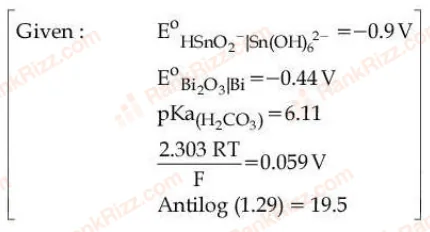
Figure for JEE Main 2026 Chemistry question on Electrode potentials, electrochemical series and cell EMF
JEE MAIN 2026 · 23 JAN S1Electrode potentials, electrochemical series and cell EMF

In the given electrochemical cell, Ag(s)∣AgCl(s)∣FeCl2(aq)Ag(s)|AgCl(s)|FeCl_{2}(aq), FeCl3(aq)∣Pt(s)FeCl_{3}(aq)|Pt(s) at298 K, theceU potential EcellE_{cell} will increase when:
A. Concentration of Fe2+Fe^{2+} is increased.
B. Concentration of Fe3+Fe^{3+} is decreased.
C. Concentration of Fe2+Fe^{2+} is decreased.
D. Concentration of Fe3+Fe^{3+} is increased.
E. Concentration of Cl−Cl^{-} is increased.
Choose the correct answer from the options given below :

  1. A

    B Only

  2. B

    A and B Only

  3. C

    C, D and E Only

  4. D

    A and E Only

JEE MAIN 2026 · 23 JAN S2Electrode potentials, electrochemical series and cell EMF
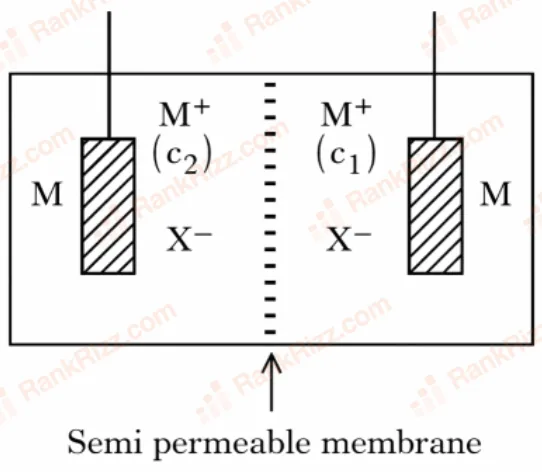
Figure for JEE Main 2026 Chemistry question on Electrode potentials, electrochemical series and cell EMF

Consider the above electrochemical cell where a metal electrode (M) is undergoing redox reaction by forming M+(M→M++e−)M^{+}(M\rightarrow M^{+}+e^{-}). The cation M+M^{+} is present in two different concentrations c1c_{1} and c2c_{2} as shown above. which of the following statement is correct for generating a positive cell potential?

  1. A

    If c1c_1 is present at anode, then c1=c2c_1 = c_2.

  2. B

    If c1c_1 is present at cathode, then c1>c2c_1 > c_2.

  3. C

    If c1c_1 is present at cathode, then c1<c2c_1 < c_2.

  4. D

    If c1c_1 is present at anode then c1>c2c_1 > c_2.

JEE MAIN 2026 · 22 JAN S1Electrode potentials, electrochemical series and cell EMF

Consider the following electrochemical cell at 298K

Pt∣HSnO2−(aq)∣Sn(OH)62−(aq)∣OH−(aq)∣Bi2O3(s)∣Bi(s)Pt \mid HSnO_2{^-}(aq)\mid Sn(OH)_6{^{2-}}(aq)\mid OH^{-}(aq)\mid Bi_{2}O_{3}(s)\mid Bi(s).

If the reaction quotient at a given time is 10610^{6}, then the cell EMF(Ecell)EMF (E_{cell}) is _____ ×10−1V\times 10^{-1} V (Nearest integer).

Given the standard half-cell reduction potential as

EBi2O3/Hi,OH−o=−0.44V and ESn(OH)62−/HSnO2−,OH−o=−0.90VE_{Bi_{2}O_{3}/Hi,OH^{-}}^{o}=-0.44V \text{ and }E_{Sn(OH)_6^{2-}/HSnO_2^{-}, OH^{-}}^{o}=-0.90V

JEE MAIN 2026 · 22 JAN S2Electrode potentials, electrochemical series and cell EMF

Consider the following reduction processes :
Al3++3e−→Al(s),E∘=−1.66VAl^{3+} + 3e^{-} \rightarrow Al(s), E^{\circ} = -1.66V
Fe3++e−→Fe2+,E∘=+0.77VFe^{3+} + e^{-} \rightarrow Fe^{2+}, E^{\circ} = +0.77V
Co3++e−→Co2+,E∘=+1.81VCo^{3+} + e^{-} \rightarrow Co^{2+}, E^{\circ} = +1.81V
Cr3++3e−→Cr(s),E∘=−0.74VCr^{3+} + 3e^{-} \rightarrow Cr(s), E^{\circ} = -0.74V
The tendency to act as reducing agent decreases in the order :

  1. A

    Al>Cr>Fe2+>Co2+Al> Cr > Fe^{2+} > Co^{2+}

  2. B

    Cr>Fe2+>Al>Co2+Cr> Fe^{2+} > Al > Co^{2+}

  3. C

    Al>Cr>Co2+>Fe2+Al > Cr > Co^{2+} > Fe^{2+}

  4. D

    Al>Fe2+>Cr>Co2+Al > Fe^{2+} > Cr > Co^{2+}

JEE MAIN 2026 · 22 JAN S2Electrode potentials, electrochemical series and cell EMF

Consider the following electrochemical cell : Pt∣O2(g)(1bar)∣HCl(aq)∣∣M2+(aqPt| O_{2}(g)(1 bar) | HCl(aq)||M^{2+}(aq, 1.0M)∣M(s)1.0M)|M(s)
The pH above which , oxygen gas would start to evolve at anode is ____ (nearest integer).
[Given: EM2+/m∘=0.994VE_{M^{2+}/m}^\circ = 0.994V , EO2/H2O∘=1.23VE_{O^{2}/H_{2}O}^\circ = 1.23V are standard reduction potential and RTF(2.303)=0.059V\frac{RT}{F}(2.303)=0.059V at the given condition]

JEE MAIN 2026 · 21 JAN S2Electrode potentials, electrochemical series and cell EMF

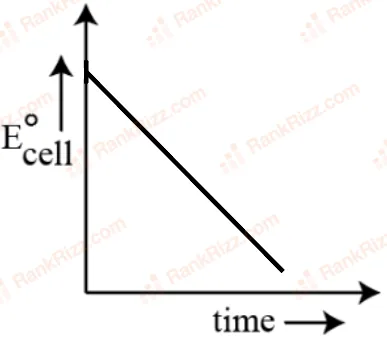
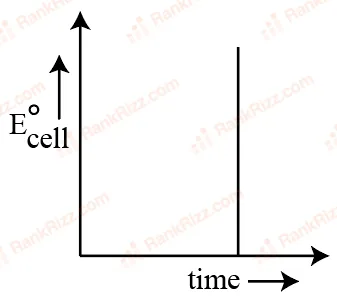
For a closed circuit Daniell cell, which of the following plots is the accurate one at a given temperature?
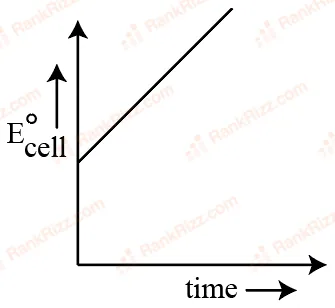
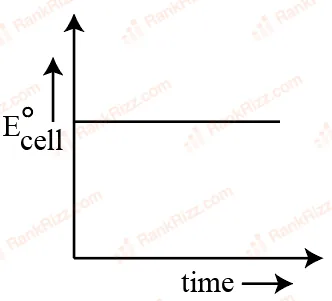
  1. A
    56 opt 1
  2. B
    56 OPT 2
  3. C
    Screenshot_37
  4. D
    56 opt 4
JEE MAIN 2026 · 21 JAN S2Electrode potentials, electrochemical series and cell EMF

MX is a sparingly soluble salt that follows the given solubility equilibrium at 298 K.
MX(s)⇌M+(aq)+X−(aq);Ksp=10−10MX(s) \rightleftharpoons M^{+} (aq)+X^{-}(aq); K_{sp}=10^{-10}
If the standard reduction potential for M+(aq)→+e−M(s)M^{+}(aq)\xrightarrow {+e^{-}}M(s) and (EM+/M⊖)=0.79V\left(E_{M^{+}/M}^\ominus\right)=0.79V, then the value of the standard reduction potential for the metal/metal insoluble salt electrode EX−/MX(s)/M⊖E^{\ominus}_{X^{-}/MX (s)/M } is __________mV.(nearest integer)
[Given : 2.303RTF=0.059V\frac{2.303RT}{F} = 0.059V]

JEE MAIN 2025 · 08 APR S2Electrode potentials, electrochemical series and cell EMF

Consider the following half cell reaction: Cr2O72−(aq)+6e−+14H+(aq)→2Cr3+(aq)+7H2O(l)Cr_2O_7^{2-}(aq) + 6e^- + 14H^+(aq) \to 2Cr^{3+}(aq) + 7H_2O(l). The reaction was conducted with the ratio of [Cr3+]2[Cr2O72−]=10−6\frac{[Cr^{3+}]^2}{[Cr_2O_7^{2-}]} = 10^{-6}. The pH value at which the EMF of the half cell will become zero is _____ . (nearest integer value)  [Given : standard half cell reduction potential ECr2O72−,H+/Cr3+0=1.33E^0_{Cr_{2}O^{2-}_{7},H^{+}/Cr^{3+}} = 1.33 V, 2.303RTF=0.059\frac{2.303RT}{F} = 0.059 V]

JEE MAIN 2025 · 07 APR S1Electrode potentials, electrochemical series and cell EMF

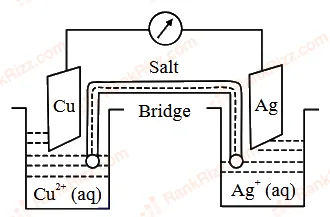
1 Faraday electricity was passed through Cu2+Cu^{2+} (1.5 M, 1 L)/Cu and 0.1 Faraday was passed through Ag+Ag^+ (0.2 M, 1 L)/Ag electrolytic cells. After this the two cells were connected as shown below to make an electrochemical cell. The emf of the cell thus formed at 298 K is ______. (Given: ECu2+/Cu0=0.34E^0_{Cu^{2+}/Cu} = 0.34 V, EAg+/Ag0=0.8E^0_{Ag^+/Ag} = 0.8 V, 2.303RTF=0.06\frac{2.303RT}{F} = 0.06 V)

Figure for JEE Main 2025 Chemistry question on Electrode potentials, electrochemical series and cell EMF
JEE MAIN 2025 · 02 APR S1Electrode potentials, electrochemical series and cell EMF

Consider the following electrochemical cell at standard condition.

Au(s)∣QH2,Q∣NH4X(0.01M)∣∣Ag+(1M)∣Ag(s)Au(s)|QH_2,Q|NH_4X(0.01M)||Ag^+(1M)|Ag(s)

Ecell=+0.4VE_{cell} = +0.4V

The couple QH2/QQH_2/Q represents quinhydrone electrode, the half cell reaction is given below:
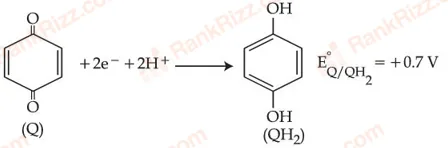
Figure for JEE Main 2025 Chemistry question on Electrode potentials, electrochemical series and cell EMF

[Given: EAg+/Ago=+0.8VE^o_{Ag^+/Ag} = +0.8V and 2.303RTF=0.06V\frac{2.303RT}{F} = 0.06V]

The pKbpK_b value of the ammonium halide salt (NH4XNH_4X) used here is ______. (nearest integer)

JEE MAIN 2025 · 29 JAN S1Electrode potentials, electrochemical series and cell EMF

The standard reduction potential values of some of the p-block ions are given below. Predict the one with the strongest oxidising capacity.

  1. A

    EPb4+/Pb2+⊖=+1.67VE_{Pb^{4+}/Pb^{2+}}^{\ominus}=+1.67 V

  2. B

    ESn4+/Sn2+⊖=+1.15VE_{Sn^{4+}/Sn^{2+}}^{\ominus}=+1.15 V

  3. C

    EAl3+/Al⊖=−1.66VE_{Al^{3+}/Al}^{\ominus}=-1.66 V

  4. D

    ETl⊖/Tl/2.26VE_{Tl}^{\ominus}/Tl/2.26 V

JEE MAIN 2025 · 29 JAN S1Electrode potentials, electrochemical series and cell EMF

For a Mg∣Mg2+(aq)∣∣Ag+(aq)∣AgMg|Mg^{2+}(aq)||Ag^{+}(aq)|Ag the correct Nernst Equation is :

  1. A

    Ecell=Ecell∘−RT2Fln[Ag+][Mg2+]E_{cell}=E_{cell}^{\circ}-\frac{RT}{2F}ln\frac{[Ag^{+}]}{[Mg^{2+}]}

  2. B

    Ecell=Ecell∘+RT2Fln[Ag+]2[Mg2+]E_{cell}=E_{cell}^{\circ}+\frac{RT}{2F}ln\frac{[Ag^{+}]^{2}}{[Mg^{2+}]}

  3. C

    Ecell=Ecell∘−RT2Fln[Ag+]2[Mg2+]E_{cell}=E_{cell}^{\circ}-\frac{RT}{2F}ln\frac{[Ag^{+}]^{2}}{[Mg^{2+}]}

  4. D

    Ecell=Ecell∘−RT2Fln[Mg2+][Ag+]E_{cell}=E_{cell}^{\circ}-\frac{RT}{2F}ln\frac{[Mg^{2+}]}{[Ag^{+}]}

JEE MAIN 2025 · 24 JAN S1Electrode potentials, electrochemical series and cell EMF

For the given cell Fe(aq)2++Ag(aq)+→Fe(aq)3++Ag(s),Fe^{2+}_{(aq)} + Ag^+_{(aq)} \rightarrow Fe^{3+}_{(aq)} + Ag_{(s)}, the standard cell potential of the above reaction is Given: Ag++e−→AgE∘=x VFe2++2e−→FeE∘=y VFe3++3e−→FeE∘=z V\begin{aligned}Ag^+ + e^- &\rightarrow Ag \qquad E^\circ = x\,V \\Fe^{2+} + 2e^- &\rightarrow Fe \qquad E^\circ = y\,V \\Fe^{3+} + 3e^- &\rightarrow Fe \qquad E^\circ = z\,V \end{aligned}

  1. A

    x+y−zx + y - z

  2. B

    x+2yx + 2y

  3. C

    x+2y−3zx + 2y - 3z

  4. D

    y−2xy - 2x

Electrode potentials, electrochemical series and cell EMF: common questions

How many Electrode potentials, electrochemical series and cell EMF questions have come in JEE Main?
Electrode potentials, electrochemical series and cell EMF has been asked 106 times in JEE Main, in 15 different years between 2004 and 2026. It came up in all of the last five exam years (2022–2026), 62 questions in all.
Is Electrode potentials, electrochemical series and cell EMF important for JEE Main?
It is the most-asked topic in Electrochemistry: 106 of the chapter's 227 JEE Main questions (47%). It came up in all of the last five exam years (2022–2026), 62 questions in all.
When was Electrode potentials, electrochemical series and cell EMF last asked in JEE Main?
Most recently in JEE Main 08 Apr 2026, Shift 2. Questions on this page are newest first, so the latest ones are at the top.
What kind of Electrode potentials, electrochemical series and cell EMF questions does JEE Main ask?
55 are multiple choice and 51 numerical-value; 25 easy, 72 medium and 5 hard by our difficulty labels. Each question shows its answer key and worked solution where we have them.