JEE MAIN 2023 · 11 APR S1Electrode potentials, electrochemical series and cell EMF
In an electrochemical reaction of lead, at standard temperature, if Volt and Volt, then the value of is given by . The value of x is _______ (Nearest integer).
Every Electrochemistry question JEE Main has set from 2004–2026, grouped by the idea it tests rather than the order of the syllabus. 227 questions across 8 distinct ideas. Free to read, answer key on every one.
DATA UPDATED
Questions
227
Distinct ideas
8
Share of marks
4.4%
Difficulty
MEDIUM
A chapter is not one subject — it is a handful of procedures the examiner reuses. These are the ones Electrochemistry questions actually test.
81–100 OF 227 · NEWEST FIRST
In an electrochemical reaction of lead, at standard temperature, if Volt and Volt, then the value of is given by . The value of x is _______ (Nearest integer).
The number of correct statements from the following is _______
A. E is an intensive parameter
B. A negative E means that the redox couple is a stronger reducing agent than the H/H couple.
C. The amount of electricity required for oxidation or reduction depends on the stoichiometry of the electrode reaction.
D. The amount of chemical reaction which occurs at any electrode during electrolysis by a current is proportional to the quantity of electricity passed through the electrolyte.
is V. The value of x is _______.
The specific conductance of 0.0025M acetic acid is S cm at a certain temperature. The dissociation constant of acetic acid is _______ . (Nearest integer)
Consider limiting molar conductivity of CHCOOH as 400 S cm mol
The reaction occurs in which of the given galvanic cell?
Pt |H(g)| HCl(sol) |AgCl(s)| Ag
Ag |AgCl(s)| KCl(sol) |AgNO |Ag
Pt |H(g)| HCl(sol) |AgNO(sol) |Ag
Pt |H(g)| KCl(sol) |AgCl(s) |Ag
The incorrect statements from the following is:
A. The electrical work that a reaction can perform at constant pressure and temperature is equal to the reaction Gibbs energy.
B. is dependent on the pressure.
C.
D. A cell is operating reversibly if the cell potential is exactly balanced by an opposing source of potential difference.
The standard electrode potential of M/M in aqueous solution does not depend on
Hydration of a gaseous metal ion
Sublimation of a solid metal
Ionisation of a solid metal atom
Ionisation of a gaseous metal atom
The standard reduction potentials at 295 K for the following half cells are given below:
NO + 4H + 3e NO(g) + 2HO E° = 0.97 V
V(aq) + 2e V(s) E° = -1.19 V
Fe(aq) + 3e Fe(s) E° = -0.04 V
Ag(aq) + e Ag(s) E° = 0.80 V
Au(aq) + 3e Au(s) E° = 1.40 V
The number of metal(s) which will be oxidised by NO in aqueous solution is ______.
At what pH, given half cell MnO(0.1M) | Mn(0.001 M) will have electrode potential of 1.282 V? (Nearest Integer)
Given E = 1.54 V, = 0.059 V
M AgNO is added to L of saturated solution of AgBr. The conductivity of this solution at 298 K is _______ S m.
[Given: K(AgBr) at 298 K, Sm mol, Sm mol, Sm mol]
Which one of the following statements is correct for electrolysis of brine solution?
Cl is formed at cathode
O is formed at cathode
H is formed at anode
OH is formed at cathode
The logarithm of equilibrium constant for the reaction is (Nearest integer)
Given: V
V
E^o = 0.65$$ V
The resistivity of a 0.8M solution of an electrolyte is cm. Its molar conductivity is cm mol. (Nearest integer)
Consider the cell
Pt, H(g, 1 atm) | H aq, 1M | Fe aq, Fe aq | Pt s
When the potential of the cell is 0.712 V at 298 K, the ratio Fe/Fe is ______ (Nearest integer)
Given: Fe + e = Fe, E° Fe, Fe Pt = 0.771, V
The electrode potential of the following half cell at 298 K
X|X(0.001M)||Y(0.01M)|Y is ______ V (Nearest integer)
Given: E V
E V
V
The standard electrode potential (M/M) for V, Cr, Mn & Co are V, V, V and V, respectively. The metal ions which can liberate H from a dilute acid are
V and Mn
Cr and Co
V and Cr
Mn and Co
Following figure shows dependence of molar conductance of two electrolytes on concentration. is the limiting molar conductivity.
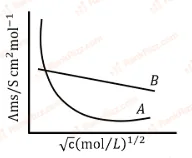
The number of Incorrect statement(s) from the following is ______
(A) for electrolyte A is obtained by extrapolation
(B) For electrolyte B, Vs graph is a straight line with intercept equal to
(C) At infinite dilution, the value of degree of dissociation approach zero for electrolyte B.
(D) for any electrolyte A or B can be calculated using for individual ions.
The equilibrium constant for the reaction Zn(s) + Sn(aq) Zn(aq) + Sn(s) is at 298 K. The magnitude of standard electrode potential of Sn/Sn if E V is ______ V. (Nearest integer)
Given: V
Consider the cell Pt(s)|H(s)(1atm)|H(aq, [H] = 1)||Fe(aq), Fe(aq)|Pt(s)
Given: E = 0.771 V and E = 0 V, T = 298 K
If the potential of the cell is 0.712 V the ratio of concentration of Fe to Fe is _____ (Nearest integer)
Pt(s)|H(g)(1 bar)|H(aq)(1M)||M(aq), M(aq)|Pt(s)
The E for the given cell is 0.1115 V at 298 K
When
The value of a is _____
Given: E = 0.2 V
= 0.059 V
JEE Advanced has set 32 Electrochemistry questions too. Electrochemistry JEE Advanced PYQs →
OTHER CHEMISTRY CHAPTERS