RankRizz

Electrochemistry — JEE Main Previous Year Questions

Every Electrochemistry question JEE Main has set from 2004–2026, grouped by the idea it tests rather than the order of the syllabus. 227 questions across 8 distinct ideas. Free to read, answer key on every one.

DATA UPDATED

Questions

227

Distinct ideas

8

Share of marks

4.4%

Difficulty

MEDIUM

The ideas inside Electrochemistry

A chapter is not one subject — it is a handful of procedures the examiner reuses. These are the ones Electrochemistry questions actually test.

Every Electrochemistry question

41–60 OF 227 · NEWEST FIRST

JEE MAIN 2025 · 24 JAN S1Electrode potentials, electrochemical series and cell EMF

For the given cell Fe(aq)2++Ag(aq)+→Fe(aq)3++Ag(s),Fe^{2+}_{(aq)} + Ag^+_{(aq)} \rightarrow Fe^{3+}_{(aq)} + Ag_{(s)}, the standard cell potential of the above reaction is Given: Ag++e−→AgE∘=x VFe2++2e−→FeE∘=y VFe3++3e−→FeE∘=z V\begin{aligned}Ag^+ + e^- &\rightarrow Ag \qquad E^\circ = x\,V \\Fe^{2+} + 2e^- &\rightarrow Fe \qquad E^\circ = y\,V \\Fe^{3+} + 3e^- &\rightarrow Fe \qquad E^\circ = z\,V \end{aligned}

  1. A

    x+y−zx + y - z

  2. B

    x+2yx + 2y

  3. C

    x+2y−3zx + 2y - 3z

  4. D

    y−2xy - 2x

JEE MAIN 2025 · 24 JAN S2Electrode potentials, electrochemical series and cell EMF

Based on the data given below: ECr2O72−/Cr3+∘=1.33VECl2/Cl−∘=1.36 VEMnO4−/Mn2+∘=1.51VECr3+/Cr∘=−0.74 V\begin{aligned}E^\circ_{\text{Cr}_2\text{O}_7^{2-}/\text{Cr}^{3+}} &= 1.33 \text{V} &E^\circ_{\text{Cl}_2/\text{Cl}^-} &= 1.36\ \text{V} \\E^\circ_{\text{MnO}_4^-/\text{Mn}^{2+}} &= 1.51 \text{V} &E^\circ_{\text{Cr}^{3+}/\text{Cr}} &= -0.74\ \text{V}\end{aligned} the strongest reducing agent is:

  1. A

    Cr\text{Cr}

  2. B

    Cl−\text{Cl}^-

  3. C

    MnO4−\text{MnO}_4^-

  4. D

    Mn2+\text{Mn}^{2+}

JEE MAIN 2025 · 23 JAN S1Electrode potentials, electrochemical series and cell EMF

FeO42−→+2.0VFe3+→0.8VFe2+→−0.5VFe0FeO_{4}^{2-}\xrightarrow{+2.0_{V}} Fe^{3+}\xrightarrow{0.8_{V}} Fe^{2+}\xrightarrow{-0.5_{V}}Fe^{0} In the above diagram, the standard electrode potentials are given in volts (over the arrow). The value of EFeO42−/Fe2+0E_{FeO_{4}^{2-}/Fe^{2+}}^{0} is

  1. A

    2.1 V

  2. B

    1.7 V

  3. C

    1.4 V

  4. D

    1.2 V

JEE MAIN 2025 · 23 JAN S2Electrode potentials, electrochemical series and cell EMF

Standard electrode potentials for a few half cells are mentioned below :
ECu2+/Cu∘=0.34V,EZn2+/Zn∘=−0.76VEAg+/Ag∘=0.80V,EMg2+/Mg∘=−2.37VE_{Cu^{2+}/Cu}^{\circ}=0.34 V,E_{Zn^{2+}/Zn}^{\circ}=-0.76 V\\E_{Ag^{+}/Ag}^{\circ}=0.80 V,E_{Mg^{2+}/Mg}^{\circ}=-2.37 V Which one of the following cells gives the most negative value of ΔG∘\Delta G^{\circ} ?

  1. A

    Zn∣Zn2+(1M)∣∣Ag+(1M)∣AgZn|Zn^{2+}(1M)||Ag^{+}(1M)|Ag

  2. B

    Zn∣Zn2+(1M)∣∣Mg2+(1M)∣MgZn|Zn^{2+}(1M)||Mg^{2+}(1M)|Mg

  3. C

    Ag∣Ag+(1M)∣∣Mg2+(1M)∣MgAg|Ag^{+}(1M)||Mg^{2+}(1M)|Mg

  4. D

    Cu∣Cu2+(1M)∣∣Ag+(1M)∣AgCu|Cu^{2+}(1M)||Ag^{+}(1M)|Ag

JEE MAIN 2025 · 22 JAN S1Conductance, conductivity and molar conductivity

Which of the following electrolyte can be used to obtain H2S2O8H_2 S_2 O_8 by the process of electrolysis?

  1. A

    Dilute solution of sodium sulphate.

  2. B

    Acidified dilute solution of sodium sulphate.

  3. C

    Dilute solution of sulphuric acid

  4. D

    Concentrated solution of sulphuric acid

JEE MAIN 2025 · 22 JAN S1Electrolysis and Faraday's laws

A solution of aluminium chloride is electrolysed for 30 minutes using a current of 2 A . The amount of the aluminium deposited at the cathode is [Given : molar mass of aluminium and chlorine are 27g mol−1mol^{-1} and 35.5 g mol−1mol^{-1} respectively. Faraday constant =96500Cmol−1=96500C mol^{-1} ]

  1. A

    1.660 g

  2. B

    0.336 g

  3. C

    0.441 g

  4. D

    1.007 g

JEE MAIN 2025 · 22 JAN S2Batteries, fuel cells and corrosion

Given below are two statements : Statement (I) : Corrosion is an electrochemical phenomenon in which pure metal acts as an anode and impure metal as a cathode. Statement (II) : The rate of corrosion is more in alkaline medium than in acidic medium. In the light of the above statements, choose the correct answer from the options given below :

  1. A

    Both Statement I and Statement II are true

  2. B

    Statement I is false but Statement II is true

  3. C

    Statement I is true but Statement II is false

  4. D

    Both Statement I and Statement II are false

JEE MAIN 2024 · 09 APR S1Conductance, conductivity and molar conductivity

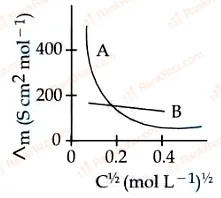
The molar conductivity for electrolytes A and B are plotted against C1/2C^{1/2} as shown below. Electrolytes A and B respectively are 
page6_img5
  1. A

    A: strong electrolyte ; B: weak electrolyte

  2. B

    A: weak electrolyte ; B: weak electrolyte

  3. C

    A: weak electrolyte ; B: strong electrolyte

      • D

        A: strong electrolyte ; B: strong electrolyte

      JEE MAIN 2024 · 09 APR S1Electrode potentials, electrochemical series and cell EMF

      The standard reduction potentials at 298298 K for the following half cells are given below :
      Cr2O72−+14H++6e−→2Cr3++7H2OCr_2O_7^{2-} + 14H^+ + 6e^- \rightarrow 2Cr^{3+} + 7H_2O, E°=1.33E° = 1.33 V
      Fe3+(aq)+3e−→FeFe^{3+}(aq) + 3e^- \rightarrow Fe, E°=−0.04E° = -0.04 V
      Ni2+(aq)+2e−→NiNi^{2+}(aq) + 2e^- \rightarrow Ni, E°=−0.25E° = -0.25 V
      Ag+(aq)+e−→AgAg^+(aq) + e^- \rightarrow Ag, E°=0.80E° = 0.80 V
      Au3+(aq)+3e−→AuAu^{3+}(aq) + 3e^- \rightarrow Au, E°=1.40E° = 1.40 V
      Consider the given electrochemical reactions, The number of metal(s) which will be oxidized by Cr2O72−Cr_2O_7^{2-}, in aqueous solution is ______

      JEE MAIN 2024 · 09 APR S2Batteries, fuel cells and corrosion

      Match List I with List II:

      Figure for JEE Main 2024 Chemistry question on Batteries, fuel cells and corrosion


      Choose the correct answer from the options given below:

      1. A

        A-III, B-II, C-I, D-IV

      2. B

        A-II, B-I, C-IV, D-III

      3. C

        A-I, B-IV, C-III, D-II

      4. D

        A-IV, B-III, C-II, D-I

      JEE MAIN 2024 · 09 APR S2Conductance, conductivity and molar conductivity

      Which out of the following is a correct equation to show change in molar conductivity with respect to concentration for a weak electrolyte, if the symbols carry their usual meaning :

      1. A

        Λm−Λm0+AC1/2=0\Lambda_m - \Lambda^0_m + AC^{1/2} = 0

      2. B

        Λm2C−KaΛm∘2+KaΛmΛm∘ =0\Lambda_m^2C-K_a\Lambda_m^{\circ2}+K_a\Lambda_m\Lambda_m^{\circ\ }=0

      3. C

        Λm2C+KaΛm∘2−KaΛmΛm∘=0\Lambda^2_m C + K_a \Lambda^{\circ 2}_m - K_a \Lambda_m \Lambda^\circ_m = 0

      4. D

        Λm−Λm∘−AC1/2=0\Lambda_m - \Lambda^\circ_m - AC^{1/2} = 0

      JEE MAIN 2024 · 08 APR S2Electrode potentials, electrochemical series and cell EMF

      The emf of cell 

      Figure for JEE Main 2024 Chemistry question on Electrode potentials, electrochemical series and cell EMF

      It could be increased by :

      1. A

        decreasing concentration of both Tl+Tl^+ and Cu2+Cu^{2+} ions

      2. C

        increasing concentration of Tl+Tl^+ ions

      3. D

        increasing concentration of both Tl+Tl^+ and Cu2+Cu^{2+} ions

      JEE MAIN 2024 · 08 APR S2Electrode potentials, electrochemical series and cell EMF

      The reaction; 12H2(g)+AgCl(s)→H(aq)++Cl(aq)−+Ag(s)\frac{1}{2}H_{2(g)} + AgCl_{(s)} \rightarrow H^+_{(aq)} + Cl^-_{(aq)} + Ag_{(s)} occurs in which of the following galvanic cell :

      1. A

        Ag∣AgCl(s)∣KCl(soln.)∣AgNO3(aq.)∣AgAg \left| AgCl_{(s)} \right| KCl_{(soln.)} \left| AgNO_{3(aq.)} \right| Ag

      2. B

        Pt∣H2(g)∣HCl(soln.)∣AgCl(s)∣AgPt \left| H_{2(g)} \right| HCl_{(soln.)} \left| AgCl_{(s)} \right| Ag

      3. C

        Pt∣H2(g)∣KCl(soln.)∣AgCl(s)∣AgPt \left| H_{2(g)} \right| KCl_{(soln.)} \left| AgCl_{(s)} \right| Ag

      4. D

        Pt∣H2(g)∣HCl(soln.)∣AgNO3(aq)∣AgPt \left| H_{2(g)} \right| HCl_{(soln.)} \left| AgNO_{3(aq)} \right| Ag

      JEE MAIN 2024 · 06 APR S1Conductance, conductivity and molar conductivity

      A conductivity cell with two electrodes (dark side) are half filled with infinitely dilute aqueous solution of a weak electrolyte. If volume is doubled by adding more water at constant temperature, the molar conductivity of the cell will -
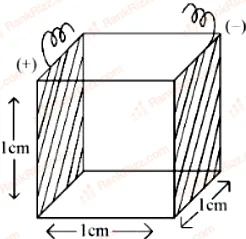
      Figure for JEE Main 2024 Chemistry question on Conductance, conductivity and molar conductivity
      1. A

        decrease sharply

      2. B

        increase sharply

      3. C

        remain same or can not be measured accurately

      4. D

        depend upon type of electrolyte

      JEE MAIN 2024 · 06 APR S2Electrode potentials, electrochemical series and cell EMF

      How can an electrochemical cell be converted into an electrolytic cell?

      1. A

        Applying an external opposite potential lower than E0E^0 cell.

      2. B

        Reversing the flow of ions in salt bridge.

      3. C

        Applying an external opposite potential greater than E0E^0 cell.

      4. D

        Exchanging the electrodes at anode and cathode.

      JEE MAIN 2024 · 05 APR S1Batteries, fuel cells and corrosion

      The reaction at cathode in the cells commonly used in clocks involves.

      1. A

        reduction of Mn from +7 to +2

      2. B

        reduction of Mn from +4 to +3

      3. C

        oxidation of Mn from +3 to +4

      4. D

        oxidation of Mn from +2 to +7

      JEE MAIN 2024 · 05 APR S1Conductance, conductivity and molar conductivity

      Molar ionic conductivities of divalent cation and anion are 57 S cm2 mol−157 \text{ S cm}^2 \text{ mol}^{-1} and 73 S cm2 mol−173 \text{ S cm}^2 \text{ mol}^{-1} respectively. The molar conductivity of solution of an electrolyte with the above cation and anion will be :

      1. A

        187 S cm2 mol−1187 \text{ S cm}^2 \text{ mol}^{-1}

      2. B

        260 S cm2 mol−1260 \text{ S cm}^2 \text{ mol}^{-1}

      3. C

        130 S cm2 mol−1130 \text{ S cm}^2 \text{ mol}^{-1}

      4. D

        65 S cm2 mol−165 \text{ S cm}^2 \text{ mol}^{-1}

      JEE MAIN 2024 · 05 APR S2Electrolysis and Faraday's laws

      The quantity of silver deposited when one coulomb charge is passed through AgNO3AgNO_3 solution :

      1. A

        1 g of silver

      2. B

        1 electrochemical equivalent of silver

      3. C

        1 chemical equivalent of silver

      4. D

        0.1 g atom of silver

      JEE MAIN 2024 · 05 APR S2Electrode potentials, electrochemical series and cell EMF

      For the electrochemical cell, if E(M2+/M)0=0.46E^0_{(M^{2+}/M)} = 0.46 V and E(X/X2−)0=0.34E^0_{(X/X^{2-})} = 0.34 V. Which of the following is correct?

      1. A

        M+X→M2++X2−M + X \rightarrow M^{2+} + X^{2-} is a spontaneous reaction

      2. B

        Ecell=0.80E_{cell} = 0.80 V

      3. C

        Ecell=−0.80E_{cell} = -0.80 V

      4. D

        M2++X2−→M+XM^{2+} + X^{2-} \rightarrow M + X is a spontaneous reaction

      JEE MAIN 2024 · 04 APR S1Electrode potentials, electrochemical series and cell EMF

      What pressure (bar) of H₂ would be required to make emf of hydrogen electrode zero in pure water at 25°C?

      1. A

        10−710^{-7}

      2. B

        0.50.5

      3. C

        11

      4. D

        10−1410^{-14}