RankRizz

Chemical Kinetics — JEE Main Previous Year Questions

Every Chemical Kinetics question JEE Main has set from 2004–2026, grouped by the idea it tests rather than the order of the syllabus. 231 questions across 8 distinct ideas. Free to read, answer key on every one.

DATA UPDATED

Questions

231

Distinct ideas

8

Share of marks

5.5%

Difficulty

MEDIUM

The ideas inside Chemical Kinetics

A chapter is not one subject — it is a handful of procedures the examiner reuses. These are the ones Chemical Kinetics questions actually test.

Every Chemical Kinetics question

161–180 OF 231 · NEWEST FIRST

JEE MAIN 2020 · 08 JAN S2Arrhenius equation and activation energy

Consider the following plots of rate constant versus 1T\frac{1}{T} for four different reactions. Which of the following orders is correct for the activation energies of these reactions?
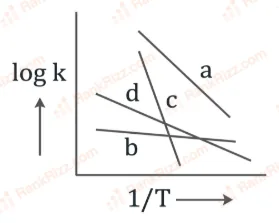
Figure for JEE Main 2020 Chemistry question on Arrhenius equation and activation energy
  1. A

    Eb>Ea>Ed>EcE_b > E_a > E_d > E_c

  2. B

    Ea>Ec>Ed>EbE_a > E_c > E_d > E_b

  3. C

    Ec>Ea>Ed>EbE_c > E_a > E_d > E_b

  4. D

    Eb>Ed>Ec>EaE_b > E_d > E_c > E_a

JEE MAIN 2020 · 07 JAN S1Radioactivity and nuclear reactions

During the nuclear explosion, one of the products is 90^{90}Sr with half life of 6.93 years. If 1μ\mug of 90^{90}Sr was absorbed in the bones of a newly born baby in place of Ca, how much time, in years, is required to reduce it by 90% if it is not lost metabolically

JEE MAIN 2020 · 07 JAN S2Rate law, order and molecularity

For the reaction 2H2(g)+2NO(g)→N2(g)+2H2O(g)2H_2(g) + 2NO(g) \rightarrow N_2(g) + 2H_2O(g) the observed rate expression is, rate =kf[NO]2[H2]= k_f[NO]^2[H_2]. The rate expression for the reverse reaction is:

  1. A

    kb[N2][H2O]2k_b[N_2][H_2O]^2

  2. B

    kb[N2][H2O]2/[NO]k_b[N_2][H_2O]^2/[NO]

  3. C

    kb[N2][H2O]k_b[N_2][H_2O]

  4. D

    kb[N2][H2O]2/[H2]k_b[N_2][H_2O]^2/[H_2]

JEE MAIN 2019 · 12 APR S1Rate law, order and molecularity

In the following reaction; xA →\to yB
log⁡10(−dAdt)=log⁡10(−dBdt)+0.3010\log_{10}\left(-\frac{dA}{dt}\right) = \log_{10}\left(-\frac{dB}{dt}\right) + 0.3010
'A' and 'B' respectively can be:

  1. A

    C2_2H4_4 and C4_4H8_8

  2. B

    C2_2H2_2 and C6_6H6_6

  3. C

    n-Butane and Iso-butane

  4. D

    N2_2O4_4 and NO2_2

JEE MAIN 2019 · 12 APR S2Rate law, order and molecularity

NO2_2 required for a reaction is produced by the decomposition of N2_2O5_5 in CCl4_4 as per the equation, 2N2_2O5_5(g) →\to 4NO2_2(g) + O2_2(g). The initial concentration of N2_2O5_5 is 3.00 mol L−1^{-1} and it is 2.75 mol L−1^{-1} after 30 minutes. The rate of formation of NO2_2 is:

  1. A

    1.667×10−21.667 \times 10^{-2} mol L−1^{-1} min−1^{-1}

  2. B

    8.333×10−38.333 \times 10^{-3} mol L−1^{-1} min−1^{-1}

  3. C

    4.167×10−34.167 \times 10^{-3} mol L−1^{-1} min−1^{-1}

  4. D

    2.083×10−32.083 \times 10^{-3} mol L−1^{-1} min−1^{-1}

JEE MAIN 2019 · 10 APR S1Integrated rate laws and half-life (zero and first order)

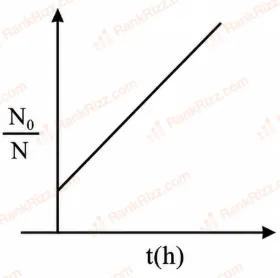
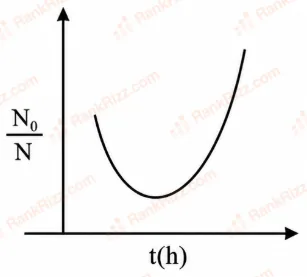
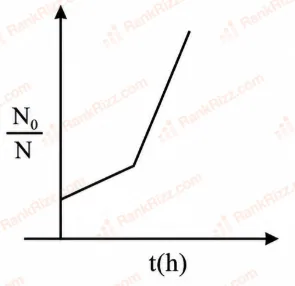
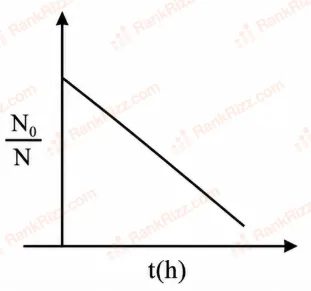
A bacterial infection in an internal wound grows as N'(t) = N0_0exp(t), where the time t is in hours. A dose of antibiotic, taken orally, needs 1 hour to reach the wound. Once it reaches there, the bacterial population goes down as dNdt=−5N2\frac{dN}{dt} = -5N^2. What will be the plot of N0N\frac{N_0}{N} vs t after 1 hour?

  1. A
    Figure for JEE Main 2019 Chemistry question on Integrated rate laws and half-life (zero and first order)
  2. B
    Figure for JEE Main 2019 Chemistry question on Integrated rate laws and half-life (zero and first order)
  3. C
    Figure for JEE Main 2019 Chemistry question on Integrated rate laws and half-life (zero and first order)
  4. D
    Figure for JEE Main 2019 Chemistry question on Integrated rate laws and half-life (zero and first order)
JEE MAIN 2019 · 10 APR S2Arrhenius equation and activation energy

For the reaction of H2_2 with I2_2, the rate constant is 2.5×10−42.5 \times 10^{-4} dm3^3 mol−1^{-1} s−1^{-1} at 327°C and 1.0 dm3^3 mol−1^{-1} s−1^{-1} at 527°C. The activation energy for the reaction, in kJ mol−1^{-1} is:
R = 8.314 JK−1^{-1} mol−1^{-1}

  1. A

    166

  2. B

    59

  3. C

    72

  4. D

    150

JEE MAIN 2019 · 09 APR S1Integrated rate laws and half-life (zero and first order)

The given plots represent the variation of the concentration of a reactant R with time for two different reactions (i) and (ii). The respective orders of the reaction are:
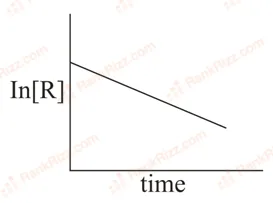
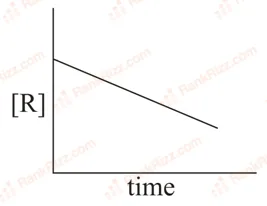
Figure for JEE Main 2019 Chemistry question on Integrated rate laws and half-life (zero and first order) Figure for JEE Main 2019 Chemistry question on Integrated rate laws and half-life (zero and first order)
  1. A

    1, 1

  2. B

    0, 1

  3. C

    1, 0

  4. D

    0, 2

JEE MAIN 2019 · 09 APR S2Arrhenius equation and activation energy

Consider the given plot of enthalpy of the following reaction between A and B.
A + B →\rightarrow C + D. Identify the incorrect statement.
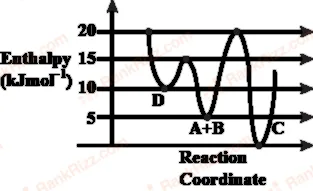
Figure for JEE Main 2019 Chemistry question on Arrhenius equation and activation energy
  1. A

    Formation of A and B from C has highest enthalpy of activation.

  2. B

    D is kinetically stable product.

  3. C

    C is the thermodynamically stable product.

  4. D

    Activation enthalpy to form C is 5 kJ mol−1^{-1} less than that to form D.

JEE MAIN 2019 · 08 APR S1Rate law, order and molecularity

For the reaction 2A + B →\rightarrow C, the values of initial rate at different reactant concentrations are given in the table below.

[A] (mol L−1^{-1})    [B] (mol L−1^{-1})    Initial Rate (mol L−1^{-1}s−1^{-1})
0.05            0.05                0.045
0.10                0.05                0.090
0.20                0.10                0.72

The rate law for the reactions is:

  1. A

    Rate = k[A]2^{2}[B]

  2. B

    Rate = k[A]2^{2}[B]2^{2}

  3. C

    Rate = k[A][B]

  4. D

    Rate = k[A][B]2^{2}

JEE MAIN 2019 · 08 APR S2Parallel, consecutive and reversible reactions

For a reaction scheme A →k1\xrightarrow{k_1} B →k2\xrightarrow{k_2} C, if the net rate of formation of B is set to be zero then the concentration of B is given by:

  1. A

    k1+k2[A]k_1 + k_2[A]

  2. B

    k1k2[A]k_1 k_2[A]

  3. C

    k1k2[A]\frac{k_1}{k_2}[A]

  4. D

    k1−k2[A]k_1 - k_2[A]

JEE MAIN 2019 · 12 JAN S1Integrated rate laws and half-life (zero and first order)

Decomposition of X exhibits a rate constant of 0.05 μ\mug/year. How many years are required for the decomposition of 5 μ\mug of X into 2.5 μ\mug?

  1. A

    20

  2. B

    40

  3. C

    25

  4. D

    50

JEE MAIN 2019 · 12 JAN S2Arrhenius equation and activation energy

For a reaction, consider the plot of ln k versus 1/T given in the figure. If the rate constant of this reaction at 400 K is 10−5s−110^{-5} s^{-1}, then the rate constant at 500 K is:

Figure for JEE Main 2019 Chemistry question on Arrhenius equation and activation energy
  1. A

    10−4s−110^{-4} s^{-1}

  2. B

    10−6s−110^{-6} s^{-1}

  3. C

    2×10⁻⁴s−12 \times 10^{-4} s^{-1}

  4. D

    4×10⁻⁴s−14 \times 10^{-4} s^{-1}

JEE MAIN 2019 · 11 JAN S1Arrhenius equation and activation energy

If a reaction follows the Arrhenius equation, the plot ln⁡k\ln k vs 1(RT)\frac{1}{(RT)} gives straight line with a gradient (−y)(-y) unit. The energy required to activate the reactant is:

  1. A

    y/Ry/R unit

  2. B

    yy unit

  3. C

    yRyR unit

  4. D

    −y-y unit

JEE MAIN 2019 · 11 JAN S2Integrated rate laws and half-life (zero and first order)

The reaction 2X→B2X \to B is a zeroth order reaction. If the initial concentration of X is 0.2M, the half-life is 6 h. When the initial concentration of X is 0.5M, the time required to reach its final concentration of 0.2M will be

  1. A

    9.0 h

  2. B

    12.0 h

  3. C

    18.0 h

  4. D

    7.2 h

JEE MAIN 2019 · 10 JAN S1Arrhenius equation and activation energy

Consider the given plots for a reaction obeying Arrhenius equation (0∘0^{\circ}C < T < 300∘^{\circ}C): (K and EaE_a are rate constant and activation energy, respectively)
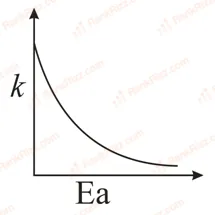
Figure for JEE Main 2019 Chemistry question on Arrhenius equation and activation energy Figure for JEE Main 2019 Chemistry question on Arrhenius equation and activation energy
  1. A

    I is wrong but II is right

  2. B

    Both I and II are wrong

  3. C

    I is right but II is wrong

  4. D

    Both I and II are correct

JEE MAIN 2019 · 10 JAN S2Rate law, order and molecularity

For an elementary chemical reaction, A2⇌k1k−12AA_2 \underset{k_{-1}}{\overset{k_1}{\rightleftharpoons}} 2A, the expression for d[A]dt\frac{d[A]}{dt} is:

  1. A

    2k1[A2]−2k−1[A]22k_1[A_2] - 2k_{-1}[A]^2

  2. B

    2k1[A2]−k−1[A]22k_1[A_2] - k_{-1}[A]^2

  3. C

    k1[A2]+k−1[A]2k_1[A_2] + k_{-1}[A]^2

  4. D

    k1[A2]−k−1[A]2k_1[A_2] - k_{-1}[A]^2

JEE MAIN 2019 · 09 JAN S1Methods to determine order of reaction

The following results were obtained during kinetic studies of the reaction.
2A+B→2A + B \rightarrow product

Experiment I: A = 0.10 mol L−1^{-1}, B = 0.20 mol L−1^{-1}, Rate = 6.93×10−36.93 \times 10^{-3} mol L−1^{-1} min−1^{-1}
Experiment II: A = 0.10 mol L−1^{-1}, B = 0.25 mol L−1^{-1}, Rate = 6.93×10−36.93 \times 10^{-3} mol L−1^{-1} min−1^{-1}
Experiment III: A = 0.20 mol L−1^{-1}, B = 0.30 mol L−1^{-1}, Rate = 1.386×10−21.386 \times 10^{-2} mol L−1^{-1} min−1^{-1}

The time (in minutes) required to consume half of A is:

  1. A

    100

  2. B

    10

  3. C

    5

  4. D

    1

JEE MAIN 2019 · 09 JAN S2Methods to determine order of reaction

For the reaction, 2A+B→2A + B \rightarrow products, when the concentration of AA and BB both were doubled, the rate of the reaction increased from 0.3 mol L−1^{-1} s−1^{-1} to 2.4 mol L−1^{-1} s−1^{-1}. When the concentration of AA alone is doubled, the rate increased from 0.3 mol L−1^{-1} s−1^{-1} to 0.6 mol L−1^{-1} s−1^{-1}. Which one of the following statements is correct?

  1. A

    Order of the reaction with respect to B is 2

  2. B

    Total order of the reaction is 4

  3. C

    Order of the reaction with respect to A is 2

  4. D

    Order of the reaction with respect to B is 1

JEE MAIN 2018 · 16 APR ONLINEIntegrated rate laws and half-life (zero and first order)

If 50% of a reaction occurs in 100 second and 75% of the reaction occurs in 200 second, the order of this reaction is:

  1. A

    2

  2. B

    3

  3. C

    Zero

  4. D

    1