Chemical Kinetics JEE Main PYQs with answer key
CHEMISTRY · 231 PAST QUESTIONS · 8 TOPICS · 2004–2026
HOW TO USE THIS SHEET
Every JEE Main Chemical Kinetics question we hold, grouped by topic, most-asked topic first and newest first inside each. The answer key is at the end (227 of 231 questions have a checked key); the worked solution is on each question’s page, printed beside it.
Integrated rate laws and half-life (zero and first order) 85
Sucrose hydrolyses in acidic medium into glucose and fructose by first order rate law with hour. The percentage of sucrose remaining after 6 hours is _______. (Nearest integer)
(Given: log 2 = 0.3010 and log 3 = 0.4771)Answer: ____________
rr2.rankrizz.com/jee-main/chemistry/chemical-kinetics/q/6-apr-2026-s1-q74
First order gas phase reaction
= initial pressure of gas A, = total pressure of the reaction mixture at time
Expression of rate constant (k) is- (A)
- (B)
- (C)
- (D)
rr2.rankrizz.com/jee-main/chemistry/chemical-kinetics/q/5-apr-2026-s1-q57
- (A)
If the half life of a first order reaction is 6.93 minutes then the time required for completion of 99% of the reaction will be _______ minutes. (Given: log 2 = 0.3010)
Answer: ____________
rr2.rankrizz.com/jee-main/chemistry/chemical-kinetics/q/5-apr-2026-s1-q75
Consider the first order reaction . The fraction of molecules decomposed in the given first order reaction can be expressed as :
- (A)
- (B)
- (C)
- (D)
rr2.rankrizz.com/jee-main/chemistry/chemical-kinetics/q/4-apr-2026-s1-q57
- (A)
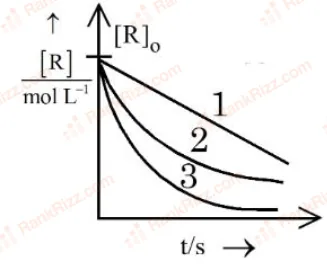
Consider the given graph showing variation of reactant concentration with time. Three different reactions were started with identical initial concentration of reactants. Which of the following statement is correct?
- (A)
The order of all the three reactions is same.
- (B)
The rate constant of reaction 3 is larger than the rate constant of reaction 2 if the order of reaction is same for both.
- (C)
The SI unit of rate constant of reaction 1 is s.
- (D)
Thermal decomposition of HI on gold surface is an example of reaction 2.
rr2.rankrizz.com/jee-main/chemistry/chemical-kinetics/q/4-apr-2026-s2-q63
- (A)
For a first order reaction A B
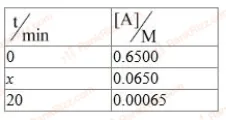
= _________ min. (Nearest integer)
Answer: ____________
rr2.rankrizz.com/jee-main/chemistry/chemical-kinetics/q/4-apr-2026-s2-q74
is the time required for the 100% completion of the reaction while is the time required for 50% of the reaction to be completed. Which of the following option correctly represents the relation between and for zero and first order reactions respectively?
- (A)
and
- (B)
and
- (C)
and
- (D)
and
rr2.rankrizz.com/jee-main/chemistry/chemical-kinetics/q/2-apr-2026-s1-q58
- (A)
Consider the following gas phase reaction being carried out in a closed vessel at 25°C.
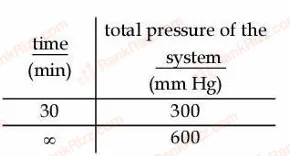
The pressure of at 30 minutes time interval would be _____ mm Hg. (nearest integer)Answer: ____________
rr2.rankrizz.com/jee-main/chemistry/chemical-kinetics/q/2-apr-2026-s2-q72
An organic compound undergoes first order decomposition. The time taken for decomposition to and of its initial concentration are and respectively. What is the value of ?
- (A)
0.9
- (B)
3
- (C)
9
- (D)
30
rr2.rankrizz.com/jee-main/chemistry/chemical-kinetics/q/28-jan-2026-s1-q59
- (A)
For the thermal decomposition of reactant AB(g), the following plot is constructed.
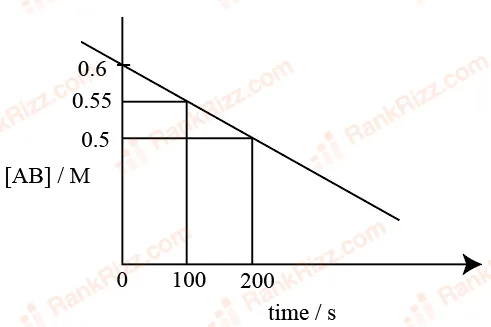
The half life of the reaction is 'x' min.
x= ____ min. (Nearest integer)Answer: ____________
rr2.rankrizz.com/jee-main/chemistry/chemical-kinetics/q/23-jan-2026-s1-q75
Decompasition of A is a first order reaction at T(K) and is given by .
In a closed 1 L vessel, 1 bar A(g) is allowed to decompose at T(K). After 100 minutes, the total pressure was 1.5bar. What is the rate constant (in of the reaction ? (log 2 = 0.3)- (A)
- (B)
- (C)
- (D)
rr2.rankrizz.com/jee-main/chemistry/chemical-kinetics/q/21-jan-2026-s2-q65
- (A)
Which of the following graphs is correct for a second-order reaction?
- (A)
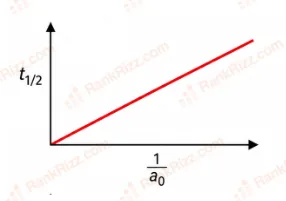
- (B)
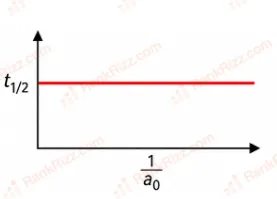
- (C)
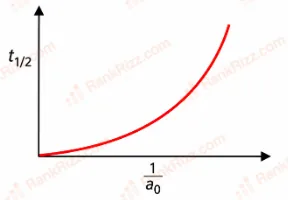
- (D)
None of these
rr2.rankrizz.com/jee-main/chemistry/chemical-kinetics/q/2026-chemistry-516674
- (A)
In a first order decomposition reaction, the time taken for the decomposition of reactant to one fourth and one eighth of its initial concentration are and (s), respectively. The ratio will :
- (A)
- (B)
- (C)
- (D)
rr2.rankrizz.com/jee-main/chemistry/chemical-kinetics/q/2025-apr-8-s2-q51
- (A)
Reaction is a first order reaction. It was started with pure A.
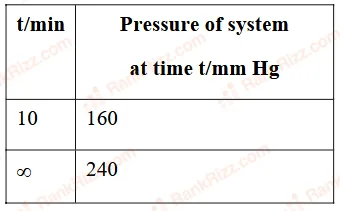
Which of the following option is incorrect?
- (A)
Initial pressure of A is 80 mm Hg
- (B)
The reaction never goes to completion
- (C)
Rate constant of the reaction is 1.693 min
- (D)
Partial pressure of A after 10 minute is 40 mm Hg
rr2.rankrizz.com/jee-main/chemistry/chemical-kinetics/q/2025-apr-7-s1-q53
- (A)
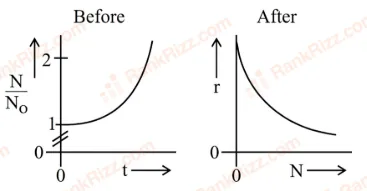
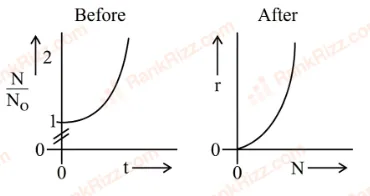
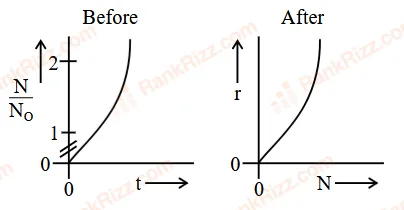
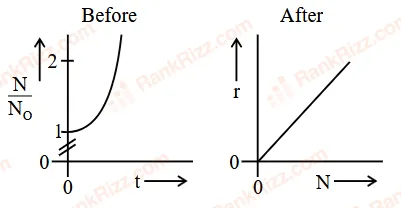
A person's wound was exposed to some bacteria and then bacteria growth started to happen at the same place. The wound was later treated with some antibacterial medicine and the rate of bacterial decay (r) was found to be proportional with the square of the existing number of bacteria at any instance. Which of the following set of graphs correctly represents the 'before' and 'after' situation of the application of the medicine?
[Given : N = No. of bacteria, t = time, bacteria growth follows order kinetics.]- (A)
- (B)
- (C)
- (D)
rr2.rankrizz.com/jee-main/chemistry/chemical-kinetics/q/2025-apr-7-s1-q67
- (A)
is a first order reaction.
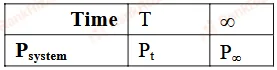
The reaction was started with reactant A only. Which of the following expression is correct for rate constant k?
- (A)
- (B)
- (C)
- (D)
rr2.rankrizz.com/jee-main/chemistry/chemical-kinetics/q/2025-apr-7-s2-q54
- (A)
Half life of zero order reaction product is 1 hour, when initial concentration of reaction is 2.0 mol L. The time required to decrease concentration of A from 0.50 to 0.25 mol L is:
- (A)
0.5 hour
- (B)
4 hour
- (C)
15 min
- (D)
60 min
rr2.rankrizz.com/jee-main/chemistry/chemical-kinetics/q/2025-apr-4-s2-q70
- (A)
In a reaction , initial concentrations of A and B are related as . The half lives of A and B are 10 min and 40 min respectively. If they start to disappear at the same time, both following first order kinetics, after how much time will the concentration of both the reactants be same?
- (A)
min
- (B)
min
- (C)
min
- (D)
min
rr2.rankrizz.com/jee-main/chemistry/chemical-kinetics/q/2025-apr-03-s1-q55
- (A)
For the reaction products.
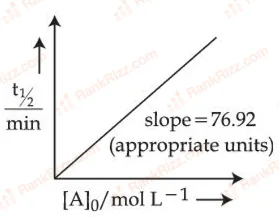
The concentration of A at 10 minutes is _______ mol L. (nearest integer).
The reaction was started with 2.5 mol L of A.
Answer: ____________
rr2.rankrizz.com/jee-main/chemistry/chemical-kinetics/q/2025-apr-02-s1-q75
Drug X becomes ineffective after 50% decomposition. The original concentration of drug in a bottle was 16mg/mL which becomes 4mg/mL in 12 months. The expiry time of the drug in months is _________
Assume that the decomposition of the drug follows first order kinetics.- (A)
2
- (B)
6
- (C)
12
- (D)
3
rr2.rankrizz.com/jee-main/chemistry/chemical-kinetics/q/29-jan-2025-s2-q52
- (A)
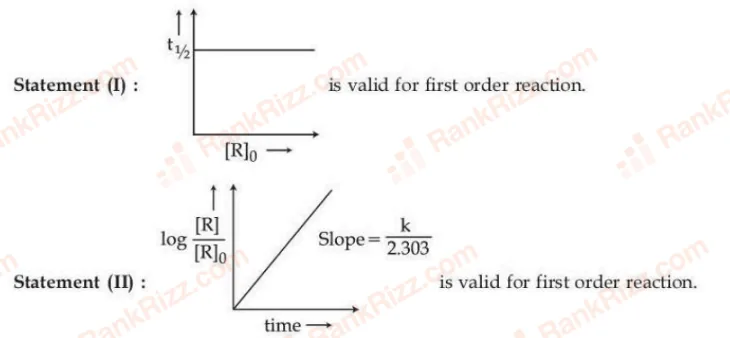
Given below are two statements :
In the light of the above statements, choose the correct answer from the options given below :- (A)
Both Statement I and Statement II are true
- (B)
Statement I is false but Statement II is true
- (C)
Statement I is true but Statement II is false
- (D)
Both Statement I and Statement II are false
rr2.rankrizz.com/jee-main/chemistry/chemical-kinetics/q/24-jan-2025-s2-q63
- (A)
For the thermal decomposition of at constant volume, the following table can be formed, for the reaction mentioned below.
atm [nearest integer] Given : Rate constant for the reaction is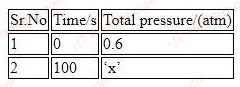
Answer: ____________
rr2.rankrizz.com/jee-main/chemistry/chemical-kinetics/q/23-jan-2025-s1-q72
Which of the following graphs most appropriately represents a zero order reaction ?
- (A)
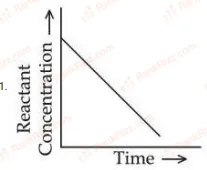
- (B)
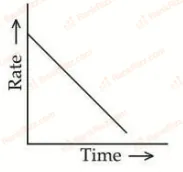
- (C)
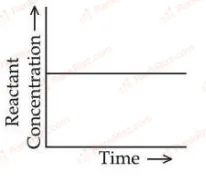
- (D)
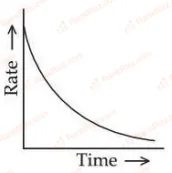
rr2.rankrizz.com/jee-main/chemistry/chemical-kinetics/q/23-jan-2025-s2-q54
- (A)
Consider the following first order gas phase reaction at constant temperature . If the total pressure of the gases is found to be 200 torr after 23 sec. and 300 torr upon the complete decomposition of A after a very long time, then the rate constant of the given reaction is ______ (nearest integer) [Given : ]
Answer: ____________
rr2.rankrizz.com/jee-main/chemistry/chemical-kinetics/q/9-apr-2024-s2-q57
Time required for 99.9% completion of a first order reaction is _______ times the time required for completion of 90% reaction. (nearest integer)
Answer: ____________
rr2.rankrizz.com/jee-main/chemistry/chemical-kinetics/q/6-apr-2024-s1-q56
Consider the two different first order reactions given below (Reaction 1) (Reaction 2). The ratio of the half life of Reaction 1 : Reaction 2 is . If and represent the time taken to complete and of Reaction 1 and Reaction 2, respectively, then the value of the ratio is ___________ (nearest integer). [Given : and ]
Answer: ____________
rr2.rankrizz.com/jee-main/chemistry/chemical-kinetics/q/6-apr-2024-s2-q55
Consider the following reaction, the rate expression of which is given below:
, rate.
The reaction is initiated by taking concentration of M of and each. If the rate constant is s, then the time taken for to become M is ______ sec. (nearest integer)Answer: ____________
rr2.rankrizz.com/jee-main/chemistry/chemical-kinetics/q/04-apr-2024-s2-q56
The following data were obtained during the first order thermal decomposition of a gas A at constant volume:
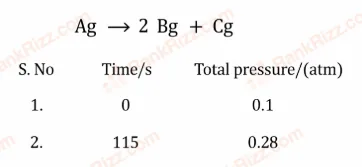
The rate constant of the reaction is ______ (nearest integer)Answer: ____________
rr2.rankrizz.com/jee-main/chemistry/chemical-kinetics/q/01-feb-2024-s2-q58
Integrated rate law equation for a first order gas phase reaction is given by (where is initial pressure and is total pressure at time )
- (A)
- (B)
- (C)
- (D)
rr2.rankrizz.com/jee-main/chemistry/chemical-kinetics/q/31-jan-2024-s1-q43
- (A)
for a reaction, 50% of A is decomposed in 120 minutes. The time taken for 90% decomposition of A is ______ minutes.
Answer: ____________
rr2.rankrizz.com/jee-main/chemistry/chemical-kinetics/q/31-jan-2024-s2-q56
The rate of first order reaction is at minutes and at minutes after initiation. Half life of the reaction is ______ minutes. (Given , )
Round off your answer to the nearest integer.Answer: ____________
rr2.rankrizz.com/jee-main/chemistry/chemical-kinetics/q/30-jan-2024-s1-q59
Time required for completion of 99.9% of first order reaction is _____ times of half life () of the reaction
Answer: ____________
rr2.rankrizz.com/jee-main/chemistry/chemical-kinetics/q/27-jan-2024-s2-q59
t is the time required for the reaction to undergo completion and t is the time required for the reaction to undergo completion. The relation between t and t for a first order reaction is
t = x t
The value of x is _____. (Nearest integer)Answer: ____________
rr2.rankrizz.com/jee-main/chemistry/chemical-kinetics/q/13-apr-2023-s1-q59
A(g) 2B(g) + C(g) is a first order reaction. The initial pressure of the system was found to be mm Hg which increased to mm Hg after min. The total pressure of the system after min will be _____ mm Hg. (Nearest integer)
Answer: ____________
rr2.rankrizz.com/jee-main/chemistry/chemical-kinetics/q/13-apr-2023-s2-q60
A molecule undergoes two independent first order reactions whose respective half lives are 12 min and 3 min. If both the reactions are occurring then the time taken for the 50% consumption of the reactant is _______ min. (Nearest integer)
Answer: ____________
rr2.rankrizz.com/jee-main/chemistry/chemical-kinetics/q/10-apr-2023-s1-q59
The number of incorrect statement/s from the following is _______
A. The successive half lives of zero order reactions decreases with time.
B. A substance appearing as reactant in the chemical equation may not affect the rate of reaction
C. Order and molecularity of a chemical reaction can be a fractional number
D. The rate constant units of zero and second order reaction are mol L s and mol L s respectivelyAnswer: ____________
rr2.rankrizz.com/jee-main/chemistry/chemical-kinetics/q/10-apr-2023-s2-q59
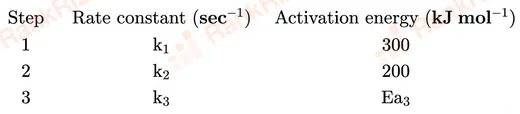
Consider the following reaction that goes from A to B in three steps as shown below:
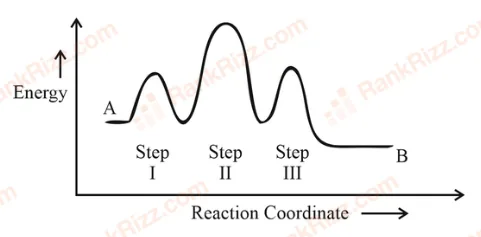
Choose the correct option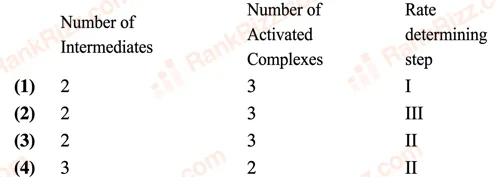
- (A)
(1)
- (B)
(2)
- (C)
(3)
- (D)
(4)
rr2.rankrizz.com/jee-main/chemistry/chemical-kinetics/q/6-apr-2023-s2-q42
- (A)
A and B are two substances undergoing radioactive decay in a container. The half life of A is 15 min and that of B is 5 min. If the initial concentration of B is 4 times that of A and they both start decaying at the same time, how much time will it take for the concentration of both of them to be same? _____ min.
Answer: ____________
rr2.rankrizz.com/jee-main/chemistry/chemical-kinetics/q/01-feb-2023-s1-q58
The above reaction is of zero order. Half life of this reaction is min. The time taken for the concentration of A to reduce to one-fourth of its initial value is ______ min. (Nearest integer)Answer: ____________
rr2.rankrizz.com/jee-main/chemistry/chemical-kinetics/q/01-feb-2023-s2-q57
The rate constant for a first order reaction is 20 min. The time required for the initial concentration of the reactant to reduce to its level is ______ min. (Nearest integer)
Answer: ____________
rr2.rankrizz.com/jee-main/chemistry/chemical-kinetics/q/31-jan-2023-s2-q58
If compound A reacts with B following first order kinetics with rate constant s. The time taken by A (in seconds) to reduce from g to g will be ______. (Nearest Integer)
log5 = 0.698, log7 = 0.845, log2 = 0.301Answer: ____________
rr2.rankrizz.com/jee-main/chemistry/chemical-kinetics/q/30-jan-2023-s1-q58
An organic compound undergoes first order decomposition. If the time taken for the decomposition is s, then the time required for decomposition will be ______ s. (Nearest integer).
Given: ;Answer: ____________
rr2.rankrizz.com/jee-main/chemistry/chemical-kinetics/q/30-jan-2023-s2-q57
For the first order reaction A B the half life is 30 min. The time taken for 75% completion of the reaction is _____ min. (Nearest integer)
Given: log 2 = 0.3010
log 3 = 0.4771
log 5 = 0.6989Answer: ____________
rr2.rankrizz.com/jee-main/chemistry/chemical-kinetics/q/25-jan-2023-s1-q57
A first order reaction has the rate constant, k = 4.6 s. The number of correct statement/s from the following is/are Given: log 3 = 0.48.
A. Reaction completes in 1000 s.
B. The reaction has a half-life of 500 s.
C. The time required for 10% completion is 25 times the time required for 90% completion.
D. The degree of dissociation is equal to .
E. The rate and the rate constant have the same unit.Answer: ____________
rr2.rankrizz.com/jee-main/chemistry/chemical-kinetics/q/25-jan-2023-s2-q56
For the given first order reaction the half life of the reaction is 0.3010 min. The ratio of the initial concentration of reactant to the concentration of reactant at time 2.0 min will be equal to _____. (Nearest integer)
Answer: ____________
rr2.rankrizz.com/jee-main/chemistry/chemical-kinetics/q/28-jul-2022-s1-q57
Reactant Product
If formation of compound [B] follows the first order of kinetics and after 70 minutes the concentration of [A] was found to be half of its initial concentration. Then the rate constant of the reaction is . The value of is ____Answer: ____________
rr2.rankrizz.com/jee-main/chemistry/chemical-kinetics/q/27-jul-2022-s2-q57
For a reaction , the half lives are and when the concentration of reactant A is and respectively. The order of the reaction is ______.
Answer: ____________
rr2.rankrizz.com/jee-main/chemistry/chemical-kinetics/q/26-jul-2022-s1-q59
At , the half life for the decomposition of is and is independent of the initial concentration of . The time required for of the to decompose is (Given: ; )
- (A)
- (B)
- (C)
- (D)
rr2.rankrizz.com/jee-main/chemistry/chemical-kinetics/q/26-jul-2022-s2-q41
- (A)
For the decomposition of azomethane , a first order reaction, the variation in partial pressure with time at is given as shown.
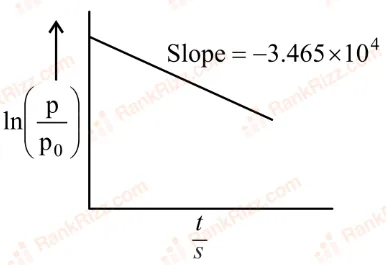
The half life of the reaction is ______ s.
Answer: ____________
rr2.rankrizz.com/jee-main/chemistry/chemical-kinetics/q/25-jul-2022-s2-q58
For a first order reaction A B, the rate constant, s. The time required for completion of reaction is times the half life of reaction. The value of is ______ Nearest integer) (Given : )
Answer: ____________
rr2.rankrizz.com/jee-main/chemistry/chemical-kinetics/q/28-jun-2022-s1-q59
A radioactive element has a half life of 200 days. The percentage of original activity remaining after 83 days is ______ (Nearest integer)
(Given: antilog 0.125 = 1.333, antilog 0.693 = 4.93)Answer: ____________
rr2.rankrizz.com/jee-main/chemistry/chemical-kinetics/q/28-jun-2022-s2-q56
A flask is filled with equal moles of A and B. The half lives of A and B are s and s respectively and are independent of the initial concentration. The time required for the concentration of A to be four times that of B is ______ s.
(Given : )Answer: ____________
rr2.rankrizz.com/jee-main/chemistry/chemical-kinetics/q/26-jun-2022-s1-q56
For a first order reaction, the time required for completion of reaction is '' times the half life of the reaction. The value of '' is
(Given: and )- (A)
1.12
- (B)
2.43
- (C)
3.32
- (D)
33.31
rr2.rankrizz.com/jee-main/chemistry/chemical-kinetics/q/24-jun-2022-s2-q42
- (A)
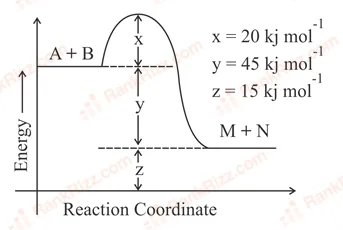
According to the following figure, the magnitude of the enthalpy change of the reaction A + B M + N in kJ mol is equal to _________. (Integer answer)
Answer: ____________
rr2.rankrizz.com/jee-main/chemistry/chemical-kinetics/q/31-aug-2021-s1-q52
For a first order reaction, the ratio of the time for 75% completion of a reaction to the time for 50% completion is _________. (Integer answer)
Answer: ____________
rr2.rankrizz.com/jee-main/chemistry/chemical-kinetics/q/31-aug-2021-s1-q57
For the first order reaction A 2B, 1 mole of reactant A gives 0.2 moles of after 100 minutes. The half life of the reaction is _________ min. (Round off to nearest integer).
[
Properties of logarithms:
]
(Round off to the nearest integer)Answer: ____________
rr2.rankrizz.com/jee-main/chemistry/chemical-kinetics/q/27-jul-2021-s2-q59
For the following graphs,
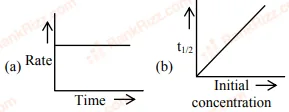
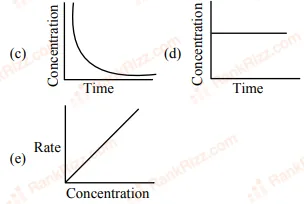
Choose from the options given below, the correct one regarding order of reaction is:- (A)
(b) zero order (c) and (e) First order
- (B)
(a) and (b) Zero order (e) First order
- (C)
(b) and (d) Zero order (e) First order
- (D)
(a) and (b) Zero order (c) and (e) First order
rr2.rankrizz.com/jee-main/chemistry/chemical-kinetics/q/25-jul-2021-s1-q38
- (A)
NO 2NO + O
In the above first order reaction the initial concentration of NO is mol L at 318 K. The concentration of NO after 1 hour was mol L. The rate constant of the reaction at 318 K is ___ min (Nearest integer):
[Given : log 3 = 0.477, log 5 = 0.699]Answer: ____________
rr2.rankrizz.com/jee-main/chemistry/chemical-kinetics/q/22-jul-2021-s1-q59
The inactivation rate of a viral preparation is proportional to the amount of virus. In the first minute after preparation, 10% of the virus is inactivated. The rate constant for viral inactivation is ___ min.
(Nearest integer) [Use : ln 10 = 2.303; property of logarithm: ]Answer: ____________
rr2.rankrizz.com/jee-main/chemistry/chemical-kinetics/q/20-jul-2021-s1-q57
PCl(g) PCl(g) + Cl(g)
In the above first order reaction the concentration of PCl reduces from initial concentration 50 mol L to 10 mol L in 120 minutes at 300 K. The rate constant for the reaction at 300 K is x min. The value of x is ___.
[Given log 5 = 0.6989]Answer: ____________
rr2.rankrizz.com/jee-main/chemistry/chemical-kinetics/q/20-jul-2021-s2-q58
A reaction has a half life of 1 min. The time required for 99.9% completion of the reaction is ___ min.
(Round off to the Nearest integer)
[Use : ln 2 = 0.69, ln 10 = 2.3]Answer: ____________
rr2.rankrizz.com/jee-main/chemistry/chemical-kinetics/q/18-mar-2021-s2-q58
For a certain first order reaction 32% of the reactant is left after 570 s. The rate constant of this reaction is ________ s. (Round off to the Nearest Integer).
[Given: , ]Answer: ____________
rr2.rankrizz.com/jee-main/chemistry/chemical-kinetics/q/17-mar-2021-s1-q59
A and B decompose via first order kinetics with half-lives 54.0 min and 18.0 min respectively. Starting from an equimolar non-reactive mixture of A and B, the time taken for the concentration of A to become 16 times that of B is ________ min. (Round off to the Nearest Integer).
Answer: ____________
rr2.rankrizz.com/jee-main/chemistry/chemical-kinetics/q/16-mar-2021-s2-q59
Gaseous cyclobutene isomerizes to butadiene in a first order process which has a 'K' value of s at 153°C. The time in minutes it takes for the isomerization to proceed 40% to completion at this temperature is ______ (Rounded off to the nearest integer)
Answer: ____________
rr2.rankrizz.com/jee-main/chemistry/chemical-kinetics/q/24-feb-2021-s1-q60
Sucrose hydrolyses in acid solution into glucose and fructose following first order rate law with a half-life of 3.33 h at 25°C. After 9 h, the fraction of sucrose remaining is f. The value of is ______ .
(Rounded off to the nearest integer)
[Assume: ln10 = 2.303, ln 2 = 0.693]Answer: ____________
rr2.rankrizz.com/jee-main/chemistry/chemical-kinetics/q/24-feb-2021-s2-q58
A flask contains a mixture of compounds A and B. Both compounds decompose by first-order kinetics. The half-lives for A and B are and , respectively. If the concentrations of A and B are equal initially, the time required for the concentration of A to be four times that of B (in s) is: (Use )
- (A)
180
- (B)
900
- (C)
300
- (D)
120
rr2.rankrizz.com/jee-main/chemistry/chemical-kinetics/q/5-sep-2020-s1-q35
- (A)
If 75% of a first order reaction was completed in 90 minutes, 60% of the same reaction would be completed in approximately (in minutes) __________ (Take: log 2 = 0.30; log 2.5 = 0.40)
Answer: ____________
rr2.rankrizz.com/jee-main/chemistry/chemical-kinetics/q/4-sep-2020-s1-q49
It is true that:
- (A)
A second order reaction is always a multistep reaction
- (B)
A zero order reaction is a multi-step reaction
- (C)
A first order reaction is always a single step reaction
- (D)
A zero order reaction is a single step reaction
rr2.rankrizz.com/jee-main/chemistry/chemical-kinetics/q/3-sep-2020-s1-q37
- (A)
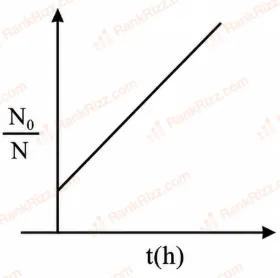
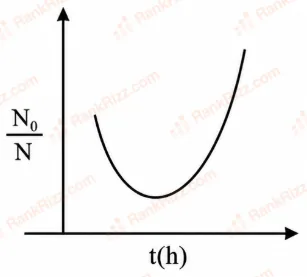
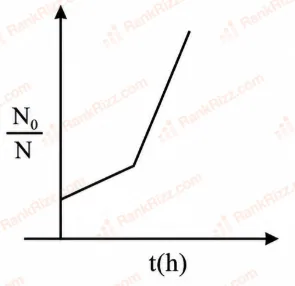
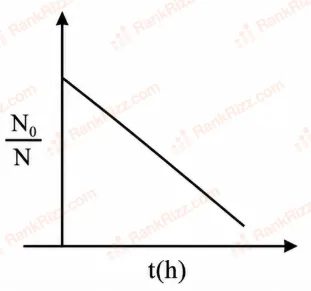
A bacterial infection in an internal wound grows as N'(t) = Nexp(t), where the time t is in hours. A dose of antibiotic, taken orally, needs 1 hour to reach the wound. Once it reaches there, the bacterial population goes down as . What will be the plot of vs t after 1 hour?
- (A)
- (B)
- (C)
- (D)
rr2.rankrizz.com/jee-main/chemistry/chemical-kinetics/q/10-apr-2019-s1-q46
- (A)
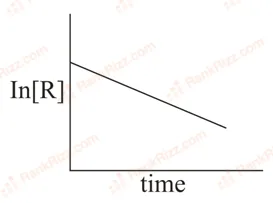
The given plots represent the variation of the concentration of a reactant R with time for two different reactions (i) and (ii). The respective orders of the reaction are:
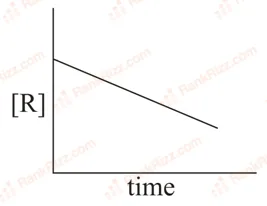
- (A)
1, 1
- (B)
0, 1
- (C)
1, 0
- (D)
0, 2
rr2.rankrizz.com/jee-main/chemistry/chemical-kinetics/q/9-apr-2019-s1-q47
- (A)
Decomposition of X exhibits a rate constant of 0.05 g/year. How many years are required for the decomposition of 5 g of X into 2.5 g?
- (A)
20
- (B)
40
- (C)
25
- (D)
50
rr2.rankrizz.com/jee-main/chemistry/chemical-kinetics/q/12-jan-2019-s1-q48
- (A)
The reaction is a zeroth order reaction. If the initial concentration of X is 0.2M, the half-life is 6 h. When the initial concentration of X is 0.5M, the time required to reach its final concentration of 0.2M will be
- (A)
9.0 h
- (B)
12.0 h
- (C)
18.0 h
- (D)
7.2 h
rr2.rankrizz.com/jee-main/chemistry/chemical-kinetics/q/11-jan-2019-s2-q47
- (A)
If 50% of a reaction occurs in 100 second and 75% of the reaction occurs in 200 second, the order of this reaction is:
- (A)
2
- (B)
3
- (C)
Zero
- (D)
1
rr2.rankrizz.com/jee-main/chemistry/chemical-kinetics/q/16-apr-2018-online-q45
- (A)
NO decomposes to NO and O and follows first order kinetics. After 50 minutes, the pressure inside the vessel increases from 50 mm Hg to 87.5 mm Hg. The pressure of the gaseous mixture after 100 minutes at constant temperature will be:
- (A)
136.25 mm Hg
- (B)
106.25 mm Hg
- (C)
175.0 mm Hg
- (D)
116.25 mm Hg
rr2.rankrizz.com/jee-main/chemistry/chemical-kinetics/q/15-apr-2018-s1-q52
- (A)
For a first order reaction, A P, t (half-life) is 10 days. The time required for th conversion of A (in days) is: (ln 2 = 0.693, ln 3 = 1.1)
- (A)
3.2
- (B)
2.5
- (C)
4.1
- (D)
5
rr2.rankrizz.com/jee-main/chemistry/chemical-kinetics/q/15-apr-2018-s2-q49
- (A)
Decomposition of follows a first order reaction. In fifty minutes the concentration of decreases from 0.5 to 0.125 M in one such decomposition. When the concentration of reaches 0.05 M, the rate of formation of will be:
- (A)
L min at STP
- (B)
mol min
- (C)
mol min
- (D)
mol min
rr2.rankrizz.com/jee-main/chemistry/chemical-kinetics/q/3-apr-2016-offline-q46
- (A)
The reaction follows first order kinetics. The pressure of a vessel containing only was found to increase from 50 mm Hg to 87.5 mm Hg in 30 min. The pressure exerted by the gases after 60 min. will be (Assume temperature remains constant):
- (A)
106.25 mm Hg
- (B)
125 mm Hg
- (C)
116.25 mm Hg
- (D)
150 mm Hg
rr2.rankrizz.com/jee-main/chemistry/chemical-kinetics/q/10-apr-2015-online-q47
- (A)
Higher order (>3) reactions are rare due to:
- (A)
Loss of active species on collision.
- (B)
Low probability of simultaneous collision of all the reacting species.
- (C)
Increase in entropy and activation energy as more molecules are involved.
- (D)
Shifting of equilibrium towards reactants due to elastic collisions.
rr2.rankrizz.com/jee-main/chemistry/chemical-kinetics/q/4-apr-2015-offline-q45
- (A)
The half-life period of a first-order reaction is 15 minutes. The amount of substance left after one hour will be:
- (A)
of the original amount
- (B)
of the original amount
- (C)
of the original amount
- (D)
of the original amount
rr2.rankrizz.com/jee-main/chemistry/chemical-kinetics/q/9-apr-2014-online-q45
- (A)
The rate constant of a zero order reaction is mol L s. If the concentration of the reactant after 25 seconds is 0.5M. What is the initial concentration?
- (A)
0.5M
- (B)
1.25M
- (C)
12.5M
- (D)
1.0M
rr2.rankrizz.com/jee-main/chemistry/chemical-kinetics/q/23-apr-2013-online-q46
- (A)
For a first order reaction, products, the concentration of changes from M to M in minutes. The rate of reaction when the concentration of is M is :
- (A)
M/min
- (B)
M/min
- (C)
M/min
- (D)
M/min
rr2.rankrizz.com/jee-main/chemistry/chemical-kinetics/q/2012-chemistry-499066
- (A)
The time for half life period of a certain reaction products is hour. When the initial concentration of the reactant '' is mol L, how much time does it take for its concentration to come from to mol L if it is a zero order reaction?
- (A)
h
- (B)
h
- (C)
h
- (D)
h
rr2.rankrizz.com/jee-main/chemistry/chemical-kinetics/q/2010-chemistry-499698
- (A)
The half life period of a first order chemical reaction is minutes. The time required for the completion of of the chemical reaction will be () :
- (A)
minutes
- (B)
minutes
- (C)
minutes
- (D)
minutes
rr2.rankrizz.com/jee-main/chemistry/chemical-kinetics/q/2009-chemistry-499607
- (A)
can be taken as the time taken for the concentration of a reactant to drop to of its initial value. If the rate constant for a first order reaction is , the can be written as
- (A)
- (B)
- (C)
- (D)
rr2.rankrizz.com/jee-main/chemistry/chemical-kinetics/q/2005-chemistry-500344
- (A)
In first order reaction, the concentration of the reactant decreases from M to M in minutes. The time taken for the concentration to change from M to M is
- (A)
minutes
- (B)
minutes
- (C)
minutes
- (D)
minutes
rr2.rankrizz.com/jee-main/chemistry/chemical-kinetics/q/2004-chemistry-500389
- (A)
Arrhenius equation and activation energy 62
Given below are two statements :
J K mol and 1 cal = 4.2 J
Statement I : When kcal/mol, at the room temperature rate constant is doubled by a 10 C increase in temperature (298 K to 308 K)
Statement II : For a first order reactions ,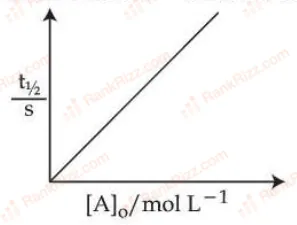
Here is the initial concentration of A and is half life of reaction.
In the light of the above statements, choose the correct answer from the options given below :- (A)
Both Statement I and Statement II are true
- (B)
Both Statement I and Statement II are false
- (C)
Statement I is true but Statement II is false
- (D)
Statement I is false but Statement II is true
rr2.rankrizz.com/jee-main/chemistry/chemical-kinetics/q/8-apr-2026-s2-q57
- (A)
Decomposition of a hydrocarbon follows the equation . The activation energy of reaction is __________ kJ mol. (Nearest Integer) Given : R = 8.3 J K mol
Answer: ____________
rr2.rankrizz.com/jee-main/chemistry/chemical-kinetics/q/6-apr-2026-s2-q75
For reaction A P, rate constant k = 1.5 × 10 s at 27°C. If activation energy for the above reaction is 60 kJ mol, then the temperature (in °C) at which rate constant, k = 4.5 × 10 s is __________. (Nearest integer) Given : log 2 = 0.30, log 3 = 0.48, R = 8.3 J K mol, ln 10 = 2.3
Answer: ____________
rr2.rankrizz.com/jee-main/chemistry/chemical-kinetics/q/2-apr-2026-s1-q74
(first reaction)
(second reaction)
Consider the above two first-order reactions. The rate constant for first reaction at 500 K is double of the same at 300 K. At 500 K, 50% of the reaction becomes complete in 2 hour. The activation energy of the second reaction is half of that of first reaction. lf the rate constant at 500 K of the second reaction becomes double of the rate constant of first reaction at the same temperature; then rate constant for the second reaction at 300 K is______ (nearest integer).Answer: ____________
rr2.rankrizz.com/jee-main/chemistry/chemical-kinetics/q/28-jan-2026-s2-q75
At 27 °C in presence of a catalyst, activation energy of a reaction is lowered by . The logarithm of ratio of is......
(Consider that the frequency factor for both the reactions is same)- (A)
3.482
- (B)
17.41
- (C)
0.1741
- (D)
1.741
rr2.rankrizz.com/jee-main/chemistry/chemical-kinetics/q/24-jan-2026-s1-q54
- (A)
The temperature at which the rate constants of the given below two gaseous reactions become equal is ______ K. (Nearest integer)
Given: ln 10 = 2.303
Answer: ____________
rr2.rankrizz.com/jee-main/chemistry/chemical-kinetics/q/22-jan-2026-s1-q72
Correct statements regarding Arrhenius equation among the following are :
A. Factor corresponds to fraction of molecules having kinetic energy less than Ea.
B. At a given temperature, lower the Ea, faster is the reaction.
C. Increase in temperature by about doubles the rate of reaction.
D. Plot of log k vs gives a straight line with slope = .
Choose the correct answer from the options given below :- (A)
A and B Only
- (B)
A and C Only
- (C)
B and D Only
- (D)
B and C Only
rr2.rankrizz.com/jee-main/chemistry/chemical-kinetics/q/22-jan-2026-s2-q68
- (A)
Consider and are two reactions. If the rate constant () of the reaction can be expressed by the followmg equation and activation energy reaction () is of the reaction (), then the value of () is _____________kJ . (Nearest Integer)
Answer: ____________
rr2.rankrizz.com/jee-main/chemistry/chemical-kinetics/q/22-jan-2026-s2-q72
Pre-exponential factors of two different reactions of same order are identical. Let activation energy of first reaction exceeds the activation energy of second reaction by 20 kJ . If are the rate constants of first and second reaction respectively at 300 K, then In will be ___.
(nearest integer)Answer: ____________
rr2.rankrizz.com/jee-main/chemistry/chemical-kinetics/q/21-jan-2026-s1-q72
A first order reaction is 50% completed in 20 minutes at 27 °C and in 5 minutes at 47 °C. The energy of activation of the reaction is:
(Given: ln 4=1.386)
- (A)
43.85 kJ/mol
- (B)
55.31 kJ/mol
- (C)
11.91 kJ/mol
- (D)
6.65 kJ/mol
rr2.rankrizz.com/jee-main/chemistry/chemical-kinetics/q/2026-chemistry-516684
- (A)
For . for forward and backward reaction are 180 and 200 kJ mol respectively. If catalyst lowers for both reaction by 100 kJ mol. Which of the following statement is correct?
- (A)
Catalyst does not alter the Gibbs energy change of a reaction.
- (B)
Catalyst can cause non-spontaneous reactions to occur.
- (C)
The enthalpy change for the reaction is +20 kJ mol.
- (D)
The enthalpy change for the catalysed reaction is different from that of uncatalysed reaction.
rr2.rankrizz.com/jee-main/chemistry/chemical-kinetics/q/2025-apr-4-s1-q57
- (A)
Consider the following plots of log of rate constant k (log k) vs for three different reactions. The correct order of activation energies of these reactions is :
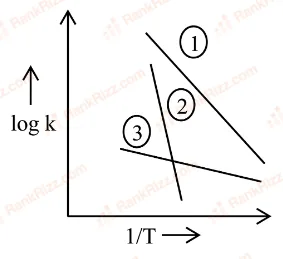
- (A)
- (B)
- (C)
- (D)
rr2.rankrizz.com/jee-main/chemistry/chemical-kinetics/q/2025-apr-4-s2-q65
- (A)
Consider the following statements related to temperature dependence of rate constants. Identify the correct statements:
A. The Arrhenius equation holds true only for an elementary homogenous reaction.
B. The unit of A is same as that of k in Arrhenius equation.
C. At a given temperature, a low activation energy means a fast reaction.
D. A and Ea as used in Arrhenius equation depend on temperature.
E. When , A and become interdependent.
Choose the correct answer from the options given below :- (A)
A, C and D Only
- (B)
B, D and E Only
- (C)
B and C Only
- (D)
A and B Only
rr2.rankrizz.com/jee-main/chemistry/chemical-kinetics/q/2025-apr-3-s2-q70
- (A)
Consider a complex reaction taking place in three steps with rate constants respectively. The overall rate constant is given by . If the activation energies of the three steps are and respectively, then the overall energy of activation in is (Nearest integer)
Answer: ____________
rr2.rankrizz.com/jee-main/chemistry/chemical-kinetics/q/24-jan-2025-s2-q73
The molecule A changes into its isomeric form B by following a first order kinetics at a temperature
of 1000 K . If the energy barrier with respect to reactant energy for such isomeric transformation is and the frequency factor is the time required for 50% molecules of A to become B is
_________ picoseconds (nearest integer).Answer: ____________
rr2.rankrizz.com/jee-main/chemistry/chemical-kinetics/q/22-jan-2025-s1-q72
Consider the given figure and choose the correct option :
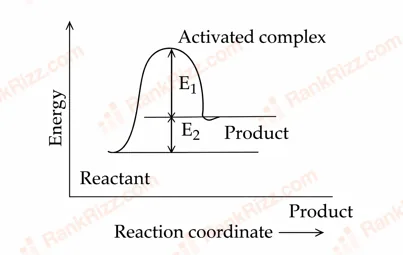
- (A)
Activation energy of both forward and backward reaction is and reactant is more stable than product.
- (B)
Activation energy of forward reaction is and product is less stable than reactant.
- (C)
Activation energy of backward reaction is and product is more stable than reactant.
- (D)
Activation energy of forward reaction is and product is more stable than reactant.
rr2.rankrizz.com/jee-main/chemistry/chemical-kinetics/q/22-jan-2025-s2-q55
- (A)
Consider the following transformation involving first order elementary reaction in each step at constant
temperature as shown below.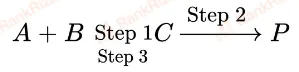
Some details of the above reactions are listed below.

Answer: ____________
rr2.rankrizz.com/jee-main/chemistry/chemical-kinetics/q/04-apr-2024-s1-q57
For a reaction taking place in three steps at same temperature, overall rate constant . If and are and kJ/mol respectively, the overall is _______ kJ/mol.
Answer: ____________
rr2.rankrizz.com/jee-main/chemistry/chemical-kinetics/q/29-jan-2024-s1-q59
For a reversible reaction A B, the forward reaction kJ mol. The activation energy of the uncatalyzed forward reaction is kJ mol. When the reaction is catalysed keeping the reactant concentration same, the rate of the catalysed forward reaction at C is found to be same as that of the uncatalyzed reaction at C. The activation energy of the catalysed backward reaction is _____ kJ mol.
Answer: ____________
rr2.rankrizz.com/jee-main/chemistry/chemical-kinetics/q/15-apr-2023-s1-q56
The number of given statement/s which is/are correct is______
(A) The stronger the temperature dependence of the rate constant, the higher is the activation energy.
(B) If a reaction has zero activation energy, its rate is independent of temperature.
(C) The stronger the temperature dependence of the rate constant, the smaller is the activation energy.
(D) If there is no correlation between the temperature and the rate constant then it means that the reaction has negative activation energy.Answer: ____________
rr2.rankrizz.com/jee-main/chemistry/chemical-kinetics/q/8-apr-2023-s1-q59
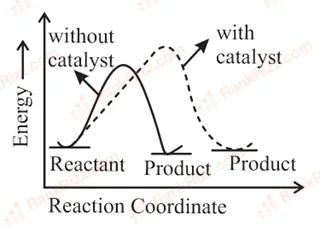
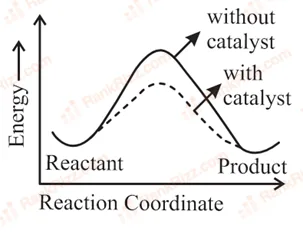
The correct reaction profile diagram for a positive catalyst reaction.
- (A)
- (B)
- (C)
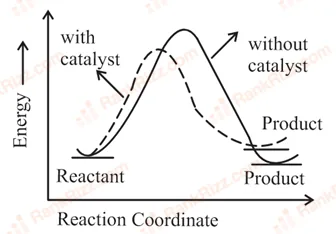
- (D)
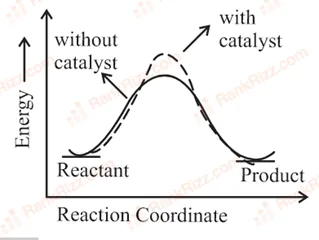
rr2.rankrizz.com/jee-main/chemistry/chemical-kinetics/q/08-apr-2023-s2-q45
- (A)
For the adsorption of hydrogen on platinum, the activation energy is 30 kJ mol and for the adsorption of hydrogen on nickel, the activation energy is 41.4 kJ mol. The logarithm of the ratio of the rates of chemisorption on equal areas of the metals at 300 K is ______ (Nearest integer)
Given: ln10 = 2.3, R = 8.3 J K molAnswer: ____________
rr2.rankrizz.com/jee-main/chemistry/chemical-kinetics/q/6-apr-2023-s1-q58
The rate constants of the above reaction at 200 K and 300 K are 0.03 min and 0.05 min respectively. The activation energy for the reaction is J (Nearest integer)
(Given: ln 10 = 2.3, R = 8.3 J K mol, log 5 = 0.70, log 3 = 0.48, log 2 = 0.30)Answer: ____________
rr2.rankrizz.com/jee-main/chemistry/chemical-kinetics/q/31-jan-2023-s1-q58
The number of correct statement/s from the following is _____.
A. Larger the activation energy, smaller is the value of the rate constant.
B. The higher is the activation energy, higher is the value of the temperature coefficient.
C. At lower temperatures, increase in temperature causes more change in the value of k than at higher temperature.
D. A plot of vs is a straight line with slope equal toAnswer: ____________
rr2.rankrizz.com/jee-main/chemistry/chemical-kinetics/q/24-jan-2023-s1-q58
The number of correct statement/s from the following is _____.
A. Larger the activation energy, smaller is the value of the rate constant.
B. The higher is the activation energy, higher is the value of the temperature coefficient.
C. At lower temperatures, increase in temperature causes more change in the value of k than at higher temperature.
D. A plot of ln k vs is a straight line with slope equal toAnswer: ____________
rr2.rankrizz.com/jee-main/chemistry/chemical-kinetics/q/24-jan-2023-s1-q58-494074
For a reaction, given below is the graph of vs . The activation energy for the reaction is equal to _____ cal mol. (Given: cal K mol)
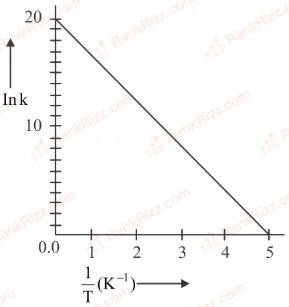
Answer: ____________
rr2.rankrizz.com/jee-main/chemistry/chemical-kinetics/q/28-jul-2022-s2-q59
The activation energy of one of the reactions in a biochemical process is 532611 J mol. When the temperature falls from 310 K to 300 K, the change in rate constant observed is k = x 10k. The value of x is ______.
[Given: ln 10 = 2.3 R = 8.3 J K mol]Answer: ____________
rr2.rankrizz.com/jee-main/chemistry/chemical-kinetics/q/29-jun-2022-s1-q57
The equation is followed for the decomposition of compound A. The activation energy for the reaction is ______ KJ mol. [nearest integer]
(Given: R = 8.314 J K mol)Answer: ____________
rr2.rankrizz.com/jee-main/chemistry/chemical-kinetics/q/29-jun-2022-s2-q57
The rate constant for a first order reaction is given by the following equation :
The Activation energy for the reaction is given by ______ kJ mol. (In Nearest integer) (Given : J K mol)Answer: ____________
rr2.rankrizz.com/jee-main/chemistry/chemical-kinetics/q/27-jun-2022-s1-q58
It has been found that for a chemical reaction with rise in temperature by K the rate constant gets doubled. Assuming a reaction to be occurring at K, the value of activation energy is found to be ______ kJ mol. [nearest integer] (Given J K mol, )
Answer: ____________
rr2.rankrizz.com/jee-main/chemistry/chemical-kinetics/q/27-jun-2022-s2-q59
Catalyst A reduces the activation energy for a reaction by kJ mol at K. The ratio of rate constants, is . The value of is ______ [nearest integer] [Assume that the pre-exponential factor is same in both the cases. Given J K mol]
Answer: ____________
rr2.rankrizz.com/jee-main/chemistry/chemical-kinetics/q/26-jun-2022-s2-q59
The rate constants for decomposition of acetaldehyde have been measured over the temperature range K. The data has been analysed by plotting vs graph. The value of activation energy for the reaction is ______ kJ mol. (Nearest integer) (Given : J K mol)
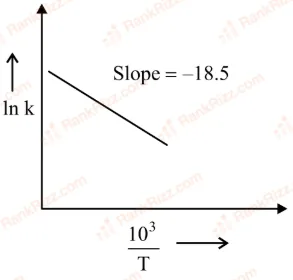
Answer: ____________
rr2.rankrizz.com/jee-main/chemistry/chemical-kinetics/q/24-jun-2022-s1-q58
Which one of the following given graphs represents the variation of rate constant (k) with temperature (T) for an endothermic reaction?
- (A)
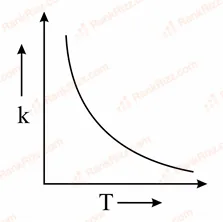
- (B)
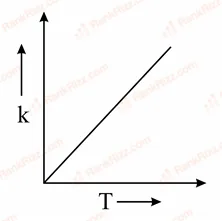
- (C)
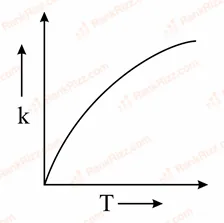
- (D)
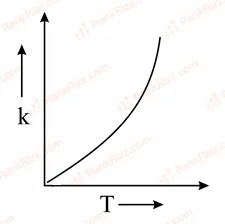
rr2.rankrizz.com/jee-main/chemistry/chemical-kinetics/q/1-sep-2021-s2-q38
- (A)
For the reaction A B, the rate constant k (in s) is given by
The energy of activation in kJ mol is _________. (Nearest integer)
[Given : R = 8.314 J K mol]Answer: ____________
rr2.rankrizz.com/jee-main/chemistry/chemical-kinetics/q/31-aug-2021-s2-q58
The first order rate constant for the decomposition of CaCO at 700 K is s and activation energy is 209 kJ mol. Its rate constant (in s) at 600 K is . The value of x is _________. (Nearest integer)
[Given R = 8.31 J K mol; log = -2.19, = ]Answer: ____________
rr2.rankrizz.com/jee-main/chemistry/chemical-kinetics/q/27-aug-2021-s2-q59
The decomposition of formic acid on gold surface follows first order kinetics. If the rate constant at 300 K is s and the activation energy kJ mol, the rate constant at 200 K is ________ s. (Round off to the Nearest Integer).
[Given J mol K]Answer: ____________
rr2.rankrizz.com/jee-main/chemistry/chemical-kinetics/q/16-mar-2021-s1-q59
If the activation energy of a reaction is 80.9 kJ mol, the fraction of molecules at 700 K, having enough energy to react to form products is . The value of is (Rounded off to the nearest integer) [Use R = 8.31 J K mol]
Answer: ____________
rr2.rankrizz.com/jee-main/chemistry/chemical-kinetics/q/26-feb-2021-s2-q59
For the reaction, , the plot of log k v/s is given below:
The temperature at which the rate constant of the reaction is s is ______ K.
(Rounded-off to the nearest integer) [Given: The rate constant of the reaction is s at 500 K.]Answer: ____________
rr2.rankrizz.com/jee-main/chemistry/chemical-kinetics/q/25-feb-2021-s1-q59
The rate constant of a reaction increases by five times on increase in temperature from 27°C to 52°C. The value of activation energy in kJ mol is ______. (Rounded-off to the nearest integer) [ J K mol]
Answer: ____________
rr2.rankrizz.com/jee-main/chemistry/chemical-kinetics/q/25-feb-2021-s2-q58
The rate of a reaction decreased by 3.555 times when the temperature was changed from to . The activation energy (in ) of the reaction is______.
Answer: ____________
rr2.rankrizz.com/jee-main/chemistry/chemical-kinetics/q/6-sep-2020-s2-q48
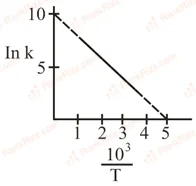
The rate constant of a reaction is measured at different temperature , and the data are plotted in the given figure. The activation energy of the reaction in is: (R is gas constant)
- (A)
- (B)
- (C)
- (D)
rr2.rankrizz.com/jee-main/chemistry/chemical-kinetics/q/5-sep-2020-s2-q38
- (A)
The number of molecules with energy greater than the threshold energy for a reaction increases five fold by a rise of temperature from 27°C to 42°C. Its energy of activation in J/mol is __________ (Take ln 5 = 1.6094; R = 8.314 J mol)
Answer: ____________
rr2.rankrizz.com/jee-main/chemistry/chemical-kinetics/q/4-sep-2020-s2-q49
For the following reactions:
It was found that the is decreased by 30 KJ/mol in the presence of catalyst. If the rate remains unchanged, the activation energy for catalysed reaction is (Assume pre-exponential factor is same):- (A)
75 KJ/mol
- (B)
105 KJ/mol
- (C)
135 KJ/mol
- (D)
198 KJ/mol
rr2.rankrizz.com/jee-main/chemistry/chemical-kinetics/q/9-jan-2020-s1-q37
- (A)
A sample of milk splits after 60 min at 300K and after 40 min at 400K when the population of lactobacillus acidophilus in it doubles. The activation energy (in kJ/mol) for this process is closest to ___________.
(Given, J mol K, , )Answer: ____________
rr2.rankrizz.com/jee-main/chemistry/chemical-kinetics/q/9-jan-2020-s2-q48
The rate of a certain biochemical reaction at physiological temperature (T) occurs times faster with enzyme than without. The change in the activation energy upon adding enzyme is:
- (A)
- (B)
- (C)
- (D)
rr2.rankrizz.com/jee-main/chemistry/chemical-kinetics/q/8-jan-2020-s1-q37
- (A)
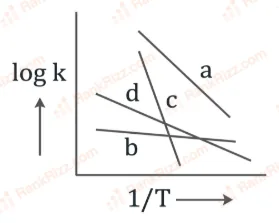
Consider the following plots of rate constant versus for four different reactions. Which of the following orders is correct for the activation energies of these reactions?
- (A)
- (B)
- (C)
- (D)
rr2.rankrizz.com/jee-main/chemistry/chemical-kinetics/q/8-jan-2020-s2-q34
- (A)
For the reaction of H with I, the rate constant is dm mol s at 327°C and 1.0 dm mol s at 527°C. The activation energy for the reaction, in kJ mol is:
R = 8.314 JK mol- (A)
166
- (B)
59
- (C)
72
- (D)
150
rr2.rankrizz.com/jee-main/chemistry/chemical-kinetics/q/10-apr-2019-s2-q49
- (A)
Consider the given plot of enthalpy of the following reaction between A and B.
A + B C + D. Identify the incorrect statement.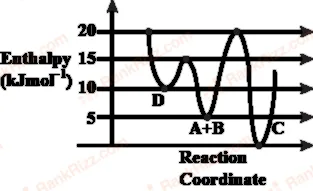
- (A)
Formation of A and B from C has highest enthalpy of activation.
- (B)
D is kinetically stable product.
- (C)
C is the thermodynamically stable product.
- (D)
Activation enthalpy to form C is 5 kJ mol less than that to form D.
rr2.rankrizz.com/jee-main/chemistry/chemical-kinetics/q/9-apr-2019-s2-q43
- (A)
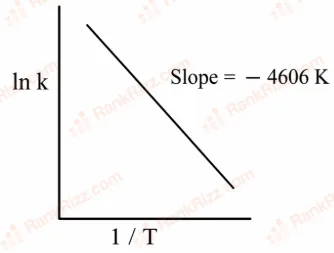
For a reaction, consider the plot of ln k versus 1/T given in the figure. If the rate constant of this reaction at 400 K is , then the rate constant at 500 K is:
- (A)
- (B)
- (C)
- (D)
rr2.rankrizz.com/jee-main/chemistry/chemical-kinetics/q/12-jan-2019-s2-q47
- (A)
If a reaction follows the Arrhenius equation, the plot vs gives straight line with a gradient unit. The energy required to activate the reactant is:
- (A)
unit
- (B)
unit
- (C)
unit
- (D)
unit
rr2.rankrizz.com/jee-main/chemistry/chemical-kinetics/q/11-jan-2019-s1-q48
- (A)
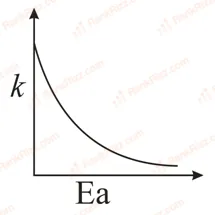
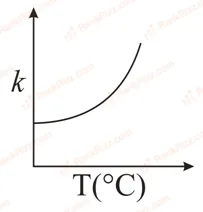
Consider the given plots for a reaction obeying Arrhenius equation (C < T < 300C): (K and are rate constant and activation energy, respectively)
- (A)
I is wrong but II is right
- (B)
Both I and II are wrong
- (C)
I is right but II is wrong
- (D)
Both I and II are correct
rr2.rankrizz.com/jee-main/chemistry/chemical-kinetics/q/10-jan-2019-s1-q49
- (A)
The rate of a reaction quadruples when the temperature changes from 300 to 310 K. The activation energy of this reaction is:
(Assume Activation energy and pre-exponential factor are independent of temperature;
ln(2) = 0.693; R = 8.314 J mol K)- (A)
53.6 kJ mol
- (B)
214.4 kJ mol
- (C)
107.2 kJ mol
- (D)
53.7 kJ mol
rr2.rankrizz.com/jee-main/chemistry/chemical-kinetics/q/9-apr-2017-online-q50
- (A)
The rate of a reaction A doubles on increasing the temperature from 300 to 310 K. By how much, the temperature of reaction B should be increased from 300 K so that rate doubles if activation energy of the reaction B is twice to that of reaction A.
- (A)
4.92 K
- (B)
9.84 K
- (C)
19.67 K
- (D)
2.45 K
rr2.rankrizz.com/jee-main/chemistry/chemical-kinetics/q/8-apr-2017-online-q50
- (A)
Two reactions A and A have identical pre-exponential factors. The activation energy of A is more than A by 10 kJ mol. If k and k are the rate constants for reactions A and A, respectively at 300 K, then is equal to
(R = 8.314 J mol K)- (A)
12
- (B)
6
- (C)
4
- (D)
8
rr2.rankrizz.com/jee-main/chemistry/chemical-kinetics/q/2-apr-2017-offline-q46
- (A)
For the equilibrium, , is kJ/mol. If the ratio of the activation energies of the forward and reverse reactions is then:
- (A)
kJ/mol, kJ/mol
- (B)
kJ/mol, kJ/mol
- (C)
kJ/mol, kJ/mol
- (D)
kJ/mol, kJ/mol
rr2.rankrizz.com/jee-main/chemistry/chemical-kinetics/q/11-apr-2015-online-q48
- (A)
The rate coefficient (k) for a particular reactions is M s at 100°C, and M s at 150°C. What is the energy of activation (E) (in kJ) for this reaction? (R = molar gas constant = 8.314 JK mol)
- (A)
16
- (B)
60
- (C)
99
- (D)
132
rr2.rankrizz.com/jee-main/chemistry/chemical-kinetics/q/12-apr-2014-online-q49
- (A)
The reaction X Y is an exothermic reaction. Activation energy of the reaction for X into Y is 150 kJ mol. Enthalpy of reaction is 135 kJ mol. The activation energy for the reverse reaction, Y X will be :
- (A)
280 kJ mol
- (B)
285 kJ mol
- (C)
270 kJ mol
- (D)
15 kJ mol
rr2.rankrizz.com/jee-main/chemistry/chemical-kinetics/q/22-apr-2013-online-q37
- (A)
The rate of a reaction doubles when its temperature changes from 300K to 310K. Activation energy of such a reaction will be:
JK mol and log 2 = 0.301- (A)
58.5 kJ mol
- (B)
60.5 kJ mol
- (C)
53.6 kJ mol
- (D)
48.6 kJ mol
rr2.rankrizz.com/jee-main/chemistry/chemical-kinetics/q/7-apr-2013-offline-q50
- (A)
The activation energy for a reaction which doubles the rate when the temperature is raised from 298 K to 308 K is
- (A)
59.2 kJ mol
- (B)
39.2 kJ mol
- (C)
52.9 kJ mol
- (D)
29.5 kJ mol
rr2.rankrizz.com/jee-main/chemistry/chemical-kinetics/q/2012-chemistry-499247
- (A)
The rate of a chemical reaction doubles for every rise of temperature. If the temperature is raised by , the rate of the reaction increases by about:
- (A)
times
- (B)
times
- (C)
times
- (D)
times
rr2.rankrizz.com/jee-main/chemistry/chemical-kinetics/q/2011-chemistry-499518
- (A)
Rate of a reaction can be expressed by Arrhenius equation as: $ In this equation, E represents
- (A)
the energy above which all the colliding molecules will react
- (B)
the energy below which colliding molecules will not react
- (C)
the total energy of the reacting molecules at a temperature,
- (D)
the fraction of molecules with energy greater than the activation energy of the reaction
rr2.rankrizz.com/jee-main/chemistry/chemical-kinetics/q/2006-chemistry-500057
- (A)
Consider an endothermic reaction, with the activation energies and for the backward and forward reactions, respectively. In general
- (A)
- (B)
- (C)
- (D)
There is no definite relation between and
rr2.rankrizz.com/jee-main/chemistry/chemical-kinetics/q/2005-chemistry-500282
- (A)
Rate law, order and molecularity 40
Consider the reaction , for which the rate constant at 30°C is mol L s. Which of the following statements are true?
A. When concentration of 'X' is increased to four times, the rate of reaction becomes 16 times.
B. The reaction is a second order reaction.
C. The half-life period is independent of the concentration of X.
D. Decomposition of is an example of the above reaction.
E.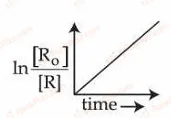
is valid for the above reaction.
Choose the correct answer from the option given below:- (A)
A and B Only
- (B)
A, B and C Only
- (C)
A, B, D and E Only
- (D)
C and D Only
rr2.rankrizz.com/jee-main/chemistry/chemical-kinetics/q/2-apr-2026-s2-q57
- (A)
is an endothermic reaction occurring in three steps ( elementary).
(i)
(ii)
(iii)
Which of the following graphs between potential energy (y-axis) vs reaction coordinate (x-axis) correctly represents the reaction profile of A-> D?- (A)
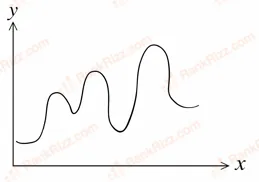
- (B)
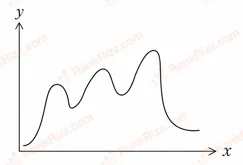
- (C)
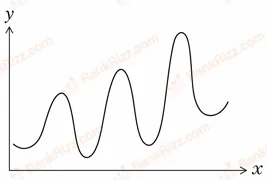
- (D)
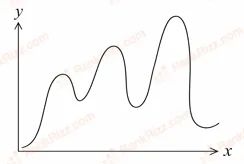
rr2.rankrizz.com/jee-main/chemistry/chemical-kinetics/q/24-jan-2026-s1-q69
- (A)
Observe the following reactions at T(K).
I. products
II.Both the reactions are started at 10.00 am. The rates of these reactions at 10.10 am are same. The value of at 10.10am. is . The concentration of A at 10.10am is . What is the first order rate constant (in ) of reaction I?
- (A)
- (B)
- (C)
- (D)
rr2.rankrizz.com/jee-main/chemistry/chemical-kinetics/q/23-jan-2026-s2-q68
- (A)
A product (First order reaction).
Three sets of experiment were performed for a reaction under similar experimental conditions:Run 1 100 mL of 10 M solution of reactant A
Run 2 200 mL of 10 M solution of reactant A
Run 3 100 mL of 10 M solution of reactant A + 100 mL of added.
The correct variation of rate of reaction is
- (A)
Rum l = Run 2 = Run 3
- (B)
Run 1 < Run 2 < Run 3
- (C)
Rum 3 < Run 1 < Run 2
- (D)
Run 3 < Run 1 = Run 2
rr2.rankrizz.com/jee-main/chemistry/chemical-kinetics/q/22-jan-2026-s1-q59
- (A)
Rate law for a reaction between A and B is given by . If concentration of A is doubled and concentration of B is halved from their initial value, the ratio of new rate of reaction to the initial rate of reaction is
- (A)
- (B)
- (C)
- (D)
rr2.rankrizz.com/jee-main/chemistry/chemical-kinetics/q/2025-apr-4-s1-q58
- (A)
Reactant A converts to product D through the given mechanism (with the net evolution of heat) :
slow ;
fast ;
fast ;
Which of the following represents the above reaction mechanism ?- (A)
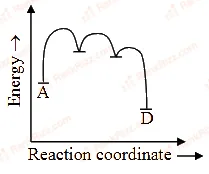
- (B)
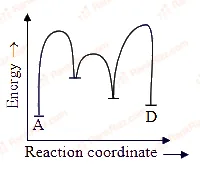
- (C)
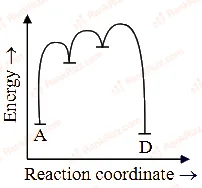
- (D)
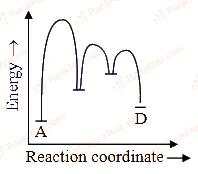
rr2.rankrizz.com/jee-main/chemistry/chemical-kinetics/q/2025-apr-02-s2-q64
- (A)
For the reaction the following graph was obtained. The time required (in seconds) for the concentration of A to reduce to 2.5 g L (if the initial concentration of A was 50 g L) is _________.
(Nearest integer)
Given :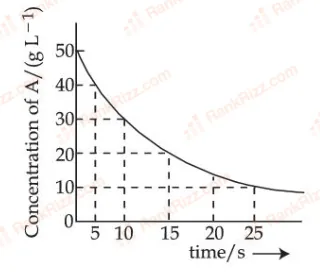
Answer: ____________
rr2.rankrizz.com/jee-main/chemistry/chemical-kinetics/q/2025-apr-02-s2-q71
The reaction follows the mechanism
The overall order of the reaction is :- (A)
2
- (B)
2.5
- (C)
3
- (D)
1.5
rr2.rankrizz.com/jee-main/chemistry/chemical-kinetics/q/29-jan-2025-s1-q64
- (A)
Consider an elementary reaction If the volume of reaction mixture is suddenly reduced to of its initial volume, the reaction rate will become 'x' times of the original reaction rate. The value of x is :
- (A)
3
- (B)
- (C)
9
- (D)
rr2.rankrizz.com/jee-main/chemistry/chemical-kinetics/q/28-jan-2025-s2-q62
- (A)
For a reaction . If the rate of formation of is set to be zero then the concentration of is given by :
- (A)
- (B)
- (C)
- (D)
rr2.rankrizz.com/jee-main/chemistry/chemical-kinetics/q/8-apr-2024-s2-q42
- (A)
Consider the following single step reaction in gas phase at constant temperature. . The initial rate of the reaction is recorded as when the reaction starts with atm pressure of A and atm pressure of B. After some time, the rate is recorded when the pressure of C becomes atm. The ratio is ______ . (Nearest integer)
Answer: ____________
rr2.rankrizz.com/jee-main/chemistry/chemical-kinetics/q/05-apr-2024-s2-q56
required for a reaction is produced by decomposition of in as by equation:
The initial concentration of is 3 mol L and it is 2.75 mol L after 30 minutes. The rate of formation of is mol L min, value of is ________.Answer: ____________
rr2.rankrizz.com/jee-main/chemistry/chemical-kinetics/q/30-jan-2024-s2-q56
KClO + 6FeSO + 3HSO KCl + 3Fe(SO) + 3HO
The above reaction was studied at 300 K by monitoring the concentration of FeSO in which initial concentration was 10 M and after half an hour became 8.8 M. The rate of production of Fe(SO) is _______ mol L s (Nearest integer)Answer: ____________
rr2.rankrizz.com/jee-main/chemistry/chemical-kinetics/q/11-apr-2023-s1-q58
For a given chemical reaction . Concentration of C changes from mmol dm to mmol dm in s. Rate of appearance of D is times the rate of disappearance of B which is twice the rate of disappearance of A. The rate of appearance of D has been experimentally determined to be mmol dm s. Therefore the rate of reaction is ______ mmol dm s. (Nearest Integer)
Answer: ____________
rr2.rankrizz.com/jee-main/chemistry/chemical-kinetics/q/25-jun-2022-s1-q59
The reaction that occurs in a breath analyser, a device used to determine the alcohol level in a person's blood stream is
If the rate of appearance of is 2.67 mol min at a particular time, the rate of disappearance of at the same time is _________ mol min. (Nearest integer)Answer: ____________
rr2.rankrizz.com/jee-main/chemistry/chemical-kinetics/q/27-aug-2021-s1-q51
The reaction rate for the reaction
was measured as a function of concentrations of different species. It was observed that
where square brackets are used to denote molar concentrations.
The equilibrium constant K = X (Nearest integer). Value of is _________
(Nearest integer)Answer: ____________
rr2.rankrizz.com/jee-main/chemistry/chemical-kinetics/q/26-aug-2021-s2-q55
For a reaction of order n, the unit of the rate constant is:
- (A)
- (B)
- (C)
- (D)
rr2.rankrizz.com/jee-main/chemistry/chemical-kinetics/q/27-jul-2021-s1-q41
- (A)
For a chemical reaction A B, it was found that concentration of B is increased by 0.2 mol L in 30 min. The average rate of the reaction is _________ mol L h. (in nearest integer)
Answer: ____________
rr2.rankrizz.com/jee-main/chemistry/chemical-kinetics/q/25-jul-2021-s2-q59
The reaction is an elementary reaction. For a certain quantity of reactants, if the volume of the reaction vessel is reduced by a factor of 3, the rate of the reaction increases by a factor of ________. (Round off to the Nearest Integer).
Answer: ____________
rr2.rankrizz.com/jee-main/chemistry/chemical-kinetics/q/17-mar-2021-s2-q58
For the reaction , which statement is correct?
- (A)
- (B)
- (C)
- (D)
rr2.rankrizz.com/jee-main/chemistry/chemical-kinetics/q/3-sep-2020-s2-q34
- (A)
For the reaction the observed rate expression is, rate . The rate expression for the reverse reaction is:
- (A)
- (B)
- (C)
- (D)
rr2.rankrizz.com/jee-main/chemistry/chemical-kinetics/q/7-jan-2020-s2-q36
- (A)
In the following reaction; xA yB
'A' and 'B' respectively can be:- (A)
CH and CH
- (B)
CH and CH
- (C)
n-Butane and Iso-butane
- (D)
NO and NO
rr2.rankrizz.com/jee-main/chemistry/chemical-kinetics/q/12-apr-2019-s1-q49
- (A)
NO required for a reaction is produced by the decomposition of NO in CCl as per the equation, 2NO(g) 4NO(g) + O(g). The initial concentration of NO is 3.00 mol L and it is 2.75 mol L after 30 minutes. The rate of formation of NO is:
- (A)
mol L min
- (B)
mol L min
- (C)
mol L min
- (D)
mol L min
rr2.rankrizz.com/jee-main/chemistry/chemical-kinetics/q/12-apr-2019-s2-q48
- (A)
For the reaction 2A + B C, the values of initial rate at different reactant concentrations are given in the table below.
[A] (mol L) [B] (mol L) Initial Rate (mol Ls)
0.05 0.05 0.045
0.10 0.05 0.090
0.20 0.10 0.72
The rate law for the reactions is:- (A)
Rate = k[A][B]
- (B)
Rate = k[A][B]
- (C)
Rate = k[A][B]
- (D)
Rate = k[A][B]
rr2.rankrizz.com/jee-main/chemistry/chemical-kinetics/q/8-apr-2019-s1-q48
- (A)
For an elementary chemical reaction, , the expression for is:
- (A)
- (B)
- (C)
- (D)
rr2.rankrizz.com/jee-main/chemistry/chemical-kinetics/q/10-jan-2019-s2-q45
- (A)
The rate law for the reaction below is given by the expression k[A][B]
Product
If the concentration of B is increased from 0.1 to 0.3 mol, keeping the value of A at 0.1 mol, the rate constant will be:- (A)
3k
- (B)
9k
- (C)
k/3
- (D)
k
rr2.rankrizz.com/jee-main/chemistry/chemical-kinetics/q/10-apr-2016-online-q47
- (A)
The reaction of ozone with oxygen atoms in the presence of chlorine atoms can occur by a two step process shown below:
...(i)
L mol s
...(ii)
L mol s
The closest rate constant for the overall reaction
is:- (A)
L mol s
- (B)
L mol s
- (C)
L mol s
- (D)
L mol s
rr2.rankrizz.com/jee-main/chemistry/chemical-kinetics/q/9-apr-2016-online-q47
- (A)
, the rate equation for the reaction is given as Rate = k[A][B]. If the concentration of A is kept the same but that of B is doubled what will happen to the rate itself?
- (A)
Doubled
- (B)
Halved
- (C)
The same
- (D)
Quadrupled
rr2.rankrizz.com/jee-main/chemistry/chemical-kinetics/q/11-apr-2015-online-q47
- (A)
For the reaction, 3A + 2B C + D, the differential rate law can be written as:
- (A)
- (B)
- (C)
- (D)
rr2.rankrizz.com/jee-main/chemistry/chemical-kinetics/q/19-apr-2014-online-q47
- (A)
In the reaction of formation of sulphur trioxide by contact process the rate of reaction was measured as mol L s. The rate of reaction in terms of [SO] in mol L s will be:
- (A)
- (B)
- (C)
- (D)
rr2.rankrizz.com/jee-main/chemistry/chemical-kinetics/q/11-apr-2014-online-q49
- (A)
For the reaction, , the rate equation can be expressed in two ways:
and . k and k' are related as:- (A)
k = k'
- (B)
2k = k'
- (C)
k = 2k'
- (D)
k = 4k'
rr2.rankrizz.com/jee-main/chemistry/chemical-kinetics/q/11-apr-2014-online-q50
- (A)
For the non-stoichiometry reaction, , the following kinetic data were obtained in three separate experiments, all at 298 K.
Initial Concentration Initial Concentration Initial rate of formation of C
(A) (B) (mol L S)
0.1 M 0.1 M
0.1 M 0.2 M
0.2 M 0.1 M
The rate law for the formation of C is:- (A)
- (B)
- (C)
- (D)
rr2.rankrizz.com/jee-main/chemistry/chemical-kinetics/q/6-apr-2014-offline-q48
- (A)
The instantaneous rate of disappearance of ion in the following reaction is Ms
The rate of appearance of is :- (A)
Ms
- (B)
Ms
- (C)
Ms
- (D)
Ms
rr2.rankrizz.com/jee-main/chemistry/chemical-kinetics/q/9-apr-2013-online-q48
- (A)
Reaction rate between two substance and is expressed as following: . If the concentration of is doubled and concentration of is made half of initial concentration, the ratio of the new rate to the earlier rate will be:
- (A)
- (B)
- (C)
- (D)
rr2.rankrizz.com/jee-main/chemistry/chemical-kinetics/q/2012-chemistry-499167
- (A)
Consider the reaction: . The rate equation for this reaction is rate . Which of these mechanisms is/are consistent with this rate equation? (A) (slow); (fast). (B) (fast equilibrium); (slow).
- (A)
B only
- (B)
Both A and B
- (C)
Neither A nor B
- (D)
A only
rr2.rankrizz.com/jee-main/chemistry/chemical-kinetics/q/2010-chemistry-499700
- (A)
Consider the reaction, Products. When concentration of alone was doubled, the half-life did not change. When the concentration of alone was doubled, the rate increased by two times. The unit of rate constant for this reaction is
- (A)
L
- (B)
no unit
- (C)
mol
- (D)
rr2.rankrizz.com/jee-main/chemistry/chemical-kinetics/q/2007-chemistry-499811
- (A)
A reaction was found to be second order with respect to the concentration of carbon monoxide. If the concentration of carbon monoxide is doubled, with everything else kept the same, the rate of reaction will
- (A)
remain unchanged
- (B)
triple
- (C)
increase by a factor of 4
- (D)
double
rr2.rankrizz.com/jee-main/chemistry/chemical-kinetics/q/2006-chemistry-500056
- (A)
The following mechanism has been proposed for the reaction of NO with to form NOBr : $ is
- (A)
1
- (B)
0
- (C)
3
- (D)
2
rr2.rankrizz.com/jee-main/chemistry/chemical-kinetics/q/2006-chemistry-500058
- (A)
A reaction involving two different reactants can never be
- (A)
Unimolecular reaction
- (B)
First order reaction
- (C)
Second order reaction
- (D)
Bimolecular reaction
rr2.rankrizz.com/jee-main/chemistry/chemical-kinetics/q/2005-chemistry-500342
- (A)
The rate equation for the reaction is found to be: rate . The correct statement in relation to this reaction is that the
- (A)
unit of must be s
- (B)
values of is independent of the initial concentration of and
- (C)
rate of formation of is twice the rate of disappearance of
- (D)
is a constant
rr2.rankrizz.com/jee-main/chemistry/chemical-kinetics/q/2004-chemistry-500391
- (A)
Methods to determine order of reaction 24
For the reaction at , the half life () is plotted as a function of initial concentration of as give below.
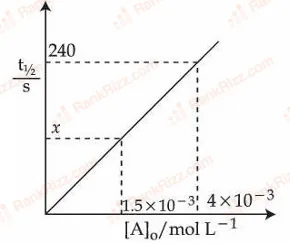
The value of in the given figure is ______ s (Nearest integer)Answer: ____________
rr2.rankrizz.com/jee-main/chemistry/chemical-kinetics/q/5-apr-2026-s2-q75
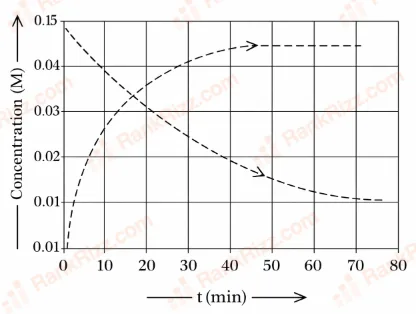
Given above is the concentration vs time plot for a dissociation reaction : .
Based on the data of the initial phase of the reaction (initial 10 min), the value of n is________.- (A)
5
- (B)
2
- (C)
4
- (D)
3
rr2.rankrizz.com/jee-main/chemistry/chemical-kinetics/q/23-jan-2026-s2-q51
- (A)
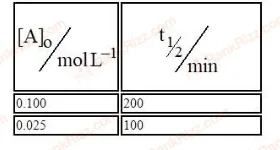
For a given reaction is related to as given in table. Given: Which of the following is true? A. The order of the reaction is 1/2.B.If is 1 M, then is C.The order of the reaction changes to 1 if the concentration of reactant changes from 0.100 M to 0.500 M . D. is 800 min for Choose the correct answer from the options given below: Options- (A)
A and C Only
- (B)
A, B and D Only
- (C)
C and D Only
- (D)
A and B Only
rr2.rankrizz.com/jee-main/chemistry/chemical-kinetics/q/28-jan-2025-s1-q61
- (A)
Given below are two statements : Statement I: The rate law for the reaction is rate . When the concentration of both A and B is doubled, the reaction rate is increased "" times. Statement II :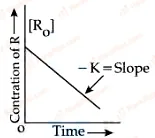
The figure is showing "the variation in concentration against time plot" for a "" order reaction. The Value of is ______
Answer: ____________
rr2.rankrizz.com/jee-main/chemistry/chemical-kinetics/q/9-apr-2024-s1-q57
Consider the following reaction . The time taken for A to become of its initial concentration is twice the time taken to become of the same. Also, when the change of concentration of is plotted against time, the resulting graph gives a straight line with a negative slope and a positive intercept on the concentration axis. The overall order of the reaction is ________
Answer: ____________
rr2.rankrizz.com/jee-main/chemistry/chemical-kinetics/q/8-apr-2024-s1-q56
During Kinetic study of reaction , the following results were obtained :
I: A = 0.1 M, B = 0.1 M, initial rate of formation of D =
II: A = 0.3 M, B = 0.2 M, initial rate =
III: A = 0.3 M, B = 0.4 M, initial rate =
IV: A = 0.4 M, B = 0.1 M, initial rate =
Based on above data, overall order of the reaction is ______Answer: ____________
rr2.rankrizz.com/jee-main/chemistry/chemical-kinetics/q/5-apr-2024-s1-q56
Consider the following data for the given reaction . : . Rate : . The order of the reaction is _______.
Answer: ____________
rr2.rankrizz.com/jee-main/chemistry/chemical-kinetics/q/27-jan-2024-s1-q59
The reaction NO Br NOBr takes place through the mechanism given below
NO Br NOBr (fast)
NOBr NO NOBr (slow)
The overall order of the reaction is _____.Answer: ____________
rr2.rankrizz.com/jee-main/chemistry/chemical-kinetics/q/12-apr-2023-s1-q57
For a chemical reaction Product, the order is 1 with respect to and .
Rate (mol L s) [A] (mol L) [B] (mol L) 0.10 20 0.5 0.40 x 0.5 0.80 40 y
What is the value of x and y?- (A)
160 and 4
- (B)
80 and 4
- (C)
80 and 2
- (D)
40 and 4
rr2.rankrizz.com/jee-main/chemistry/chemical-kinetics/q/11-apr-2023-s2-q40
- (A)
For certain chemical reaction X Y, the rate of formation of product is plotted against the time as shown in the figure. The number of Correct statement/s from the following is ______
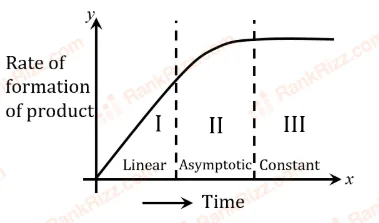
(A) Over all order of this reaction is one
(B) Order of this reaction can't be determined
(C) In region-I and III, the reaction is of first and zero order respectively
(D) In region-II, the reaction is of first order
(E) In region-II, the order of reaction is in the range of 0.1 to 0.9.Answer: ____________
rr2.rankrizz.com/jee-main/chemistry/chemical-kinetics/q/29-jan-2023-s1-q59
For conversion of compound A B, the rate constant of the reaction was found to be L mol s. The order of the reaction is ______.
Answer: ____________
rr2.rankrizz.com/jee-main/chemistry/chemical-kinetics/q/29-jan-2023-s2-q58
A student has studied the decomposition of a gas at 25°C. He obtained the following data
p (mm Hg) 50 100 200 400 Relative (s) 4 2 1 0.5
The order of the reaction is- (A)
0.5
- (B)
2
- (C)
1
- (D)
0
rr2.rankrizz.com/jee-main/chemistry/chemical-kinetics/q/24-jan-2023-s2-q57
- (A)
The reaction between X and Y is first order with respect to X and zero order with respect to Y.
Experiment [X] mol L [Y] mol L Initial rate mol L min I 0.1 0.1 II L 0.2 III 0.4 0.4 IV 0.1 0.2
Examine the data of table and calculate ratio of numerical values of M and L.Answer: ____________
rr2.rankrizz.com/jee-main/chemistry/chemical-kinetics/q/29-jul-2022-s1-q58
. The above reaction has been studied at .The related data are given in the table below
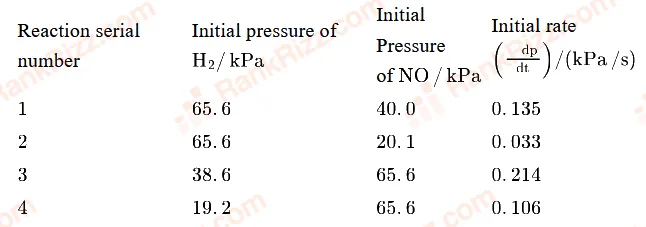
The order of the reaction with respect to NO is ______.
Answer: ____________
rr2.rankrizz.com/jee-main/chemistry/chemical-kinetics/q/27-jul-2022-s1-q57
The half life for the decomposition of gaseous compound A is when the gaseous pressure was initially. When the pressure was , the half life was found to be . The order of the reaction is ______ (Nearest integer).
Answer: ____________
rr2.rankrizz.com/jee-main/chemistry/chemical-kinetics/q/25-jul-2022-s1-q57
At K, the half life for the decomposition of a sample of a gaseous compound initially at kPa was s. When the pressure was kPa, the half life was found to be s. The order of the reaction is ______ [integer answer]
Answer: ____________
rr2.rankrizz.com/jee-main/chemistry/chemical-kinetics/q/25-jun-2022-s2-q56
The following data was obtained for chemical reaction given below at 975 K.
[NO] = 8 , [H] = 8 , Rate = 7
[NO] = 24 , [H] = 8 , Rate = 2.1
[NO] = 24 , [H] = 32 , Rate = 8.4
The order of the reaction with respect to NO is _________ [Integer answer]Answer: ____________
rr2.rankrizz.com/jee-main/chemistry/chemical-kinetics/q/26-aug-2021-s1-q58
Consider the following reactions:
The order of the above reactions are a, b, c and d, respectively. The following graph is obtained when log[rate] vs log[conc.] are plotted: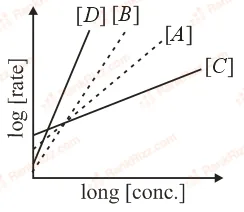
Among the following, the correct sequence for the order of the reactions is:- (A)
- (B)
- (C)
- (D)
rr2.rankrizz.com/jee-main/chemistry/chemical-kinetics/q/6-sep-2020-s1-q36
- (A)
The results given in the below table were obtained during kinetic studies of the following reaction:
Experiment [A]/mol L [B]/mol L Initial rate/mol L min I 0.1 0.1 II 0.1 0.2 III 0.2 0.1 IV X 0.2 V 0.3 Y
X and Y in the given table are respectively:- (A)
0.4, 0.4
- (B)
0.4, 0.3
- (C)
0.3, 0.4
- (D)
0.3, 0.3
rr2.rankrizz.com/jee-main/chemistry/chemical-kinetics/q/2-sep-2020-s2-q36
- (A)
The following results were obtained during kinetic studies of the reaction.
product
Experiment I: A = 0.10 mol L, B = 0.20 mol L, Rate = mol L min
Experiment II: A = 0.10 mol L, B = 0.25 mol L, Rate = mol L min
Experiment III: A = 0.20 mol L, B = 0.30 mol L, Rate = mol L min
The time (in minutes) required to consume half of A is:- (A)
100
- (B)
10
- (C)
5
- (D)
1
rr2.rankrizz.com/jee-main/chemistry/chemical-kinetics/q/9-jan-2019-s1-q49
- (A)
For the reaction, products, when the concentration of and both were doubled, the rate of the reaction increased from 0.3 mol L s to 2.4 mol L s. When the concentration of alone is doubled, the rate increased from 0.3 mol L s to 0.6 mol L s. Which one of the following statements is correct?
- (A)
Order of the reaction with respect to B is 2
- (B)
Total order of the reaction is 4
- (C)
Order of the reaction with respect to A is 2
- (D)
Order of the reaction with respect to B is 1
rr2.rankrizz.com/jee-main/chemistry/chemical-kinetics/q/9-jan-2019-s2-q44
- (A)
At 518C, the rate of decomposition of a sample of gaseous acetaldehyde, initially at a pressure of 363 Torr was 1.00 Torr s when 5% had reacted and 0.50 Torr s when 33% had reacted. The order of the reaction is:
- (A)
0
- (B)
2
- (C)
3
- (D)
1
rr2.rankrizz.com/jee-main/chemistry/chemical-kinetics/q/8-apr-2018-offline-q50
- (A)
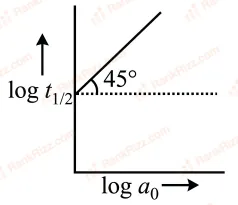
For a reaction Products, a plot of versus is shown in the figure. If the initial concentration of is represented by , the order of the reaction is
- (A)
one
- (B)
zero
- (C)
two
- (D)
three
rr2.rankrizz.com/jee-main/chemistry/chemical-kinetics/q/2012-chemistry-499337
- (A)
In a chemical reaction is converted into . The rates of reaction, starting with initial concentrations of as M and M, are equal to Ms and Ms respectively. The order of reaction with respect to reactant will be
- (A)
- (B)
- (C)
- (D)
rr2.rankrizz.com/jee-main/chemistry/chemical-kinetics/q/2012-chemistry-499428
- (A)
Radioactivity and nuclear reactions 16
The half-life of is 245 days. After x days, 75% of original activity remained. The value of x in days is ___ . (Nearest integer)
(Given: log 3 = 0.4771 and log 2 = 0.3010)Answer: ____________
rr2.rankrizz.com/jee-main/chemistry/chemical-kinetics/q/24-jan-2026-s2-q75
For bacterial growth in a cell culture, growth law is very similar to the law of radioactive decay. Which of the following graphs is most suitable to represent bacterial colony growth ? Where N - Number of Bacteria at any time, - Initial number of Bacteria.
- (A)
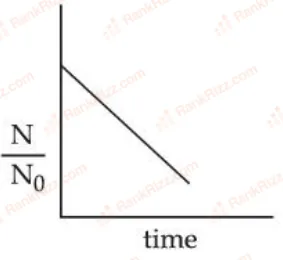
- (B)
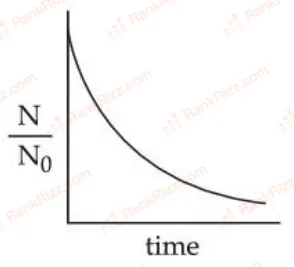
- (C)
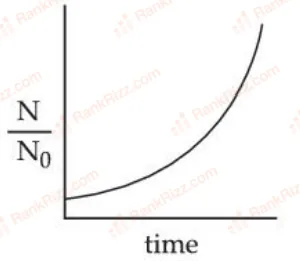
- (D)
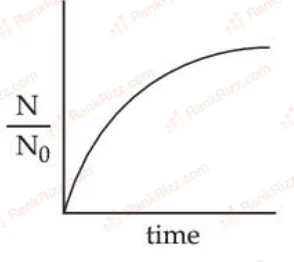
rr2.rankrizz.com/jee-main/chemistry/chemical-kinetics/q/28-jan-2025-s2-q57
- (A)
Which of the following statement is not true for radioactive decay?
- (A)
Decay constant increases with increase in temperature.
- (B)
Amount of radioactive substance remained after three half lives is of original amount.
- (C)
Decay constant does not depend upon temperature.
- (D)
Half life is times of
rr2.rankrizz.com/jee-main/chemistry/chemical-kinetics/q/22-jan-2025-s1-q62
- (A)
The ratio of in a piece of wood is part that of atmosphere. If half life of is years, the age of wood sample is _____ years.
Answer: ____________
rr2.rankrizz.com/jee-main/chemistry/chemical-kinetics/q/01-feb-2024-s1-q58
The half-life of radioisotopic bromine-82 is hours. The fraction which remains after one day is ______ .
(Given antilog )Answer: ____________
rr2.rankrizz.com/jee-main/chemistry/chemical-kinetics/q/29-jan-2024-s2-q59
Assuming 1 g of trace radioactive element X with a half life of 30 years is absorbed by a growing tree. The amount of X remaining in the tree after 100 years is _____ g. [Given: ; ]
Answer: ____________
rr2.rankrizz.com/jee-main/chemistry/chemical-kinetics/q/29-jul-2022-s2-q56
Which of the following forms of hydrogen emits low energy particles?
- (A)
Deuterium
- (B)
Proton
- (C)
Tritium
- (D)
Protium
rr2.rankrizz.com/jee-main/chemistry/chemical-kinetics/q/26-feb-2021-s2-q36
- (A)
During the nuclear explosion, one of the products is Sr with half life of 6.93 years. If 1g of Sr was absorbed in the bones of a newly born baby in place of Ca, how much time, in years, is required to reduce it by 90% if it is not lost metabolically
Answer: ____________
rr2.rankrizz.com/jee-main/chemistry/chemical-kinetics/q/7-jan-2020-s1-q48
A radioactive isotope having a half-life period of 3 days was received after 12 days. If 3 g of the isotope is left in the container, what would be the initial mass of the isotope?
- (A)
12 g
- (B)
36 g
- (C)
48 g
- (D)
24 g
rr2.rankrizz.com/jee-main/chemistry/chemical-kinetics/q/25-apr-2013-online-q50
- (A)
A radioactive element gets spilled over the floor of a room. Its half-life period is 30 days. If the initial activity is ten times the permissible value, after how many days will it be safe to enter the room?
- (A)
1000 days
- (B)
300 days
- (C)
10 days
- (D)
100 days
rr2.rankrizz.com/jee-main/chemistry/chemical-kinetics/q/2007-chemistry-499812
- (A)
Which of the following nuclear reactions will generate an isotope?
- (A)
neutron particle emission
- (B)
positron emission
- (C)
-particle emission
- (D)
-particle emission
rr2.rankrizz.com/jee-main/chemistry/chemical-kinetics/q/2007-chemistry-499816
- (A)
In the transformation of to , if one emission is an -particle, what should be the other emission(s)?
- (A)
Two
- (B)
Two and one
- (C)
One and one
- (D)
One and one
rr2.rankrizz.com/jee-main/chemistry/chemical-kinetics/q/2006-chemistry-500027
- (A)
The photon of hard gamma radiation knocks a proton out of Mg nucleus to form
- (A)
the isotope of parent nucleus
- (B)
the isobar of parent nucleus
- (C)
the nuclide Na
- (D)
the isobar of Na
rr2.rankrizz.com/jee-main/chemistry/chemical-kinetics/q/2005-chemistry-500267
- (A)
Hydrogen bomb is based on the principle of
- (A)
Nuclear fission
- (B)
Natural radioactivity
- (C)
Nuclear fusion
- (D)
Artificial radioactivity
rr2.rankrizz.com/jee-main/chemistry/chemical-kinetics/q/2005-chemistry-500304
- (A)
Consider the following nuclear reactions ; . The number of neutrons in the element is
- (A)
- (B)
- (C)
- (D)
rr2.rankrizz.com/jee-main/chemistry/chemical-kinetics/q/2004-chemistry-500305
- (A)
The half-life of a radioisotope is four hours. If the initial mass of the isotope was g, the mass remaining after hours undecayed is
- (A)
g
- (B)
g
- (C)
g
- (D)
g
rr2.rankrizz.com/jee-main/chemistry/chemical-kinetics/q/2004-chemistry-500393
- (A)
Rate of reaction 2
For a reaction, in a constant volume container, no products were present initially. The final pressure of the system when of reaction gets completed is:
- (A)
- (B)
- (C)
- (D)
rr2.rankrizz.com/jee-main/chemistry/chemical-kinetics/q/24-jan-2025-s1-q58
- (A)
For a reaction , rate of disappearance of '' is related to the rate of appearance of '' by the expression
- (A)
- (B)
- (C)
- (D)
rr2.rankrizz.com/jee-main/chemistry/chemical-kinetics/q/2008-chemistry-499921
- (A)
Parallel, consecutive and reversible reactions 1
For a reaction scheme A B C, if the net rate of formation of B is set to be zero then the concentration of B is given by:
- (A)
- (B)
- (C)
- (D)
rr2.rankrizz.com/jee-main/chemistry/chemical-kinetics/q/8-apr-2019-s2-q47
- (A)
Collision theory and effect of catalyst on rate 1
The energies of activation for forward and reverse reactions for are 180 kJ and 200 kJ respectively. The presence of catalyst lowers the activation energy of both (forward and reverse) reactions by 100 kJ . The enthalpy change of the reaction in the presence of catalyst will be (in kJ )
- (A)
300
- (B)
120
- (C)
280
- (D)
20
rr2.rankrizz.com/jee-main/chemistry/chemical-kinetics/q/2007-chemistry-499810
- (A)
Answer key
- 01 25
- 02 A
- 03 —
- 04 D
- 05 —
- 06 7
- 07 B
- 08 20
- 09 C
- 10 10
- 11 C
- 12 A
- 13 D
- 14 C
- 15 B
- 16 C
- 17 C
- 18 D
- 19 2435
- 20 B
- 21 C
- 22 897
- 23 A
- 24 3
- 25 3
- 26 17
- 27 50
- 28 2
- 29 A
- 30 399
- 31 24
- 32 10
- 33 3
- 34 2200
- 35 2
- 36 1
- 37 B
- 38 15
- 39 75
- 40 17
- 41 623
- 42 1350
- 43 60
- 44 1
- 45 100
- 46 165
- 47 2
- 48 C
- 49 2
- 50 16
- 51 75
- 52 200
- 53 C
- 54 45
- 55 2
- 56 655
- 57 D
- 58 7
- 59 106
- 60 1
- 61 10
- 62 2
- 63 108
- 64 26
- 65 81
- 66 B
- 67 60
- 68 B
- 69 A
- 70 C
- 71 D
- 72 C
- 73 D
- 74 B
- 75 C
- 76 D
- 77 A
- 78 B
- 79 A
- 80 D
- 81 B
- 82 C
- 83 C
- 84 B
- 85 A
- 86 C
- 87 232
- 88 41
- 89 5
- 90 D
- 91 1303
- 92 D
- 93 57
- 94 8
- 95 B
- 96 A
- 97 A
- 98 C
- 99 20
- 100 69
- 101 B
- 102 100
- 103 30
- 104 130
- 105 2
- 106 B
- 107 2
- 108 2520
- 109 3
- 110 3
- 111 8
- 112 1
- 113 216
- 114 166
- 115 59
- 116 4
- 117 154
- 118 D
- 119 47
- 120 16
- 121 10
- 122 14
- 123 526
- 124 52
- 125 100
- 126 D
- 127 84297
- 128 A
- 129 —
- 130 A
- 131 C
- 132 A
- 133 D
- 134 A
- 135 B
- 136 D
- 137 C
- 138 A
- 139 C
- 140 C
- 141 B
- 142 B
- 143 C
- 144 C
- 145 B
- 146 B
- 147 A
- 148 A
- 149 D
- 150 B
- 151 D
- 152 A
- 153 A
- 154 43
- 155 D
- 156 C
- 157 B
- 158 315
- 159 17
- 160 333
- 161 1
- 162 4
- 163 50
- 164 C
- 165 4
- 166 27
- 167 C
- 168 D
- 169 A
- 170 A
- 171 D
- 172 A
- 173 D
- 174 C
- 175 A
- 176 C
- 177 D
- 178 B
- 179 D
- 180 B
- 181 D
- 182 D
- 183 A
- 184 C
- 185 D
- 186 A
- 187 B
- 188 90
- 189 D
- 190 B
- 191 8
- 192 1
- 193 3
- 194 2
- 195 3
- 196 C
- 197 1
- 198 2
- 199 B
- 200 40
- 201 2
- 202 1
- 203 0
- 204 1
- 205 D
- 206 C
- 207 C
- 208 A
- 209 B
- 210 B
- 211 D
- 212 102
- 213 C
- 214 A
- 215 17190
- 216 63
- 217 1
- 218 C
- 219 —
- 220 C
- 221 D
- 222 A
- 223 A
- 224 C
- 225 C
- 226 D
- 227 C
- 228 D
- 229 B
- 230 C
- 231 D
“—” marks a question whose key we have not checked yet; its page shows the latest on it.
Past questions are reproduced with their sitting. Not affiliated with NTA or the IITs. Every question, online and free: rr2.rankrizz.com/jee-main/chemistry/chemical-kinetics