RankRizz

Arrhenius equation and activation energy — JEE Main Previous Year Questions

Arrhenius equation and activation energy has been asked 62 times in JEE Main, in 16 different years between 2005 and 2026, and in all of the last five exam years (2022–2026), 32 questions in all. That is 27% of Chemical Kinetics, one of its three most-asked topics. Last asked in JEE Main 08 Apr 2026, Shift 2. 30 are multiple choice and 32 numerical-value; 12 easy, 44 medium and 1 hard by our difficulty labels. All of them are below, newest first, free to read.

Questions

62

Years asked

16

Since

2005

Of the chapter

27%

When JEE Main asked it

Questions on Arrhenius equation and activation energy in every year it was asked, newest first.

JEE Main questions on Arrhenius equation and activation energy by year, 2005–2026
YearRelative frequencyQuestions
202610
20256
20242
20237
20227
20217
20207
20195
20173
20151
20141
20132
20121
20111
20061
20051
Total62

Every Arrhenius equation and activation energy question

1–20 OF 62 · NEWEST FIRST

JEE MAIN 2026 · 08 APR S2Arrhenius equation and activation energy

Given below are two statements :
R=8.314R = 8.314 J K−1^{-1} mol−1^{-1} and 1 cal = 4.2 J
Statement I : When Ea=12.6E_a = 12.6 kcal/mol, at the room temperature rate constant is doubled by a 10 ∘^\circC increase in temperature (298 K to 308 K)
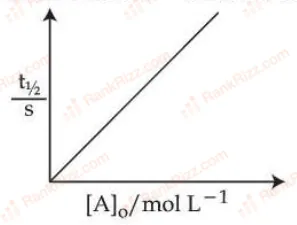
Statement II : For a first order reactions A→BA \to B,

Figure for JEE Main 2026 Chemistry question on Arrhenius equation and activation energy


Here [A]0[A]_0 is the initial concentration of A and t1/2t_{1/2} is half life of reaction.
In the light of the above statements, choose the correct answer from the options given below :

  1. A

    Both Statement I and Statement II are true

  2. B

    Both Statement I and Statement II are false

  3. C

    Statement I is true but Statement II is false

  4. D

    Statement I is false but Statement II is true
JEE MAIN 2026 · 06 APR S2Arrhenius equation and activation energy

Decomposition of a hydrocarbon follows the equation k=(5.5×10¹¹s−1)e−28000KTk = (5.5 \times 10^{11} s^{-1}) e^{\frac{-28000K}{T}}. The activation energy of reaction is __________ kJ mol−1^{-1}. (Nearest Integer) Given : R = 8.3 J K−1^{-1} mol−1^{-1}

JEE MAIN 2026 · 02 APR S1Arrhenius equation and activation energy

For reaction A →\rightarrow P, rate constant k = 1.5 × 10³^3 s−1^{-1} at 27°C. If activation energy for the above reaction is 60 kJ mol−1^{-1}, then the temperature (in °C) at which rate constant, k = 4.5 × 10³^3 s−1^{-1} is __________. (Nearest integer) Given : log 2 = 0.30, log 3 = 0.48, R = 8.3 J K−1^{-1} mol−1^{-1}, ln 10 = 2.3

JEE MAIN 2026 · 28 JAN S2Arrhenius equation and activation energy

A→BA \rightarrow B (first reaction)
C→DC \rightarrow D (second reaction)
Consider the above two first-order reactions. The rate constant for first reaction at 500 K is double of the same at 300 K. At 500 K, 50% of the reaction becomes complete in 2 hour. The activation energy of the second reaction is half of that of first reaction. lf the rate constant at 500 K of the second reaction becomes double of the rate constant of first reaction at the same temperature; then rate constant for the second reaction at 300 K is______×10−1hour−1\times 10^{-1}hour^{-1} (nearest integer).

JEE MAIN 2026 · 24 JAN S1Arrhenius equation and activation energy

At 27 °C in presence of a catalyst, activation energy of a reaction is lowered by 10KJ  mol−110 \text{KJ  mol}^{-1}. The logarithm of ratio of k(catalysed)k(uncatalysed)\frac{k(\text{catalysed})}{k(\text{uncatalysed})} is......
(Consider that the frequency factor for both the reactions is same)

  1. A

    3.482

  2. B

    17.41

  3. C

    0.1741

  4. D

    1.741

JEE MAIN 2026 · 22 JAN S1Arrhenius equation and activation energy

The temperature at which the rate constants of the given below two gaseous reactions become equal is ______ K. (Nearest integer)

X→YX \rightarrow Y k1=106e−30000Tk_{1}=10^{6}e^{\frac{-30000}{T}}

P→QP \rightarrow Q k2=104e−24000Tk_{2}=10^{4}e^{\frac{-24000}{T}}

Given: ln 10 = 2.303

JEE MAIN 2026 · 22 JAN S2Arrhenius equation and activation energy

Correct statements regarding Arrhenius equation among the following are :
A. Factor e−Ea/RTe^{-Ea / RT} corresponds to fraction of molecules having kinetic energy less than Ea.
B. At a given temperature, lower the Ea, faster is the reaction.
C. Increase in temperature by about 10∘C10^{\circ}C doubles the rate of reaction.
D. Plot of log k vs 1T\frac{1}{T} gives a straight line with slope = −EaR- \frac{Ea}{R}.
Choose the correct answer from the options given below :

  1. A

    A and B Only

  2. B

    A and C Only

  3. C

    B and D Only

  4. D

    B and C Only

JEE MAIN 2026 · 22 JAN S2Arrhenius equation and activation energy

Consider A→k1BA \xrightarrow{k_1} B and C→k2DC \xrightarrow{k_2} D are two reactions. If the rate constant (k1k_{1}) of the A→BA \rightarrow B reaction can be expressed by the followmg equation log⁡10K=14.34−1.5×10⁴T/K\log_{10}K = 14.34- \frac{1.5 \times 10^{4}}{T/K} and activation energy C→DC\rightarrow D reaction (Ea2Ea_{2}) is 15th\frac{1}{5}th of the A→BA\rightarrow B reaction (Ea1Ea_{1}), then the value of (Ea2Ea_{2}) is _____________kJ mol−1mol^{-1}. (Nearest Integer)

JEE MAIN 2026 · 21 JAN S1Arrhenius equation and activation energy

Pre-exponential factors of two different reactions of same order are identical. Let activation energy of first reaction exceeds the activation energy of second reaction by 20 kJ mol−1mol^{-1}. If k1 and k2k_{1}\text{ and }k_{2} are the rate constants of first and second reaction respectively at 300 K, then In k2k1\frac{k_{2}}{k_{1}} will be ___.
(nearest integer) [R=8.3JK−1mol−1][R=8.3JK^{-1}mol^{-1}]

JEE MAIN 2026Arrhenius equation and activation energy

A first order reaction is 50% completed in 20 minutes at 27 °C and in 5 minutes at 47 °C. The energy of activation of the reaction is:

(Given: ln 4=1.386)

  1. A

    43.85 kJ/mol

  2. B

    55.31 kJ/mol

  3. C

    11.91 kJ/mol

  4. D

    6.65 kJ/mol

JEE MAIN 2025 · 04 APR S1Arrhenius equation and activation energy

For A2+B2⇌2ABA_2 + B_2 \rightleftharpoons 2AB. EaE_a for forward and backward reaction are 180 and 200 kJ mol−1^{-1} respectively. If catalyst lowers EaE_a for both reaction by 100 kJ mol−1^{-1}. Which of the following statement is correct?

  1. A

    Catalyst does not alter the Gibbs energy change of a reaction.

  2. B

    Catalyst can cause non-spontaneous reactions to occur.

  3. C

    The enthalpy change for the reaction is +20 kJ mol−1^{-1}.

  4. D

    The enthalpy change for the catalysed reaction is different from that of uncatalysed reaction.

JEE MAIN 2025 · 04 APR S2Arrhenius equation and activation energy

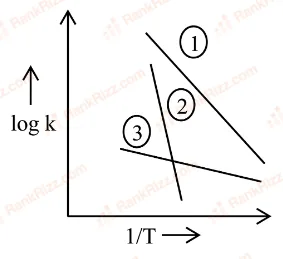
Consider the following plots of log of rate constant k (log k) vs 1T\frac{1}{T} for three different reactions. The correct order of activation energies of these reactions is :

Figure for JEE Main 2025 Chemistry question on Arrhenius equation and activation energy
  1. A

    Ea2>Ea1>Ea3Ea_2 > Ea_1 > Ea_3

  2. B

    Ea1>Ea3>Ea2Ea_1 > Ea_3 > Ea_2

  3. C

    Ea1>Ea2>Ea3Ea_1 > Ea_2 > Ea_3

  4. D

    Ea3>Ea2>Ea1Ea_3 > Ea_2 > Ea_1

JEE MAIN 2025 · 03 APR S2Arrhenius equation and activation energy

Consider the following statements related to temperature dependence of rate constants. Identify the correct statements:
A. The Arrhenius equation holds true only for an elementary homogenous reaction.
B. The unit of A is same as that of k in Arrhenius equation.
C. At a given temperature, a low activation energy means a fast reaction.
D. A and Ea as used in Arrhenius equation depend on temperature.
E. When Ea≫RTE_a \gg RT, A and EaE_a become interdependent.
Choose the correct answer  from the options given below :

  1. A

    A, C and D Only

  2. B

    B, D and E Only

  3. C

    B and C Only

  4. D

    A and B Only

JEE MAIN 2025 · 24 JAN S2Arrhenius equation and activation energy

Consider a complex reaction taking place in three steps with rate constants k1,  k2 and k3k_1,\; k_2 \text{ and } k_3 respectively. The overall rate constant  kk is given by k=k1k3k2k=\sqrt{\frac{k_1k_3}{k_2}}. If the activation energies of the three steps are 60,  3060,\;30  and  10 kJ mol−110\,kJ\,mol^{-1}  respectively, then the overall energy of activation in  kJ mol−1kJ\,mol^{-1} is  ‾.\underline{\hspace{2cm}}. (Nearest integer)

JEE MAIN 2025 · 22 JAN S1Arrhenius equation and activation energy

A→BA \rightarrow B The molecule A changes into its isomeric form B by following a first order kinetics at a temperature
of 1000 K . If the energy barrier with respect to reactant energy for such isomeric transformation is 191.48kJ191.48kJ Mol−1Mol^{-1} and the frequency factor is 1020,10^{20}, the time required for 50% molecules of A to become B is
_________ picoseconds (nearest integer). [R=8.314JK−1mol−1][R=8.314 JK^{-1} mol^{-1}]

JEE MAIN 2025 · 22 JAN S2Arrhenius equation and activation energy

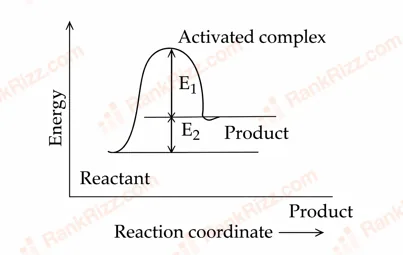
Consider the given figure and choose the correct option :

Figure for JEE Main 2025 Chemistry question on Arrhenius equation and activation energy
  1. A

    Activation energy of both forward and backward reaction is E1+E2E_{1}+E_{2} and reactant is more stable than product.

  2. B

    Activation energy of forward reaction is E1+E2E_{1}+E_{2} and product is less stable than reactant.

  3. C

    Activation energy of backward reaction is E1E_{1} and product is more stable than reactant.

  4. D

    Activation energy of forward reaction is E1+E2E_{1}+E_{2} and product is more stable than reactant.

JEE MAIN 2024 · 04 APR S1Arrhenius equation and activation energy

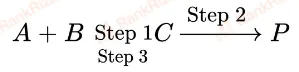
Consider the following transformation involving first order elementary reaction in each step at constant
temperature as shown below.

Figure for JEE Main 2024 Chemistry question on Arrhenius equation and activation energy

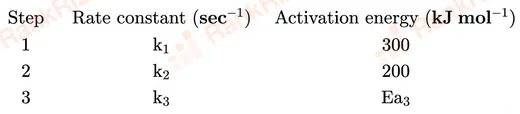
Some details of the above reactions are listed below.

Figure for JEE Main 2024 Chemistry question on Arrhenius equation and activation energy Figure for JEE Main 2024 Chemistry question on Arrhenius equation and activation energy
JEE MAIN 2024 · 29 JAN S1Arrhenius equation and activation energy

For a reaction taking place in three steps at same temperature, overall rate constant K=K1K2K3K = \frac{K_1 K_2}{K_3}. If Ea1,Ea2Ea_1, Ea_2 and Ea3Ea_3 are 40,5040, 50 and 6060 kJ/mol respectively, the overall EaEa is _______ kJ/mol.

JEE MAIN 2023 · 15 APR S1Arrhenius equation and activation energy

For a reversible reaction A ⇌\rightleftharpoons B, the ΔH\Delta H forward reaction =20= 20 kJ mol−1^{-1}. The activation energy of the uncatalyzed forward reaction is 300300 kJ mol−1^{-1}. When the reaction is catalysed keeping the reactant concentration same, the rate of the catalysed forward reaction at 27°27°C is found to be same as that of the uncatalyzed reaction at 327°327°C. The activation energy of the catalysed backward reaction is _____ kJ mol−1^{-1}.

JEE MAIN 2023 · 08 APR S1Arrhenius equation and activation energy

The number of given statement/s which is/are correct is______
(A) The stronger the temperature dependence of the rate constant, the higher is the activation energy.
(B) If a reaction has zero activation energy, its rate is independent of temperature.
(C) The stronger the temperature dependence of the rate constant, the smaller is the activation energy.
(D) If there is no correlation between the temperature and the rate constant then it means that the reaction has negative activation energy.

Arrhenius equation and activation energy: common questions

How many Arrhenius equation and activation energy questions have come in JEE Main?
Arrhenius equation and activation energy has been asked 62 times in JEE Main, in 16 different years between 2005 and 2026. It came up in all of the last five exam years (2022–2026), 32 questions in all.
Is Arrhenius equation and activation energy important for JEE Main?
It is one of the three most-asked topics in Chemical Kinetics: 62 of the chapter's 231 JEE Main questions (27%). It came up in all of the last five exam years (2022–2026), 32 questions in all.
When was Arrhenius equation and activation energy last asked in JEE Main?
Most recently in JEE Main 08 Apr 2026, Shift 2. Questions on this page are newest first, so the latest ones are at the top.
What kind of Arrhenius equation and activation energy questions does JEE Main ask?
30 are multiple choice and 32 numerical-value; 12 easy, 44 medium and 1 hard by our difficulty labels. Each question shows its answer key and worked solution where we have them.