RankRizz

Chemical Kinetics — JEE Main Previous Year Questions

Every Chemical Kinetics question JEE Main has set from 2004–2026, grouped by the idea it tests rather than the order of the syllabus. 231 questions across 8 distinct ideas. Free to read, answer key on every one.

DATA UPDATED

Questions

231

Distinct ideas

8

Share of marks

5.5%

Difficulty

MEDIUM

The ideas inside Chemical Kinetics

A chapter is not one subject — it is a handful of procedures the examiner reuses. These are the ones Chemical Kinetics questions actually test.

Every Chemical Kinetics question

201–220 OF 231 · NEWEST FIRST

JEE MAIN 2013 · 23 APR ONLINEIntegrated rate laws and half-life (zero and first order)

The rate constant of a zero order reaction is 2.0×10−22.0 \times 10^{-2} mol L−1^{-1} s−1^{-1}. If the concentration of the reactant after 25 seconds is 0.5M. What is the initial concentration?

  1. A

    0.5M

  2. B

    1.25M

  3. C

    12.5M

  4. D

    1.0M

JEE MAIN 2013 · 22 APR ONLINEArrhenius equation and activation energy

The reaction X →\rightarrow Y is an exothermic reaction. Activation energy of the reaction for X into Y is 150 kJ mol−1^{-1}. Enthalpy of reaction is 135 kJ mol−1^{-1}. The activation energy for the reverse reaction, Y →\rightarrow X will be :

  1. A

    280 kJ mol−1^{-1}

  2. B

    285 kJ mol−1^{-1}

  3. C

    270 kJ mol−1^{-1}

  4. D

    15 kJ mol−1^{-1}

JEE MAIN 2013 · 09 APR ONLINERate law, order and molecularity

The instantaneous rate of disappearance of MnO4−MnO_4^- ion in the following reaction is 4.56×10−34.56 \times 10^{-3} Ms−1^{-1}
2MnO4−+10I−+16H+→2Mn2++5I2+8H2O2MnO_4^- + 10I^- + 16H^+ \rightarrow 2Mn^{2+} + 5I_2 + 8H_2O
The rate of appearance of I2I_2 is :

  1. A

    4.56×10−44.56 \times 10^{-4} Ms−1^{-1}

  2. B

    1.14×10−21.14 \times 10^{-2} Ms−1^{-1}

  3. C

    1.14×10−31.14 \times 10^{-3} Ms−1^{-1}

  4. D

    5.7×10−35.7 \times 10^{-3} Ms−1^{-1}

JEE MAIN 2013 · 07 APR ONLINEArrhenius equation and activation energy

The rate of a reaction doubles when its temperature changes from 300K to 310K. Activation energy of such a reaction will be:
(R=8.314(R = 8.314 JK−1^{-1} mol−1^{-1} and log 2 = 0.301))

  1. A

    58.5 kJ mol−1^{-1}

  2. B

    60.5 kJ mol−1^{-1}

  3. C

    53.6 kJ mol−1^{-1}

  4. D

    48.6 kJ mol−1^{-1}

JEE MAIN 2012Integrated rate laws and half-life (zero and first order)

For a first order reaction, (A)→(A) \rightarrow products, the concentration of AA changes from 0.10.1 M to 0.0250.025 M in 4040 minutes. The rate of reaction when the concentration of AA is 0.010.01 M is :

  1. A

    1.73×10−51.73 \times 10^{-5} M/min

  2. B

    3.47×10−43.47 \times 10^{-4} M/min

  3. C

    3.47×10−53.47 \times 10^{-5} M/min

  4. D

    1.73×10−41.73 \times 10^{-4} M/min

JEE MAIN 2012Rate law, order and molecularity

Reaction rate between two substance AA and BB is expressed as following: rate=k[A]n[B]m\text{rate} = k[A]^n[B]^m. If the concentration of AA is doubled and concentration of BB is made half of initial concentration, the ratio of the new rate to the earlier rate will be:

  1. A

    m+nm + n

  2. B

    n−mn - m

  3. C

    12(m+n)\dfrac{1}{2^{(m+n)}}

  4. D

    2(n−m)2^{(n-m)}

JEE MAIN 2012Arrhenius equation and activation energy

The activation energy for a reaction which doubles the rate when the temperature is raised from 298 K to 308 K is

  1. A

    59.2 kJ mol−1^{-1}

  2. B

    39.2 kJ mol−1^{-1}

  3. C

    52.9 kJ mol−1^{-1}

  4. D

    29.5 kJ mol−1^{-1}

JEE MAIN 2012Methods to determine order of reaction

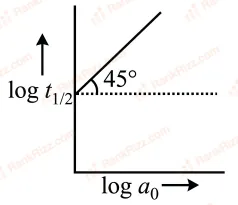
For a reaction A→A \rightarrow Products, a plot of log⁡t1/2\log t_{1/2} versus log⁡a0\log a_0 is shown in the figure. If the initial concentration of AA is represented by a0a_0, the order of the reaction is

Figure for JEE Main 2012 Chemistry question on Methods to determine order of reaction
  1. A

    one

  2. B

    zero

  3. C

    two

  4. D

    three

JEE MAIN 2012Methods to determine order of reaction

In a chemical reaction AA is converted into BB. The rates of reaction, starting with initial concentrations of AA as 2×10⁻³²\times 10^{-3} M and 1×10⁻³¹\times 10^{-3} M, are equal to 2.40×10−42.40\times 10^{-4} Ms−1^{-1} and 0.60×10−40.60\times 10^{-4} Ms−1^{-1} respectively. The order of reaction with respect to reactant AA will be

  1. A

    00

  2. B

    1.51.5

  3. C

    11

  4. D

    22

JEE MAIN 2011Arrhenius equation and activation energy

The rate of a chemical reaction doubles for every 10∘C10^\circ \text{C} rise of temperature. If the temperature is raised by 50∘C50^\circ \text{C}, the rate of the reaction increases by about:

  1. A

    2424 times

  2. B

    3232 times

  3. C

    6464 times

  4. D

    1010 times

JEE MAIN 2010Integrated rate laws and half-life (zero and first order)

The time for half life period of a certain reaction A→A \to products is 11 hour. When the initial concentration of the reactant 'AA' is 2.02.0 mol L−1^{-1}, how much time does it take for its concentration to come from 0.500.50 to 0.250.25 mol L−1^{-1} if it is a zero order reaction?

  1. A

    44 h

  2. B

    0.50.5 h

  3. C

    0.250.25 h

  4. D

    11 h

JEE MAIN 2010Rate law, order and molecularity

Consider the reaction: Cl2(aq)+H2S(aq)→S(s)+2H+(aq)+2Cl−(aq)\text{Cl}_2(\text{aq}) + \text{H}_2\text{S}(\text{aq}) \to \text{S}(\text{s}) + 2\text{H}^+(\text{aq}) + 2\text{Cl}^-(\text{aq}). The rate equation for this reaction is rate =k[Cl2][H2S]= k[\text{Cl}_2][\text{H}_2\text{S}]. Which of these mechanisms is/are consistent with this rate equation? (A) Cl2+H2S→H++Cl−+Cl++HS−\text{Cl}_2 + \text{H}_2\text{S} \to \text{H}^+ + \text{Cl}^- + \text{Cl}^+ + \text{HS}^- (slow); Cl++HS−→H++Cl−+S\text{Cl}^+ + \text{HS}^- \to \text{H}^+ + \text{Cl}^- + \text{S} (fast). (B) H2S↔H++HS−\text{H}_2\text{S} \leftrightarrow \text{H}^+ + \text{HS}^- (fast equilibrium); Cl2+HS−→2Cl−+H++S\text{Cl}_2 + \text{HS}^- \to 2\text{Cl}^- + \text{H}^+ + \text{S} (slow).

  1. A

    B only

  2. B

    Both A and B

  3. C

    Neither A nor B

  4. D

    A only

JEE MAIN 2009Integrated rate laws and half-life (zero and first order)

The half life period of a first order chemical reaction is 6.936.93 minutes. The time required for the completion of 99%99\% of the chemical reaction will be (log⁡2=0.301\log 2 = 0.301) :

  1. A

    230.3230.3 minutes

  2. B

    23.0323.03 minutes

  3. C

    46.0646.06 minutes

  4. D

    460.6460.6 minutes

JEE MAIN 2008Rate of reaction

For a reaction 12A→2B\frac{1}{2}A \to 2B, rate of disappearance of 'AA' is related to the rate of appearance of 'BB' by the expression

  1. A

    −d[A]dt=12d[B]dt-\frac{d[A]}{dt} = \frac{1}{2}\frac{d[B]}{dt}

  2. B

    −d[A]dt=14d[B]dt-\frac{d[A]}{dt} = \frac{1}{4}\frac{d[B]}{dt}

  3. C

    −d[A]dt=d[B]dt-\frac{d[A]}{dt} = \frac{d[B]}{dt}

  4. D

    −d[A]dt=4d[B]dt-\frac{d[A]}{dt} = 4\frac{d[B]}{dt}

JEE MAIN 2007Collision theory and effect of catalyst on rate

The energies of activation for forward and reverse reactions for A2+B2⇌2ABA_2 + B_2 \rightleftharpoons 2AB are 180 kJ mol−1mol^{-1} and 200 kJ mol−1mol^{-1} respectively. The presence of catalyst lowers the activation energy of both (forward and reverse) reactions by 100 kJ mol−1mol^{-1}. The enthalpy change of the reaction (A2+B2⟶2AB)(A_2 + B_2 \longrightarrow 2AB) in the presence of catalyst will be (in kJ mol−1mol^{-1})

  1. A

    300

  2. B

    120

  3. C

    280

  4. D

    20

JEE MAIN 2007Rate law, order and molecularity

Consider the reaction, 2A+B→2A + B \rightarrow Products. When concentration of BB alone was doubled, the half-life did not change. When the concentration of AA alone was doubled, the rate increased by two times. The unit of rate constant for this reaction is

  1. A

    L mol−1s−1mol^{-1} s^{-1}

  2. B

    no unit

  3. C

    mol L−1s−1L^{-1} s^{-1}

  4. D

    s−1s^{-1}

JEE MAIN 2007Radioactivity and nuclear reactions

A radioactive element gets spilled over the floor of a room. Its half-life period is 30 days. If the initial activity is ten times the permissible value, after how many days will it be safe to enter the room?

  1. A

    1000 days

  2. B

    300 days

  3. C

    10 days

  4. D

    100 days

JEE MAIN 2007Radioactivity and nuclear reactions

Which of the following nuclear reactions will generate an isotope?

  1. A

    neutron particle emission

  2. B

    positron emission

  3. C

    α\alpha-particle emission

  4. D

    β\beta-particle emission

JEE MAIN 2006Radioactivity and nuclear reactions

In the transformation of 92238U_{92}^{238}U to 92234U_{92}^{234}U, if one emission is an α\alpha-particle, what should be the other emission(s)?

  1. A

    Two β−\beta^-

  2. B

    Two β−\beta^- and one β+\beta^+

  3. C

    One β−\beta^- and one γ\gamma

  4. D

    One β+\beta^+ and one β−\beta^-

JEE MAIN 2006Rate law, order and molecularity

A reaction was found to be second order with respect to the concentration of carbon monoxide. If the concentration of carbon monoxide is doubled, with everything else kept the same, the rate of reaction will

  1. A

    remain unchanged

  2. B

    triple

  3. C

    increase by a factor of 4

  4. D

    double