RankRizz

Chemical Kinetics — JEE Main Previous Year Questions

Every Chemical Kinetics question JEE Main has set from 2004–2026, grouped by the idea it tests rather than the order of the syllabus. 231 questions across 8 distinct ideas. Free to read, answer key on every one.

DATA UPDATED

Questions

231

Distinct ideas

8

Share of marks

5.5%

Difficulty

MEDIUM

The ideas inside Chemical Kinetics

A chapter is not one subject — it is a handful of procedures the examiner reuses. These are the ones Chemical Kinetics questions actually test.

Every Chemical Kinetics question

21–40 OF 231 · NEWEST FIRST

JEE MAIN 2026 · 23 JAN S2Rate law, order and molecularity

Observe the following reactions at T(K).

I. A→A\rightarrowproducts
II. 5Br−(aq)+BrO3 −(aq)→3Br2(aq)+3H2O(l)5Br^{-}(aq)+BrO_{3}\text{ } ^{-}(aq)\rightarrow 3Br_2(aq)+3H_2O(l)

Both the reactions are started at 10.00 am. The rates of these reactions at 10.10 am are same. The value of −△[Br−]△t-\frac{\triangle[Br^{-}]}{\triangle t} at 10.10am. is 2×10⁻⁴mol L−1min−12\times 10^{-4} mol \text{ }L^{-1}min^{-1}. The concentration of A at 10.10am is 10−1mol L−110^{-1}mol \text{ } L^{-1}. What is the first order rate constant (in min−1min^{-1}) of reaction I?

  1. A

    10−310^{-3}

  2. B

    2×10⁻³²\times 10^{-3}

  3. C

    10−210^{-2}

  4. D

    4×10⁻³⁴\times10^{-3}

JEE MAIN 2026 · 22 JAN S1Rate law, order and molecularity

A→\rightarrow product (First order reaction).
Three sets of experiment were performed for a reaction under similar experimental conditions:

Run 1 ⇒\Rightarrow 100 mL of 10 M solution of reactant A

Run 2 ⇒\Rightarrow 200 mL of 10 M solution of reactant A

Run 3 ⇒\Rightarrow 100 mL of 10 M solution of reactant A + 100 mL of H2OH_{2}O added.

The correct variation of rate of reaction is

  1. A

    Rum l = Run 2 = Run 3

  2. B

    Run 1 < Run 2 < Run 3

  3. C

    Rum 3 < Run 1 < Run 2

  4. D

    Run 3 < Run 1 = Run 2

JEE MAIN 2026 · 22 JAN S1Arrhenius equation and activation energy

The temperature at which the rate constants of the given below two gaseous reactions become equal is ______ K. (Nearest integer)

X→YX \rightarrow Y k1=106e−30000Tk_{1}=10^{6}e^{\frac{-30000}{T}}

P→QP \rightarrow Q k2=104e−24000Tk_{2}=10^{4}e^{\frac{-24000}{T}}

Given: ln 10 = 2.303

JEE MAIN 2026 · 22 JAN S2Arrhenius equation and activation energy

Correct statements regarding Arrhenius equation among the following are :
A. Factor e−Ea/RTe^{-Ea / RT} corresponds to fraction of molecules having kinetic energy less than Ea.
B. At a given temperature, lower the Ea, faster is the reaction.
C. Increase in temperature by about 10∘C10^{\circ}C doubles the rate of reaction.
D. Plot of log k vs 1T\frac{1}{T} gives a straight line with slope = −EaR- \frac{Ea}{R}.
Choose the correct answer from the options given below :

  1. A

    A and B Only

  2. B

    A and C Only

  3. C

    B and D Only

  4. D

    B and C Only

JEE MAIN 2026 · 22 JAN S2Arrhenius equation and activation energy

Consider A→k1BA \xrightarrow{k_1} B and C→k2DC \xrightarrow{k_2} D are two reactions. If the rate constant (k1k_{1}) of the A→BA \rightarrow B reaction can be expressed by the followmg equation log⁡10K=14.34−1.5×10⁴T/K\log_{10}K = 14.34- \frac{1.5 \times 10^{4}}{T/K} and activation energy C→DC\rightarrow D reaction (Ea2Ea_{2}) is 15th\frac{1}{5}th of the A→BA\rightarrow B reaction (Ea1Ea_{1}), then the value of (Ea2Ea_{2}) is _____________kJ mol−1mol^{-1}. (Nearest Integer)

JEE MAIN 2026 · 21 JAN S1Arrhenius equation and activation energy

Pre-exponential factors of two different reactions of same order are identical. Let activation energy of first reaction exceeds the activation energy of second reaction by 20 kJ mol−1mol^{-1}. If k1 and k2k_{1}\text{ and }k_{2} are the rate constants of first and second reaction respectively at 300 K, then In k2k1\frac{k_{2}}{k_{1}} will be ___.
(nearest integer) [R=8.3JK−1mol−1][R=8.3JK^{-1}mol^{-1}]

JEE MAIN 2026 · 21 JAN S2Integrated rate laws and half-life (zero and first order)

Decompasition of A is a first order reaction at T(K) and is given by A(g)→B(g)+C(g)A(g) \rightarrow B(g)+C(g).
In a closed 1 L vessel, 1 bar A(g) is allowed to decompose at T(K). After 100 minutes, the total pressure was 1.5bar. What is the rate constant (in min−1)min^{-1}) of the reaction ? (log 2 = 0.3)

  1. A

    6.9×10−16.9 \times 10^{-1}

  2. B

    6.9×10−46.9 \times 10^{-4}

  3. C

    6.9×10−36.9 \times 10^{-3}

  4. D

    6.9×10−26.9 \times 10^{-2}

JEE MAIN 2026Integrated rate laws and half-life (zero and first order)

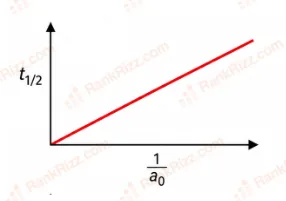
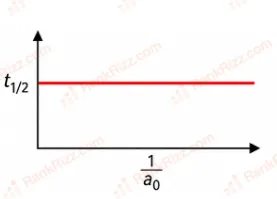
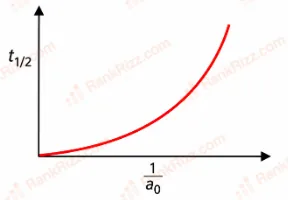
Which of the following graphs is correct for a second-order reaction?

  1. A
    Screenshot 2026-09-01 3
  2. B
    Screenshot 2026-09-01 3
  3. C
    Screenshot 2026-09-01 3
  4. D

    None of these

JEE MAIN 2026Arrhenius equation and activation energy

A first order reaction is 50% completed in 20 minutes at 27 °C and in 5 minutes at 47 °C. The energy of activation of the reaction is:

(Given: ln 4=1.386)

  1. A

    43.85 kJ/mol

  2. B

    55.31 kJ/mol

  3. C

    11.91 kJ/mol

  4. D

    6.65 kJ/mol

JEE MAIN 2025 · 08 APR S2Integrated rate laws and half-life (zero and first order)

In a first order decomposition reaction, the time taken for the decomposition of reactant to one fourth and one eighth of its initial concentration are t1t_1 and t2t_2 (s), respectively. The ratio t1/t2t_1/t_2 will :

  1. A

    43\frac{4}{3}

  2. B

    32\frac{3}{2}

  3. C

    34\frac{3}{4}

  4. D

    23\frac{2}{3}

JEE MAIN 2025 · 07 APR S1Integrated rate laws and half-life (zero and first order)

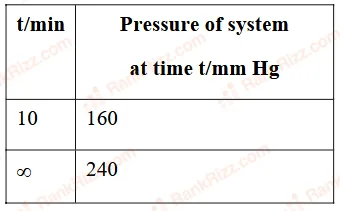
Reaction A(g)→2B(g)+C(g)A(g) \rightarrow 2B(g) + C(g) is a first order reaction. It was started with pure A.

Figure for JEE Main 2025 Chemistry question on Integrated rate laws and half-life (zero and first order)

Which of the following option is incorrect?

  1. A

    Initial pressure of A is 80 mm Hg

  2. B

    The reaction never goes to completion

  3. C

    Rate constant of the reaction is 1.693 min−1^{-1}

  4. D

    Partial pressure of A after 10 minute is 40 mm Hg

JEE MAIN 2025 · 07 APR S1Integrated rate laws and half-life (zero and first order)

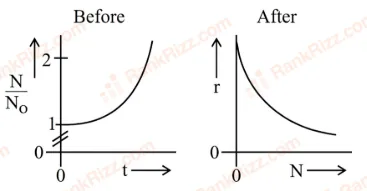
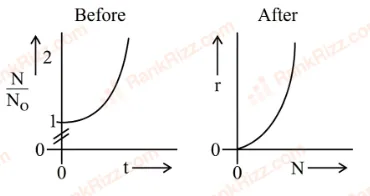
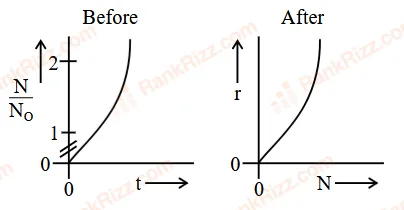
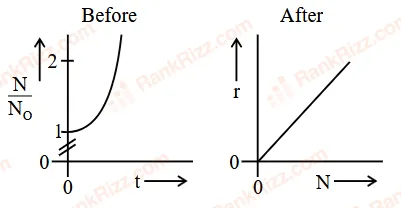
A person's wound was exposed to some bacteria and then bacteria growth started to happen at the same place. The wound was later treated with some antibacterial medicine and the rate of bacterial decay (r) was found to be proportional with the square of the existing number of bacteria at any instance. Which of the following set of graphs correctly represents the 'before' and 'after' situation of the application of the medicine?
[Given : N = No. of bacteria, t = time, bacteria growth follows IstI^{st} order kinetics.]

  1. A
    Figure for JEE Main 2025 Chemistry question on Integrated rate laws and half-life (zero and first order)
  2. B
    Figure for JEE Main 2025 Chemistry question on Integrated rate laws and half-life (zero and first order)
  3. C
    Figure for JEE Main 2025 Chemistry question on Integrated rate laws and half-life (zero and first order)
  4. D
    Figure for JEE Main 2025 Chemistry question on Integrated rate laws and half-life (zero and first order)
JEE MAIN 2025 · 07 APR S2Integrated rate laws and half-life (zero and first order)

A(g)→B(g)+C(g)A(g) \to B(g) + C(g) is a first order reaction.

Figure for JEE Main 2025 Chemistry question on Integrated rate laws and half-life (zero and first order)

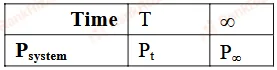
The reaction was started with reactant A only. Which of the following expression is correct for rate constant k?

  1. A

    k=1tln⁡2(p∞−Pt)Ptk = \frac{1}{t} \ln \frac{2(p_\infty - P_t)}{P_t}

  2. B

    k=1tln⁡p∞Ptk = \frac{1}{t} \ln \frac{p_\infty}{P_t}

  3. C

    k=1tln⁡p∞2(p∞−Pt)k = \frac{1}{t} \ln \frac{p_\infty}{2(p_\infty - P_t)}

  4. D

    k=1tln⁡p∞(p∞−Pt)k = \frac{1}{t} \ln \frac{p_\infty}{(p_\infty - P_t)}

JEE MAIN 2025 · 04 APR S1Arrhenius equation and activation energy

For A2+B2⇌2ABA_2 + B_2 \rightleftharpoons 2AB. EaE_a for forward and backward reaction are 180 and 200 kJ mol−1^{-1} respectively. If catalyst lowers EaE_a for both reaction by 100 kJ mol−1^{-1}. Which of the following statement is correct?

  1. A

    Catalyst does not alter the Gibbs energy change of a reaction.

  2. B

    Catalyst can cause non-spontaneous reactions to occur.

  3. C

    The enthalpy change for the reaction is +20 kJ mol−1^{-1}.

  4. D

    The enthalpy change for the catalysed reaction is different from that of uncatalysed reaction.

JEE MAIN 2025 · 04 APR S1Rate law, order and molecularity

Rate law for a reaction between A and B is given by R=k[A]n[B]mR = k[A]^n[B]^m. If concentration of A is doubled and concentration of B is halved from their initial value, the ratio of new rate of reaction to the initial rate of reaction (r2r1)\left(\dfrac{r_2}{r_1}\right) is

  1. A

    2(n−m)2^{(n-m)}

  2. B

    (n−m)(n - m)

  3. C

    (m+n)(m + n)

  4. D

    12m+n\dfrac{1}{2^{m+n}}

JEE MAIN 2025 · 04 APR S2Arrhenius equation and activation energy

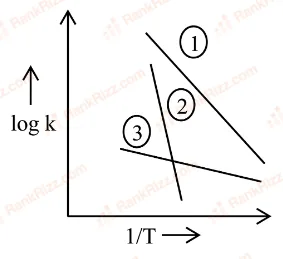
Consider the following plots of log of rate constant k (log k) vs 1T\frac{1}{T} for three different reactions. The correct order of activation energies of these reactions is :

Figure for JEE Main 2025 Chemistry question on Arrhenius equation and activation energy
  1. A

    Ea2>Ea1>Ea3Ea_2 > Ea_1 > Ea_3

  2. B

    Ea1>Ea3>Ea2Ea_1 > Ea_3 > Ea_2

  3. C

    Ea1>Ea2>Ea3Ea_1 > Ea_2 > Ea_3

  4. D

    Ea3>Ea2>Ea1Ea_3 > Ea_2 > Ea_1

JEE MAIN 2025 · 04 APR S2Integrated rate laws and half-life (zero and first order)

Half life of zero order reaction A→A \rightarrow product is 1 hour, when initial concentration of reaction is 2.0 mol L−1^{-1}. The time required to decrease concentration of A from 0.50 to 0.25 mol L−1^{-1} is:

  1. A

    0.5 hour

  2. B

    4 hour

  3. C

    15 min

  4. D

    60 min

JEE MAIN 2025 · 03 APR S1Integrated rate laws and half-life (zero and first order)

In a reaction A+B→CA + B \to C, initial concentrations of A and B are related as [A]0=8[B]0[A]_0 = 8[B]_0. The half lives of A and B are 10 min and 40 min respectively. If they start to disappear at the same time, both following first order kinetics, after how much time will the concentration of both the reactants be same?

  1. A

    6060 min

  2. B

    8080 min

  3. C

    2020 min

  4. D

    4040 min

JEE MAIN 2025 · 03 APR S2Arrhenius equation and activation energy

Consider the following statements related to temperature dependence of rate constants. Identify the correct statements:
A. The Arrhenius equation holds true only for an elementary homogenous reaction.
B. The unit of A is same as that of k in Arrhenius equation.
C. At a given temperature, a low activation energy means a fast reaction.
D. A and Ea as used in Arrhenius equation depend on temperature.
E. When Ea≫RTE_a \gg RT, A and EaE_a become interdependent.
Choose the correct answer  from the options given below :

  1. A

    A, C and D Only

  2. B

    B, D and E Only

  3. C

    B and C Only

  4. D

    A and B Only

JEE MAIN 2025 · 02 APR S1Integrated rate laws and half-life (zero and first order)

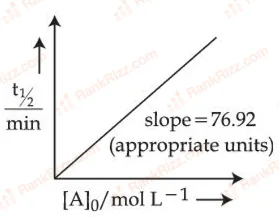
For the reaction A→A \rightarrow products.

Figure for JEE Main 2025 Chemistry question on Integrated rate laws and half-life (zero and first order)

The concentration of A at 10 minutes is _______ ×10−3\times 10^{-3} mol L−1^{-1}. (nearest integer).

The reaction was started with 2.5 mol L−1^{-1} of A.