RankRizz

Chemical Kinetics — JEE Main Previous Year Questions

Every Chemical Kinetics question JEE Main has set from 2004–2026, grouped by the idea it tests rather than the order of the syllabus. 231 questions across 8 distinct ideas. Free to read, answer key on every one.

DATA UPDATED

Questions

231

Distinct ideas

8

Share of marks

5.5%

Difficulty

MEDIUM

The ideas inside Chemical Kinetics

A chapter is not one subject — it is a handful of procedures the examiner reuses. These are the ones Chemical Kinetics questions actually test.

Every Chemical Kinetics question

61–80 OF 231 · NEWEST FIRST

JEE MAIN 2024 · 06 APR S2Integrated rate laws and half-life (zero and first order)

Consider the two different first order reactions given below A+B→CA + B \rightarrow C (Reaction 1) P→QP \rightarrow Q (Reaction 2). The ratio of the half life of Reaction 1 : Reaction 2 is 5:25 : 2. If t1t_1 and t2t_2 represent the time taken to complete 23rd\frac{2}{3}^{rd} and 45th\frac{4}{5}^{th} of Reaction 1 and Reaction 2, respectively, then the value of the ratio t1:t2t_1 : t_2 is ___________ ×10−1\times 10^{-1} (nearest integer). [Given : log⁡10(3)=0.477\log_{10}(3) = 0.477 and log⁡10(5)=0.699\log_{10}(5) = 0.699]

JEE MAIN 2024 · 05 APR S1Methods to determine order of reaction

During Kinetic study of reaction 2A+B→C+D2A + B \to C + D, the following results were obtained :
I: A = 0.1 M, B = 0.1 M, initial rate of formation of D = 6.0×10−36.0 \times 10^{-3}
II: A = 0.3 M, B = 0.2 M, initial rate = 7.20×10−27.20 \times 10^{-2}
III: A = 0.3 M, B = 0.4 M, initial rate = 2.88×10−12.88 \times 10^{-1}
IV: A = 0.4 M, B = 0.1 M, initial rate = 2.40×10−22.40 \times 10^{-2}
Based on above data, overall order of the reaction is ______

JEE MAIN 2024 · 05 APR S2Rate law, order and molecularity

Consider the following single step reaction in gas phase at constant temperature. 2A(g)+B(g)→C(g)2A_{(g)} + B_{(g)} \rightarrow C_{(g)}. The initial rate of the reaction is recorded as r1r_1 when the reaction starts with 1.51.5 atm pressure of A and 0.70.7 atm pressure of B. After some time, the rate r2r_2 is recorded when the pressure of C becomes 0.50.5 atm. The ratio r1:r2r_1 : r_2 is ______ ×10−1\times 10^{-1}. (Nearest integer)

JEE MAIN 2024 · 04 APR S1Arrhenius equation and activation energy

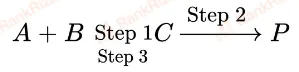
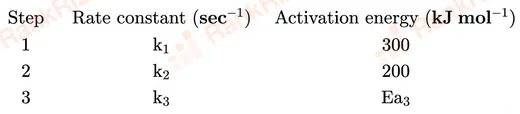
Consider the following transformation involving first order elementary reaction in each step at constant
temperature as shown below.

Figure for JEE Main 2024 Chemistry question on Arrhenius equation and activation energy

Some details of the above reactions are listed below.

Figure for JEE Main 2024 Chemistry question on Arrhenius equation and activation energy Figure for JEE Main 2024 Chemistry question on Arrhenius equation and activation energy
JEE MAIN 2024 · 04 APR S2Integrated rate laws and half-life (zero and first order)

Consider the following reaction, the rate expression of which is given below: 

A+B→CA + B \rightarrow C, rate=k[A]1/2[B]1/2= k[A]^{1/2}[B]^{1/2}.
The reaction is initiated by taking concentration of 11M of AA and BB each. If the rate constant (k)(k) is 4.6×10−24.6 \times 10^{-2} s−1^{-1}, then the time taken for AA to become 0.10.1M is ______ sec. (nearest integer)

JEE MAIN 2024 · 01 FEB S1Radioactivity and nuclear reactions

The ratio of 14C12C\frac{^{14}C}{^{12}C} in a piece of wood is 18\frac{1}{8} part that of atmosphere. If half life of 14C^{14}C is 57305730 years, the age of wood sample is _____ years.

JEE MAIN 2024 · 01 FEB S2Integrated rate laws and half-life (zero and first order)

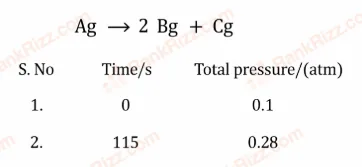
The following data were obtained during the first order thermal decomposition of a gas A at constant volume:

Figure for JEE Main 2024 Chemistry question on Integrated rate laws and half-life (zero and first order)


The rate constant of the reaction is ______ ×10−2 s−1\times 10^{-2} \text{ s}^{-1} (nearest integer)

JEE MAIN 2024 · 31 JAN S1Integrated rate laws and half-life (zero and first order)

Integrated rate law equation for a first order gas phase reaction is given by (where PiP_i is initial pressure and PtP_t is total pressure at time tt)

  1. A

    k=2.303t×log⁡Pi2Pi−Ptk = \frac{2.303}{t} \times \log\frac{P_i}{2P_i - P_t}

  2. B

    k=2.303t×log⁡2Pi2Pi−Ptk = \frac{2.303}{t} \times \log\frac{2P_i}{2P_i - P_t}

  3. C

    k=2.303t×log⁡2Pi−PtPik = \frac{2.303}{t} \times \log\frac{2P_i - P_t}{P_i}

  4. D

    k=2.303t×Pi2Pi−Ptk = \frac{2.303}{t} \times \frac{P_i}{2P_i - P_t}

JEE MAIN 2024 · 31 JAN S2Integrated rate laws and half-life (zero and first order)

r=kAr = kA for a reaction, 50% of A is decomposed in 120 minutes. The time taken for 90% decomposition of A is ______ minutes.

JEE MAIN 2024 · 30 JAN S1Integrated rate laws and half-life (zero and first order)

The rate of first order reaction is 0.04 mol L−1s−10.04 \text{ mol L}^{-1} \text{s}^{-1} at 1010 minutes and 0.03 mol L−1s−10.03 \text{ mol L}^{-1} \text{s}^{-1} at 2020 minutes after initiation. Half life of the reaction is ______ minutes. (Given log⁡2=0.3010\log 2 = 0.3010, log⁡3=0.4771\log 3 = 0.4771)
Round off your answer to the nearest integer.

JEE MAIN 2024 · 30 JAN S2Rate law, order and molecularity

NO2NO_2 required for a reaction is produced by decomposition of N2O5N_2O_5 in CCl4CCl_4 as by equation:
2N2O5(g)→4NO2(g)+O2(g)2N_2O_{5(g)} \rightarrow 4NO_{2(g)} + O_{2(g)}
The initial concentration of N2O5N_2O_5 is 3 mol L−1^{-1} and it is 2.75 mol L−1^{-1} after 30 minutes. The rate of formation of NO2NO_2 is x×10−3x \times 10^{-3} mol L−1^{-1} min−1^{-1}, value of xx is ________.

JEE MAIN 2024 · 29 JAN S1Arrhenius equation and activation energy

For a reaction taking place in three steps at same temperature, overall rate constant K=K1K2K3K = \frac{K_1 K_2}{K_3}. If Ea1,Ea2Ea_1, Ea_2 and Ea3Ea_3 are 40,5040, 50 and 6060 kJ/mol respectively, the overall EaEa is _______ kJ/mol.

JEE MAIN 2024 · 29 JAN S2Radioactivity and nuclear reactions

The half-life of radioisotopic bromine-82 is 3636 hours. The fraction which remains after one day is ______ ×10−2\times 10^{-2}.
(Given antilog 0.2006=1.5870.2006 = 1.587)

JEE MAIN 2024 · 27 JAN S1Methods to determine order of reaction

Consider the following data for the given reaction 2HI(g)→H2(g)+I2(g)2HI_{(g)} \rightarrow H_{2(g)} + I_{2(g)}. [HI] (mol L−1)[HI] \text{ (mol L}^{-1}\text{)}: 0.005,  0.01,  0.020.005, \; 0.01, \; 0.02. Rate (mol L−1 s−1)\text{(mol L}^{-1} \text{ s}^{-1}\text{)}: 7.5×10⁻⁴,  3.0×10⁻³,  1.2×10−27.5 \times 10^{-4}, \; 3.0 \times 10^{-3}, \; 1.2 \times 10^{-2}. The order of the reaction is _______.

JEE MAIN 2024 · 27 JAN S2Integrated rate laws and half-life (zero and first order)

Time required for completion of 99.9% of first order reaction is _____ times of half life (t1/2t_{1/2}) of the reaction

JEE MAIN 2023 · 15 APR S1Arrhenius equation and activation energy

For a reversible reaction A ⇌\rightleftharpoons B, the ΔH\Delta H forward reaction =20= 20 kJ mol−1^{-1}. The activation energy of the uncatalyzed forward reaction is 300300 kJ mol−1^{-1}. When the reaction is catalysed keeping the reactant concentration same, the rate of the catalysed forward reaction at 27°27°C is found to be same as that of the uncatalyzed reaction at 327°327°C. The activation energy of the catalysed backward reaction is _____ kJ mol−1^{-1}.

JEE MAIN 2023 · 13 APR S1Integrated rate laws and half-life (zero and first order)

t87.5_{87.5} is the time required for the reaction to undergo 87.5%87.5\% completion and t50_{50} is the time required for the reaction to undergo 50%50\% completion. The relation between t87.5_{87.5} and t50_{50} for a first order reaction is
t87.5_{87.5} = x ×\times t50_{50}
The value of x is _____. (Nearest integer)

JEE MAIN 2023 · 13 APR S2Integrated rate laws and half-life (zero and first order)

A(g) →\to 2B(g) + C(g) is a first order reaction. The initial pressure of the system was found to be 800800 mm Hg which increased to 16001600 mm Hg after 1010 min. The total pressure of the system after 3030 min will be _____ mm Hg. (Nearest integer)

JEE MAIN 2023 · 12 APR S1Methods to determine order of reaction

The reaction 22NO ++ Br2→2_2 \to 2 NOBr takes place through the mechanism given below
NO ++ Br2⇌_2 \rightleftharpoons NOBr2_2 (fast)
NOBr2+_2 + NO →2\to 2 NOBr (slow)
The overall order of the reaction is _____.

JEE MAIN 2023 · 11 APR S1Rate law, order and molecularity

KClO3_3 + 6FeSO4_4 + 3H2_2SO4_4 →\to KCl + 3Fe2_2(SO4_4)3_3 + 3H2_2O
The above reaction was studied at 300 K by monitoring the concentration of FeSO4_4 in which initial concentration was 10 M and after half an hour became 8.8 M. The rate of production of Fe2_2(SO4_4)3_3 is _______ ×10−6\times 10^{-6} mol L−1^{-1} s−1^{-1} (Nearest integer)