RankRizz

Chemical Kinetics — JEE Main Previous Year Questions

Every Chemical Kinetics question JEE Main has set from 2004–2026, grouped by the idea it tests rather than the order of the syllabus. 231 questions across 8 distinct ideas. Free to read, answer key on every one.

DATA UPDATED

Questions

231

Distinct ideas

8

Share of marks

5.5%

Difficulty

MEDIUM

The ideas inside Chemical Kinetics

A chapter is not one subject — it is a handful of procedures the examiner reuses. These are the ones Chemical Kinetics questions actually test.

Every Chemical Kinetics question

121–140 OF 231 · NEWEST FIRST

JEE MAIN 2022 · 24 JUN S1Arrhenius equation and activation energy

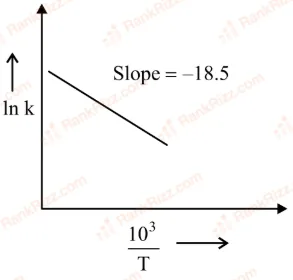
The rate constants for decomposition of acetaldehyde have been measured over the temperature range 700−1000700 - 1000 K. The data has been analysed by plotting ln⁡k\ln k vs 103T\frac{10^3}{T} graph. The value of activation energy for the reaction is ______ kJ mol−1^{-1}. (Nearest integer) (Given : R=8.31R = 8.31 J K−1^{-1} mol−1^{-1})

Figure for JEE Main 2022 Chemistry question on Arrhenius equation and activation energy
JEE MAIN 2022 · 24 JUN S2Integrated rate laws and half-life (zero and first order)

For a first order reaction, the time required for completion of 90%90\% reaction is 'xx' times the half life of the reaction. The value of 'xx' is
(Given: ln⁡10=2.303\ln 10 = 2.303 and log⁡2=0.3010\log 2 = 0.3010)

  1. A

    1.12

  2. B

    2.43

  3. C

    3.32

  4. D

    33.31

JEE MAIN 2021 · 01 SEP S2Arrhenius equation and activation energy

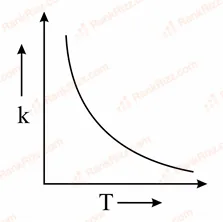
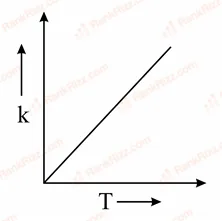
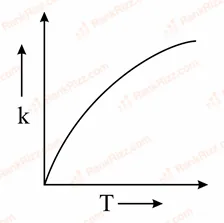
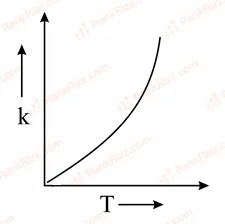
Which one of the following given graphs represents the variation of rate constant (k) with temperature (T) for an endothermic reaction?

  1. A
    Figure for JEE Main 2021 Chemistry question on Arrhenius equation and activation energy
  2. B
    Figure for JEE Main 2021 Chemistry question on Arrhenius equation and activation energy
  3. C
    Figure for JEE Main 2021 Chemistry question on Arrhenius equation and activation energy
  4. D
    Figure for JEE Main 2021 Chemistry question on Arrhenius equation and activation energy
JEE MAIN 2021 · 31 AUG S1Integrated rate laws and half-life (zero and first order)

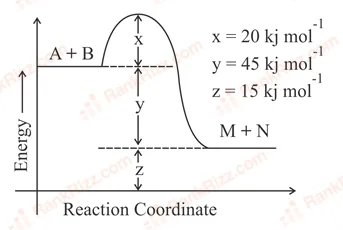
According to the following figure, the magnitude of the enthalpy change of the reaction A + B →\rightarrow M + N in kJ mol−1^{-1} is equal to _________. (Integer answer)

Figure for JEE Main 2021 Chemistry question on Integrated rate laws and half-life (zero and first order)
JEE MAIN 2021 · 31 AUG S1Integrated rate laws and half-life (zero and first order)

For a first order reaction, the ratio of the time for 75% completion of a reaction to the time for 50% completion is _________. (Integer answer)

JEE MAIN 2021 · 31 AUG S2Arrhenius equation and activation energy

For the reaction A →\rightarrow B, the rate constant k (in s−1^{-1}) is given by
log⁡10k=20.35−2.47×10³T\log_{10} k = 20.35 - \frac{2.47 \times 10^3}{T}
The energy of activation in kJ mol−1^{-1} is _________. (Nearest integer)
[Given : R = 8.314 J K−1^{-1} mol−1^{-1}]

JEE MAIN 2021 · 27 AUG S1Rate law, order and molecularity

The reaction that occurs in a breath analyser, a device used to determine the alcohol level in a person's blood stream is
2K2Cr2O7+8H2SO4+3C2H6O→2Cr2(SO4)3+3C2H4O2+2K2SO4+11H2O2K_2Cr_2O_7 + 8H_2SO_4 + 3C_2H_6O \rightarrow 2Cr_2(SO_4)_3 + 3C_2H_4O_2 + 2K_2SO_4 + 11H_2O
If the rate of appearance of Cr2(SO4)3Cr_2(SO_4)_3 is 2.67 mol min−1^{-1} at a particular time, the rate of disappearance of C2H6OC_2H_6O at the same time is _________ mol min−1^{-1}. (Nearest integer)

JEE MAIN 2021 · 27 AUG S2Arrhenius equation and activation energy

The first order rate constant for the decomposition of CaCO3_3 at 700 K is 6.36×10−36.36 \times 10^{-3} s−1^{-1} and activation energy is 209 kJ mol−1^{-1}. Its rate constant (in s−1^{-1}) at 600 K is x×10−6x \times 10^{-6}. The value of x is _________. (Nearest integer)
[Given R = 8.31 J K−1^{-1} mol−1^{-1}; log 6.36×10−36.36 \times 10^{-3} = -2.19, 10−4.7910^{-4.79} = 1.62×10−51.62 \times 10^{-5}]

JEE MAIN 2021 · 26 AUG S1Methods to determine order of reaction

The following data was obtained for chemical reaction given below at 975 K.
2NO(g)+2H2(g)→N2(g)+2H2O(g)2NO_{(g)} + 2H_{2(g)} \rightarrow N_{2(g)} + 2H_2O_{(g)}
[NO] = 8 ×10⁻⁵\times 10^{-5}, [H2_2] = 8 ×10⁻⁵\times 10^{-5}, Rate = 7 ×10⁻⁹\times 10^{-9}
[NO] = 24 ×10−5\times 10^{-5}, [H2_2] = 8 ×10⁻⁵\times 10^{-5}, Rate = 2.1 ×10⁻⁸\times 10^{-8}
[NO] = 24 ×10−5\times 10^{-5}, [H2_2] = 32 ×10−5\times 10^{-5}, Rate = 8.4 ×10⁻⁸\times 10^{-8}
The order of the reaction with respect to NO is _________ [Integer answer]

JEE MAIN 2021 · 26 AUG S2Rate law, order and molecularity

The reaction rate for the reaction
[PtCl4]2−+H2O⇌[Pt(H2O)Cl3]−+Cl−[PtCl_4]^{2-} + H_2O \rightleftharpoons [Pt(H_2O)Cl_3]^- + Cl^-
was measured as a function of concentrations of different species. It was observed that
−d[PtCl4]2−dt=4.8×10⁻⁵[PtCl4]2−−2.4×10⁻³[Pt(H2O)Cl3]−][Cl−]\frac{-d[PtCl_4]^{2-}}{dt} = 4.8 \times 10^{-5}[PtCl_4]^{2-} - 2.4 \times 10^{-3}[Pt(H_2O)Cl_3]^-][Cl^-]
where square brackets are used to denote molar concentrations.
The equilibrium constant Kc_c = X (Nearest integer). Value of 1X\frac{1}{X} is _________ 
Kc=XK_c = X (Nearest integer)

JEE MAIN 2021 · 27 JUL S1Rate law, order and molecularity

For a reaction of order n, the unit of the rate constant is:

  1. A

    mol1−n L1−n smol^{1-n} \, L^{1-n} \, s

  2. B

    mol1−n L2n s−1mol^{1-n} \, L^{2n} \, s^{-1}

  3. C

    mol1−n Ln−1 s−1mol^{1-n} \, L^{n-1} \, s^{-1}

  4. D

    mol1−n L1−n s−1mol^{1-n} \, L^{1-n} \, s^{-1}

JEE MAIN 2021 · 27 JUL S2Integrated rate laws and half-life (zero and first order)

For the first order reaction A →\rightarrow 2B, 1 mole of reactant A gives 0.2 moles of BB after 100 minutes. The half life of the reaction is _________ min. (Round off to nearest integer).
[Use:ln2=0.69,ln10=2.3Use: ln 2 = 0.69, ln 10 = 2.3
Properties of logarithms: ln⁡xy=yln⁡x\ln x^y = y \ln x
ln⁡(xy)=ln⁡x−ln⁡y\ln\left(\frac{x}{y}\right)=\ln x-\ln y]
(Round off to the nearest integer)

JEE MAIN 2021 · 25 JUL S1Integrated rate laws and half-life (zero and first order)

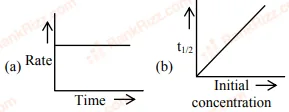
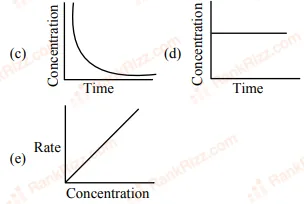
For the following graphs,

Figure for JEE Main 2021 Chemistry question on Integrated rate laws and half-life (zero and first order) Figure for JEE Main 2021 Chemistry question on Integrated rate laws and half-life (zero and first order)


Choose from the options given below, the correct one regarding order of reaction is:

  1. A

    (b) zero order (c) and (e) First order

  2. B

    (a) and (b) Zero order (e) First order

  3. C

    (b) and (d) Zero order (e) First order

  4. D

    (a) and (b) Zero order (c) and (e) First order

JEE MAIN 2021 · 25 JUL S2Rate law, order and molecularity

For a chemical reaction A →\rightarrow B, it was found that concentration of B is increased by 0.2 mol L−1^{-1} in 30 min. The average rate of the reaction is _________ ×10−1\times 10^{-1} mol L−1^{-1} h−1^{-1}. (in nearest integer)

JEE MAIN 2021 · 22 JUL S1Integrated rate laws and half-life (zero and first order)

N2_2O5(g)→_{5(g)} \to 2NO2(g)_{2(g)} + 12\frac{1}{2}O2(g)_{2(g)}
In the above first order reaction the initial concentration of N2_2O5_5 is 2.40×10−22.40 \times 10^{-2} mol L−1^{-1} at 318 K. The concentration of N2_2O5_5 after 1 hour was 1.60×10−21.60 \times 10^{-2} mol L−1^{-1}. The rate constant of the reaction at 318 K is ___ ×10−3\times 10^{-3} min−1^{-1} (Nearest integer):
[Given : log 3 = 0.477, log 5 = 0.699]

JEE MAIN 2021 · 20 JUL S1Integrated rate laws and half-life (zero and first order)

The inactivation rate of a viral preparation is proportional to the amount of virus. In the first minute after preparation, 10% of the virus is inactivated. The rate constant for viral inactivation is ___ ×10−3\times 10^{-3} min−1^{-1}.
(Nearest integer) [Use : ln 10 = 2.303; log⁡103=0.477\log_{10} 3 = 0.477 property of logarithm: log⁡xy=ylog⁡x\log x^y = y \log x]

JEE MAIN 2021 · 20 JUL S2Integrated rate laws and half-life (zero and first order)

PCl5_5(g) →\to PCl3_3(g) + Cl2_2(g)
In the above first order reaction the concentration of PCl5_5 reduces from initial concentration 50 mol L−1^{-1} to 10 mol L−1^{-1} in 120 minutes at 300 K. The rate constant for the reaction at 300 K is x ×10−2\times 10^{-2} min−1^{-1}. The value of x is ___.
[Given log 5 = 0.6989]

JEE MAIN 2021 · 18 MAR S2Integrated rate laws and half-life (zero and first order)

A reaction has a half life of 1 min. The time required for 99.9% completion of the reaction is ___ min.
(Round off to the Nearest integer)
[Use : ln 2 = 0.69, ln 10 = 2.3]

JEE MAIN 2021 · 17 MAR S1Integrated rate laws and half-life (zero and first order)

For a certain first order reaction 32% of the reactant is left after 570 s. The rate constant of this reaction is ________ ×10−3\times 10^{-3} s−1^{-1}. (Round off to the Nearest Integer).
[Given: log⁡102=0.301\log_{10} 2 = 0.301, ln⁡10=2.303\ln 10 = 2.303]

JEE MAIN 2021 · 17 MAR S2Rate law, order and molecularity

The reaction 2A+B2→2AB2A + B_2 \to 2AB is an elementary reaction. For a certain quantity of reactants, if the volume of the reaction vessel is reduced by a factor of 3, the rate of the reaction increases by a factor of ________. (Round off to the Nearest Integer).