RankRizz

Chemical Kinetics — JEE Main Previous Year Questions

Every Chemical Kinetics question JEE Main has set from 2004–2026, grouped by the idea it tests rather than the order of the syllabus. 231 questions across 8 distinct ideas. Free to read, answer key on every one.

DATA UPDATED

Questions

231

Distinct ideas

8

Share of marks

5.5%

Difficulty

MEDIUM

The ideas inside Chemical Kinetics

A chapter is not one subject — it is a handful of procedures the examiner reuses. These are the ones Chemical Kinetics questions actually test.

Every Chemical Kinetics question

41–60 OF 231 · NEWEST FIRST

JEE MAIN 2025 · 02 APR S2Rate law, order and molecularity

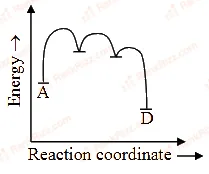
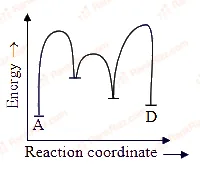
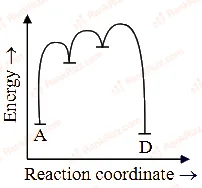
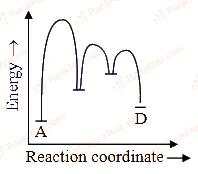
Reactant A converts to product D through the given mechanism (with the net evolution of heat) :
A→BA \to B   slow ; ΔH=+ve\Delta H = +ve
B→CB \to C   fast ; ΔH=−ve\Delta H = -ve
C→DC \to D   fast ; ΔH=−ve\Delta H = -ve

Which of the following represents the above reaction mechanism ?

  1. A
    Figure for JEE Main 2025 Chemistry question on Rate law, order and molecularity
  2. B
    Figure for JEE Main 2025 Chemistry question on Rate law, order and molecularity
  3. C
    Figure for JEE Main 2025 Chemistry question on Rate law, order and molecularity
  4. D
    Figure for JEE Main 2025 Chemistry question on Rate law, order and molecularity
JEE MAIN 2025 · 02 APR S2Rate law, order and molecularity

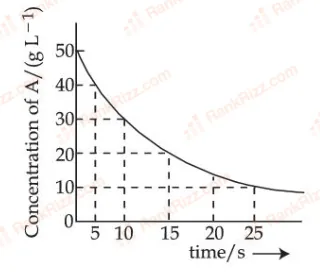
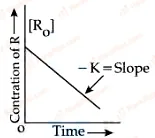
For the reaction A→BA \to B the following graph was obtained. The time required (in seconds) for the concentration of A to reduce to 2.5 g L−1^{-1} (if the initial concentration of A was 50 g L−1^{-1}) is _________.
(Nearest integer)
Given : log⁡2=0.3010\log 2 = 0.3010

Figure for JEE Main 2025 Chemistry question on Rate law, order and molecularity
JEE MAIN 2025 · 29 JAN S1Rate law, order and molecularity

The reaction A2+B2→2ABA_{2}+B_{2}\rightarrow 2AB follows the mechanism
A2k1A+A(fast)     k−1A+B2→k2AB+B(slow)A+B→AB(fast)A_{2}k_{1}A+A(fast)\\ \text{     }{_{k_{-1}}}\\ \\A+B_{2}\xrightarrow{k_{2}}AB+B(slow)\\A+B \rightarrow AB(fast)
The overall order of the reaction is :

  1. A

    2

  2. B

    2.5

  3. C

    3

  4. D

    1.5

JEE MAIN 2025 · 29 JAN S2Integrated rate laws and half-life (zero and first order)

Drug X becomes ineffective after 50% decomposition. The original concentration of drug in a bottle was 16mg/mL which becomes 4mg/mL in 12 months. The expiry time of the drug in months is _________
Assume that the decomposition of the drug follows first order kinetics.

  1. A

    2

  2. B

    6

  3. C

    12

  4. D

    3

JEE MAIN 2025 · 28 JAN S1Methods to determine order of reaction
page11_img1


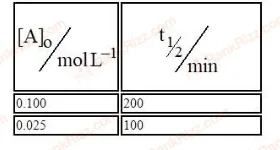
For a given reaction R→P,t1/2R\rightarrow P,t_{1/2} is related to [A]∘[A]_{\circ} as given in table. Given: log⁡2=0.30\log 2=0.30 Which of the following is true? A. The order of the reaction is 1/2.B.If [A]∘[A]_{\circ} is 1 M, then t1/2t_{1/2} is 20010min200\sqrt{10}min C.The order of the reaction changes to 1 if the concentration of reactant changes from 0.100 M to 0.500 M . D. t1/2t_{1/2} is 800 min for [A]∘=1.6M[A]_{\circ}=1.6M Choose the correct answer from the options given below: Options

  1. A

    A and C Only

  2. B

    A, B and D Only

  3. C

    C and D Only

  4. D

    A and B Only

JEE MAIN 2025 · 28 JAN S2Radioactivity and nuclear reactions

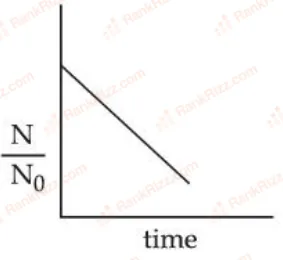
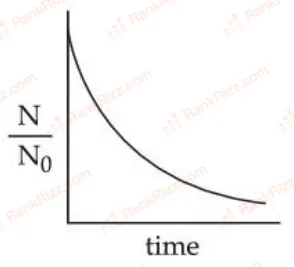
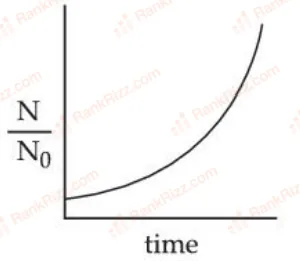
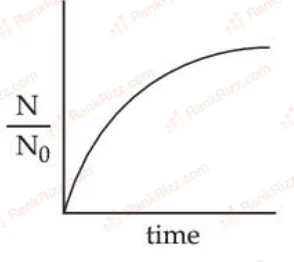
For bacterial growth in a cell culture, growth law is very similar to the law of radioactive decay. Which of the following graphs is most suitable to represent bacterial colony growth ? Where N - Number of Bacteria at any time, N0N_{0} - Initial number of Bacteria.

  1. A
    page9_img1
  2. B
    page9_img2
  3. C
    page9_img3
  4. D
    page9_img4
JEE MAIN 2025 · 28 JAN S2Rate law, order and molecularity

Consider an elementary reaction A(g)+B(g)→C(g)+D(g)A(g)+B(g)\rightarrow C(g)+D(g) If the volume of reaction mixture is suddenly reduced to 13\frac{1}{3} of its initial volume, the reaction rate will become 'x' times of the original reaction rate. The value of x is :

  1. A

    3

  2. B

    19\frac{1}{9}

  3. C

    9

  4. D

    13\frac{1}{3}

JEE MAIN 2025 · 24 JAN S1Rate of reaction

For a reaction, N2O5(g)→2NO2(g)+12O2(g)N_2O_5(g) \rightarrow 2NO_2(g) + \frac{1}{2}O_2(g) in a constant volume container, no products were present initially.  The final pressure of the system when 50%50\% of reaction gets completed is:

  1. A

    5 times of initial pressure5 \text{ times of initial pressure}

  2. B

    52 times of initial pressure\frac{5}{2} \text{ times of initial pressure}

  3. C

    72 times of initial pressure\frac{7}{2} \text{ times of initial pressure}

  4. D

    74 times of initial pressure\frac{7}{4} \text{ times of initial pressure}

JEE MAIN 2025 · 24 JAN S2Integrated rate laws and half-life (zero and first order)
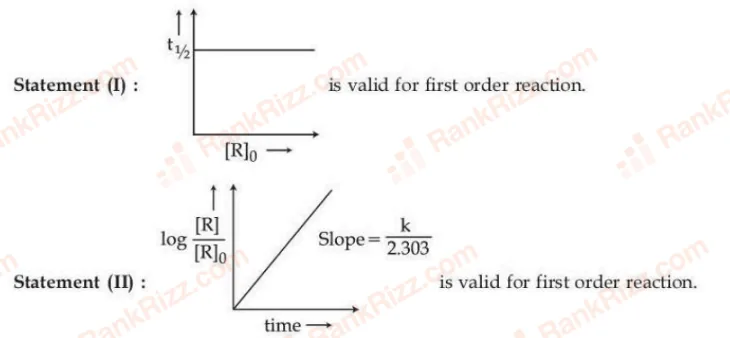
page12_img1

Given below are two statements :
In the light of the above statements, choose the correct answer from the options given below :

  1. A

    Both Statement I and Statement II are true

  2. B

    Statement I is false but Statement II is true

  3. C

    Statement I is true but Statement II is false

  4. D

    Both Statement I and Statement II are false

JEE MAIN 2025 · 24 JAN S2Arrhenius equation and activation energy

Consider a complex reaction taking place in three steps with rate constants k1,  k2 and k3k_1,\; k_2 \text{ and } k_3 respectively. The overall rate constant  kk is given by k=k1k3k2k=\sqrt{\frac{k_1k_3}{k_2}}. If the activation energies of the three steps are 60,  3060,\;30  and  10 kJ mol−110\,kJ\,mol^{-1}  respectively, then the overall energy of activation in  kJ mol−1kJ\,mol^{-1} is  ‾.\underline{\hspace{2cm}}. (Nearest integer)

JEE MAIN 2025 · 23 JAN S1Integrated rate laws and half-life (zero and first order)

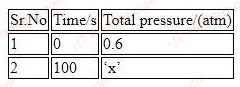
For the thermal decomposition of N2O5(g)N_{2}O_{5}(g) at constant volume, the following table can be formed, for the reaction mentioned below. 2N2O5(g)→2N2O4(g)+O2(g)2 N_{2}O_{5}(g)\rightarrow 2 N_{2}O_{4}(g)+O_{2}(g)
x=....×10−3x= .... \times 10^{-3} atm [nearest integer] Given : Rate constant for the reaction is 4.606×10⁻²s−1.4.606 \times 10^{-2} s^{-1}.

page12_img2
JEE MAIN 2025 · 23 JAN S2Integrated rate laws and half-life (zero and first order)

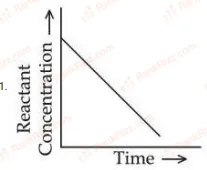
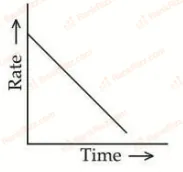
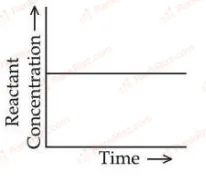
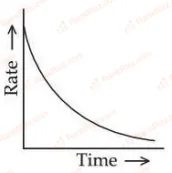
Which of the following graphs most appropriately represents a zero order reaction ?

  1. A
    page9_img1
  2. B
    page9_img2
  3. C
    page9_img3
  4. D
    page9_img4
JEE MAIN 2025 · 22 JAN S1Radioactivity and nuclear reactions

Which of the following statement is not true for radioactive decay?

  1. A

    Decay constant increases with increase in temperature.

  2. B

    Amount of radioactive substance remained after three half lives is 18th\frac{1}{8}th of original amount.

  3. C

    Decay constant does not depend upon temperature.

  4. D

    Half life is ln⁡2\ln 2 times of

JEE MAIN 2025 · 22 JAN S1Arrhenius equation and activation energy

A→BA \rightarrow B The molecule A changes into its isomeric form B by following a first order kinetics at a temperature
of 1000 K . If the energy barrier with respect to reactant energy for such isomeric transformation is 191.48kJ191.48kJ Mol−1Mol^{-1} and the frequency factor is 1020,10^{20}, the time required for 50% molecules of A to become B is
_________ picoseconds (nearest integer). [R=8.314JK−1mol−1][R=8.314 JK^{-1} mol^{-1}]

JEE MAIN 2025 · 22 JAN S2Arrhenius equation and activation energy

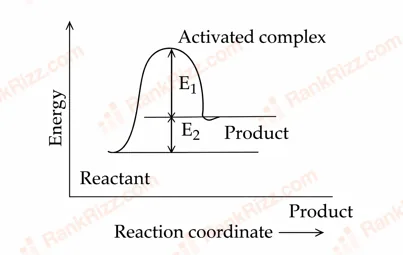
Consider the given figure and choose the correct option :

Figure for JEE Main 2025 Chemistry question on Arrhenius equation and activation energy
  1. A

    Activation energy of both forward and backward reaction is E1+E2E_{1}+E_{2} and reactant is more stable than product.

  2. B

    Activation energy of forward reaction is E1+E2E_{1}+E_{2} and product is less stable than reactant.

  3. C

    Activation energy of backward reaction is E1E_{1} and product is more stable than reactant.

  4. D

    Activation energy of forward reaction is E1+E2E_{1}+E_{2} and product is more stable than reactant.

JEE MAIN 2024 · 09 APR S1Methods to determine order of reaction


Given below are two statements : Statement I: The rate law for the reaction A+B→CA + B \rightarrow C is rate (r)=k[A]2[B](r) = k[A]^2[B]. When the concentration of both A and B is doubled, the reaction rate is increased "xx" times. Statement II : 

page10_img1

The figure is showing "the variation in concentration against time plot" for a "yy" order reaction. The Value of x+yx + y is ______

JEE MAIN 2024 · 09 APR S2Integrated rate laws and half-life (zero and first order)

Consider the following first order gas phase reaction at constant temperature A(g)→2B(g)+C(g)A(g) \to 2B(g) + C(g). If the total pressure of the gases is found to be 200 torr after 23 sec. and 300 torr upon the complete decomposition of A after a very long time, then the rate constant of the given reaction is ______ ×10−2 s−1\times 10^{-2} \text{ s}^{-1} (nearest integer) [Given : log⁡10(2)=0.301\log_{10}(2) = 0.301]

JEE MAIN 2024 · 08 APR S1Methods to determine order of reaction

Consider the following reaction A+B→CA + B \rightarrow C. The time taken for A to become 1/4th1/4^{th} of its initial concentration is twice the time taken to become 1/21/2 of the same. Also, when the change of concentration of BB is plotted against time, the resulting graph gives a straight line with a negative slope and a positive intercept on the concentration axis. The overall order of the reaction is ________

JEE MAIN 2024 · 08 APR S2Rate law, order and molecularity

For a reaction A→K1B→K2CA \xrightarrow{K_1} B \xrightarrow{K_2} C. If the rate of formation of BB is set to be zero then the concentration of BB is given by :

  1. A

    (K1+K2)[A](K_1 + K_2)[A]

  2. B

    (K1/K2)[A](K_1/K_2)[A]

  3. C

    (K1−K2)[A](K_1 - K_2)[A]

  4. D

    K1K2[A]K_1 K_2[A]

JEE MAIN 2024 · 06 APR S1Integrated rate laws and half-life (zero and first order)

Time required for 99.9% completion of a first order reaction is _______ times the time required for completion of 90% reaction. (nearest integer)