RankRizz

Chemical Kinetics — JEE Main Previous Year Questions

Every Chemical Kinetics question JEE Main has set from 2004–2026, grouped by the idea it tests rather than the order of the syllabus. 231 questions across 8 distinct ideas. Free to read, answer key on every one.

DATA UPDATED

Questions

231

Distinct ideas

8

Share of marks

5.5%

Difficulty

MEDIUM

The ideas inside Chemical Kinetics

A chapter is not one subject — it is a handful of procedures the examiner reuses. These are the ones Chemical Kinetics questions actually test.

Every Chemical Kinetics question

81–100 OF 231 · NEWEST FIRST

JEE MAIN 2023 · 11 APR S2Methods to determine order of reaction

For a chemical reaction A+B→A + B \to Product, the order is 1 with respect to AA and BB.

Rate (mol L−1^{-1} s−1^{-1})[A] (mol L−1^{-1})[B] (mol L−1^{-1})
0.10200.5
0.40x0.5
0.8040y

What is the value of x and y?
  1. A

    160 and 4

  2. B

    80 and 4

  3. C

    80 and 2

  4. D

    40 and 4

JEE MAIN 2023 · 10 APR S1Integrated rate laws and half-life (zero and first order)

A molecule undergoes two independent first order reactions whose respective half lives are 12 min and 3 min. If both the reactions are occurring then the time taken for the 50% consumption of the reactant is _______ min. (Nearest integer)

JEE MAIN 2023 · 10 APR S2Integrated rate laws and half-life (zero and first order)

The number of incorrect statement/s from the following is _______
A. The successive half lives of zero order reactions decreases with time.
B. A substance appearing as reactant in the chemical equation may not affect the rate of reaction
C. Order and molecularity of a chemical reaction can be a fractional number
D. The rate constant units of zero and second order reaction are mol L−1^{-1} s−1^{-1} and mol−1^{-1} L s−1^{-1} respectively

JEE MAIN 2023 · 08 APR S1Arrhenius equation and activation energy

The number of given statement/s which is/are correct is______
(A) The stronger the temperature dependence of the rate constant, the higher is the activation energy.
(B) If a reaction has zero activation energy, its rate is independent of temperature.
(C) The stronger the temperature dependence of the rate constant, the smaller is the activation energy.
(D) If there is no correlation between the temperature and the rate constant then it means that the reaction has negative activation energy.

JEE MAIN 2023 · 08 APR S2Arrhenius equation and activation energy

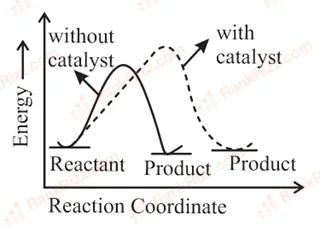
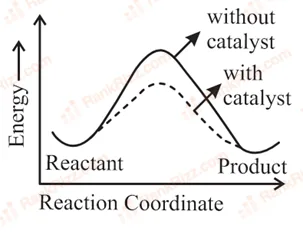
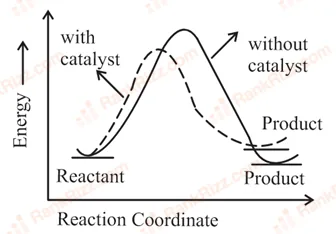
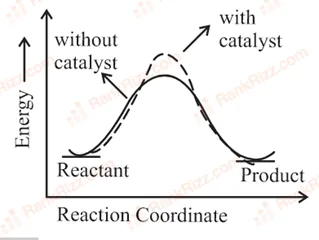
The correct reaction profile diagram for a positive catalyst reaction.

  1. A
    Figure for JEE Main 2023 Chemistry question on Arrhenius equation and activation energy
  2. B
    Figure for JEE Main 2023 Chemistry question on Arrhenius equation and activation energy
  3. C
    Figure for JEE Main 2023 Chemistry question on Arrhenius equation and activation energy
  4. D
    Figure for JEE Main 2023 Chemistry question on Arrhenius equation and activation energy
JEE MAIN 2023 · 06 APR S1Arrhenius equation and activation energy

For the adsorption of hydrogen on platinum, the activation energy is 30 kJ mol−1^{-1} and for the adsorption of hydrogen on nickel, the activation energy is 41.4 kJ mol−1^{-1}. The logarithm of the ratio of the rates of chemisorption on equal areas of the metals at 300 K is ______ (Nearest integer)
Given: ln10 = 2.3, R = 8.3 J K−1^{-1} mol−1^{-1}

JEE MAIN 2023 · 06 APR S2Integrated rate laws and half-life (zero and first order)

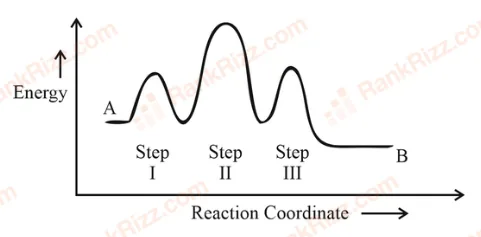
Consider the following reaction that goes from A to B in three steps as shown below:

Figure for JEE Main 2023 Chemistry question on Integrated rate laws and half-life (zero and first order)


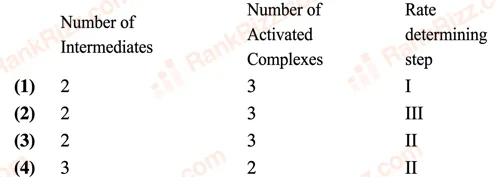
Choose the correct option

Figure for JEE Main 2023 Chemistry question on Integrated rate laws and half-life (zero and first order)
  1. A

    (1)

  2. B

    (2)

  3. C

    (3)

  4. D

    (4)

JEE MAIN 2023 · 01 FEB S1Integrated rate laws and half-life (zero and first order)

A and B are two substances undergoing radioactive decay in a container. The half life of A is 15 min and that of B is 5 min. If the initial concentration of B is 4 times that of A and they both start decaying at the same time, how much time will it take for the concentration of both of them to be same? _____ min.

JEE MAIN 2023 · 01 FEB S2Integrated rate laws and half-life (zero and first order)

A→B\text{A} \to \text{B}
The above reaction is of zero order. Half life of this reaction is 5050 min. The time taken for the concentration of A to reduce to one-fourth of its initial value is ______ min. (Nearest integer)

JEE MAIN 2023 · 31 JAN S1Arrhenius equation and activation energy

A→BA \rightarrow B
The rate constants of the above reaction at 200 K and 300 K are 0.03 min−1^{-1} and 0.05 min−1^{-1} respectively. The activation energy for the reaction is J (Nearest integer)
(Given: ln 10 = 2.3, R = 8.3 J K−1^{-1} mol−1^{-1}, log 5 = 0.70, log 3 = 0.48, log 2 = 0.30)

JEE MAIN 2023 · 31 JAN S2Integrated rate laws and half-life (zero and first order)

The rate constant for a first order reaction is 20 min−1^{-1}. The time required for the initial concentration of the reactant to reduce to its 132\dfrac{1}{32} level is ______ ×10−2\times 10^{-2} min. (Nearest integer)

JEE MAIN 2023 · 30 JAN S1Integrated rate laws and half-life (zero and first order)

If compound A reacts with B following first order kinetics with rate constant 2.011×10−32.011 \times 10^{-3} s−1^{-1}. The time taken by A (in seconds) to reduce from 77 g to 22 g will be ______. (Nearest Integer)
log5 = 0.698, log7 = 0.845, log2 = 0.301

JEE MAIN 2023 · 30 JAN S2Integrated rate laws and half-life (zero and first order)

An organic compound undergoes first order decomposition. If the time taken for the 60%60\% decomposition is 540540 s, then the time required for 90%90\% decomposition will be ______ s. (Nearest integer).
Given: ln⁡10=2.3\ln 10 = 2.3; log⁡2=0.3\log 2 = 0.3

JEE MAIN 2023 · 29 JAN S1Methods to determine order of reaction

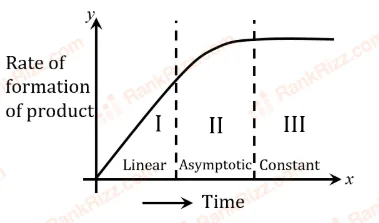
For certain chemical reaction X →\to Y, the rate of formation of product is plotted against the time as shown in the figure. The number of Correct statement/s from the following is ______

Figure for JEE Main 2023 Chemistry question on Methods to determine order of reaction

(A) Over all order of this reaction is one
(B) Order of this reaction can't be determined
(C) In region-I and III, the reaction is of first and zero order respectively
(D) In region-II, the reaction is of first order
(E) In region-II, the order of reaction is in the range of 0.1 to 0.9.

JEE MAIN 2023 · 29 JAN S2Methods to determine order of reaction

For conversion of compound A →\to B, the rate constant of the reaction was found to be 4.6×10−54.6 \times 10^{-5} L mol−1^{-1} s−1^{-1}. The order of the reaction is ______.

JEE MAIN 2023 · 25 JAN S1Integrated rate laws and half-life (zero and first order)

For the first order reaction A →\to B the half life is 30 min. The time taken for 75% completion of the reaction is _____ min. (Nearest integer)
Given: log 2 = 0.3010
log 3 = 0.4771
log 5 = 0.6989

JEE MAIN 2023 · 25 JAN S2Integrated rate laws and half-life (zero and first order)

A first order reaction has the rate constant, k = 4.6 ×10⁻³\times 10^{-3} s−1^{-1}. The number of correct statement/s from the following is/are Given: log 3 = 0.48.
A. Reaction completes in 1000 s.
B. The reaction has a half-life of 500 s.
C. The time required for 10% completion is 25 times the time required for 90% completion.
D. The degree of dissociation is equal to (1−e−kt)(1 - e^{-kt}).
E. The rate and the rate constant have the same unit.

JEE MAIN 2023 · 24 JAN S1Arrhenius equation and activation energy

The number of correct statement/s from the following is _____.
A. Larger the activation energy, smaller is the value of the rate constant.
B. The higher is the activation energy, higher is the value of the temperature coefficient.
C. At lower temperatures, increase in temperature causes more change in the value of k than at higher temperature.
D. A plot of ln⁡k\ln k vs 1T\frac{1}{T} is a straight line with slope equal to −EaR-\frac{E_a}{R}

JEE MAIN 2023 · 24 JAN S1Arrhenius equation and activation energy

The number of correct statement/s from the following is _____.
A. Larger the activation energy, smaller is the value of the rate constant.
B. The higher is the activation energy, higher is the value of the temperature coefficient.
C. At lower temperatures, increase in temperature causes more change in the value of k than at higher temperature.
D. A plot of ln k vs 1T\frac{1}{T} is a straight line with slope equal to −EaR\frac{-E_a}{R}

JEE MAIN 2023 · 24 JAN S2Methods to determine order of reaction

A student has studied the decomposition of a gas AB3AB_3 at 25°C. He obtained the following data

p (mm Hg)50100200400
Relative t1/2t_{1/2} (s)4210.5


The order of the reaction is

  1. A

    0.5

  2. B

    2

  3. C

    1

  4. D

    0