The decomposition of formic acid on gold surface follows first order kinetics. If the rate constant at 300 K is s and the activation energy kJ mol, the rate constant at 200 K is ________ s. (Round off to the Nearest Integer).
[Given J mol K]
Every Chemical Kinetics question JEE Main has set from 2004–2026, grouped by the idea it tests rather than the order of the syllabus. 231 questions across 8 distinct ideas. Free to read, answer key on every one.
DATA UPDATED
Questions
231
Distinct ideas
8
Share of marks
5.5%
Difficulty
MEDIUM
A chapter is not one subject — it is a handful of procedures the examiner reuses. These are the ones Chemical Kinetics questions actually test.
141–160 OF 231 · NEWEST FIRST
The decomposition of formic acid on gold surface follows first order kinetics. If the rate constant at 300 K is s and the activation energy kJ mol, the rate constant at 200 K is ________ s. (Round off to the Nearest Integer).
[Given J mol K]
A and B decompose via first order kinetics with half-lives 54.0 min and 18.0 min respectively. Starting from an equimolar non-reactive mixture of A and B, the time taken for the concentration of A to become 16 times that of B is ________ min. (Round off to the Nearest Integer).
Which of the following forms of hydrogen emits low energy particles?
Deuterium
Proton
Tritium
Protium
If the activation energy of a reaction is 80.9 kJ mol, the fraction of molecules at 700 K, having enough energy to react to form products is . The value of is (Rounded off to the nearest integer) [Use R = 8.31 J K mol]
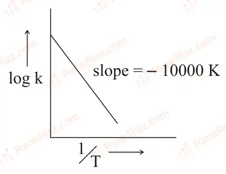
For the reaction, , the plot of log k v/s is given below:
The temperature at which the rate constant of the reaction is s is ______ K.
(Rounded-off to the nearest integer) [Given: The rate constant of the reaction is s at 500 K.]
The rate constant of a reaction increases by five times on increase in temperature from 27°C to 52°C. The value of activation energy in kJ mol is ______. (Rounded-off to the nearest integer) [ J K mol]
Gaseous cyclobutene isomerizes to butadiene in a first order process which has a 'K' value of s at 153°C. The time in minutes it takes for the isomerization to proceed 40% to completion at this temperature is ______ (Rounded off to the nearest integer)
Sucrose hydrolyses in acid solution into glucose and fructose following first order rate law with a half-life of 3.33 h at 25°C. After 9 h, the fraction of sucrose remaining is f. The value of is ______ .
(Rounded off to the nearest integer)
[Assume: ln10 = 2.303, ln 2 = 0.693]
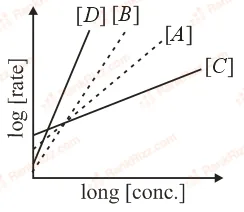
Consider the following reactions:
The order of the above reactions are a, b, c and d, respectively. The following graph is obtained when log[rate] vs log[conc.] are plotted:
Among the following, the correct sequence for the order of the reactions is:
The rate of a reaction decreased by 3.555 times when the temperature was changed from to . The activation energy (in ) of the reaction is______.
A flask contains a mixture of compounds A and B. Both compounds decompose by first-order kinetics. The half-lives for A and B are and , respectively. If the concentrations of A and B are equal initially, the time required for the concentration of A to be four times that of B (in s) is: (Use )
180
900
300
120
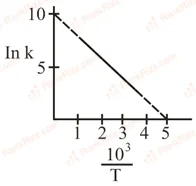
The rate constant of a reaction is measured at different temperature , and the data are plotted in the given figure. The activation energy of the reaction in is: (R is gas constant)

If 75% of a first order reaction was completed in 90 minutes, 60% of the same reaction would be completed in approximately (in minutes) __________ (Take: log 2 = 0.30; log 2.5 = 0.40)
The number of molecules with energy greater than the threshold energy for a reaction increases five fold by a rise of temperature from 27°C to 42°C. Its energy of activation in J/mol is __________ (Take ln 5 = 1.6094; R = 8.314 J mol)
It is true that:
A second order reaction is always a multistep reaction
A zero order reaction is a multi-step reaction
A first order reaction is always a single step reaction
A zero order reaction is a single step reaction
For the reaction , which statement is correct?
The results given in the below table were obtained during kinetic studies of the following reaction:
| Experiment | [A]/mol L | [B]/mol L | Initial rate/mol L min |
|---|---|---|---|
| I | 0.1 | 0.1 | |
| II | 0.1 | 0.2 | |
| III | 0.2 | 0.1 | |
| IV | X | 0.2 | |
| V | 0.3 | Y |
X and Y in the given table are respectively:
0.4, 0.4
0.4, 0.3
0.3, 0.4
0.3, 0.3
For the following reactions:
It was found that the is decreased by 30 KJ/mol in the presence of catalyst. If the rate remains unchanged, the activation energy for catalysed reaction is (Assume pre-exponential factor is same):
75 KJ/mol
105 KJ/mol
135 KJ/mol
198 KJ/mol
A sample of milk splits after 60 min at 300K and after 40 min at 400K when the population of lactobacillus acidophilus in it doubles. The activation energy (in kJ/mol) for this process is closest to ___________.
(Given, J mol K, , )
The rate of a certain biochemical reaction at physiological temperature (T) occurs times faster with enzyme than without. The change in the activation energy upon adding enzyme is:
JEE Advanced has set 33 Chemical Kinetics questions too. Chemical Kinetics JEE Advanced PYQs →
OTHER CHEMISTRY CHAPTERS