For a reaction , of X, of Y and of Z were taken in a 1L vessel and allowed to react. At equilibrium, the concentration of Z was . The equilibrium constant of the reaction is . The value of x is.......
Every Chemical and Ionic Equilibrium question JEE Main has set from 2004–2026, grouped by the idea it tests rather than the order of the syllabus. 274 questions across 10 distinct ideas. Free to read, answer key on every one.
DATA UPDATED
Questions
274
Distinct ideas
10
Share of marks
5.7%
Difficulty
MEDIUM
A chapter is not one subject — it is a handful of procedures the examiner reuses. These are the ones Chemical and Ionic Equilibrium questions actually test.
161–180 OF 274 · NEWEST FIRST
For a reaction , of X, of Y and of Z were taken in a 1L vessel and allowed to react. At equilibrium, the concentration of Z was . The equilibrium constant of the reaction is . The value of x is.......
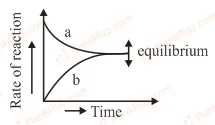
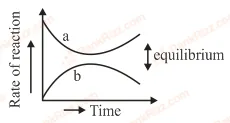
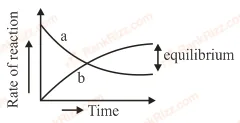
For the equilibrium , the variation of the rate of the forward (a) and reverse (b) reaction with time is given by:


If the equilibrium constant for is and that of is , the equilibrium constant for is:
An acidic buffer is obtained on mixing:
100 mL of 0.1 M CHCOOH and 100 mL of 0.1 M NaOH
100 mL of 0.1 M HCl and 200 mL of 0.1 M NaCl
100 mL of 0.1 M CHCOOH and 200 mL of 0.1 M NaOH
100 mL of 0.1 M HCl and 200 mL of 0.1 M CHCOONa
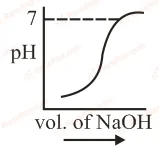
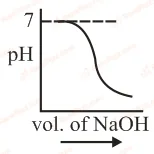
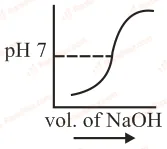
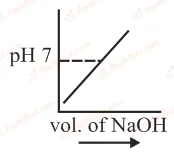
100 mL of 0.1 M HCl is taken in a beaker and to it 100 mL 0.1 M NaOH of is added in steps of 2 mL and the pH is continuously measured. Which of the following graphs correctly depicts the change in pH?


For the following Assertion and Reason, the correct option is:
Assertion (A): When Cu (II) and sulphide ions are mixed, they react together extremely quickly to give a solid.
Reason (R): The equilibrium constant of is high because the solubility product is low.
(A) is false and (R) is true.
Both (A) and (R) are false.
Both (A) and (R) are true but (R) is not the explanation for (A).
Both (A) and (R) are true and (R) is the explanation for (A).
The for the following dissociation is
Which of the following choices is correct for a mixture of 300 mL 0.134 M and 100 mL 0.4 M NaCl?
Not enough data provided
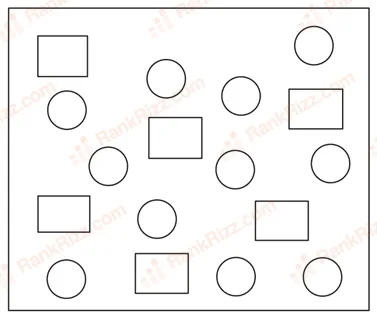
In the figure shown below reactant A (represented by square) is in equilibrium with product B (represented by circle). The equilibrium constant is (approx):

4
8
1
2
The solubility product of at 298K is . The concentration of hydroxide ions in a saturated solution of will be:
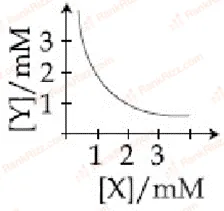
The stoichiometry and solubility product of a salt with the solubility curve given below is, respectively:

XY, M
XY, M
XY, M
XY, M
The strength of an aqueous NaOH solution is most accurately determined by titrating: (Note: consider that an appropriate indicator is used)
Aq. NaOH in a pipette and aqueous oxalic acid in a burette
Aq. NaOH in a burette and aqueous oxalic acid in a conical flask
Aq. NaOH in a burette and concentrate HSO in a conical flask
Aq. NaOH in a volumetric flask and concentrated HSO in a conical flask
For the following Assertion and Reason, the correct option is:
Assertion: The pH of water increases with increase in temperature.
Reason: The dissociation of water into H and OH is an exothermic reaction.
Both assertion and reason are true, and the reason is the correct explanation for the assertion.
Both assertion and reason are false.
Both assertion and reason are true, but the reason is not the correct explanation for the assertion.
Assertion is not true, but reason is true.
Two solutions, A and B, each of 100L was made by dissolving 4g of NaOH and 9.8g of HSO in water, respectively. The pH of the resultant solution obtained from mixing 40L of solution A and 10L of solution B is (log 2 = 0.3)
3 g of acetic acid is added to 250 mL of 0.1 M HCl and the solution made up to 500 mL. To 20 mL of this solution mL of 5M NaOH is added. The pH of the solution is
[Given: pKa of acetic acid = 4.75, molar mass of acetic acid 60 g/mol, log 3 = 0.4771, Neglect any changes in volume]
What is the molar solubility of Al(OH) in 0.2 M NaOH solution? Given that, solubility product of Al(OH) = :
The incorrect match in the following is:
In which one of the following equilibria, K ≠ K?
2HI(g) H(g) + I(g)
2C(s) + O(g) 2CO(g)
2NO(g) N(g) + O(g)
NO(g) + SO(g) NO(g) + SO(g)
The molar solubility of Cd(OH) is M in water. The expected solubility of Cd(OH) in a buffer solution of pH = 12 is:
M
M
M
M
Consider the following statements
(a) The pH of a mixture containing 400 mL of 0.1 M HSO and 400 mL of 0.1 M NaOH will be approximately 1.3.
(b) Ionic product of water is temperature dependent.
(c) A monobasic acid with K = 10 has a pH = 5. The degree of dissociation of this acid is 50%.
(d) The Le Chatelier's principle is not applicable to common-ion effect.
The correct statements are:
(b) and (c)
(a), (b) and (d)
(a) and (b)
(a), (b) and (c)
For the reaction,
2SOg + Og 2SO g,
ΔH = -57.2 kJ mol and K = .
Which of the following statements is incorrect?
The equilibrium constant is large suggestive of reaction going to completion and so, no catalyst is required.
The equilibrium will shift in forward direction as the pressure increases.
The equilibrium constant decreases as the temperature increases.
The addition of inert gas at constant volume will not affect the equilibrium constant.
JEE Advanced has set 24 Chemical and Ionic Equilibrium questions too. Chemical and Ionic Equilibrium JEE Advanced PYQs →
OTHER CHEMISTRY CHAPTERS