RankRizz

Chemical and Ionic Equilibrium — JEE Main Previous Year Questions

Every Chemical and Ionic Equilibrium question JEE Main has set from 2004–2026, grouped by the idea it tests rather than the order of the syllabus. 274 questions across 10 distinct ideas. Free to read, answer key on every one.

DATA UPDATED

Questions

274

Distinct ideas

10

Share of marks

5.7%

Difficulty

MEDIUM

The ideas inside Chemical and Ionic Equilibrium

A chapter is not one subject — it is a handful of procedures the examiner reuses. These are the ones Chemical and Ionic Equilibrium questions actually test.

Every Chemical and Ionic Equilibrium question

181–200 OF 274 · NEWEST FIRST

JEE MAIN 2019 · 10 APR S2Hydrolysis of salts

The pH of a 0.02 M NH4_4Cl solution will be [Given: Kb_b NH4_4OH = 10−5^{-5} and log 2 = 0.301]

  1. A

    4.65

  2. B

    2.65

  3. C

    4.35

  4. D

    5.35

JEE MAIN 2019 · 09 APR S2pH of acids, bases and their mixtures

In an acid-base titration, 0.1 M HCl solution was added to the NaOH solution of unknown strength. Which of the following correctly shows the change of pH of the titration mixture in this experiment?
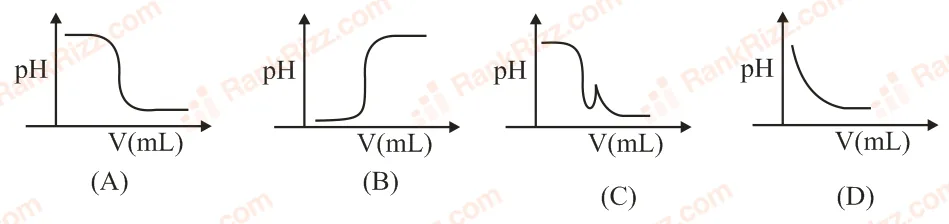
Figure for JEE Main 2019 Chemistry question on pH of acids, bases and their mixtures
  1. A

    A

  2. B

    B

  3. C

    D

  4. D

    C

JEE MAIN 2019 · 08 APR S1Solubility product and common ion effect

If solubility product of Zr3_3(PO4_4)4_4 is denoted by Ksp_{sp} and its molar solubility is denoted by S, then which of the following relation between S and Ksp_{sp} is correct?

  1. A

    S=(Ksp144)1/6S = \left(\frac{K_{sp}}{144}\right)^{1/6}

  2. B

    S=(Ksp6912)1/7S = \left(\frac{K_{sp}}{6912}\right)^{1/7}

  3. C

    S=(Ksp929)1/9S = \left(\frac{K_{sp}}{929}\right)^{1/9}

  4. D

    S=(Ksp216)1/7S = \left(\frac{K_{sp}}{216}\right)^{1/7}

JEE MAIN 2019 · 08 APR S2Law of mass action and equilibrium constants Kc and Kp

For the following reaction, equilibrium constants are given:
S(s)+O2(g)⇌SO2(g);K1=1052S(s) + O_2(g) \rightleftharpoons SO_2(g); \quad K_1 = 10^{52}
2S(s)+3O2(g)⇌2SO3(g);K2=101292S(s) + 3O_2(g) \rightleftharpoons 2SO_3(g); \quad K_2 = 10^{129}
The equilibrium constant for the reaction, 2SO2(g)+O2(g)⇌2SO3(g)2SO_2(g) + O_2(g) \rightleftharpoons 2SO_3(g) is:

  1. A

    1015410^{154}

  2. B

    102510^{25}

  3. C

    1018110^{181}

  4. D

    107710^{77}

JEE MAIN 2019 · 12 JAN S1Law of mass action and equilibrium constants Kc and Kp

In a chemical reaction, A+2B⇌K2C+DA + 2B \xrightleftharpoons{K} 2C + D, the initial concentration of B was 1.5 times the concentration of A, but the equilibrium concentrations of A and B were found to be equal. The equilibrium constant (K) for the chemical reaction is:

  1. A

    1

  2. B

    4

  3. C

    14\frac{1}{4}

  4. D

    16

JEE MAIN 2019 · 12 JAN S1Law of mass action and equilibrium constants Kc and Kp

Two solids dissociate as follows: A(s)⇌B(g)+C(g)A(s) \rightleftharpoons B(g) + C(g); KP1=xK_{P_1} = x atm2^2, D(s)⇌C(g)+E(g)D(s) \rightleftharpoons C(g) + E(g); KP2=yK_{P_2} = y atm2^2. The total pressure when both the solids dissociate simultaneously is:

  1. A

    x+y\sqrt{x+y} atm

  2. B

    x2+y2x^2 + y^2 atm

  3. C

    (x + y) atm

  4. D

    2(x+y)2\left(\sqrt{x+y}\right) atm

JEE MAIN 2019 · 12 JAN S2Solubility product and common ion effect

If KspK_{sp} of Ag2CO3Ag_2CO_3 is 8×10−128 \times 10^{-12}, the molar solubility of Ag2CO3Ag_2CO_3 in 0.1 M AgNO3AgNO_3 is:

  1. A

    8×10−138 \times 10^{-13} M

  2. B

    8×10−118 \times 10^{-11} M

  3. C

    8×10−128 \times 10^{-12} M

  4. D

    8×10−108 \times 10^{-10} M

JEE MAIN 2019 · 11 JAN S1Law of mass action and equilibrium constants Kc and Kp

Consider the reaction N2(g)+3H2(g)⇌2NH3(g)N_2(g) + 3H_2(g) \rightleftharpoons 2NH_3(g). The equilibrium constant of the above reaction is KPK_P. If pure ammonia is left to dissociate, the partial pressure of ammonia at equilibrium is given by (Assume that PNH3≪PtotalP_{NH_3} \ll P_{total} at equilibrium)

  1. A

    33/2KP1/2P216\frac{3^{3/2} K_P^{1/2} P^2}{16}

  2. B

    KP1/2P216\frac{K_P^{1/2} P^2}{16}

  3. C

    KP1/2P24\frac{K_P^{1/2} P^2}{4}

  4. D

    33/2KP1/2P24\frac{3^{3/2} K_P^{1/2} P^2}{4}

JEE MAIN 2019 · 10 JAN S1Law of mass action and equilibrium constants Kc and Kp

What are the values of KpKc\frac{K_p}{K_c} for the following reactions at 300 K respectively?
(At 300 K, RT = 24.62 dm2^2 atm mol−1^{-1})
N2(g)+O2(g)⇌2NO(g)N_2(g) + O_2(g) \rightleftharpoons 2NO(g)
N2O4(g)⇌2NO(g)N_2O_4(g) \rightleftharpoons 2NO(g)
N2(g)+3H2(g)⇌2NH3(g)N_2(g) + 3H_2(g) \rightleftharpoons 2NH_3(g)

  1. A

    24.63 dm3^3 atm mol−1^{-1}, 606.0 dm6^6 atm2^2 mol−2^{-2}, 1.65×10−31.65 \times 10^{-3} dm−6^{-6} atm−2^{-2} mol2^2

  2. B

    1, 24.62 dm6^6 atm3^3 mol−1^{-1}, 606.0 dm6^6 atm2^2 mol−2^{-2}

  3. C

    1, 24.62 dm3^3 atm mol−1^{-1}, 1.65×10−31.65 \times 10^{-3} dm−6^{-6} atm−2^{-2} mol2^2

  4. D

    1, 4.1×10−24.1 \times 10^{-2} dm−3^{-3} atm−1^{-1} mol, 606 dm6^6 atm2^2 mol−2^{-2}

JEE MAIN 2019 · 10 JAN S1Solubility product and common ion effect

A mixture of 100 m mol of Ca(OH)2Ca(OH)_2 and 2 g of sodium sulphate was dissolved in water and the volume was made up to 100 mL. What is the mass of calcium sulphate formed and the concentration of OH−OH^- in resulting solution, respectively? (Molar mass of Ca(OH)2Ca(OH)_2, Na2SO4Na_2SO_4 and CaSO4CaSO_4 are 74, 143 and 136 g mol−1^{-1}, respectively; KspK_{sp} of Ca(OH)2Ca(OH)_2 is 5.5×10−65.5 \times 10^{-6})

  1. A

    1.9 g, 0.14 mol L−1^{-1}

  2. B

    13.6 g, 0.28 mol L−1^{-1}

  3. C

    1.9 g, 0.28 mol L−1^{-1}

  4. D

    13.6 g, 0.14 mol L−1^{-1}

JEE MAIN 2019 · 10 JAN S2Law of mass action and equilibrium constants Kc and Kp

5.1 g NH4SHNH_4SH is introduced in 3.0 L evacuated flask at 327∘^{\circ}C. 30% of the solid NH4SHNH_4SH is decomposed to NH3NH_3 and H2SH_2S as gases. The KPK_P of the reaction at 327∘^{\circ}C is: (R=0.082R = 0.082 L atm mol−1^{-1} K−1^{-1}, Molar mass of S = 32 g mol−1^{-1}, Molar mass of N = 14 g mol−1^{-1})

  1. A

    0.242 atm2^2

  2. B

    0.242×10−40.242 \times 10^{-4} atm2^2

  3. C

    1×10−41 \times 10^{-4} atm2^2

  4. D

    4.9×10−34.9 \times 10^{-3} atm2^2

JEE MAIN 2019 · 09 JAN S1pH of acids, bases and their mixtures

20 ml of 0.1 M H2SO4H_2SO_4 solution is added to 30 mL of 0.2 M NH4OHNH_4OH solution. The pH of the resultant mixture is: (pKbpK_b of NH4OH=4.7NH_4OH = 4.7)

  1. A

    5.0

  2. B

    5.2

  3. C

    9.4

  4. D

    9.0

JEE MAIN 2019 · 09 JAN S2pH of acids, bases and their mixtures

The pH of rain water is approximately:

  1. A

    5.6

  2. B

    6.5

  3. C

    7.5

  4. D

    7.0

JEE MAIN 2019 · 09 JAN S2Law of mass action and equilibrium constants Kc and Kp

Consider the following reversible chemical reactions:
A2(g)+B2(g) ⇌k12AB(g)…(1)A_2(g) + B_2(g) \stackrel{k_1}{\rightleftharpoons} 2AB(g) \ldots (1) 
6AB(g) ⇌k23A2(g)+3B2(g)…(2)6AB(g) \stackrel{k_2}{\rightleftharpoons} 3A_2(g) + 3B_2(g) \ldots (2) 
The relation between K1K_1 and K2K_2 is:

  1. A

    K2=K1−3K_2 = K_1^{-3}

  2. B

    K1K2=13K_1 K_2 = \frac{1}{3}

  3. C

    K2=K13K_2 = K_1^3

  4. D

    K1K2=3K_1 K_2 = 3

JEE MAIN 2018 · 16 APR ONLINEReaction quotient, degree of dissociation and equilibrium calculations

At 320 K, a gas A2_2 is 20% dissociated to A(g). The standard Gibbs free energy change at 320 K and 1 atm in J mol−1^{-1} is approximately: (R = 8.314 J K−1^{-1} mol−1^{-1}; ln 2 = 0.693; ln 3 = 1.098)

  1. A

    1844

  2. B

    2068

  3. C

    4281

  4. D

    4763

JEE MAIN 2018 · 16 APR ONLINELe Chatelier's principle and factors affecting equilibrium

The gas phase reaction 2NO2_2(g) →\rightarrow N2_2O4_4(g) is an exothermic reaction. The decomposition of N2_2O4_4, in equilibrium mixture of NO2_2(g) and N2_2O4_4(g) can be increased by:

  1. A

    Addition of an inert gas at constant pressure

  2. B

    Lowering the temperature

  3. C

    Increasing the pressure

  4. D

    Addition of an inert gas at constant volume

JEE MAIN 2018 · 15 APR S1Le Chatelier's principle and factors affecting equilibrium

In which of the following reactions, an increase in the volume of the container will favour the formation of products?

  1. A

    4NH3_3(g) + 5O2_2(g) ⇌\rightleftharpoons 4NO(g) + 6H2_2O(l)

  2. B

    2NO2_2(g) ⇌\rightleftharpoons 2NO(g) + O2_2(g)

  3. C

    3O2_2 ⇌\rightleftharpoons 2O3_3(g)

  4. D

    H2_2(g) + I2_2(g) ⇌\rightleftharpoons 2HI(g)

JEE MAIN 2018 · 15 APR S1Arrhenius, Bronsted-Lowry and Lewis acid-base concepts

Which of the following is a Lewis acid?

  1. A

    PH3_3

  2. B

    NF3_3

  3. C

    NaH

  4. D

    B(CH3_3)3_3

JEE MAIN 2018 · 15 APR S1Solubility product and common ion effect

The minimum volume of water required to dissolve 0.1 g lead (II) chloride to get a saturated solution (KSPK_{SP} of PbCl2_2 = 3.2×10−83.2 \times 10^{-8}; atomic mass of Pb = 207 u) is:

  1. A

    1.798 L

  2. B

    0.36 L

  3. C

    17.95 L

  4. D

    0.18 L

JEE MAIN 2018 · 15 APR S2Law of mass action and equilibrium constants Kc and Kp

At a certain temperature in a 5L vessel, 2 moles of carbon monoxide and 3 moles of chlorine were allowed to reach equilibrium according to the reaction, CO + Cl2_2 ⇌\rightleftharpoons COCl2_2. At equilibrium, if one mole of CO is present then equilibrium constant (Kc_c) for the reaction is:

  1. A

    2.5

  2. B

    4

  3. C

    2

  4. D

    3