RankRizz

Chemical and Ionic Equilibrium — JEE Main Previous Year Questions

Every Chemical and Ionic Equilibrium question JEE Main has set from 2004–2026, grouped by the idea it tests rather than the order of the syllabus. 274 questions across 10 distinct ideas. Free to read, answer key on every one.

DATA UPDATED

Questions

274

Distinct ideas

10

Share of marks

5.7%

Difficulty

MEDIUM

The ideas inside Chemical and Ionic Equilibrium

A chapter is not one subject — it is a handful of procedures the examiner reuses. These are the ones Chemical and Ionic Equilibrium questions actually test.

Every Chemical and Ionic Equilibrium question

41–60 OF 274 · NEWEST FIRST

JEE MAIN 2025 · 29 JAN S2Le Chatelier's principle and factors affecting equilibrium

Consider the equilibrium CO(g)+3H2(g)⇌CH4(g)+H2O(g)CO(g)+3H_{2}(g)\rightleftharpoons CH_{4}(g)+H_{2}O(g) If the pressure applied over the system
increases by two fold at constant temperature then (A) Concentration of reactants and products increases. (B) Equilibrium will shift in forward direction. (C) Equilibrium constant increases since concentration of products increases. (D) Equilibrium constant remains unchanged as concentration of reactants and products remain same. Choose the correct answer from the options given below :

  1. A

    (A), (B) and (C) only

  2. B

    (A) and (B) only

  3. C

    (A), (B) and (D) only

  4. D

    (B) and (C) only

JEE MAIN 2025 · 28 JAN S1Ionisation of weak electrolytes and Ostwald's dilution law

A weak acid HA has degree of dissociation x . Which option gives the correct expression of (pHpKa)(pH pK_{a}) ?

  1. A

    0

  2. B

    log⁡(1+2x)\log(1+2x)

  3. C

    log⁡(1−xx)\log(\frac{1-x}{x})

  4. D

    log⁡(x1−x)\log(\frac{x}{1-x})

JEE MAIN 2025 · 28 JAN S1Le Chatelier's principle and factors affecting equilibrium

Ice and water are placed in a closed container at a pressure of 1 atm and temperature 273.15 K . If pressure of the system is increased 2 times, keeping temperature constant, then identify correct observation from following

  1. A

    Volume of system increases .

  2. B

    The solid phase (ice) disappears completely.

  3. C

    Liquid phase disappears completely.

  4. D

    The amount of ice decreases.

JEE MAIN 2025 · 28 JAN S2Solubility product and common ion effect

Arrange the following in increasing order of solubility product :Ca(OH)2, AgBr, PbS, HgS\mathrm{Ca(OH)_2, \ AgBr, \ PbS, \ HgS}

  1. A

    HgS<AgBr<PbS<Ca(OH)2\mathrm{HgS < AgBr < PbS < Ca(OH)_2}

  2. B

    Ca(OH)2<AgBr<HgS<PbS\mathrm{Ca(OH)_2 < AgBr < HgS < PbS}

  3. C

    PbS<HgS<Ca(OH)2<AgBr\mathrm{PbS < HgS < Ca(OH)_2 < AgBr}

  4. D

    HgS<PbS<AgBr<Ca(OH)2\mathrm{HgS < PbS < AgBr < Ca(OH)_2}

JEE MAIN 2025 · 24 JAN S1Solubility product and common ion effect

Ksp for Cr(OH)3 is 1.6×10−30.K_{sp} \text{ for } Cr(OH)_3 \text{ is } 1.6\times10^{-30}. What is the molar solubility of this salt in water?

  1. A

    1.8×10−3027\sqrt{\frac{1.8\times10^{-30}}{27}}

  2. B

    1.8×10−305\sqrt[5]{1.8\times10^{-30}}

  3. C

    1.6×10−30274\sqrt[4]{\frac{1.6\times10^{-30}}{27}}

  4. D

    1.6×10⁻³⁰\sqrt{1.6\times10^{-30}}

JEE MAIN 2025 · 24 JAN S1Law of mass action and equilibrium constants Kc and Kp

37.8 g N2O537.8\,g\,N_2O_5 was taken in a  1 L1\,L reaction vessel and allowed to undergo the following reaction at 500 K  2N2O5(g)⇌2N2O4(g)+O2(g)2N_2O_5(g) \rightleftharpoons 2N_2O_4(g) + O_2(g) The total pressure at equilibrium was found to be  18.65 18.65\,bar.  Then, Kp=‾×10−2K_p = \underline{\hspace{2cm}}\times10^{-2}  [nearest integer]. Assume  N2O5N_2O_5  to behave ideally under these conditions. Given:  R=0.082 bar L mol−1K−1R=0.082\,bar\,L\,mol^{-1}K^{-1}

JEE MAIN 2025 · 24 JAN S2Law of mass action and equilibrium constants Kc and Kp

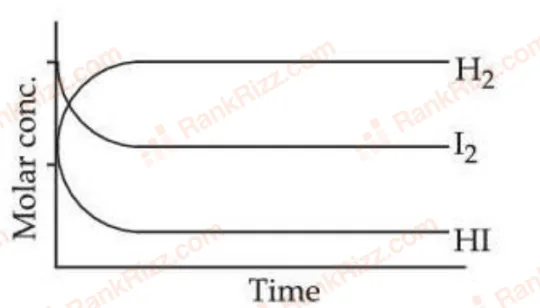
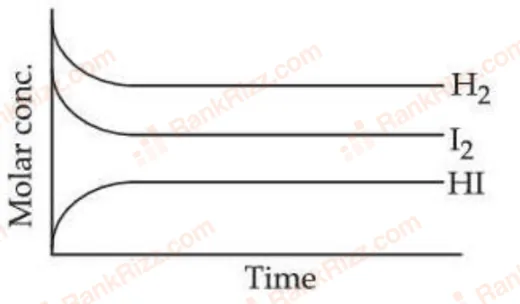
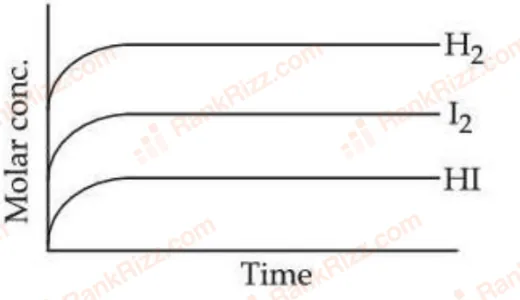
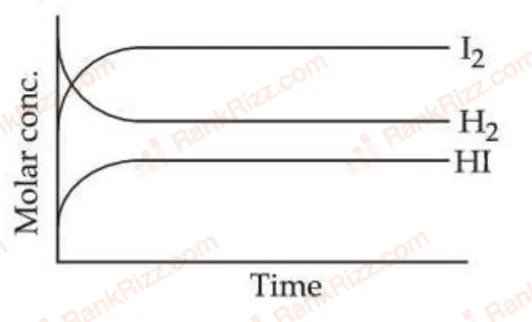
For the reaction, H2(g)+I2(g)⇌2HI(g),\text{For the reaction, } H_2(g) + I_2(g) \rightleftharpoons 2HI(g),  Attainment of equilibrium is predicted correctly by:

  1. A
    page11_img1
  2. B
    page11_img2
  3. C
    page11_img3
  4. D
    page11_img4
JEE MAIN 2025 · 23 JAN S1Solubility product and common ion effect

Which of the following happens when NH4OHNH_{4}OH is added gradually to the solution containing 1 M A2+A^{2+} and 1MB3+1MB^{3+} ions? Given : Ksp[A(OH)2]=9×10⁻¹⁰K_{sp}[A(OH)_{2}]= 9 \times 10^{-10} and Ksp[B(OH)3]=27×10−18K_{sp}[B(OH)_{3}]= 27 \times 10^{-18} at 298 K .

  1. A

    Both A(OH)2A(OH)_{2} and B(OH)3B(OH)_{3} do not show precipitation with NH4OHNH_{4}OH

  2. B

    A(OH)2A(OH)_{2} will precipitate before B(OH)3B(OH)_{3}

  3. C

    B(OH)3B(OH)_{3} will precipitate before A(OH)2A(OH)_{2}

  4. D

    A(OH)2A(OH)_{2} and B(OH)3B(OH)_{3} will precipitate together

JEE MAIN 2025 · 23 JAN S1Ionisation of weak electrolytes and Ostwald's dilution law

If 1 mM solution of ethylamine produces pH=9, then the ionization constant (Kb)(K_{b}) of ethylamine is 10−x10^{-x}. The value of is ______ (nearest integer). [The degree of ionization of ethylamine can be neglected with respect to unity.]

JEE MAIN 2025 · 23 JAN S2Law of mass action and equilibrium constants Kc and Kp

Consider the reaction X2Y(g)=X2(g)+12Y2(g)X_{2}Y(g)=X_{2}(g)+\frac{1}{2}Y_{2}(g) The equation representing correct relationship between the degree of dissociation (x) of X2Y(g)X_{2}Y(g) with its equilibrium constant Kp is ______ . Assume x to be very very small.

  1. A

    x=2Kpp3x=\sqrt[3]{\frac{2Kp}{p}}

  2. B

    x=2Kp2p3x=\sqrt[3]{\frac{2Kp^{2}}{p}}

  3. C

    x=Kpp3x=\sqrt[3]{\frac{Kp}{p}}

  4. D

    x=Kp2p3x=\sqrt[3]{\frac{Kp}{2p}}

JEE MAIN 2025 · 23 JAN S2pH of acids, bases and their mixtures

pH of water is 7 at 25∘C25^{\circ}C.If water is heated to 80∘C80^{\circ}C.,it's pH will :

  1. A

    Decrease

  2. B

    H+H^{+} concentration increases,OH−OH^{-} concentration decreases

  3. C

    Remains the same

  4. D

    Increase

JEE MAIN 2025 · 22 JAN S1Law of mass action and equilibrium constants Kc and Kp

A vessel at 1000 K contains CO2CO_2 with a pressure of 0.5 atm . Some of CO2CO_2 is converted into CO on addition of graphite. If total pressure at equilibrium is 0.8 atm , then Kp is :

  1. A

    1.8 atm

  2. B

    0.3 atm

  3. C

    3 atm

  4. D

    0.18 atm

JEE MAIN 2025 · 22 JAN S2Solubility product and common ion effect

The molar solubility(s) of zirconium phosphate with molecular formula (Zr4+)3(PO43−)4(Zr^{4+})_{3}(PO_{4}^{3-})_{4} is given by relation :

  1. A

    (Ksp9612)13(\frac{K_{sp}}{9612})^{\frac{1}{3}}

  2. B

    (Ksp6912)17(\frac{K_{sp}}{6912})^{\frac{1}{7}}

  3. C

    (Ksp8435)17(\frac{K_{sp}}{8435})^{\frac{1}{7}}

  4. D

    (Ksp5348)16(\frac{K_{sp}}{5348})^{\frac{1}{6}}

JEE MAIN 2024 · 09 APR S2Solubility product and common ion effect

For a sparingly soluble salt AB2AB_2, the equilibrium concentrations of A2+A^{2+} ions and B−B^- ions are 1.2×10⁻⁴M1.2 \times 10^{-4} M and 0.24×10⁻³M0.24 \times 10^{-3} M, respectively. The solubility product of AB2AB_2 is :

  1. A

    6.91×10−126.91 \times 10^{-12}

  2. B

    0.276×10−120.276 \times 10^{-12}

  3. C

    27.65×10−1227.65 \times 10^{-12}

  4. D

    0.069×10−120.069 \times 10^{-12}

JEE MAIN 2024 · 08 APR S1Law of mass action and equilibrium constants Kc and Kp

For the given hypothetical reactions, the equilibrium constants are as follows: X⇌Y;K1=1.0X \rightleftharpoons Y; K_1 = 1.0, Y⇌Z;K2=2.0Y \rightleftharpoons Z; K_2 = 2.0, Z⇌W;K3=4.0Z \rightleftharpoons W; K_3 = 4.0. The equilibrium constant for the reaction X⇌WX \rightleftharpoons W is

  1. A

    6.0

  2. B

    12.0

  3. C

    7.0

  4. D

    8.0

JEE MAIN 2024 · 08 APR S2pH of acids, bases and their mixtures

The equilibrium Cr2O72−⇌2CrO42−Cr_2O_7^{2-} \rightleftharpoons 2CrO_4^{2-} is shifted to the right in :

  1. A

    an acidic medium

  2. B

    a basic medium

  3. C

    a neutral medium

  4. D

    a weakly acidic medium

JEE MAIN 2024 · 08 APR S2pH of acids, bases and their mixtures

Given below are two statements : Statement (I) : A Buffer solution is the mixture of a salt and an acid or a base mixed in any particular quantities. Statement (II) : Blood is naturally occurring buffer solution whose pH is maintained by H2CO3/HCO3−H_2CO_3/HCO_3^- concentrations. In the light of the above statements, choose the correct answer from the options given below :

  1. A

    Statement I is true but Statement II is false

  2. B

    Both Statement I and Statement II are true

  3. C

    Statement I is false but Statement II is true

  4. D

    Both Statement I and Statement II are false

JEE MAIN 2024 · 06 APR S1Law of mass action and equilibrium constants Kc and Kp

At −20°C-20°C and 1 atm pressure, a cylinder is filled with equal number of H2H_2, I2I_2 and HIHI molecules for the reaction H2(g)+I2(g)⇌2HI(g)H_2(g) + I_2(g) \rightleftharpoons 2HI(g), the KpK_p for the process is x×10−1x \times 10^{-1}. x=x = _______ [Given : R=0.082 L atm K−1mol−1R = 0.082 \text{ L atm K}^{-1} \text{mol}^{-1}]

  1. A

    0.01

  2. B

    10

  3. C

    2

  4. D

    1

JEE MAIN 2024 · 06 APR S2Law of mass action and equilibrium constants Kc and Kp

The ratio KPKC\frac{K_P}{K_C} for the reaction : CO(g)+12O2(g)⇌CO2(g)CO_{(g)} + \frac{1}{2} O_{2(g)} \rightleftharpoons CO_{2(g)} is :

  1. A

    1RT\frac{1}{\sqrt{RT}}

  2. B

    (RT)1/2(RT)^{1/2}

  3. C

    RTRT

  4. D

    11

JEE MAIN 2024 · 05 APR S1Le Chatelier's principle and factors affecting equilibrium

The following reaction occurs in the Blast furnace where iron ore is reduced to iron metal Fe2O3(s)+3CO(g)⇌Fe(l)+3CO2(g)Fe_2O_{3(s)} + 3CO_{(g)} \rightleftharpoons Fe_{(l)} + 3CO_{2(g)}. Using the Le-Chatelier's principle, predict which one of the following will not disturb the equilibrium.

  1. A

    Addition of CO2CO_2

  2. B

    Removal of CO2CO_2

  3. C

    Addition of Fe2O3Fe_2O_3

  4. D

    Removal of CO