JEE MAIN 2026 · 28 JAN S2Le Chatelier's principle and factors affecting equilibrium
The plot of gives a straight Line. The intercept and slope respectively are
(where K is equilibrium constant).
- A
- B
- C
- D
Le Chatelier's principle and factors affecting equilibrium has been asked 24 times in JEE Main, in 10 different years between 2005 and 2026, and in 4 of the last five exam years (2022–2026), 9 questions in all. That is 9% of Chemical and Ionic Equilibrium. Last asked in JEE Main 28 Jan 2026, Shift 2. 22 are multiple choice and 2 numerical-value; 6 easy and 10 medium by our difficulty labels. All of them are below, newest first, free to read.
Questions
24
Years asked
10
Since
2005
Of the chapter
9%
Questions on Le Chatelier's principle and factors affecting equilibrium in every year it was asked, newest first.
| Year | Relative frequency | Questions |
|---|---|---|
| 2026 | 2 | |
| 2025 | 3 | |
| 2024 | 1 | |
| 2023 | 3 | |
| 2019 | 1 | |
| 2018 | 8 | |
| 2017 | 1 | |
| 2015 | 1 | |
| 2014 | 2 | |
| 2005 | 2 | |
| Total | 24 |
1–20 OF 24 · NEWEST FIRST
The plot of gives a straight Line. The intercept and slope respectively are
(where K is equilibrium constant).
Consider the following gaseous equilibrimn in a closed container of volume 'V' at T(K).
2 moles each of , and PQ(g) are present at equilibrium. Now one mole each of'' and '' are added to the equilibrium keeping the temperature at T(K). The number of moles of , and PQ at the new equilibrium, respectively, are
2.67, 2.67, 2.67
1.21, 2.24, 1.56
1.66, 1.66, 1.66
2.56, 1.62, 2.24
In the following system,
at equilibrium, upon addition of xenon gas at constant T & p, the concentration of
will increase
will decrease
, & remain constant
will increase
Consider the equilibrium If the pressure applied over the system
increases by two fold at constant temperature then (A) Concentration of reactants and products increases. (B) Equilibrium will shift in forward direction. (C) Equilibrium constant increases since concentration of products increases. (D) Equilibrium constant remains unchanged as concentration of reactants and products remain same. Choose the correct answer from the options given below :
(A), (B) and (C) only
(A) and (B) only
(A), (B) and (D) only
(B) and (C) only
Ice and water are placed in a closed container at a pressure of 1 atm and temperature 273.15 K . If pressure of the system is increased 2 times, keeping temperature constant, then identify correct observation from following
Volume of system increases .
The solid phase (ice) disappears completely.
Liquid phase disappears completely.
The amount of ice decreases.
The following reaction occurs in the Blast furnace where iron ore is reduced to iron metal . Using the Le-Chatelier's principle, predict which one of the following will not disturb the equilibrium.
Addition of
Removal of
Addition of
Removal of CO
The number of correct statement/s involving equilibria in physical processes from the following is _______.
(A) Equilibrium is possible only in a closed system at a given temperature.
(B) Both the opposing processes occur at the same rate.
(C) When equilibrium is attained at a given temperature, the value of all its parameters became equal
(D) For dissolution of solids in liquids, the solubility is constant at a given temperature.
The effect of addition of helium gas to the following reaction in equilibrium state at constant volume, is:
the equilibrium will shift in the forward direction and more of Cl and PCl gases will be produced.
the equilibrium will go backward due to suppression of dissociation of PCl.
helium will deactivate PCl and reaction will stop.
addition of helium will not affect the equilibrium.
Consider the following equation:
kJ.
The number of factors which will increase the yield of SO at equilibrium from the following is ______.
A. Increasing temperature
B. Increasing pressure
C. Adding more SO
D. Adding more O
E. Addition of catalyst
For the reaction,
2SOg + Og 2SO g,
ΔH = -57.2 kJ mol and K = .
Which of the following statements is incorrect?
The equilibrium constant is large suggestive of reaction going to completion and so, no catalyst is required.
The equilibrium will shift in forward direction as the pressure increases.
The equilibrium constant decreases as the temperature increases.
The addition of inert gas at constant volume will not affect the equilibrium constant.
The gas phase reaction 2NO(g) NO(g) is an exothermic reaction. The decomposition of NO, in equilibrium mixture of NO(g) and NO(g) can be increased by:
Addition of an inert gas at constant pressure
Lowering the temperature
Increasing the pressure
Addition of an inert gas at constant volume
In which of the following reactions, an increase in the volume of the container will favour the formation of products?
4NH(g) + 5O(g) 4NO(g) + 6HO(l)
2NO(g) 2NO(g) + O(g)
3O 2O(g)
H(g) + I(g) 2HI(g)
Which of the following lines correctly show the temperature dependence of equilibrium constant K, for an exothermic reaction?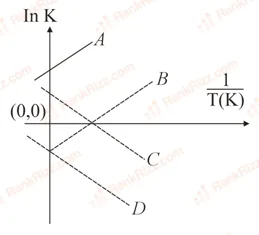
A & D
A & B
B & C
C & D
An aqueous solution contains 0.10 M HS and 0.20 M HCl. If the equilibrium constant for the formation of HS from HS is and that of S from HS ions is , then the concentration of S ions in the aqueous solution is:
An aqueous solution contains an unknown concentration of Ba. When 50 mL of a 1 M solution of NaSO is added, BaSO just begins to precipitate. The final volume is 500 mL. The solubility product of BaSO is . What is the original concentration of Ba?
M
M
M
M
Which of the following salts is the most basic in aqueous solution?
Pb(CHCOO)
Al(CN)
CHCOOK
FeCl
An alkali is titrated against acid with methyl orange as an indicator, which of the following is a correct combination?
Base: Strong, Acid: Strong, End point: Pink to colourless
Base: Weak, Acid: Strong, End point: Colourless to pink
Base: Strong, Acid: strong, End point: Pinkish red to yellow
Base: Weak, Acid: Strong, End point: Yellow to pinkish red
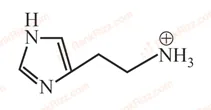
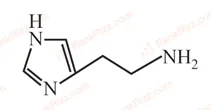
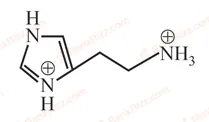
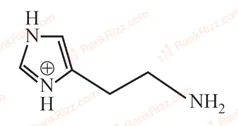
The predominant form of histamine present in human blood is (pK, Histidine = 6.0):
The following reaction occurs in the Blast Furnace where iron ore is reduced to iron metal:
FeO(s) + 3CO(g) 2Fe(l) + 3CO(g)
Using the Le Chatelier's principle, predict which one of the following will not disturb the equilibrium?
Addition of CO
Removal of CO
Addition of FeO
Removal of CO
The increase of pressure on ice water system at constant temperature will lead to:
A decrease in the entropy of the system
An increase in the Gibbs energy of the system
A shift of the equilibrium in the forward direction
No effect on the equilibrium
RELATED CHEMICAL AND IONIC EQUILIBRIUM TOPICS