JEE Main 2020 Chemistry question — Solubility product and common ion effect
The stoichiometry and solubility product of a salt with the solubility curve given below is, respectively:
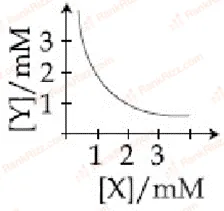
SOLUTION
Step 1: Identify a Clear Coordinate Point from the Graph
By examining the equilibrium curve, we can identify a distinct, well-defined point where the concentrations of both ions intersect cleanly at integer grid marks:
Step 2: Determine the Stoichiometry
The ratio of the molar concentrations of the ions in the saturated solution gives the stoichiometric coefficients of the salt formula:
This means that for every 1 mole of ions that dissolves, 2 moles of ions are released into the solution. Therefore, the empirical formula of the salt is .
Step 3: Calculate the Solubility Product ()
The dissolution equation for the salt is written as:
The expression for its solubility product constant () is:
Substituting the equilibrium concentration values from Step 1 into the expression:
Conclusion:
The stoichiometry corresponds to and the calculated solubility product is .
Answer: Option B —