JEE MAIN 2026 · 24 JAN S1Solubility product and common ion effect
Consider two Group IV metal ious
A solution containing is satmated with . The pH at which the metal sulphide YS will form as a precipitate is __ . (Nearest integer)
Every Chemical and Ionic Equilibrium question JEE Main has set from 2004–2026, grouped by the idea it tests rather than the order of the syllabus. 274 questions across 10 distinct ideas. Free to read, answer key on every one.
DATA UPDATED
Questions
274
Distinct ideas
10
Share of marks
5.7%
Difficulty
MEDIUM
A chapter is not one subject — it is a handful of procedures the examiner reuses. These are the ones Chemical and Ionic Equilibrium questions actually test.
21–40 OF 274 · NEWEST FIRST
Consider two Group IV metal ious
A solution containing is satmated with . The pH at which the metal sulphide YS will form as a precipitate is __ . (Nearest integer)
Consider the following gaseous equilibrimn in a closed container of volume 'V' at T(K).
2 moles each of , and PQ(g) are present at equilibrium. Now one mole each of'' and '' are added to the equilibrium keeping the temperature at T(K). The number of moles of , and PQ at the new equilibrium, respectively, are
2.67, 2.67, 2.67
1.21, 2.24, 1.56
1.66, 1.66, 1.66
2.56, 1.62, 2.24
Consider the general reaction given below at 400 K
.
The values of are studied under the same condition of temperature but variation in x and y
(i) appropriate units
(ii) appropriate units
The values of x and yin (i) and (ii) respectively are:
(i)1,2 (ii)2,1
(i)1,3 (ii)2,1
(i)4,1 (ii)4,1
(i)3,1 (ii)3,1
For the following gas phase equilibrium reaction at constant temperature,
if the to tal pressure is atm and the pressure equilibrium constant () is 9 atm, then the degree of dissociation is given as .The value of x is ______. (nearest integer)
and are added to a 1 L flask and it is found that the system attains the above equilibrium at T(K) with the number of moles of and being 3, 3 and 9 mol respectively (equilibrium moles). Under this condition of equilibrium, 10 mol of ) is added to the flask and the temperature is maintained at . Then the number of moles of in the flask when the new equilibrium is established is __ . (Nearest integer)
Dissociation of a gas takes place according to the following chemical reaction.
At equilibrium, the total pressure is 1 bar at 300K.
The standard Gibbs energy of formation of the involved substances has been
provided below:
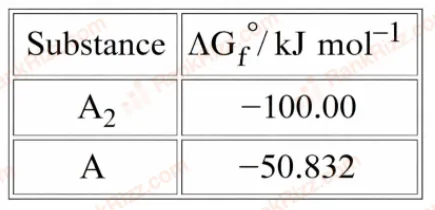
The degree of dissociation of is given by where =
_____ . (Nearest integer).
[Given:
Assume degree of dissociation is not negligible.
Which of the followmg mixture gives a buffer solution with pH=9.25?
Given : = 4.75
0.2 M (0.4 L) + 0.1 M HCl (1 L)
0.4 M (1 L) + 0.1 M HCl (1 L)
0.5 M (0.2 L) + 0.2 M HCl (0.5 L)
0.2 M (0.5 L) + 0.1 M HCl (0.5 L)
The first and second ionization constants of are and respectively. The concentration of in solution is _________ . (Nearest Integer)
The volume of water (in mL) required to be added to a 100 mL solution (aq. 0.1 M) of a weak acid (HA) at 25 °C to double its degree of dissociation is _____ mL.
The equilibrium constant for decomposition of
( kJ mol) is at 2300 K and total pressure at equilibrium is 1 bar. Under this condition, the degree of dissociation () of water is _____ . (nearest integer value)
[Assume is negligible with respect to 1]
An aqueous solution of HCl with pH 1.0 is diluted by adding equal volume of water (ignoring dissociation of water). The pH of HCl solution would
(Given log 2 = 0.30)
reduce to 0.5
increase to 1.3
remain same
increase to 2
Only litre buffer solution was prepared by adding 0.10 mol each of and in deionised water. The change in pH on addition of 0.05 mol of HCl to the above solution is _____ .(Nearest integer)
(Given : of = 4.745 and )
The pH of a 0.01 M weak acid HX () is found to be 5. Now the acid solution is diluted with excess of water so that the pH of the solution changes to 6. The new concentration of the diluted weak acid is given as M. The value of x is ________ (nearest integer).
x mg of (molar mass = 58) is required to be dissolved in 1.0 L of water to produce a pH of 10.0 at 298 K. The value of x is ____ mg. (Nearest integer)
(Given : is assumed to dissociate completely in )
Given below are two statements
Statement I : A catalyst cannot alter the equilibrium constant of the reaction, temperature remaining constant
Statement II : A homogeneous catalyst can change the equilibrium composition of a system temperature remaining constant
In the light of the above statements, choose the correct answer from the options given below
Statement I is false but Statement II is true
Both Statement I and Statement II are true
Both Statement I and Statement II are false
Statement I is true but Statement II is false
In the following system,
at equilibrium, upon addition of xenon gas at constant T & p, the concentration of
will increase
will decrease
, & remain constant
will increase
If equal volumes of and XY (both are salts) aqueous solutions are mixed, which of the following combination will give a precipitate of at 300 K?
(Given (at 300 K) for )
M , M XY
M , M XY
M , M XY
M , M XY
Consider the following equilibrium,
0.1 mol of CO along with a catalyst is present in a 2 dm flask maintained at 500 K. Hydrogen is introduced into the flask until the pressure is 5 bar and 0.04 mol of is formed. The is _______ . (nearest integer)
Given dm bar K mol
Assume only methanol is formed as the product and the system follows ideal gas behaviour.
Consider the following chemical equilibrium of the gas phase reaction at a constant temperature :
If p being the total pressure, is the pressure equilibrium constant and is the degree of dissociation, then which of the following is true at equilibrium ?
If p value is extremely high compared to ,
When p increases decreases
If value is extremely high compared to p, becomes much less than unity
When p increases increases
At temperature , compound dissociates as having degree of dissociation (small compared to unity). The correct expression for in terms of and p is
JEE Advanced has set 24 Chemical and Ionic Equilibrium questions too. Chemical and Ionic Equilibrium JEE Advanced PYQs →
OTHER CHEMISTRY CHAPTERS