RankRizz

Chemical and Ionic Equilibrium — JEE Main Previous Year Questions

Every Chemical and Ionic Equilibrium question JEE Main has set from 2004–2026, grouped by the idea it tests rather than the order of the syllabus. 274 questions across 10 distinct ideas. Free to read, answer key on every one.

DATA UPDATED

Questions

274

Distinct ideas

10

Share of marks

5.7%

Difficulty

MEDIUM

The ideas inside Chemical and Ionic Equilibrium

A chapter is not one subject — it is a handful of procedures the examiner reuses. These are the ones Chemical and Ionic Equilibrium questions actually test.

Every Chemical and Ionic Equilibrium question

261–274 OF 274 · NEWEST FIRST

JEE MAIN 2006Law of mass action and equilibrium constants Kc and Kp

The equilibrium constant for the reaction SO3(g)⇌SO2(g)+12O2(g)SO_3(g) \rightleftharpoons SO_2(g) + \frac{1}{2}O_2(g)isisKc=4.9×10⁻²K_c = 4.9 \times 10^{-2}.Thevalueof. The value ofKcK_cforthereactionfor the reaction2SO2(g)+O2(g)⇌2SO3(g)2SO_2(g) + O_2(g) \rightleftharpoons 2SO_3(g)$ will be

  1. A

    416

  2. B

    2.40×10−32.40 \times 10^{-3}

  3. C

    9.8×10−29.8 \times 10^{-2}

  4. D

    4.9×10−24.9 \times 10^{-2}

JEE MAIN 2006Arrhenius, Bronsted-Lowry and Lewis acid-base concepts

Which of the following statements is true?

  1. A

    H3PO3H_3PO_3 is a stronger acid than H2SO3H_2SO_3

  2. B

    In aqueous medium HF is a stronger acid than HCl

  3. C

    HClO4HClO_4 is a weaker acid than HClO3HClO_3

  4. D

    HNO3HNO_3 is a stronger acid than HNO2HNO_2

JEE MAIN 2005Le Chatelier's principle and factors affecting equilibrium

The exothermic formation of ClF3_3 is represented by the equation: Cl2(g)+3F2(g)⇌2ClF3(g);ΔrH=−329\text{Cl}_{2(g)} + 3\text{F}_{2(g)} \rightleftharpoons 2\text{ClF}_{3(g)}; \Delta_r H = -329 kJ. Which of the following will increase the quantity of ClF3_3 in an equilibrium mixture of Cl2_2, F2_2 and ClF3_3?

  1. A

    Increasing the temperature

  2. B

    Removing Cl2_2

  3. C

    Increasing the volume of the container

  4. D

    Adding F2_2

JEE MAIN 2005Law of mass action and equilibrium constants Kc and Kp

For the reaction 2NO2(g)⇌2NO(g)+O2(g)2\text{NO}_{2(g)} \rightleftharpoons 2\text{NO}_{(g)} + \text{O}_{2(g)}, (Kc=1.8×10⁻⁶ at 184∘C)(K_c = 1.8 \times 10^{-6} \text{ at } 184^\circ\text{C}), (R=0.0831 kJ/(mol⋅K))(R = 0.0831 \text{ kJ}/(\text{mol} \cdot \text{K})). When KpK_p and KcK_c are compared at 184∘184^\circC, it is found that

  1. A

    KpK_p is greater than KcK_c

  2. B

    KpK_p is less than KcK_c

  3. C

    Kp=KcK_p = K_c

  4. D

    Whether KpK_p is greater than, less than or equal to KcK_c depends upon the total gas pressure

JEE MAIN 2005Le Chatelier's principle and factors affecting equilibrium

A schematic plot of ln⁡Keq\ln K_{eq} versus inverse of temperature for a reaction is shown below. The reaction must be
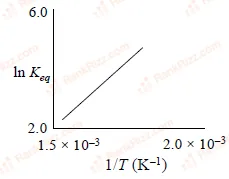
Figure for JEE Main 2005 Chemistry question on Le Chatelier's principle and factors affecting equilibrium
  1. A

    exothermic

  2. B

    endothermic

  3. C

    one with negligible enthalpy change

  4. D

    highly spontaneous at ordinary temperature

JEE MAIN 2005Reaction quotient, degree of dissociation and equilibrium calculations

An amount of solid NH4_4HS is placed in a flask already containing ammonia gas at a certain temperature and 0.500.50 atm pressure. Ammonium hydrogen sulphide decomposes to yield NH3_3 and H2_2S gases in the flask. When the decomposition reaction reaches equilibrium, the total pressure in the flask rises to 0.840.84 atm. The equilibrium constant for NH4_4HS decomposition at this temperature is

  1. A

    0.300.30

  2. B

    0.180.18

  3. C

    0.170.17

  4. D

    0.110.11

JEE MAIN 2005Solubility product and common ion effect

The solubility product of a salt having general formula MX2MX_2, in water is 4×10−124 \times 10^{-12}. The concentration of M2+^{2+} ions in the aqueous solution of the salt is

  1. A

    2.0×10−62.0 \times 10^{-6} M

  2. B

    1.0×10−41.0 \times 10^{-4} M

  3. C

    1.6×10−41.6 \times 10^{-4} M

  4. D

    4.0×10−104.0 \times 10^{-10} M

JEE MAIN 2005pH of acids, bases and their mixtures

Hydrogen ion concentration in mol/L in a solution of pH =5.4= 5.4 will be

  1. A

    3.98×1083.98 \times 10^8

  2. B

    3.88×1063.88 \times 10^6

  3. C

    3.68×10−63.68 \times 10^{-6}

  4. D

    3.98×10−63.98 \times 10^{-6}

JEE MAIN 2005Arrhenius, Bronsted-Lowry and Lewis acid-base concepts

What is the conjugate base of OH−^-?

  1. A

    O2_2

  2. B

    H2_2O

  3. C

    O−^-

  4. D

    O2−^{2-}

JEE MAIN 2004Law of mass action and equilibrium constants Kc and Kp

What is the equilibrium expression for the reaction P4(s)+5O2(g)⇌P4O10(s)P_{4(s)} + 5O_{2(g)} \rightleftharpoons P_4O_{10(s)}?

  1. A

    Kc=[P4O10]/[P4][O2]5K_c = [P_4O_{10}]/[P_4][O_2]^5

  2. B

    Kc=1/[O2]5K_c = 1/[O_2]^5

  3. C

    Kc=[O2]5K_c = [O_2]^5

  4. D

    Kc=[P4O10]/5[P4][O2]K_c = [P_4O_{10}]/5[P_4][O_2]

JEE MAIN 2004Law of mass action and equilibrium constants Kc and Kp

For the reaction, CO(g)+Cl2(g)⇌COCl2(g)CO(g) + Cl_2(g) \rightleftharpoons COCl_2(g) the KpKc\frac{K_p}{K_c} is equal to

  1. A

    1RT\frac{1}{RT}

  2. B

    1.01.0

  3. C

    RT\sqrt{RT}

  4. D

    RTRT

JEE MAIN 2004Law of mass action and equilibrium constants Kc and Kp

The equilibrium constant for the reaction N2(g)+O2(g)⇌2NO(g)N_2(g) + O_2(g) \rightleftharpoons 2NO(g) at temperature TT is 4×10−44 \times 10^{-4}. The value of KcK_c for the reaction NO(g)⇌12N2(g)+12O2(g)NO(g) \rightleftharpoons \frac{1}{2}N_2(g) + \frac{1}{2}O_2(g) at the same temperature is

  1. A

    2.5×1022.5 \times 10^2

  2. B

    0.020.02

  3. C

    4×10−44 \times 10^{-4}

  4. D

    5050

JEE MAIN 2004Arrhenius, Bronsted-Lowry and Lewis acid-base concepts

The conjugate base of H2PO4−H_2PO_4^- is

  1. A

    PO43−PO_4^{3-}

  2. B

    HPO42−HPO_4^{2-}

  3. C

    H3PO4H_3PO_4

  4. D

    P2O5P_2O_5

JEE MAIN 2004Solubility product and common ion effect

The molar solubility product is KspK_{sp}. 'ss' is given in terms of KspK_{sp} by the relation

  1. A

    s=(Ksp/128)1/4s = (K_{sp}/128)^{1/4}

  2. B

    s=(Ksp/256)1/5s = (K_{sp}/256)^{1/5}

  3. C

    S=(256Ksp)1/5S = (256 K_{sp})^{1/5}

  4. D

    s=(128Ksp)1/4s = (128 K_{sp})^{1/4}