JEE MAIN 2026 · 08 APR S2Law of mass action and equilibrium constants Kc and Kp
Consider the following reactions in which all the reactants and products are present in gaseous state
The value of for the equilibrium is :
- A
- B
- C
- D
Law of mass action and equilibrium constants Kc and Kp has been asked 93 times in JEE Main, in 18 different years between 2004 and 2026, and in all of the last five exam years (2022–2026), 47 questions in all. That is 34% of Chemical and Ionic Equilibrium, its most-asked topic. Last asked in JEE Main 08 Apr 2026, Shift 2. 54 are multiple choice and 39 numerical-value; 37 easy and 48 medium by our difficulty labels. All of them are below, newest first, free to read.
Questions
93
Years asked
18
Since
2004
Of the chapter
34%
Questions on Law of mass action and equilibrium constants Kc and Kp in every year it was asked, newest first.
| Year | Relative frequency | Questions |
|---|---|---|
| 2026 | 13 | |
| 2025 | 9 | |
| 2024 | 8 | |
| 2023 | 8 | |
| 2022 | 9 | |
| 2021 | 11 | |
| 2020 | 8 | |
| 2019 | 8 | |
| 2018 | 1 | |
| 2016 | 2 | |
| 2015 | 2 | |
| 2014 | 3 | |
| 2013 | 3 | |
| 2012 | 2 | |
| 2008 | 1 | |
| 2006 | 1 | |
| 2005 | 1 | |
| 2004 | 3 | |
| Total | 93 |
1–20 OF 93 · NEWEST FIRST
Consider the following reactions in which all the reactants and products are present in gaseous state
The value of for the equilibrium is :
Solid carbon, CaO and CaCO are mixed and allowed to attain equilibrium at T K.
atm
atm
The partial pressure of CO is __________ atm
One mole each of He and A(g) are taken in a 10 L closed flask and heated to 400 K to establish the following equilibrium.
A(g) B(g)
K for this reaction at 400 K is 4.0. The partial pressures (in atm) of He and B(g) are respectively (at equilibrium)
(Assume He, A(g) and B(g) behave as ideal gases)
(Given: R = 0.082 L atm K mol)
3.28, 2.624
2.624, 3.28
3.28, 0.656
0.656, 6.56
In a closed flask at 600 K, one mole of attains equilibrium as given below : $ At equilibrium, 75% was dissociated and the total pressure is 1 atm. The magnitude of (in kJ mol) at this temperature is __________. (Nearest Integer) (Given : R = 8.3 J mol K; ln 10 = 2.3, log 2 = 0.3, log 3 = 0.48, log 5 = 0.69, log 7 = 0.84)
The values of pressure equilibrium constant recorded at different temperatures for the following equilibrium reaction have been given below
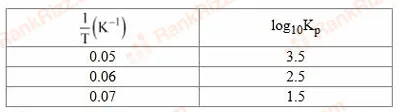
The magnitude of calculated from the above data is _______. (Nearest integer)
The reaction was initiated with the amount `` of . At equilibrium it is found that the amount of remaining is at a total pressure of .
The equilibrium constant of the reaction can be calculated from the expression:
At (K), the equilibrium constant of is . What is the equilibrium constant for at the same temperature?
For the following reaction at 50 °C and at 2 atm pressure,
NO is 50% dissociated.
The magnitude of standard free energy change at this temperature is .
= _________ J mol [Nearest integer].
Given: J mol K, , , , °C + 273 = K
Observe the following equilibrium in a 1 L flask.
At T(K), the equilibrium concentrations of A and B are 0.5 Mand 0.375 M respectively. 0.1 moles of A is added into the flask and heated to T(K) to establish the equilibrium again. The new equilibrium concentrations (in M) of A and B are respectively
0.557, 0.418.
0.53, 0.4.
0.742, 0.557.
0.367, 0.275.
Consider the general reaction given below at 400 K
.
The values of are studied under the same condition of temperature but variation in x and y
(i) appropriate units
(ii) appropriate units
The values of x and yin (i) and (ii) respectively are:
(i)1,2 (ii)2,1
(i)1,3 (ii)2,1
(i)4,1 (ii)4,1
(i)3,1 (ii)3,1
For the following gas phase equilibrium reaction at constant temperature,
if the to tal pressure is atm and the pressure equilibrium constant () is 9 atm, then the degree of dissociation is given as .The value of x is ______. (nearest integer)
and are added to a 1 L flask and it is found that the system attains the above equilibrium at T(K) with the number of moles of and being 3, 3 and 9 mol respectively (equilibrium moles). Under this condition of equilibrium, 10 mol of ) is added to the flask and the temperature is maintained at . Then the number of moles of in the flask when the new equilibrium is established is __ . (Nearest integer)
Dissociation of a gas takes place according to the following chemical reaction.
At equilibrium, the total pressure is 1 bar at 300K.
The standard Gibbs energy of formation of the involved substances has been
provided below:
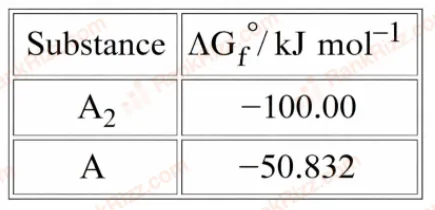
The degree of dissociation of is given by where =
_____ . (Nearest integer).
[Given:
Assume degree of dissociation is not negligible.
The equilibrium constant for decomposition of
( kJ mol) is at 2300 K and total pressure at equilibrium is 1 bar. Under this condition, the degree of dissociation () of water is _____ . (nearest integer value)
[Assume is negligible with respect to 1]
Given below are two statements
Statement I : A catalyst cannot alter the equilibrium constant of the reaction, temperature remaining constant
Statement II : A homogeneous catalyst can change the equilibrium composition of a system temperature remaining constant
In the light of the above statements, choose the correct answer from the options given below
Statement I is false but Statement II is true
Both Statement I and Statement II are true
Both Statement I and Statement II are false
Statement I is true but Statement II is false
Consider the following equilibrium,
0.1 mol of CO along with a catalyst is present in a 2 dm flask maintained at 500 K. Hydrogen is introduced into the flask until the pressure is 5 bar and 0.04 mol of is formed. The is _______ . (nearest integer)
Given dm bar K mol
Assume only methanol is formed as the product and the system follows ideal gas behaviour.
Consider the following chemical equilibrium of the gas phase reaction at a constant temperature :
If p being the total pressure, is the pressure equilibrium constant and is the degree of dissociation, then which of the following is true at equilibrium ?
If p value is extremely high compared to ,
When p increases decreases
If value is extremely high compared to p, becomes much less than unity
When p increases increases
At temperature , compound dissociates as having degree of dissociation (small compared to unity). The correct expression for in terms of and p is
was taken in a reaction vessel and allowed to undergo the following reaction at 500 K The total pressure at equilibrium was found to be bar. Then, [nearest integer]. Assume to behave ideally under these conditions. Given:
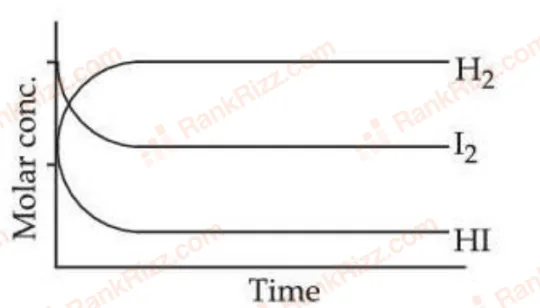
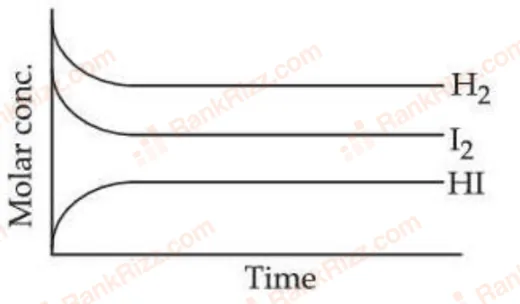
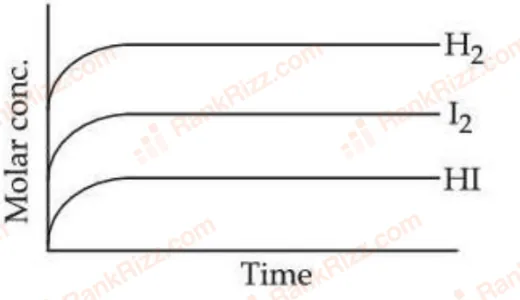
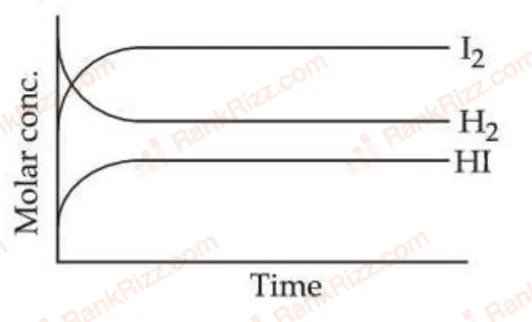
Attainment of equilibrium is predicted correctly by:
RELATED CHEMICAL AND IONIC EQUILIBRIUM TOPICS