JEE MAIN 2026 · 02 APR S1Directive influence of substituents
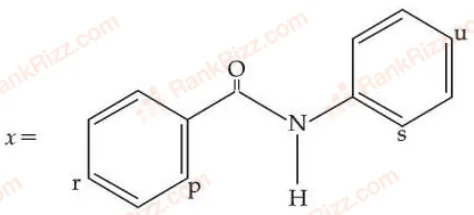
For the given molecule, "x", the preferred site for the attack of the electrophile is :
- A
Predominantly at "r"
- B
"r" and "u"
- C
"p" and "s"
- D
Predominantly at "u"
Directive influence of substituents has been asked 17 times in JEE Main, in 8 different years between 2007 and 2026, and in all of the last five exam years (2022–2026), 12 questions in all. That is 8% of Hydrocarbons. Last asked in JEE Main 02 Apr 2026, Shift 1. 15 are multiple choice and 2 numerical-value; 5 easy and 9 medium by our difficulty labels. All of them are below, newest first, free to read.
Questions
17
Years asked
8
Since
2007
Of the chapter
8%
Questions on Directive influence of substituents in every year it was asked, newest first.
| Year | Relative frequency | Questions |
|---|---|---|
| 2026 | 2 | |
| 2025 | 2 | |
| 2024 | 6 | |
| 2023 | 1 | |
| 2022 | 1 | |
| 2019 | 2 | |
| 2012 | 1 | |
| 2007 | 2 | |
| Total | 17 |
1–17 OF 17 · NEWEST FIRST
For the given molecule, "x", the preferred site for the attack of the electrophile is :
Predominantly at "r"
"r" and "u"
"p" and "s"
Predominantly at "u"
Identify the conect statements:
The presence of - group in benzene ring
A. activates the ring towards electrophilic substitutions.
B. deactivates the ring towards electrophilic substitutions.
C. activates the ring towards nucleophilic substitutions.
D. deactivates the ring towards nucleophilic substitutions.
choose the correct answer from the options given below :
C and A Only
B and C Only
B and D Only
A and D Only
Given below are two statements : Statement (I) : On nitration of m-xylene with , followed by oxidation, 4-nitrobenzene-1,3-dicarboxylic acid is obtained as the major product. Statement (II) : group is o/p-directing while group is m-directing group. In the light of the above statements, choose the correct answer from the options given below :
Both Statement I and Statement II are false
Statement I is false but Statement II is true
Statement I is true but Statement II is false
Both Statement I and Statement II are true
are meta directing groups. Activating groups act as ortho- and para-directing groups. Halides are activating groups. Choose the correct answer from the options given below:
(A) only
(A), (B) and (E) only
(A) and (C) only
(A), (C) and (D) only
The correct arrangement for decreasing order of electrophilic substitution for above compounds is :
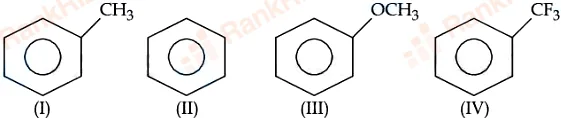
Which of the following compound will most easily be attacked by an electrophile?

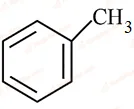
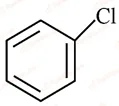
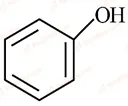
Total number of deactivating groups in aromatic electrophilic substitution reaction among the following is:
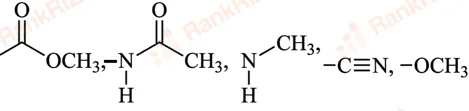
The set of meta directing functional groups from the following sets is:
The correct order of reactivity in electrophilic substitution reaction of the following compounds is:
Among the following, total number of meta directing functional groups is (Integer based) , , , , , , , ,
Given below are two statements, one is labelled as Assertion A and the other is labelled as Reason R.
Assertion A: Benzene is more stable than hypothetical cyclohexatriene.
Reason R: The delocalized electron cloud is attracted more strongly by nuclei of carbon atoms.
In the light of the above statements, choose the correct answer from the options given below:
A is true but R is false.
A is false but R is true.
Both A and R are correct and R is the correct explanation of A.
Both A and R are correct but R is not the correct explanation of A.
Arrange the following in increasing order of reactivity towards nitration
A. p-xylene
B. bromobenzene
C. mesitylene
D. nitrobenzene
E. benzene
Choose the correct answer from the options given below
The increasing order of the reactivity of the following compounds towards electrophilic aromatic substitution reactions is:
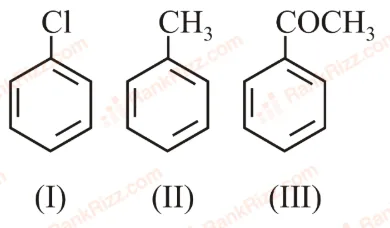
II < I < III
III < II < I
III < I < II
I < III < II
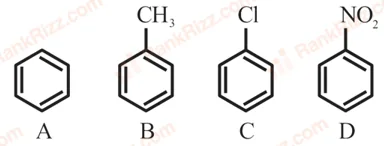
The increasing order of reactivity of the following compounds towards aromatic electrophilic substitution reaction is:
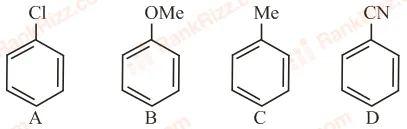
A < B < C < D
B < C < A < D
D < B < A < C
D < A < C < B
In the below mentioned compounds the decreasing order of reactivity towards electrophilic substitution is
(i)
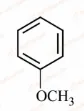
(ii)
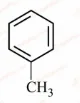
(iii)
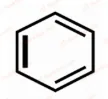
(iv)
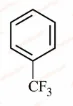
(iv) > (i) > (ii) > (iii)
(ii) > (iii) > (i) > (iv)
(iii) > (i) > (iv) > (ii)
(i) > (ii) > (iii) > (iv)
The reaction of toluene with in presence of gives predominantly
benzoyl chloride
benzyl chloride
and chlorotoluene
chlorotoluene
Presence of a nitro group in a benzene ring
activates the ring towards electrophilic substitution
renders the ring basic
deactivates the ring towards nucleophilic substitution
deactivates the ring towards electrophilic substitution