JEE MAIN 2023 · 01 FEB S2+4 / −1
JEE Main 2023 Chemistry question — Electrophilic aromatic substitution
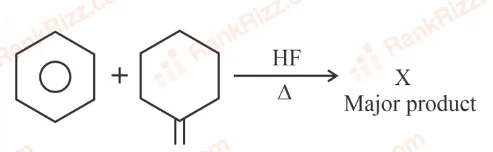
'X' is:
SOLUTION
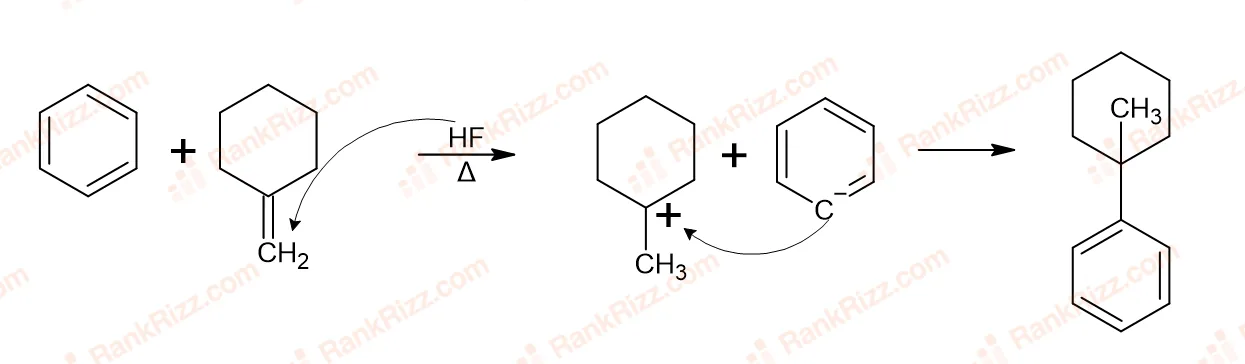
1. Formation of the Carbocation (Protonation)
The reaction uses hydrofluoric acid () as an acid catalyst. The exocyclic double bond of methylenecyclohexane undergoes protonation according to Markovnikov's rule:
- The from adds to the terminal carbon (), converting it into a methyl group ().
- This creates a highly stable tertiary () carbocation at the ring carbon (the 1-methylcyclohexyl cation).
2. Electrophilic Aromatic Substitution (Friedel-Crafts Alkylation)
Benzene acts as the nucleophile and attacks this stable tertiary carbocation:
- The -electrons of the benzene ring attack the positively charged carbon atom of the 1-methylcyclohexyl cation.
- Subsequent deprotonation restores the aromaticity of the benzene ring.