JEE Main 2020 Chemistry question — Electrophilic addition to alkenes
In the following reaction sequence, structures of A and B are, respectively
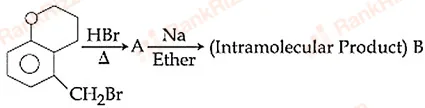
SOLUTION
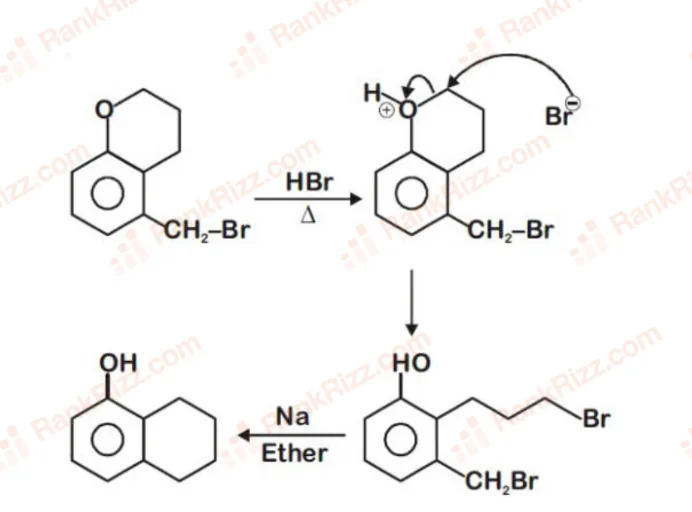
We need to determine the structures of the intermediates or products in the given intramolecular coupling reaction mediated by sodium in ether.
Reaction Mechanism: Intramolecular Wurtz-like Coupling
-
Radical Formation:
When the starting material containing two alkyl bromide groups ( and the side-chain terminal ) is treated with metallic sodium () in an anhydrous solvent like ether, sodium donates electrons to the carbon-halogen bonds. This generates reactive radical or organosodium intermediates at both alkyl carbon centers.
-
Intramolecular Ring Closure (Cyclization):
The two highly reactive radical centers (or the carbanion and the remaining alkyl halide) undergo a rapid, favorable intramolecular homolytic/heterolytic carbon-carbon () bond coupling. This brings the two side chains together to close a new six-membered saturated ring fused directly to the existing benzene ring:
Conclusion:
The reaction is a classic example of an intramolecular Wurtz coupling that efficiently constructs a stable six-membered ring fused to the phenolic framework, yielding a tetrahydronaphthol derivative.
Answer: The option showing the corresponding structures matching the intramolecular cyclization pathway (Option C).