JEE MAIN 2025 · 28 JAN S2Molecular orbital theory of diatomic species
Total number of molecules/species from following which will be paramagnetic is ______
, , , , , , , ,
Every Chemical Bonding and Molecular Structure question JEE Main has set from 2004–2026, grouped by the idea it tests rather than the order of the syllabus. 316 questions across 11 distinct ideas. Free to read, answer key on every one.
DATA UPDATED
Questions
316
Distinct ideas
11
Share of marks
4.8%
Difficulty
MEDIUM
A chapter is not one subject — it is a handful of procedures the examiner reuses. These are the ones Chemical Bonding and Molecular Structure questions actually test.
41–60 OF 316 · NEWEST FIRST
Total number of molecules/species from following which will be paramagnetic is ______
, , , , , , , ,
Which of the following statement is true with respect to and The central atoms of all the molecules are hybridized. The and angles in the above molecules are and respectively. The increasing order of dipole moment is Both and are Lewis acids and is a Lewis base. A solution of in is basic. In this solution and act as Lowry-Bronsted acid and base respectively. Choose the correct answer from the options given below:
A, B and C only
A, D and E Only
C, D and E Only
A, B, C and E Only
Which of the following linear combination of atomic orbitals will lead to formation of molecular orbitals in homonuclear diatomic molecules [internuclear axis in -direction] ? A. and B. 2 s and C. 3 and 3 D. 2 s and E. and Choose the correct answer from the options given below:
A and B Only
D Only
E Only
C and D Only
Given below are two statements : Statement (I): Experimentally determined oxygen-oxygen bond lengths in the are found to be same and the bond length is greater than that of a (double bond) but less than that of a single bond. Statement (II) : The strong lone pair-lone pair repulsion between oxygen atoms is solely responsible for the fact that the bond length in ozone is smaller than that of a double bond but more than that of a single bond . In the light of the above statements, choose the correct answer from the options given below :
Both Statement I and Statement II are false
Statement I is false but Statement II is true
Statement I is true but Statement II is false
Both Statement I and Statement II are true
In the given structure, the number of hybridized carbon atoms present respectively are:
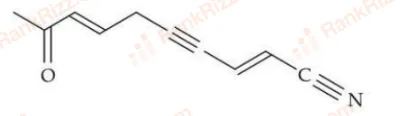
4 and 5
3 and 5
3 and 6
4 and 6
Match the LIST-I with LIST-II
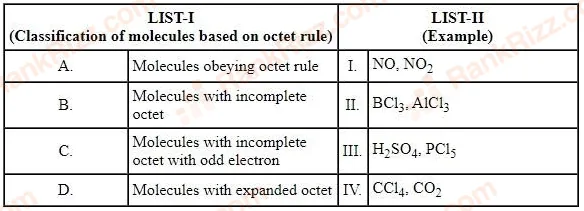
Choose the correct answer from the options given below:
A-IV, B-I, C-III, D-II
A-IV, B-II, C-I, D-III
A-II, B-IV, C-III, D-I
A-III, B-II, C-I, D-IV
The number of molecules/ions that show linear geometry among the following is ______
, , , , , , , , ,
Arrange the following compounds in increasing order of their dipole moment :
In which one of the following pairs the central atoms exhibit hybridization ?
and
and
and
and
The total number of species from the following in which one unpaired electron is present, is _______
The correct increasing order for bond angles among , and is :
Total number of electrons present in molecular orbitals of , and is ______.
Match List I with List II
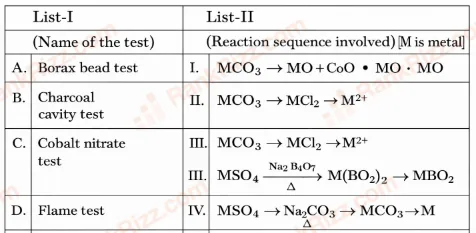
Choose the correct answer from the options given below:
A-III, B-II, C-IV, D-I
A-III, B-IV, C-I, D-II
A-III, B-I, C-II, D-IV
A-III, B-I, C-IV, D-II
Number of molecules from the following which are exceptions to octet rule is ______ , , , , , , , , , , ,
The shape of carbocation is :
diagonal pyramidal
trigonal planar
tetrahedral
diagonal
When and are the wave functions of atomic orbitals, then is represented by :
Number of molecules having bond order 2 from the following molecules is _____ :
Match List I with List II
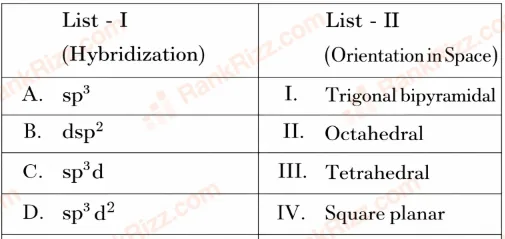
Choose the correct answer from the options given below:
A-IV, B-III, C-I, D-II
A-III, B-IV, C-I, D-II
A-III, B-I, C-IV, D-II
A-II, B-I, C-IV, D-III
Match List I with List II
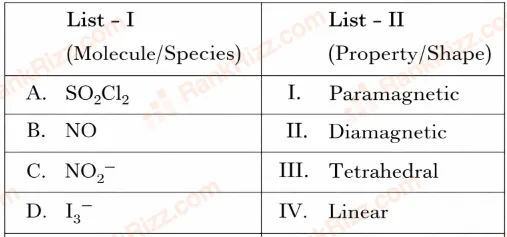
Choose the correct answer from the options given below:
A-II, B-III, C-I, D-IV
A-III, B-I, C-II, D-IV
A-IV, B-I, C-III, D-II
A-III, B-IV, C-II, D-I
Match List I with List II
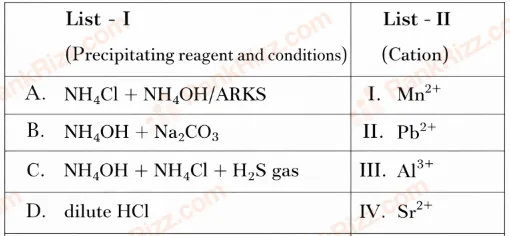
Choose the correct answer from the options given below:
A-III, B-IV, C-I, D-II
A-III, B-IV, C-II, D-I
A-IV, B-III, C-II, D-I
A-IV, B-III, C-I, D-II
JEE Advanced has set 33 Chemical Bonding and Molecular Structure questions too. Chemical Bonding and Molecular Structure JEE Advanced PYQs →
OTHER CHEMISTRY CHAPTERS