JEE ADVANCED 2026 · PAPER 1Dipole moment and molecular polarity
The correct order of dipole moments for the given species is
- A
- B
- C
- D
Chemical Bonding and Molecular Structure has been asked in 16 of the 20 JEE Advanced years from 2007 to 2026: 33 questions in all. In 2026 it averaged 1.5 questions per paper (3 across 2 papers), 8.8% of Chemistry questions, up from 6.3% in 2025. Across the last 20 papers it carried 5.1% of Chemistry questions. By type: 15 single-correct, 10 multiple-correct, 7 numerical and 1 match-the-list. Of the 33 with a difficulty tag, 33% are easy, 55% medium and 12% hard. Most asked: VSEPR theory and shapes of molecules and ions (13, 39%), Molecular orbital theory of diatomic species (10, 30%) and Hydrogen bonding and intermolecular forces (4, 12%).
DATA UPDATED
Questions
33
Distinct ideas
7
Share of marks
5.1%
Difficulty
EASY
The share of each year’s Chemistry questions that came from Chemical Bonding and Molecular Structure, counted from the 19 papers we hold for the last 10 years, and paper by paper inside a year.
Rising: 7.0% of Chemistry questions in 2024–2026, up from 3.8% in 2017–2023. Its heaviest year was 2023, at 11.8%. Not asked at all in 2018, 2021.
| YEAR | QS | PER PAPER | SHARE OF CHEMISTRY | CHANGE | |
|---|---|---|---|---|---|
| 2026 | 3 / 34 | 1.5 | 8.8% | +2.5 pts | PAPER 1 12.5%PAPER 2 5.6% |
| 2025 | 2 / 32 | 1.0 | 6.3% | +0.4 pts | PAPER 1 6.3%PAPER 2 6.3% |
| 2024 | 2 / 34 | 1.0 | 5.9% | −5.9 pts | PAPER 1 11.8%PAPER 2 0.0% |
| 2023 | 4 / 34 | 2.0 | 11.8% | +9.0 pts | PAPER 1 11.8%PAPER 2 11.8% |
| 2022 | 1 / 36 | 0.5 | 2.8% | +2.8 pts | PAPER 1 5.6%PAPER 2 0.0% |
| 2021 | 0 / 38 | 0.0 | 0.0% | −2.8 pts | PAPER 1 0.0%PAPER 2 0.0% |
| 2020 | 1 / 36 | 0.5 | 2.8% | level | PAPER 1 0.0%PAPER 2 5.6% |
| 2019 | 1 / 36 | 0.5 | 2.8% | +2.8 pts | PAPER 1 5.6%PAPER 2 0.0% |
| 2018 | 0 / 18 | 0.0 | 0.0% | −5.6 pts | 1 PAPER |
| 2017 | 2 / 36 | 1.0 | 5.6% | — | PAPER 1 11.1%PAPER 2 0.0% |
“QS” is Chemical Bonding and Molecular Structure questions out of all Chemistry questions that year; “per paper” is that count over the year’s papers, and “change” is the share against the year before. A year with more sittings asks more questions, which is why the share, not the count, is the number to compare.
A chapter is not one subject — it is a handful of procedures the examiner reuses. These are the ones Chemical Bonding and Molecular Structure questions actually test.
Every JEE Advanced Chemical Bonding and Molecular Structure question we hold, newest first inside each topic. Open one for its options, answer key and solution.
FREE PDF
All 33 questions on A4, by topic, with the answer key at the end. No sign-up, no email: your browser saves it as a PDF.
Download free PDFUNIQUE CONCEPTS
11 ideas, each with the latest past question that tested it, drawn from 347 JEE Main and Advanced questions.
Chemical Bonding and Molecular Structure Unique Concepts sheet →JEE MAIN
JEE Main has set 316 Chemical Bonding and Molecular Structure questions, 2004–2026.
Chemical Bonding and Molecular Structure JEE Main PYQs →Not every year. It has been asked in 16 of the 20 JEE Advanced years from 2007 to 2026; the years without a Chemical Bonding and Molecular Structure question were 2008, 2013, 2018 and 2021.
VSEPR theory and shapes of molecules and ions: 13 of the 33 questions (39%). Next come Molecular orbital theory of diatomic species (10) and Hydrogen bonding and intermolecular forces (4).
About 5.1% of Chemistry questions across the last 20 papers. In 2026 it was 8.8% (3 of 34 Chemistry questions).
In JEE Advanced 2026 Paper 2, the latest sitting with a Chemical Bonding and Molecular Structure question.
33 from 2007 to 2026, across 7 topics. Every one is listed on this page by topic and links to its own page, with the answer key and solution wherever we have them. Free, no sign-up.
1–20 OF 33 · NEWEST FIRST
The correct order of dipole moments for the given species is
The correct order of ONO bond angle in the given species is
Consider the following species:
, , , , , , ,
List-I contains different molecular shapes and List-II contains total number of species with the same molecular shapes from the given species. Match each entry in List-I with the appropriate entry in List-II and choose the correct option.
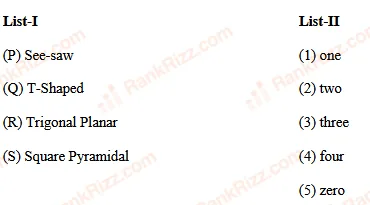
(P)(1), (Q)(2), (R)(5), (S)(3)
(P)(5), (Q)(4), (R)(2), (S)(3)
(P)(3), (Q)(2), (R)(1), (S)(4)
(P)(1), (Q)(3), (R)(5), (S)(4)
The correct statement(s) about intermolecular forces is(are)
The potential energy between two point charges approaches zero more rapidly than the potential energy between a point dipole and a point charge as the distance between them approaches infinity.
The average potential energy of two rotating polar molecules that are separated by a distance has dependence.
The dipole-induced dipole average interaction energy is independent of temperature.
Nonpolar molecules attract one another even though neither has a permanent dipole moment.
Regarding the molecular orbital (MO) energy levels for homonuclear diatomic molecules, the INCORRECT statement(s) is(are)
Bond order of Ne is zero.
The highest occupied molecular orbital (HOMO) of F is -type.
Bond energy of O is smaller than the bond energy of O.
Bond length of Li is larger than the bond length of B.
The option(s) in which at least three molecules follow Octet Rule is(are)
, , and
, , and
, , and
, , and
Based on VSEPR model, match the xenon compounds given in List-I with the corresponding geometries and the number of lone pairs on xenon given in List-II and choose the correct option.
| List-I | List-II | ||
|---|---|---|---|
| (P) | (1) | Trigonal bipyramidal and two lone pair of electrons | |
| (Q) | (2) | Tetrahedral and one lone pair of electrons | |
| (R) | (3) | Octahedral and two lone pair of electrons | |
| (S) | (4) | Trigonal bipyramidal and no lone pair of electrons | |
| (5) | Trigonal bipyramidal and three lone pair of electrons | ||
P-5, Q-2, R-3, S-1
P-5, Q-3, R-2, S-4
P-4, Q-3, R-2, S-1
P-4, Q-2, R-5, S-3
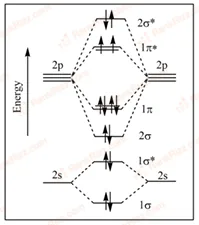
The correct molecular orbital diagram for F molecule in the ground state is
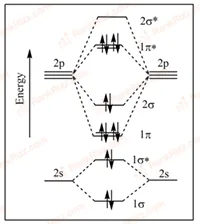
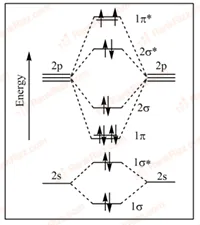
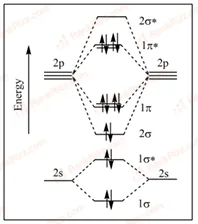
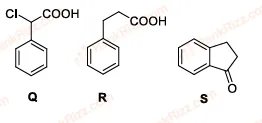
In the following reactions, P, Q, R, and S are the major products.
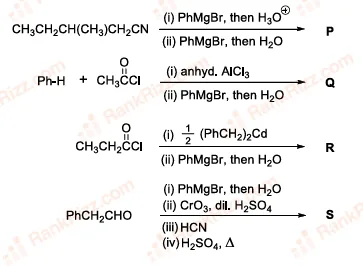
The correct statement(s) about P, Q, R, and S is(are)
Both P and Q have asymmetric carbon(s).
Both Q and R have asymmetric carbon(s).
Both P and R have asymmetric carbon(s).
P has asymmetric carbon(s), S does not have any asymmetric carbon.
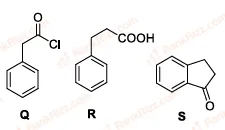
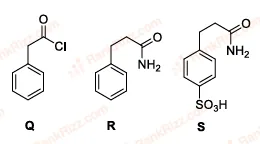
Consider the following reaction scheme and choose the correct option(s) for the major products Q, R and S.
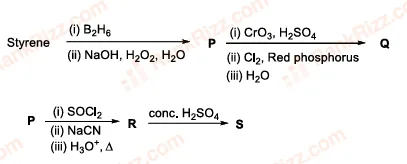
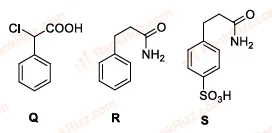
Among [I], [SiO], SOCl, XeF, SF, ClF, Ni(CO), XeOF, [PtCl], XeF, and SOCl, the total number of species having hybridised central atom is ____.
For diatomic molecules, the correct statement(s) about the molecular orbitals formed by the overlap of two 2 orbitals is(are)
orbital has a total of two nodal planes.
orbital has one node in the -plane containing the molecular axis.
orbital has one node in the plane which is perpendicular to the molecular axis and goes through the center of the molecule.
orbital has one node in the -plane containing the molecular axis.
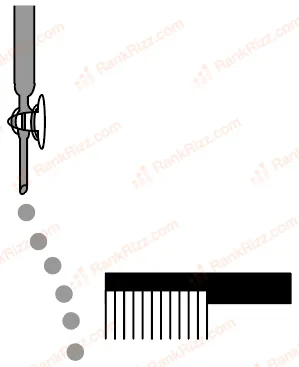
Consider the following compounds in the liquid form:
.
When a charged comb is brought near their flowing stream, how many of them show deflection as per the following figure?
Each of the following options contains a set of four molecules. Identify the option(s) where all four molecules possess permanent dipole moment at room temperature.
The sum of the number of lone pairs of electrons on each central atom in the following species is
, and
(Atomic numbers: N = 7, F = 9, S = 16, Br = 35, Te = 52, Xe = 54)
Among , and , the number of diamagnetic species is
(Atomic numbers: H = 1, He = 2, Li = 3, Be = 4, B = 5, C = 6, N = 7, O = 8, F = 9)
The geometries of the ammonia complexes of and , respectively, are
octahedral, square planar and tetrahedral
square planar, octahedral and tetrahedral
tetrahedral, square planar and octahedral
octahedral, tetrahedral and square planar
According to Molecular Orbital Theory,
is expected to be diamagnetic
is expected to have a longer bond length than
and have the same bond order
has the same energy as two isolated He atoms
The compound(s) with TWO lonepairs of electrons on the central atom is(are)
Among the triatomic molecules/ions, and , the total number of linear molecule(s)/ion(s) where the hybridization of the central atom does not have contribution from the d-orbital(s) is [Atomic number: S = 16, Cl= 17, 1=53 and Xe = 54]
OTHER CHEMISTRY CHAPTERS