Which of the following pictorial diagram most correctly represents the ( - antibonding) molecular orbital between two atoms if the internuclear axis is taken to be in the z-direction ?
- A

- B
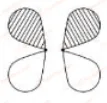
- C
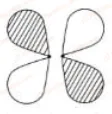
- D
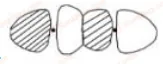
Molecular orbital theory of diatomic species has been asked 79 times in JEE Main, in 20 different years between 2004 and 2026, and in all of the last five exam years (2022–2026), 31 questions in all. That is 25% of Chemical Bonding and Molecular Structure, one of its three most-asked topics. Last asked in JEE Main 04 Apr 2026, Shift 2. 62 are multiple choice and 17 numerical-value; 23 easy and 41 medium by our difficulty labels. All of them are below, newest first, free to read.
Questions
79
Years asked
20
Since
2004
Of the chapter
25%
Questions on Molecular orbital theory of diatomic species in every year it was asked, newest first.
| Year | Relative frequency | Questions |
|---|---|---|
| 2026 | 4 | |
| 2025 | 3 | |
| 2024 | 11 | |
| 2023 | 5 | |
| 2022 | 8 | |
| 2021 | 10 | |
| 2020 | 3 | |
| 2019 | 7 | |
| 2018 | 7 | |
| 2017 | 2 | |
| 2015 | 1 | |
| 2014 | 3 | |
| 2013 | 6 | |
| 2012 | 1 | |
| 2009 | 1 | |
| 2008 | 2 | |
| 2007 | 2 | |
| 2006 | 1 | |
| 2005 | 1 | |
| 2004 | 1 | |
| Total | 79 |
1–20 OF 79 · NEWEST FIRST
Which of the following pictorial diagram most correctly represents the ( - antibonding) molecular orbital between two atoms if the internuclear axis is taken to be in the z-direction ?


Given below are two statements : **Statement (I) :** The correct sequence of bond lengths in the following species is : **Statement (II) :** The correct sequence of number of unpaired electrons in the following species is : In the light of the above statements, choose the correct answer from the options given below :
Both Statement I and Statement II are true
Both Statement I and Statement II are false
Statement I is true but Statement II is false
Statement I is false but Statement II is true
Pair of species among the following having same bond order as well as paramagnetic character will be-
Which of the following statement is correct?
O₂, B₂, C₂ are paramagnetic
C₂, NO, B₂ are diamagnetic
NO, B₂, O₂ are paramagnetic
O₂, NO, C₂ are diamagnetic
Which of the following molecules show/s paramagnetic behavior?
(A) (B) (C) (D) (E)
Choose the correct answer:
B only
A & C only
A & E only
A & D only
Total number of molecules/species from following which will be paramagnetic is ______
, , , , , , , ,
Which of the following linear combination of atomic orbitals will lead to formation of molecular orbitals in homonuclear diatomic molecules [internuclear axis in -direction] ? A. and B. 2 s and C. 3 and 3 D. 2 s and E. and Choose the correct answer from the options given below:
A and B Only
D Only
E Only
C and D Only
The total number of species from the following in which one unpaired electron is present, is _______
Total number of electrons present in molecular orbitals of , and is ______.
When and are the wave functions of atomic orbitals, then is represented by :
Number of molecules having bond order 2 from the following molecules is _____ :
Number of molecules/species from the following having one unpaired electron is ______.
Given below are two statements:
Statement (I): A bonding MO has lower electron density above and below the inter-nuclear axis.
Statement (II): The antibonding MO has a node between the nuclei.
In light of the above statements, choose the most appropriate answer from the options given below:
Both Statement I and Statement II are false
Both Statement I and Statement II are true
Statement I is false but Statement II is true
Statement I is true but Statement II is false
The linear combination of atomic orbitals to form molecular orbitals takes place only when the combining atomic orbitals A. have the same energy B. have the minimum overlap C. have same symmetry about the molecular axis D. have different symmetry about the molecular axis. Choose the most appropriate from the options given below:
A, B, C only
A and C only
B, C, D only
B and D only
The total number of molecular orbitals formed from and atomic orbitals of a diatomic molecule is _______.
The number of species from the following which are paramagnetic and with bond order equal to one is _______
The total number of anti bonding molecular orbitals, formed from and atomic orbitals in a diatomic molecule is ______.
Sum of bond order of CO and is _______.
In which of the following processes, the bond order increases and paramagnetic character changes to diamagnetic one?
O O
O O
NO NO
N N
The bond order and magnetic property of acetylide ion are same as that of
O
N
NO
O
RELATED CHEMICAL BONDING AND MOLECULAR STRUCTURE TOPICS