JEE MAIN 2020 · 02 SEP S1VSEPR theory and shapes of molecules and ions
If molecule is a polar molecule, a possible geometry of is:
- A
Square pyramidal
- B
Tetrahedral
- C
Rectangular planar
- D
Square planar
Every Chemical Bonding and Molecular Structure question JEE Main has set from 2004–2026, grouped by the idea it tests rather than the order of the syllabus. 316 questions across 11 distinct ideas. Free to read, answer key on every one.
DATA UPDATED
Questions
316
Distinct ideas
11
Share of marks
4.8%
Difficulty
MEDIUM
A chapter is not one subject — it is a handful of procedures the examiner reuses. These are the ones Chemical Bonding and Molecular Structure questions actually test.
201–220 OF 316 · NEWEST FIRST
If molecule is a polar molecule, a possible geometry of is:
Square pyramidal
Tetrahedral
Rectangular planar
Square planar
The shape/structure of and , respectively are:
pentagonal planar and trigonal bipyramidal
octahedral and square pyramidal
trigonal bipyramidal and pentagonal planar
trigonal bipyramidal and trigonal bipyramidal
Match the type of interaction in column A with the distance dependence of their interaction energy in column B:
A B
(i) ion - ion (a)
(ii) Dipole - dipole (b)
(iii) London dispersion (c)
(iv)
(i)-(b); (ii)-(d); (iii)-(c)
(i)-(a); (ii)-(b); (iii)-(d)
(i)-(a); (ii)-(b); (iii)-(c)
(i)-(a); (ii)-(c); (iii)-(d)
The molecular geometry of is octahedral. What is the geometry of (including lone pair(s) of electrons, if any)?
Tetrahedral
Trigonal bipyramidal
Pyramidal
Square planar
If the magnetic moment of a di-oxygen species is 1.73 B.M., it may be:
or
or
or
or
The number of hybrid orbitals in a molecule of benzene is:
24
6
18
12
The predominant intermolecular forces present in ethyl acetate, a liquid, are:
London dispersion and dipole-dipole
hydrogen bonding and London dispersion
Dipole-dipole and hydrogen bonding
London dispersion, dipole-dipole and hydrogen bonding
Arrange the following bonds according to their average bond energies in descending order:
C-Cl, C-Br, C-F, C-I
The dipole moments of CCl, CHCl and CH are in the order
CHCl < CH = CCl
CCl < CH < CHCl
CH < CCl < CHCl
CH = CCl < CHCl
The relative strength of the interionic/ intermolecular forces in a decreasing order is:
dipole-dipole > ion-dipole > ion-ion
ion-dipole > ion-ion > dipole-dipole
ion-dipole > dipole-dipole > ion-ion
ion-ion > ion-dipole > dipole-dipole
Chlorine reacts with hot and concentrated NaOH and produces compounds (X) and (Y). Compound (X) gives white precipitate with silver nitrate solution. The average bond order between Cl and O atoms in (Y) is
The bond order and the magnetic characteristic of CN are
, diamagnetic
3, diamagnetic
3, paramagnetic
, paramagnetic
The correct statement among the following is:
is planar and less basic than
is pyramidal and more basic than
is pyramidal and less basic than
is planar and more basic than
During the change of O to O, the incoming electron goes to the orbital:
2p
2p
2p
2p
Among the following, the molecule expected to be stabilized by anion formation is: C, O, NO, F
F
C
O
NO
The major product of the following reaction is:
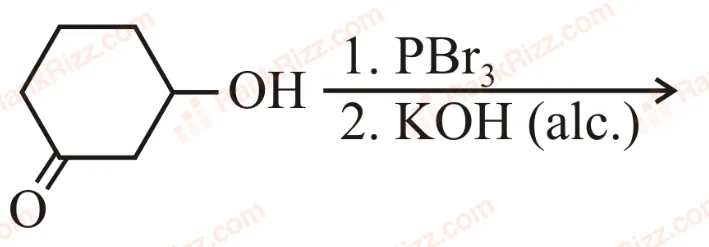
1. PBr
2. KOH (alc.)
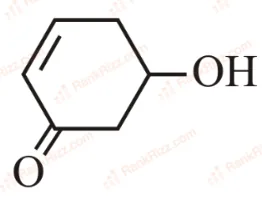
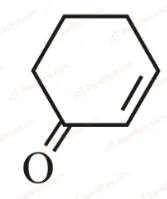
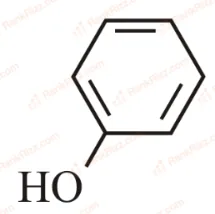
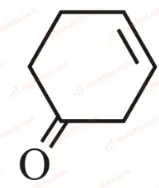
Among the following species, the diamagnetic molecule is:
CO
B
O
NO
HF has highest boiling point among hydrogen halides, because it has:
lowest dissociation enthalpy
strongest van der Waals' interactions
strongest hydrogen bonding
lowest ionic character
Among the following molecules/ions, , , , , which one is diamagnetic and has the shortest bond length?
The covalent alkaline earth metal halide X = Cl, Br, I is:
CaX
MgX
SrX
BeX
JEE Advanced has set 33 Chemical Bonding and Molecular Structure questions too. Chemical Bonding and Molecular Structure JEE Advanced PYQs →
OTHER CHEMISTRY CHAPTERS