Bromine trifluoride autoionizes to form and . The shapes of the cation and anion are respectively __________, and __________.
- A
bent, square planar
- B
linear, square planar
- C
bent, see-saw
- D
linear, tetrahedral
VSEPR theory and shapes of molecules and ions has been asked 118 times in JEE Main, in 19 different years between 2004 and 2026, and in all of the last five exam years (2022–2026), 69 questions in all. That is 37% of Chemical Bonding and Molecular Structure, its most-asked topic. Last asked in JEE Main 08 Apr 2026, Shift 2. 92 are multiple choice and 26 numerical-value; 48 easy and 59 medium by our difficulty labels. All of them are below, newest first, free to read.
Questions
118
Years asked
19
Since
2004
Of the chapter
37%
Questions on VSEPR theory and shapes of molecules and ions in every year it was asked, newest first.
| Year | Relative frequency | Questions |
|---|---|---|
| 2026 | 11 | |
| 2025 | 11 | |
| 2024 | 16 | |
| 2023 | 15 | |
| 2022 | 16 | |
| 2021 | 14 | |
| 2020 | 7 | |
| 2019 | 3 | |
| 2018 | 4 | |
| 2017 | 2 | |
| 2016 | 2 | |
| 2015 | 1 | |
| 2014 | 2 | |
| 2013 | 4 | |
| 2012 | 4 | |
| 2011 | 1 | |
| 2006 | 2 | |
| 2005 | 1 | |
| 2004 | 2 | |
| Total | 118 |
1–20 OF 118 · NEWEST FIRST
Bromine trifluoride autoionizes to form and . The shapes of the cation and anion are respectively __________, and __________.
bent, square planar
linear, square planar
bent, see-saw
linear, tetrahedral
Given below are two statements :
Statement I : is the correct trend in terms of bond angle.
Statement II : SiF, SnF and PbF are ionic in nature.
In the light of the above statements, choose the correct answer from the options given below :
Both Statement I and Statement II are true
Both Statement I and Statement II are false
Statement I is true but Statement II is false
Statement I is false but Statement II is true
Consider the following species:
, , , , , , , , ,
Number of species having hybridized central atom is _______.
is isostructural with :
A.
B.
C.
D.
E.
Choose the correct answer from the options given below :
C Only
C and E Only
A and D Only
B and E Only
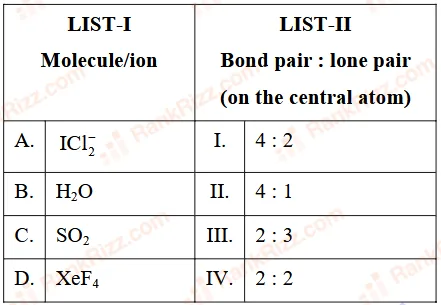
Match List - I with List - Il according to shape.
List - I List - II
A. I.
B. II.
C. III.
D. IV.
Choose the correct answer from the options given below:
A-II, B-III, C-I, D-IV
A-II, B-III, C-IV, D-I
A-III, B-Il, C-IV, D-I
A-II, B-I, C-III, D-IV
Among the following, the CORRECT combinations are
Choose the correct answer from the options given below:
B, C and D Only
A, B and C Only
A and B Only
A, B, C and D
ldentify the molecule (X) with maximum number of lone pairs of electrons (obtained using Lewis dot structure) among . Choose the correct bond angle made by the central atom of the molecule (X).
Which statements are NOT TRUE about ?
A. It has a see-saw shape.
B. Xe has 5 electron pairs in its valence shell in .
C. The bond angle is close to .
D. The bond angle is close to .
E. has 16 valence electrons in .
Choose the correct answer from the options given below:
B, C and E Only
B and D Only
Aand D Only
B, D and E Only
Two p-block elements and form fluorides of the type . The fluoride compound is a Lewis acid and is a Lewis base. The hybridizations of the central atoms of and respectively are
Both
and
Both
and
Given below are two statements:
Statement I :
The number of species among and , tha t have tetrahedral geometry is 3.
Statement II :
In the set all the molecules have incomplete octet around central atom.
In the light of the above statements, choose the correct answer from the options given below :
Both Statement I and Statement II are false
Both Statement I and Statement II are true
Statement I is true but Statement II is false
Statement I is false but Statement II is true
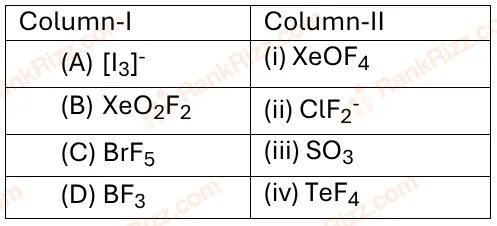
Match column-I with column-II according to their shape.

A-II ,B-IV ,C-III ,D-I
A-III ,B-IV ,C-I ,D-II
A-II ,B-I ,C-IV ,D-III
A-II ,B-IV ,C-I ,D-III
Match the LIST-I with LIST-II.

Choose the correct answer from the options given below :
A-IV, B-III, C-II, D-I
A-III, B-IV, C-II, D-I
A-III, B-IV, C-I, D-II
A-I, B-I, C-IV, D-III
In , and the hybridizations at the central atom are respectively :
, and sp
, sp and sp
, and
sp, and sp
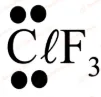
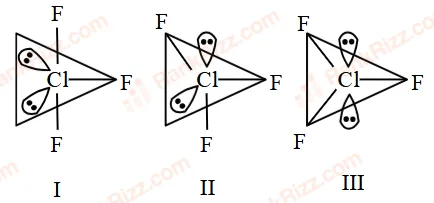
Given below are two statements:
Statement (I) : for

, all three possible structures may be drawn.

Statement (II) : Structure III is most stable, as the orbitals having the lone pairs are axial, where the repulsion is minimum.
In the light of the above statements, choose the most appropriate answer from the options given below:
Statement I is incorrect but statement II is correct.
Statement I is correct but Statement II is incorrect.
Both Statement I and statement II are correct.
Both Statement I and Statement II are incorrect.
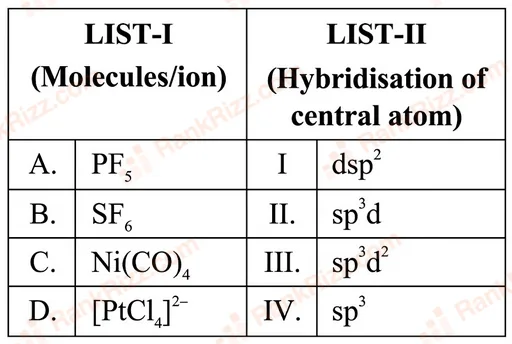
Match the LIST-I with LIST-II.
Choose the correct answer from the options given below :
A-II, B-III, C-IV, D-I
A-IV, B-I, C-II, D-III
A-I, B-II, C-III, D-IV
A-III, B-I, C-IV, D-II
Among , , , , and , the hybridization of the molecule with non-zero dipole moment and highest number of lone pairs of electrons on the central atom is:
A molecule with the formula has all its elements from p-block. Element is rarest, monoatomic, non-radioactive from its group and has the lowest ionization enthalpy value among and . Elements and have first and second highest electronegativity values respectively among all the known elements. The shape of the molecule is:
Square pyramidal
Octahedral
Pentagonal planar
Trigonal bipyramidal
Which among the following molecules is (a) involved in hybridization, (b) has different bond lengths and (c) has lone pair of electrons on the central atom ?
The molecules having square pyramidal geometry are
Consider is the number of lone pair of electrons present in the equatorial position of the most stable structure of . The ions from the following with number of unpaired electrons are Choose the correct answer from the options given below :
A and C Only
A, D and E Only
B and D Only
B and C Only
RELATED CHEMICAL BONDING AND MOLECULAR STRUCTURE TOPICS