JEE MAIN 2021 · 18 MAR S2VSEPR theory and shapes of molecules and ions
The number of species below that have two lone pairs of electrons in their central atom is ___ (Round off to the Nearest integer)
SF, BF, ClF, AsF, PCl, BrF, XeF, SF
Every Chemical Bonding and Molecular Structure question JEE Main has set from 2004–2026, grouped by the idea it tests rather than the order of the syllabus. 316 questions across 11 distinct ideas. Free to read, answer key on every one.
DATA UPDATED
Questions
316
Distinct ideas
11
Share of marks
4.8%
Difficulty
MEDIUM
A chapter is not one subject — it is a handful of procedures the examiner reuses. These are the ones Chemical Bonding and Molecular Structure questions actually test.
181–200 OF 316 · NEWEST FIRST
The number of species below that have two lone pairs of electrons in their central atom is ___ (Round off to the Nearest integer)
SF, BF, ClF, AsF, PCl, BrF, XeF, SF
A central atom in a molecule has two lone pairs of electrons and forms three single bonds. The shape of this molecule is:
see-saw
planar triangular
T-shaped
trigonal pyramidal
Amongst the following, the linear species is:
NO
ClO
O
N
Given below are two statements: one is labelled as Assertion A and the other is labelled as Reason R:
Assertion A: The H-O-H bond angle in water molecule is 104.5°.
Reason R: The lone pair - lone pair repulsion of electrons is higher than the bond pair - bond pair repulsion.
A is false but R is true
Both A and R are true, but R is not the correct explanation of A
A is true but R is false
Both A and R are true, and R is the correct explanation of A
Match List-I with List-II.
| List-I (Molecule) | List-II (Bond order) |
|---|---|
| (a) | (i) 1 |
| (b) | (ii) 2 |
| (c) | (iii) 0 |
| (d) | (iv) 3 |
(a)(ii), (b)(i), (c)(iv), (d)(iii)
(a)(iii), (b)(iv), (c)(i), (d)(ii)
(a)(i), (b)(ii), (c)(iii), (d)(iv)
(a)(iv), (b)(iii), (c)(ii), (d)(i)
In
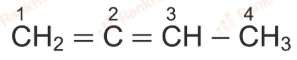
molecule, the hybridization of carbon 1, 2, 3 and 4 respectively, are:
According to molecular orbital theory, the species among the following that does not exist is:
Which among the following species has unequal bond lengths?
Which of the following are isostructural pairs?
A. and
B. and
C. and
D. and
A and C only
B and C only
A and B only
C and D only
The correct set from the following in which both pairs are in correct order of melting point is:
LiF > LiCl; NaCl > MgO
LiCl > LiF; MgO > NaCl
LiCl > LiF; NaCl > MgO
LiF > LiCl; MgO > NaCl
The correct shape and I - I - I bond angles respectively in ion are:
T-shaped; 180° and 90°
Distorted trigonal planar; 135° and 90°
Trigonal planar; 120°
Linear; 180°
The potential energy curve for the molecule as a function of internuclear distance is:
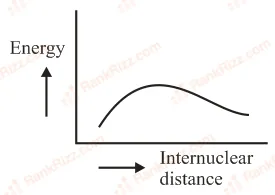
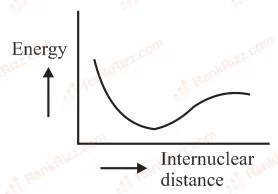
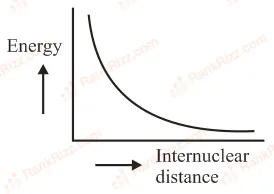
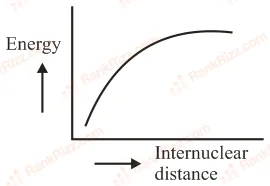
The structure of in the solid state is:
tetrahedral and octahedral
square planar and octahedral
square pyramidal
trigonal bipyramidal
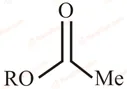
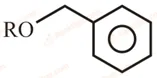
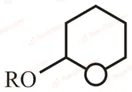
Which of the following derivatives of alcohols is unstable in an aqueous base?
The increasing order of boiling points of the following compounds is:
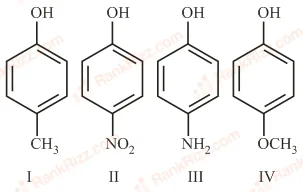
I < III < IV < II
I < IV < II < III
IV < I < II < III
III < I < II < IV
The compound that has the largest bond angle () is:
The intermolecular potential energy for the molecules A, B, C and D given below suggests that:
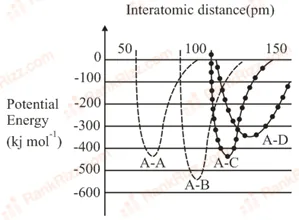
A - D has the shortest bond length
A - A has the largest bond enthalpy
D is more electronegative than other atoms.
A - B has the stiffest bond.
The reaction in which the hybridisation of the underlined atom is affected is
Of the species, NO, NO, NO and NO, the one with minimum bond strength is:
NO
NO
NO
NO
Consider the following molecules and statements related to them:
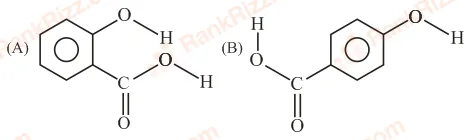
(a) (B) is more likely to be crystalline than (A)
(b) (B) has higher boiling point than (A)
(c) (B) dissolves more readily than (A) in water
Identify the correct option from below:
(a) and (b) are true
(a) and (c) are true
only (a) is true
(b) and (c) are true
JEE Advanced has set 33 Chemical Bonding and Molecular Structure questions too. Chemical Bonding and Molecular Structure JEE Advanced PYQs →
OTHER CHEMISTRY CHAPTERS