JEE MAIN 2024 · 04 APR S2Colour and magnetic behaviour of complexes from CFT
If an iron (III) complex with the formula has no electron in its orbital, then the value of is:
- A
4
- B
5
- C
6
- D
3
Every Coordination Compounds question JEE Main has set from 2004–2026, grouped by the idea it tests rather than the order of the syllabus. 373 questions across 10 distinct ideas. Free to read, answer key on every one.
DATA UPDATED
Questions
373
Distinct ideas
10
Share of marks
7.7%
Difficulty
MEDIUM
A chapter is not one subject — it is a handful of procedures the examiner reuses. These are the ones Coordination Compounds questions actually test.
101–120 OF 373 · NEWEST FIRST
If an iron (III) complex with the formula has no electron in its orbital, then the value of is:
4
5
6
3
The number of unpaired d-electrons in is:
2
1
0
4
Which of the following complex is homoleptic?
Given below are two statements: Statement (I): A solution of is green in colour. Statement (II): A solution of is colourless. In the light of the above statements, choose the most appropriate answer from the options given below:
Both Statement I and Statement II are incorrect
Both Statement I and Statement II are correct
Statement I is incorrect but Statement II is correct
Statement I is correct but Statement II is incorrect
Which of the following compounds show colour due to d-d transition?
Given below are two statements:
Statement (I): Dimethyl glyoxime forms a six membered covalent chelate when treated with solution in presence of .
Statement (II): Prussian blue precipitate contains iron both in +2 and +3 oxidation states.
In the light of the above statements, choose the most appropriate answer from the options given below:
Statement I is false but Statement II is true
Both Statement I and Statement II are true
Both Statement I and Statement II are false
Statement I is true but Statement II is false
and are respectively known as:
Spin free Complex, Spin paired Complex
Spin paired Complex, Spin free Complex
Outer orbital Complex, Inner orbital Complex
Inner orbital Complex, Spin paired Complex
The correct statements from the following are:
A. The strength of anionic ligands can be explained by crystal field theory.
B. Valence bond theory does not give a quantitative interpretation of kinetic stability of coordination compounds.
C. The hybridization involved in formation of complex is .
D. The number of possible isomer(s) of cis- is one.
Choose the correct answer from the options given below:
A, D only
A, C only
B, D only
B, C only
The 'Spin only' Magnetic moment for is ______ BM. (given = Atomic number of Ni : 28) Round off your answer to the nearest integer.
Select the option with correct property:
and both diamagnetic
and both paramagnetic
diamagnetic, paramagnetic
diamagnetic, paramagnetic
Match List I with List II
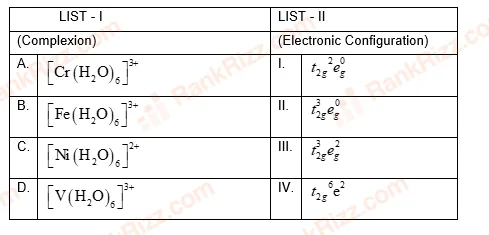
Choose the correct answer from the options given below:
A-III, B-II, C-IV, D-I
A-IV, B-I, C-II, D-III
A-IV, B-III, C-I, D-II
A-II, B-III, C-IV, D-I
Choose the correct Statements from the following:
(A) Ethane-1,2-diamine is a chelating ligand.
(B) Metallic aluminium is produced by electrolysis of aluminium oxide in presence of cryolite.
(C) Cyanide ion is used as ligand for leaching of silver.
(D) Phosphine acts as a ligand in Wilkinson catalyst.
(E) The stability constants of and are similar with EDTA complexes.
(B), (C), (E) only
(C), (D), (E) only
(A), (B), (C) only
(A), (D), (E) only
The coordination geometry around the manganese in decacarbonyldimanganese(0) is:
Octahedral
Trigonal bipyramidal
Square pyramidal
Square planar
Number of complexes which show optical isomerism among the following is _________.
, , , , ,
In which one of the following metal carbonyls, CO forms a bridge between metal atoms?
Match List I with List II
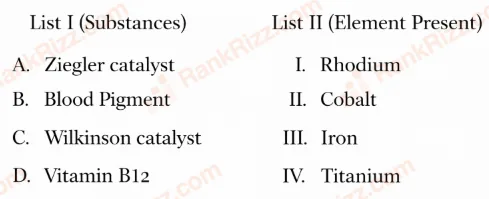
Choose the correct answer from the options given below:
A-II, B-IV, C-I, D-III
A-II, B-III, C-IV, D-I
A-III, B-II, C-IV, D-I
A-IV, B-III, C-I, D-II
The correct IUPAC name of is:
Potassium tetraoxopermanganate (VI)
Potassium tetraoxidomanganate (VI)
Dipotassium tetraoxidomanganate (VII)
Potassium tetraoxidomanganese (VI)
Yellow compound of lead chromate gets dissolved on treatment with hot NaOH solution. The product of lead formed is a :
Tetraanionic complex with coordination number six
Neutral complex with coordination number four
Dianionic complex with coordination number six
Dianionic complex with coordination number four
Consider the following complex ions , , . The correct order of the complex ions, according to their spin only magnetic moment values (in B.M.) is :
Identity the incorrect pair from the following:
Photography - AgBr
Polythene preparation -
Haber process - Iron
Wacker process -
JEE Advanced has set 46 Coordination Compounds questions too. Coordination Compounds JEE Advanced PYQs →
OTHER CHEMISTRY CHAPTERS