JEE MAIN 2020 · 02 SEP S1Werner's theory and coordination terminology
The oxidation states of iron atoms in compounds (A), (B) and (C), respectively, are x, y and z. Then sum of x, y and z is ___________.
(A) (B) (C)
Every Coordination Compounds question JEE Main has set from 2004–2026, grouped by the idea it tests rather than the order of the syllabus. 373 questions across 10 distinct ideas. Free to read, answer key on every one.
DATA UPDATED
Questions
373
Distinct ideas
10
Share of marks
7.7%
Difficulty
MEDIUM
A chapter is not one subject — it is a handful of procedures the examiner reuses. These are the ones Coordination Compounds questions actually test.
261–280 OF 373 · NEWEST FIRST
The oxidation states of iron atoms in compounds (A), (B) and (C), respectively, are x, y and z. Then sum of x, y and z is ___________.
(A) (B) (C)
Simplified absorption spectra of three complexes ((i) and (ii) and (iii)) of ion are provided below; their values are marked as A, B and C respectively. The correct match between the complexes and their values is: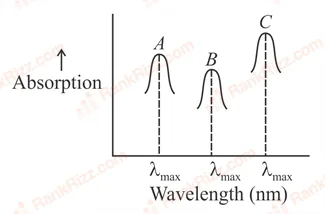
(i)
(ii)
(iii)
A-(iii), (B)-(i), C-(ii)
A-(ii), (B)-(i), C-(iii)
A-(ii), (B)-(iii), C-(i)
A-(i), (B)-(ii), C-(iii)
The one that is not expected to show isomerism is:
Complex X of composition has a spin only magnetic moment of 3.83 B.M. It reacts with and shows geometrical isomerism. The IUPAC nomenclature of X is:
Hexaaquachromium(III) chloride
Tetraaquadichlorido chromium(IV) chloride dihydrate
Dichloridotetraaqua chromium(IV) chloride dihydrate
Tetraaquadichlorido chromium(III) chloride dihydrate
has number of geometrical isomers. Then, the spin-only magnetic moment and crystal field stabilization energy [CFSE] of , respectively, are:
[Note: Ignore the pairing energy]
2.84 BM and
5.92 BM and 0
1.73 BM and
0 BM and
The correct order of the spin-only magnetic moments of the following complexes is:
(I)
(II)
(III)
(IV)
The isomer(s) of that has/have a Cl - Co - Cl angle of 90, is/are:
meridional and trans
cis and trans
trans only
cis only
The complex that can show fac- and mer-isomers is:
[Co(NH)Cl]
[Pt(NH)Cl]
[CoCl(en)]
[Co(NH)(NO)]
Among (a) - (d), the complexes that can show geometrical isomerism are:
(a) [Pt(NH)Cl]
(b) [Pt(NH)Cl]
(c) [Pt(NH)Cl(NO)]
(d) [Pt(NH)ClBr]
b and c
d and a
c and d
a and b
The correct order of the calculated spin-only magnetic moments of complexes (A) to (D) is:
(A) Ni(CO)
(B) [Ni(HO)]Cl
(C) Na[Ni(CN)]
(D) PdCl(PPh)
(A) (C) < (B) (D)
(C) < (D) < (B) < (A)
(C) (D) < (B) < (A)
(A) (C) (D) < (B)
Complexes (ML) of metals Ni and Fe have ideal square pyramidal and trigonal bipyramidal geometries, respectively. The sum of the 90, 120 and 180 L-M-L angles in the two complexes is
The IUPAC name of the complex [Pt(NH)Cl(NHCH)]Cl is
Diamminechlorido (methanamine) platinum (II) chloride
Diammine(methanamine)chlorido platinum (II) chloride
Diamminechlorido (aminomethane) platinum (II) chloride
Bisammine (methanamine) chlorido platinum (II) chloride
The theory that can completely/properly explain the nature of bonding in [Ni(CO)] is:
Werner's theory
Molecular orbital theory
Crystal field theory
Valence bond theory
The number of possible optical isomers for the complexes MAB with sp and dsp hybridized metal atom, respectively, is:
Note: A and B are unidentate neutral and unidentate monoanionic ligands, respectively.
0 and 2
2 and 2
0 and 0
0 and 1
Among the statements (a) - (d), the incorrect ones are:
(a) Octahedral Co(III) complexes with strong field ligands have very high magnetic moments
(b) When , the d-electron configuration of Co(III) in an octahedral complex is
(c) Wavelength of light absorbed by [Co(en)] is lower than that of [CoF]
(d) If the for an octahedral complex of Co(III) is 18,000 cm, the for its tetrahedral complex with the same ligand will be 16,000 cm.
(a) and (d) only
(c) and (d) only
(a) and (b) only
(b) and (c) only
The complex ion that will lose its crystal field stabilization energy upon oxidation of metal to +3 state is:
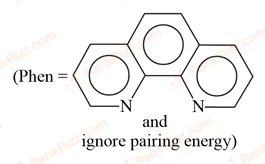
(Phen = phenanthroline, ignore pairing energy)
[Ni(phen)]
[Fe(phen)]
[Co(phen)]
[Zn(phen)]
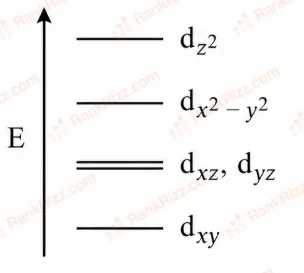
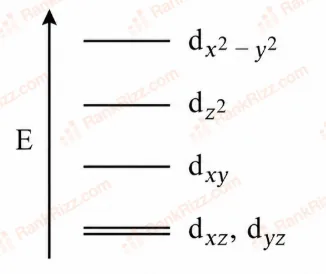
Complete removal of both the axial ligands (along the z-axis) from an octahedral complex leads to which of the following splitting patterns? (relative orbital energies not on scale).
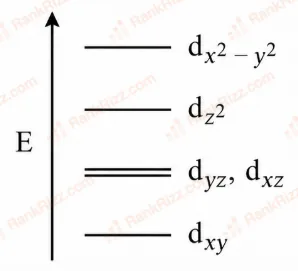
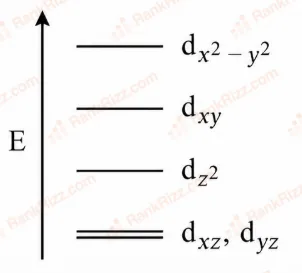
The coordination numbers of Co and Al in [Co(Cl)(en)]Cl and K[Al(CO)], respectively are:
(en = ethane-1, 2-diamine)
3 and 3
5 and 3
5 and 6
6 and 6
The compound used in the treatment of lead poisoning is:
Desferrioxime B
EDTA
Cis-platin
D-penicillamine
The species that can have a trans-isomer is:
(en = ethane-1, 2-diamine, ox = oxalate)
[Cr(en)(ox)]
[Pt(en)Cl]
[Zn(en)Cl]
[Pt(en)Cl]
JEE Advanced has set 46 Coordination Compounds questions too. Coordination Compounds JEE Advanced PYQs →
OTHER CHEMISTRY CHAPTERS