Stability and applications of coordination compounds — JEE Main Previous Year Questions
Stability and applications of coordination compounds has been asked 27 times in JEE Main, in 7 different years between 2004 and 2026, and in 4 of the last five exam years (2022–2026), 16 questions in all. That is 7% of Coordination Compounds. Last asked in JEE Main 22 Jan 2026, Shift 1. 21 are multiple choice and 6 numerical-value; 17 easy and 9 medium by our difficulty labels. All of them are below, newest first, free to read.
Questions on Stability and applications of coordination compounds in every year it was asked, newest first.
JEE Main questions on Stability and applications of coordination compounds by year, 2004–2026
Year
Relative frequency
Questions
2026
1
2024
7
2023
6
2022
2
2021
4
2019
6
2004
1
Total
27
Every Stability and applications of coordination compounds question
1–20 OF 27 · NEWEST FIRST
JEE MAIN 2026 · 22 JAN S1Stability and applications of coordination compounds
A first row transition metal (M) does not liberate H2 gas from dilute HCI. 1 mol of aqueous solution of MSO4 is treated with excess of aqueous KCN and then H2S(g) is passed through the solution. The amount of MS (metal sulphide) formed from the above reaction is _______ mol.
JEE MAIN 2024 · 08 APR S1Stability and applications of coordination compounds
Given below are two statements: Statement I: N(CH3)3 and P(CH3)3 can act as ligands to form transition metal complexes. Statement II: As N and P are from same group, the nature of bonding of N(CH3)3 and P(CH3)3 is always same with transition metals. In the light of the above statements, choose the most appropriate answer from the options given below:
A
Statement I is correct but Statement II is incorrect.
B
Statement I is incorrect but Statement II is correct.
JEE MAIN 2024 · 06 APR S2Stability and applications of coordination compounds
Consider the following reactions NiS+HNO3+HCl→A+NO+S+H2O. A+NH4OH+H3C−C(=N−OH)−C(=N−OH)−H3C→B+NH4Cl+H2O. The number of protons that do not involve in hydrogen bonding in the product B is ___________.
JEE MAIN 2024 · 01 FEB S2Stability and applications of coordination compounds
Given below are two statements: Statement (I): Dimethyl glyoxime forms a six membered covalent chelate when treated with NiCl2 solution in presence of NH4OH. Statement (II): Prussian blue precipitate contains iron both in +2 and +3 oxidation states. In the light of the above statements, choose the most appropriate answer from the options given below:
JEE MAIN 2024 · 30 JAN S1Stability and applications of coordination compounds
Choose the correct Statements from the following: (A) Ethane-1,2-diamine is a chelating ligand. (B) Metallic aluminium is produced by electrolysis of aluminium oxide in presence of cryolite. (C) Cyanide ion is used as ligand for leaching of silver. (D) Phosphine acts as a ligand in Wilkinson catalyst. (E) The stability constants of Ca2+ and Mg2+ are similar with EDTA complexes.
JEE MAIN 2023 · 13 APR S1Stability and applications of coordination compounds
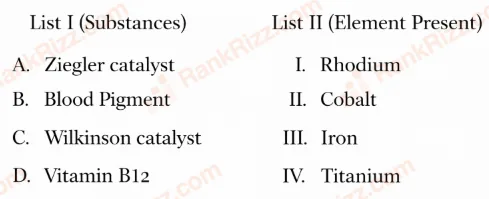
The mismatched combinations are A. Chlorophyll − Co B. Water hardness − EDTA C. Photography − [Ag(CN)2]− D. Wilkinson catalyst − [(Ph3P)3RhCl] E. Chelating ligand − D − Penicillamine Choose the correct answer from the options given below.
JEE MAIN 2023 · 30 JAN S1Stability and applications of coordination compounds
To inhibit the growth of tumours, identify the compounds used from the following: (A) EDTA (B) Coordination Compounds of Pt (C) D-Penicillamine (D) Cis - Platin Choose the correct answer from the option given below:
JEE MAIN 2021 · 27 AUG S1Stability and applications of coordination compounds
The number of moles of NH3, that must be added to 2 L of 0.80 M AgNO3 in order to reduce the concentration of Ag+ ions to 5.0×10⁻⁸ M (Kformation for [Ag(NH3)2]+=1.0×10⁸) is _________. (Nearest integer) [Assume no volume change on adding NH3]
JEE MAIN 2021 · 24 FEB S1Stability and applications of coordination compounds
The stepwise formation of [Cu(NH3)4]2+ is given below: Cu2++NH3K1[Cu(NH3)]2+ [Cu(NH3)]2++NH3K2[Cu(NH3)2]2+ [Cu(NH3)2]2++NH3K3[Cu(NH3)3]2+ [Cu(NH3)3]2++NH3K4[Cu(NH3)4]2+ The value of stability constants K1, K2, K3 and K4 are 104, 1.58×10³, 5×10² and 102 respectively. The overall equilibrium constant for dissociation of [Cu(NH3)4]2+ is x×10−12. The value of x is ______ (Rounded off to the nearest integer)
Stability and applications of coordination compounds: common questions
How many Stability and applications of coordination compounds questions have come in JEE Main?
Stability and applications of coordination compounds has been asked 27 times in JEE Main, in 7 different years between 2004 and 2026. It came up in 4 of the last five exam years (2022–2026), 16 questions in all.
Is Stability and applications of coordination compounds important for JEE Main?
It is part of Coordination Compounds: 27 of the chapter's 373 JEE Main questions (7%). It came up in 4 of the last five exam years (2022–2026), 16 questions in all.
When was Stability and applications of coordination compounds last asked in JEE Main?
Most recently in JEE Main 22 Jan 2026, Shift 1. Questions on this page are newest first, so the latest ones are at the top.
What kind of Stability and applications of coordination compounds questions does JEE Main ask?
21 are multiple choice and 6 numerical-value; 17 easy and 9 medium by our difficulty labels. Each question shows its answer key and worked solution where we have them.