RankRizz

Valence bond theory of complexes — JEE Main Previous Year Questions

Valence bond theory of complexes has been asked 79 times in JEE Main, in 18 different years between 2004 and 2026, and in all of the last five exam years (2022–2026), 37 questions in all. That is 21% of Coordination Compounds, one of its three most-asked topics. Last asked in JEE Main 06 Apr 2026, Shift 2. 61 are multiple choice and 18 numerical-value; 13 easy, 58 medium and 3 hard by our difficulty labels. All of them are below, newest first, free to read.

Questions

79

Years asked

18

Since

2004

Of the chapter

21%

When JEE Main asked it

Questions on Valence bond theory of complexes in every year it was asked, newest first.

JEE Main questions on Valence bond theory of complexes by year, 2004–2026
YearRelative frequencyQuestions
20266
20258
20244
20238
202211
202114
20205
20196
20183
20171
20162
20143
20133
20121
20111
20071
20061
20041
Total79

Every Valence bond theory of complexes question

1–20 OF 79 · NEWEST FIRST

JEE MAIN 2026 · 06 APR S2Valence bond theory of complexes

Which of the following sequences of hybridisation, geometry and magnetic nature are correct for the given coordination compounds?
A. [NiCl4]2−[NiCl_4]^{2-} -- sp3^3, tetrahedral, paramagnetic
B. [Ni(NH3)6]2+[Ni(NH_3)_6]^{2+} -- sp3^3d2^2, octahedral, paramagnetic
C. [Ni(CO)4][Ni(CO)_4] -- sp3^3, tetrahedral, paramagnetic
D. [Ni(CN)4]2−[Ni(CN)_4]^{2-} -- dsp2^2, square planar, diamagnetic
Choose the correct answer from the options given below :

  1. A

    A, B, C and D

  2. B

    B, C and D only

  3. C

    A, C and D only

  4. D

    A, B and D only

JEE MAIN 2026 · 06 APR S2Valence bond theory of complexes

An excess of AgNO3_3 is added to 100 mL of a 0.05 M solution of tetraaquadichloridochromium (III) chloride. The number of moles of AgCl precipitated will be __________ ×10−3\times 10^{-3}. (Nearest integer)

JEE MAIN 2026 · 05 APR S2Valence bond theory of complexes

Identify the correct statements from the following

A.\textbf{A.} [Fe(C2O4)3]3−[\text{Fe}(\text{C}_2\text{O}_4)_3]^{3-} is the most stable complex among [Fe(OH)6]3−[\text{Fe}(\text{OH})_6]^{3-}, [Fe(C2O4)3]3−[\text{Fe}(\text{C}_2\text{O}_4)_3]^{3-} and [Fe(SCN)6]3−[\text{Fe}(\text{SCN})_6]^{3-}

B.\textbf{B.} The stability of [Cu(NH3)4]2+[\text{Cu}(\text{NH}_3)_4]^{2+} is greater than that of [Cu(en)2]2+[\text{Cu}(\text{en})_2]^{2+}

C.\textbf{C.} The hybridization of Fe in K4[Fe(CN)6]\text{K}_4[\text{Fe}(\text{CN})_6] is d2sp3d^2sp^3

D.\textbf{D.} [Fe(NO2)3Cl3]3−[\text{Fe}(\text{NO}_2)_3\text{Cl}_3]^{3-} exhibits linkage isomerism

E.\textbf{E.} NO2−\text{NO}_2^{-} and SCN−\text{SCN}^{-} ligands are NOT ambidentate ligands

Choose the correct answer from the options given below:

  1. A

    A, B, C, D, E

  2. B

    B, C, D

  3. C

    A, C, D

  4. D

    A, C, E

JEE MAIN 2026 · 02 APR S1Valence bond theory of complexes

5.33 g of CrCl3_3·6H2_2O, which is a 1 : 3 electrolyte, is dissolved in water and is passed through a cation exchanger. The chloride ions in the eluted solution, on treatment with AgNO3_3 results in 8.61 g of AgCl. The ratio of moles of complex reacted and moles of AgCl formed is __________ × 10−2^{-2}. (Nearest integer) [Molar mass in g mol−1^{-1} Cr : 52, Ag : 108, Cl : 35.5, H : 1, O : 16]

JEE MAIN 2026 · 24 JAN S2Valence bond theory of complexes

A chromium complex with a formula CrCl3.6H2OCrCl_{3}.6H_{2}O has a spin only magnetic moment value of 3.87 BM and its solution conductivity corresponds to 1:2 electrolyte. 2.75 g of the complex solution was initially passed through a cation exchanger. The solution obtained after the process was reacted with excess of AgNO3AgNO_{3}. The amount of AgCI formed in the above process is __ g. (Nearest
integer)
[Given: Molar massing mol−1mol^{-1} Cr:52; Cl:35.5, Ag:108, 0:16, H:1]

JEE MAIN 2026 · 23 JAN S2Valence bond theory of complexes

Identify the CORRECT set of details from the following:

A. [Co(NH3)6]3+[Co(NH_3)_6]^{3+} : Inner orbital compex; d2sp3d^{2}sp^{3} hybridized

B. [MnCl6]3−[MnCl_6]^{3-} : Outer orbital complex; sp3d2sp^{3}d^{2} hybridized

C. [CoF6]3−[CoF_6]^{3-} : Outer orbital complex; d2sp3d^{2}sp^{3} hybridized

D. [FeF6]3−[FeF_6]^{3-} : Outer orbital complex; sp3d2sp^{3}d^{2} hybridized

E. [Ni(CN)4]2−[Ni(CN)_4]^{2-} : Inner orbital complex; sp3d2sp^{3}d^{2} hybridized

Choose the correct answer from the options given below:

  1. A

    A, B, C, D & E

  2. B

    C & D Only

  3. C

    A, C & E Only

  4. D

    A, B & D Only

JEE MAIN 2025 · 08 APR S2Valence bond theory of complexes

The number of species from the following that are involved in sp3d2sp^3d^2 hybridization is : [Co(NH3)6]3+[Co(NH_3)_6]^{3+}, SF6SF_6, [CrF6]3−[CrF_6]^{3-}, [CoF6]3−[CoF_6]^{3-}, [Mn(CN)6]3−[Mn(CN)_6]^{3-}, and [MnCl6]3−[MnCl_6]^{3-}

  1. A

    5

  2. B

    6

  3. C

    4

  4. D

    3

JEE MAIN 2025 · 07 APR S1Valence bond theory of complexes

The number of paramagnetic complex among [FeF6]3−[FeF_6]^{3-}, [Fe(CN)6]3−[Fe(CN)_6]^{3-}, [Mn(CN)6]3−[Mn(CN)_6]^{3-}, [Co(C2O4)3]3−[Co(C_2O_4)_3]^{3-}, [MnCl6]3−[MnCl_6]^{3-} and [CoF6]3−[CoF_6]^{3-}, which involved d2sp3d^2sp^3 hybridisation of metal is ______.

JEE MAIN 2025 · 07 APR S2Valence bond theory of complexes

'X' is the number of acidic oxides among VO2VO_2, V2O3V_2O_3, CrO3CrO_3, V2O5V_2O_5 and Mn2O7Mn_2O_7. The primary valency of cobalt in [Co(H2NCH2CH2NH3)3]2(SO4)3[Co(H_2NCH_2CH_2NH_3)_3]_2(SO_4)_3 is Y. The value of X + Y is :

  1. A

    5

  2. B

    4

  3. C

    2

  4. D

    3

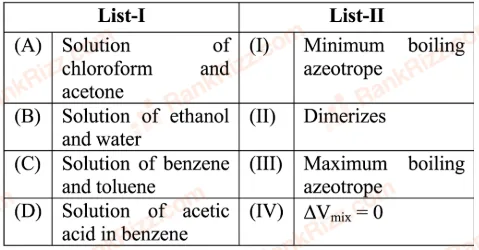
JEE MAIN 2025 · 07 APR S2Valence bond theory of complexes

Match List-I with List-II.

Figure for JEE Main 2025 Chemistry question on Valence bond theory of complexes

Choose the correct answer from the options given below :

  1. A

    (A)-(III), (B)-(I), (C)-(IV), (D)-(II)

  2. B

    (A)-(II), (B)-(IV), (C)-(I), (D)-(III)

  3. C

    (A)-(III), (B)-(IV), (C)-(I), (D)-(II)

  4. D

    (A)-(II), (B)-(I), (C)-(IV), (D)-(III)

JEE MAIN 2025 · 02 APR S2Valence bond theory of complexes

The type of hybridization and the magnetic property of [MnCl6]3−[MnCl_6]^{3-} are :

  1. A

    d2sp3d^2sp^3, paramagnetic with four unpaired electrons

  2. B

    sp3d2sp^3d^2, paramagnetic with four unpaired electrons

  3. C

    d2sp3d^2sp^3, paramagnetic with two unpaired electrons

  4. D

    sp3d2sp^3d^2, paramagnetic with two unpaired electrons

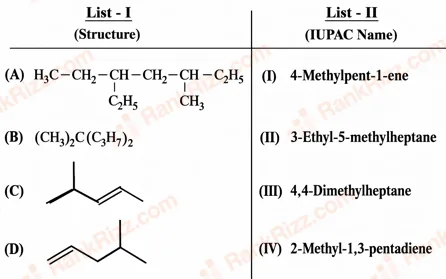
JEE MAIN 2025 · 29 JAN S1Valence bond theory of complexes

Match List - I with List - II.

Figure for JEE Main 2025 Chemistry question on Valence bond theory of complexes


Choose the correct answer from the options given below :

  1. A

    (A)-(II), (B)-(III), (C)-(IV), (D)-(I)

  2. B

    (A)-(II), (B)-(III), (C)-(I), (D)-(IV)

  3. C

    (A)-(III), (B)-(II), (C)-(I), (D)-(IV)

  4. D

    (A)-(III), (B)-(II), (C)-(IV), (D)-(I)

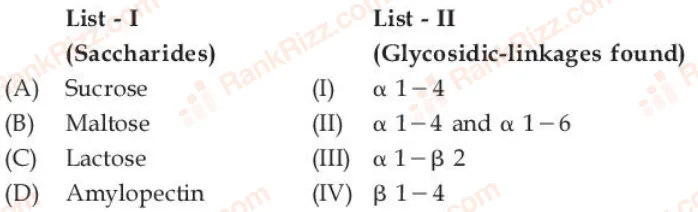
JEE MAIN 2025 · 28 JAN S2Valence bond theory of complexes

Match List - I with List - II.

page11_img1

Choose the correct answer from the options given below :

  1. A

    (A)-(IV), (B)-(II), (C)-(I), (D)-(III)

  2. B

    (A)-(I), (B)-(II), (C)-(III), (D)-(IV)

  3. C

    (A)-(III), (B)-(I), (C)-(IV), (D)-(II)

  4. D

    (A)-(II), (B)-(IV), (C)-(III), (D)-(I)

JEE MAIN 2025 · 24 JAN S1Valence bond theory of complexes

One mole of the octahedral complex compound  Co(NH3)5Cl3Co(NH_3)_5Cl_3  gives 3 moles of ions on dissolution in water. One mole of the same complex reacts with excess  AgNO3AgNO_3 solution to yield two moles of  AgCl(s).AgCl(s).  The structure of the complex is:

  1. A

    [Co(NH3)4Cl2]⋅Cl⋅NH3[Co(NH_3)_4Cl_2]\cdot Cl \cdot NH_3

  2. B

    [Co(NH3)3Cl3]⋅2NH3[Co(NH_3)_3Cl_3]\cdot 2NH_3

  3. C

    [Co(NH3)5Cl]Cl2[Co(NH_3)_5Cl]Cl_2

  4. D

    [Co(NH3)4Cl]⋅Cl2⋅NH3[Co(NH_3)_4Cl]\cdot Cl_2 \cdot NH_3

JEE MAIN 2024 · 09 APR S2Valence bond theory of complexes

The coordination environment of Ca2+Ca^{2+} ion in its complex with EDTA4−EDTA^{4-} is :

  1. A

    tetrahedral

  2. B

    trigonal prismatic

  3. C

    octahedral

  4. D

    square planar

JEE MAIN 2024 · 09 APR S2Valence bond theory of complexes

Match List I with List II:

Figure for JEE Main 2024 Chemistry question on Valence bond theory of complexes


Choose the correct answer from the options given below:

  1. A

    A-III, B-IV, C-I, D-II

  2. B

    A-I, B-II, C-III, D-IV

  3. C

    A-IV, B-I, C-II, D-III

  4. D

    A-II, B-III, C-IV, D-I

JEE MAIN 2024 · 31 JAN S1Valence bond theory of complexes

The correct statements from the following are:

A. The strength of anionic ligands can be explained by crystal field theory.

B. Valence bond theory does not give a quantitative interpretation of kinetic stability of coordination compounds. 

C. The hybridization involved in formation of [Ni(CN)4]2−[Ni(CN)_4]^{2-} complex is dsp2dsp^2. 

D. The number of possible isomer(s) of cis-[PtCl2(en)2]2+[PtCl_2(en)_2]^{2+} is one. 

Choose the correct answer from the options given below:

  1. A

    A, D only

  2. B

    A, C only

  3. C

    B, D only

  4. D

    B, C only

JEE MAIN 2024 · 27 JAN S2Valence bond theory of complexes

Identify from the following species in which d2sp3d^2sp^3 hybridization is shown by central atom:

  1. A

    [Co(NH3)6]3+[Co(NH_3)_6]^{3+}

  2. B

    BrF5BrF_5

  3. C

    [Pt(Cl)4]2−[Pt(Cl)_4]^{2-}

  4. D

    SF6SF_6

JEE MAIN 2023 · 13 APR S2Valence bond theory of complexes

Which of the following complexes will exhibit maximum attraction to an applied magnetic field?

  1. A

    [Ni(H2O)6]2+[Ni(H_2O)_6]^{2+}

  2. B

    [Co(en)3]3+[Co(en)_3]^{3+}

  3. C

    [Zn(H2O)6]2+[Zn(H_2O)_6]^{2+}

  4. D

    [Co(H2O)6]2+[Co(H_2O)_6]^{2+}

JEE MAIN 2023 · 11 APR S2Valence bond theory of complexes

The magnetic moment is measured in Bohr Magneton (BM). Spin only magnetic moment of Fe in [Fe(H2_2O)6_6]3+^{3+} and [Fe(CN)6_6]3−^{3-} complexes respectively is:

  1. A

    6.92 B.M. in both

  2. B

    3.87 B.M. and 1.732 B.M.

  3. C

    5.92 B.M. and 1.732 B.M.

  4. D

    4.89 B.M. and 6.92 B.M.

Valence bond theory of complexes: common questions

How many Valence bond theory of complexes questions have come in JEE Main?
Valence bond theory of complexes has been asked 79 times in JEE Main, in 18 different years between 2004 and 2026. It came up in all of the last five exam years (2022–2026), 37 questions in all.
Is Valence bond theory of complexes important for JEE Main?
It is one of the three most-asked topics in Coordination Compounds: 79 of the chapter's 373 JEE Main questions (21%). It came up in all of the last five exam years (2022–2026), 37 questions in all.
When was Valence bond theory of complexes last asked in JEE Main?
Most recently in JEE Main 06 Apr 2026, Shift 2. Questions on this page are newest first, so the latest ones are at the top.
What kind of Valence bond theory of complexes questions does JEE Main ask?
61 are multiple choice and 18 numerical-value; 13 easy, 58 medium and 3 hard by our difficulty labels. Each question shows its answer key and worked solution where we have them.