RankRizz

Coordination Compounds — JEE Main Previous Year Questions

Every Coordination Compounds question JEE Main has set from 2004–2026, grouped by the idea it tests rather than the order of the syllabus. 373 questions across 10 distinct ideas. Free to read, answer key on every one.

DATA UPDATED

Questions

373

Distinct ideas

10

Share of marks

7.7%

Difficulty

MEDIUM

The ideas inside Coordination Compounds

A chapter is not one subject — it is a handful of procedures the examiner reuses. These are the ones Coordination Compounds questions actually test.

Every Coordination Compounds question

61–80 OF 373 · NEWEST FIRST

JEE MAIN 2025 · 29 JAN S1Valence bond theory of complexes

Match List - I with List - II.
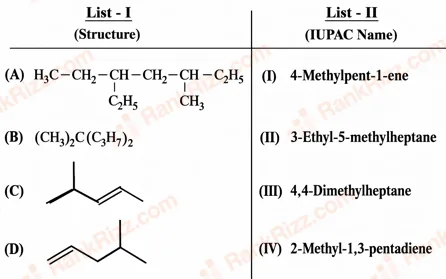
Figure for JEE Main 2025 Chemistry question on Valence bond theory of complexes


Choose the correct answer from the options given below :

  1. A

    (A)-(II), (B)-(III), (C)-(IV), (D)-(I)

  2. B

    (A)-(II), (B)-(III), (C)-(I), (D)-(IV)

  3. C

    (A)-(III), (B)-(II), (C)-(I), (D)-(IV)

  4. D

    (A)-(III), (B)-(II), (C)-(IV), (D)-(I)
JEE MAIN 2025 · 29 JAN S1Colour and magnetic behaviour of complexes from CFT

The correct increasing order of stability of the complexes based on Δ∘\Delta_{\circ} value is: I.[Mn(CN)6]3[Mn(CN)_{6}]^{3} II.[Co(CN)6]4−[Co(CN)_{6}]^{4-} III.[Fe(CN)6]4−[Fe(CN)_{6}]^{4-} IV.[Fe(CN)6]3−[Fe(CN)_{6}]^{3-}

  1. A

    IV < III < II < I

  2. B

    I < II < IV < III

  3. C

    III < II < IV < I

  4. D

    II < III < I < IV

JEE MAIN 2025 · 29 JAN S2Colour and magnetic behaviour of complexes from CFT

Identify the homoleptic complexes with odd number of d electrons in the central metal : (A) [FeO4]2−[FeO_4]^{2-} (B) [Fe(CN)6]3−[Fe(CN)_6]^{3-} (C) [Fe(CN)5NO]2−[Fe(CN)_5NO]^{2-} (D) [CoCl4]2−[CoCl_4]^{2-} (E) [Co(H2O)3F3][Co(H_2O)_3F_3] Choose the correct answer from the options given below :

  1. A

    (A), (B) and (D) only

  2. B

    (C) and (E) only

  3. C

    (B) and (D) only

  4. D

    (A), (C) and (E) only

JEE MAIN 2025 · 29 JAN S2Colour and magnetic behaviour of complexes from CFT

The calculated spin-only magnetic moments of K3[Fe(OH)6]K_3[Fe(OH)_6] and K4[Fe(OH)6]K_4[Fe(OH)_6] respectively are :

  1. A

    3.87 and 4.90 B.M.

  2. B

    4.90 and 5.92 B.M.

  3. C

    4.90 and 4.90 B.M.

  4. D

    5.92 and 4.90 B.M.

JEE MAIN 2025 · 29 JAN S2Colour and magnetic behaviour of complexes from CFT

Consider the following low-spin complexes K3[Co(NO2)6]K_3[Co(NO_2)_6],   K4[Fe(CN)6]\; K_4[Fe(CN)_6],   K3[Fe(CN)6]\; K_3[Fe(CN)_6],   Cu2[Fe(CN)6]andZn2[Fe(CN)6]\; Cu_2[Fe(CN)_6] and Zn_2[Fe(CN)_6] The sum of the spin-only magnetic moment values of
complexes having yellow colour is. _____ B.M. (answer in nearest integer)

JEE MAIN 2025 · 28 JAN S2Valence bond theory of complexes

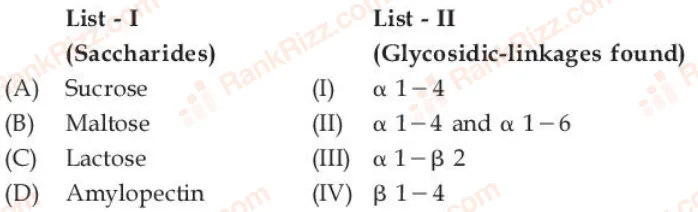
Match List - I with List - II.

page11_img1

Choose the correct answer from the options given below :

  1. A

    (A)-(IV), (B)-(II), (C)-(I), (D)-(III)

  2. B

    (A)-(I), (B)-(II), (C)-(III), (D)-(IV)

  3. C

    (A)-(III), (B)-(I), (C)-(IV), (D)-(II)

  4. D

    (A)-(II), (B)-(IV), (C)-(III), (D)-(I)

JEE MAIN 2025 · 24 JAN S1Valence bond theory of complexes

One mole of the octahedral complex compound  Co(NH3)5Cl3Co(NH_3)_5Cl_3  gives 3 moles of ions on dissolution in water. One mole of the same complex reacts with excess  AgNO3AgNO_3 solution to yield two moles of  AgCl(s).AgCl(s).  The structure of the complex is:

  1. A

    [Co(NH3)4Cl2]⋅Cl⋅NH3[Co(NH_3)_4Cl_2]\cdot Cl \cdot NH_3

  2. B

    [Co(NH3)3Cl3]⋅2NH3[Co(NH_3)_3Cl_3]\cdot 2NH_3

  3. C

    [Co(NH3)5Cl]Cl2[Co(NH_3)_5Cl]Cl_2

  4. D

    [Co(NH3)4Cl]⋅Cl2⋅NH3[Co(NH_3)_4Cl]\cdot Cl_2 \cdot NH_3

JEE MAIN 2025 · 24 JAN S2Colour and magnetic behaviour of complexes from CFT

When Ethane-1,2-diamine is added progressively to an aqueous solution of Nickel (II) chloride, the sequence of colour change observed will be :

  1. A

    Violet→Blue→Pale Blue→Green\text{Violet} \rightarrow \text{Blue} \rightarrow \text{Pale Blue} \rightarrow \text{Green}

  2. B

    Pale Blue→Blue→Green→Violet\text{Pale Blue} \rightarrow \text{Blue} \rightarrow \text{Green} \rightarrow \text{Violet}

  3. C

    Green→Pale Blue→Blue→Violet\text{Green} \rightarrow \text{Pale Blue} \rightarrow \text{Blue} \rightarrow \text{Violet}

  4. D

    Pale Blue→Blue→Violet→Green\text{Pale Blue} \rightarrow \text{Blue} \rightarrow \text{Violet} \rightarrow \text{Green}

JEE MAIN 2025 · 24 JAN S2Colour and magnetic behaviour of complexes from CFT

{The conditions and consequence that favours the  t2ggeg1t_{2gg} e_g^1  configuration in a metal complex are:

  1. A

    weak field ligand, low spin complex

  2. B

    weak field ligand, high spin complex

  3. C

    strong field ligand, high spin complex

  4. D

    strong field ligand, low spin complex

JEE MAIN 2025 · 23 JAN S1Structural isomerism in complexes

The complex that shows Facial - Meridional isomerism is:

  1. A

    [Co(en)2Cl2]+[Co(en)_{2}Cl_{2}]^{+}

  2. B

    [Co(en)3]3+[Co(en)_{3}]^{3+}

  3. C

    [Co(NH3)3Cl3][Co(NH_{3})_{3}Cl_{3}]

  4. D

    [Co(NH3)4Cl2]+[Co(NH_{3})_{4}Cl_{2}]^{+}

JEE MAIN 2025 · 23 JAN S1Colour and magnetic behaviour of complexes from CFT

The d- electronic configuration of an octahedral Co(II) complex having magnetic moment of 3.95 BM is:

  1. A

    t2g3eg0t_{2} {}_{g} {}^{3}e_{g}{}^{0}

  2. B

    t2g6eg1t_{2} {}_{g} {}^{6}e_{g}{}^{1}

  3. C

    t2g5eg2t_{2} {}_{g} {}^{5}e_{g}{}^{2}

  4. D

    e4t23e^{4}t_{2}{}^{3}

JEE MAIN 2025 · 23 JAN S2Colour and magnetic behaviour of complexes from CFT

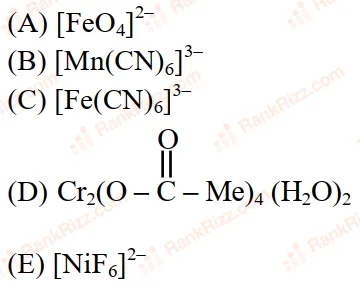
Identify the coordination complexes in which the central metal ion has d4d^{4} configuration.

page13_img1

Choose the correct answer from the options given below :

  1. A

    (B), (C) and (D) only

  2. B

    (C) and (E) only

  3. C

    (B) and (D) only

  4. D

    (A), (B) and (E) only

JEE MAIN 2025 · 22 JAN S1Colour and magnetic behaviour of complexes from CFT

In which of the following complexes the CFSE, △o\triangle_o will be equal to zero?

  1. A

    [Fe(en)3]Cl3[Fe(en)_3]Cl_3

  2. B

    K4[Fe(CN)6]K_4[Fe(CN)_6]

  3. C

    [Fe(NH3)6]Br2[Fe(NH_3)_6]Br_2

  4. D

    K3[Fe(SCN)6]K_3[Fe(SCN)_6]

JEE MAIN 2025 · 22 JAN S1Colour and magnetic behaviour of complexes from CFT

From the magnetic behaviour of [NiCl4]2−(paramagnetic) and [Ni(CO)4][NiCl_4]^{2-} \text{(paramagnetic) and } [Ni(CO)_4] (diamagnetic), choose the correct geometry and oxidation state.

  1. A

    [NiCl4]2−:NiII, tetrahedral [NiCl_4]^{2-} : Ni^{II},\text{ tetrahedral }

    [Ni(CO)4]:NiII, square planar [Ni(CO)_4]:Ni^{II}, \text{ square planar }

  2. B

    [NiCl4]2−:NiII, square planar [NiCl_4]^{2-} : Ni^{II},\text{ square planar } 

    [Ni(CO)4]:Ni(0), square planar [Ni(CO)_4]:Ni(0), \text{ square planar }

  3. C

    [NiCl4]2−:NiII, tetrahedral [NiCl_4]^{2-} : Ni^{II},\text{ tetrahedral }

    [Ni(CO)4]:Ni(0), tetrahedral [Ni(CO)_4]:Ni(0), \text{ tetrahedral }

  4. D

    [NiCl4]2−:Ni(0), tetrahedral [NiCl_4]^{2-} : Ni(0),\text{ tetrahedral } 

    [Ni(CO)4]:Ni(0), square planar [Ni(CO)_4]:Ni(0), \text{ square planar }

JEE MAIN 2025 · 22 JAN S2Colour and magnetic behaviour of complexes from CFT

The correct order of the following complexes in terms of their crystal field stabilization energies is :

  1. A

    [Co(NH3)4]2+<[Co(NH3)6]2+<[Co(en)3]3+<[Co(NH3)6]3+[Co(NH_{3})_{4}]^{2+} < [Co(NH_{3})_{6}]^{2+} < [Co(en)_{3}]^{3+} < [Co(NH_{3})_{6}]^{3+}

  2. B

    [Co(NH3)6]2+<[Co(NH3)6]3+<[Co(NH3)4]2+<[Co(en)3]3+[Co(NH_{3})_{6}]^{2+} < [Co(NH_{3})_{6}]^{3+} < [Co(NH_{3})_{4}]^{2+} < [Co(en)_{3}]^{3+}

  3. C

    [Co(en)3]3+<[Co(NH3)6]3+<[Co(NH3)6]2+<[Co(NH3)4]2+[Co(en)_{3}]^{3+} < [Co(NH_{3})_{6}]^{3+} < [Co(NH_{3})_{6}]^{2+} < [Co(NH_{3})_{4}]^{2+}

  4. D

    [Co(NH3)4]2+<[Co(NH3)6]2+<[Co(NH3)6]3+<[Co(en)3]3+[Co(NH_{3})_{4}]^{2+} < [Co(NH_{3})_{6}]^{2+} < [Co(NH_{3})_{6}]^{3+} < [Co(en)_{3}]^{3+}

JEE MAIN 2025 · 22 JAN S2Colour and magnetic behaviour of complexes from CFT

Identify the homoleptic complex(es) that is/are low spin. (A)[Fe(CN)5NO]2−(B)[CoF6]3−(C)[Fe(CN)6]4−(D)[Co(NH3)6]3+(E)[Cr(H2O)6]2+(A)[Fe(CN)_{5}NO]^{2-}(B)[CoF_{6}]^{3-}(C)[Fe(CN)_{6}]^{4-}(D)[Co(NH_{3})_{6}]^{3+}(E)[Cr(H_{2}O)_{6}]^{2+} Choose the correct answer from the options given below :

  1. A

    (C) only

  2. B

    (C) and (D) only

  3. C

    (A) and (C) only

  4. D

    (B) and (E) only

JEE MAIN 2025 · 22 JAN S2Werner's theory and coordination terminology

The complex of Ni2+Ni^{2+} ion and dimethyl glyoxime contains ________ number of Hydrogen (H) atoms.

JEE MAIN 2024 · 09 APR S1Structural isomerism in complexes

Given below are two statements : one is labelled as Assertion (A) and the other is labelled as Reason (R). Assertion (A) : The total number of geometrical isomers shown by [Co(en)2Cl2]+[Co(en)_2Cl_2]^+ complex ion is three. Reason (R) : [Co(en)2Cl2]+[Co(en)_2Cl_2]^+ complex ion has an octahedral geometry. In the light of the above statements, choose the most appropriate answer from the options given below :

  1. A

    Both (A) and (R) are correct but (R) is not the correct explanation of (A)

  2. B

    (A) is not correct but (R) is correct

  3. C

    Both (A) and (R) are correct and (R) is the correct explanation of (A)

  4. D

    (A) is correct but (R) is not correct

JEE MAIN 2024 · 09 APR S1Ligands, denticity and chelation

Number of ambidentate ligands among the following is ______
NO2−,SCN−,C2O42−,NH3,CN−,SO42−,H2ONO_2^-, SCN^-, C_2O_4^{2-}, NH_3, CN^-, SO_4^{2-}, H_2O

JEE MAIN 2024 · 09 APR S2Valence bond theory of complexes

The coordination environment of Ca2+Ca^{2+} ion in its complex with EDTA4−EDTA^{4-} is :

  1. A

    tetrahedral

  2. B

    trigonal prismatic

  3. C

    octahedral

  4. D

    square planar