RankRizz

Thermodynamics — JEE Main Previous Year Questions

Every Thermodynamics question JEE Main has set from 2004–2026, grouped by the idea it tests rather than the order of the syllabus. 190 questions across 6 distinct ideas. Free to read, answer key on every one.

DATA UPDATED

Questions

190

Distinct ideas

6

Share of marks

3%

Difficulty

MEDIUM

The ideas inside Thermodynamics

A chapter is not one subject — it is a handful of procedures the examiner reuses. These are the ones Thermodynamics questions actually test.

Every Thermodynamics question

141–160 OF 190 · NEWEST FIRST

JEE MAIN 2019 · 11 JAN S2Isobaric, isochoric and polytropic processes

In a process, temperature and volume of one mole of an ideal monoatomic gas are varied according to the relation VT = K, where K is a constant. In this process the temperature of the gas is increased by ΔT\Delta T. The amount of heat absorbed by gas is (R is gas constant):

  1. A

    12RΔT\frac{1}{2}R\Delta T

  2. B

    12KRΔT\frac{1}{2}KR\Delta T

  3. C

    32RΔT\frac{3}{2}R\Delta T

  4. D

    2K3ΔT\frac{2K}{3}\Delta T

JEE MAIN 2019 · 10 JAN S1Carnot engine and Carnot cycle

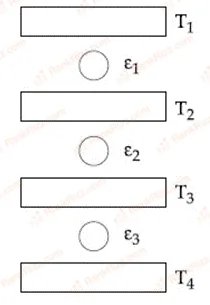
Three Carnot engines operate in series between a heat source at a temperature T1T_1 and a heat sink at temperature T4T_4 (see figure). There are two other reservoirs at temperature T2T_2 and T3T_3, as shown, with T1>T2>T3>T4T_1 > T_2 > T_3 > T_4. The three engines are equally efficient if:

Figure for JEE Main 2019 Physics question on Carnot engine and Carnot cycle
  1. A

    T2=(T1T42)1/3;T3=(T12T4)1/3T_2 = (T_1 T_4^2)^{1/3}; T_3 = (T_1^2 T_4)^{1/3}

  2. B

    T2=(T1T4)1/2;T3=(T12T4)1/3T_2 = (T_1 T_4)^{1/2}; T_3 = (T_1^2 T_4)^{1/3}

  3. C

    T2=(T12T4)1/3;T3=(T1T42)1/3T_2 = (T_1^2 T_4)^{1/3}; T_3 = (T_1 T_4^2)^{1/3}

  4. D

    T2=(T13T4)1/4;T3=(T1T43)1/4T_2 = (T_1^3 T_4)^{1/4}; T_3 = (T_1 T_4^3)^{1/4}

JEE MAIN 2019 · 10 JAN S2Isobaric, isochoric and polytropic processes

Half mole of an ideal monoatomic gas is heated at a constant pressure of 1 atm from 20∘^{\circ}C to 90∘^{\circ}C. Work done by the gas is

  1. A

    73 J

  2. B

    581 J

  3. C

    291 J

  4. D

    146 J

JEE MAIN 2019 · 09 JAN S1Zeroth and first law of thermodynamics

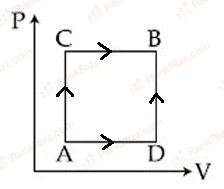
A gas can be taken from A to B via two different processes ACB and ADB.

Figure for JEE Main 2019 Physics question on Zeroth and first law of thermodynamics


When path ACB is used 60 J of heat flows into the system and 30 J of work is done by the system. If the path ADB is used then work done by the system is 10 J, the heat flows into the system in the path ADB is:

  1. A

    100 J

  2. B

    20 J

  3. C

    40 J

  4. D

    80 J

JEE MAIN 2019 · 09 JAN S2Carnot engine and Carnot cycle

Two carnot engines AA and BB are operated in series. The first one, AA, receives heat at T1(=600K)T_1 (= 600K) and rejects to a reservoir at temperature T2T_2. The second engine BB receives heat rejected by the first engine and, in turn, rejects to a heat reservoir at T3(=400K)T_3 (= 400K). Calculate the temperature T2T_2 if the work outputs of the two engines are equal:

  1. A

    500 K

  2. B

    400 K

  3. C

    300 K

  4. D

    600 K

JEE MAIN 2018 · 16 APR ONLINEWork done in thermodynamic processes and P-V diagrams

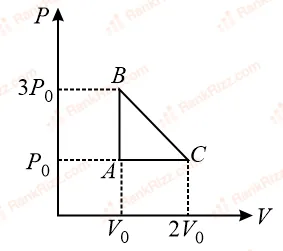
One mole of an ideal monatomic gas is taken along the path ABCA as shown in the PV diagram. The maximum temperature attained by the gas along the path BC is given by:

Figure for JEE Main 2018 Physics question on Work done in thermodynamic processes and P-V diagrams
  1. A

    254P0V0R\frac{25}{4} \frac{P_0 V_0}{R}

  2. B

    58P0V0R\frac{5}{8} \frac{P_0 V_0}{R}

  3. C

    258P0V0R\frac{25}{8} \frac{P_0 V_0}{R}

  4. D

    2516P0V0R\frac{25}{16} \frac{P_0 V_0}{R}

JEE MAIN 2018 · 15 APR S1Carnot engine and Carnot cycle

A Carnot's engine works as a refrigerator between 250 K and 300 K. It receives 500 cal heat from the reservoir at the lower temperature. The amount of work done in each cycle to operate the refrigerator is:

  1. A

    420 J

  2. B

    2100 J

  3. C

    772 J

  4. D

    2520 J

JEE MAIN 2018 · 15 APR S1Isothermal and adiabatic processes

One mole of an ideal monoatomic gas is compressed isothermally in a rigid vessel to double its pressure at room temperature, 27∘^\circC. The work done on the gas will be:

  1. A

    300R ln 6

  2. B

    300R

  3. C

    300R ln 7

  4. D

    300R ln 2

JEE MAIN 2018 · 15 APR S2Carnot engine and Carnot cycle

Two Carnot engines A and B are operated in series. Engine A receives heat from a reservoir at 600 K and rejects heat to a reservoir at temperature T. Engine B receives heat rejected by engine A and in turn rejects it to a reservoir at 100 K. If the efficiencies of the two engines A and B are represented by ηA\eta_A and ηB\eta_B respectively, then what is the value of ηAηB\frac{\eta_A}{\eta_B}?

  1. A

    127\frac{12}{7}

  2. B

    125\frac{12}{5}

  3. C

    512\frac{5}{12}

  4. D

    712\frac{7}{12}

JEE MAIN 2017 · 09 APR ONLINEWork done in thermodynamic processes and P-V diagrams

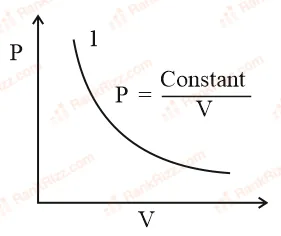
For the P−VP - V diagram given for an ideal gas

Figure for JEE Main 2017 Physics question on Work done in thermodynamic processes and P-V diagrams

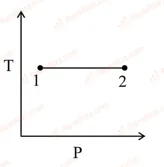
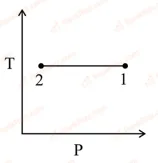
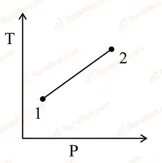
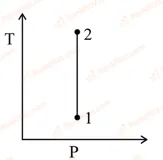
Out of the following which one correctly represents the T−PT - P diagram?

  1. A
    Figure for JEE Main 2017 Physics question on Work done in thermodynamic processes and P-V diagrams
  2. B
    Figure for JEE Main 2017 Physics question on Work done in thermodynamic processes and P-V diagrams
  3. C
    Figure for JEE Main 2017 Physics question on Work done in thermodynamic processes and P-V diagrams
  4. D
    Figure for JEE Main 2017 Physics question on Work done in thermodynamic processes and P-V diagrams
JEE MAIN 2017 · 08 APR ONLINESecond law, heat engines, refrigerators and reversibility

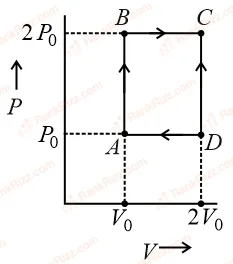
An engine operates by taking nn moles of an ideal gas through the cycle ABCDAABCDA shown in figure. The thermal efficiency of the engine is: (Take Cv=1.5RC_v = 1.5R, where RR is gas constant)

Figure for JEE Main 2017 Physics question on Second law, heat engines, refrigerators and reversibility
  1. A

    0.24

  2. B

    0.15

  3. C

    0.32

  4. D

    0.08

JEE MAIN 2016 · 10 APR ONLINECarnot engine and Carnot cycle

A Carnot freezer takes heat from water at 0°C0°C inside it and rejects it to the room at a temperature of 27°C27°C. The latent heat of ice is 336×103336 \times 10^3 J kg−1^{-1}. If 5 kg of water at 0°C0°C is converted into ice at 0°C0°C by the freezer, then the energy consumed by the freezer is close to:

  1. A

    1.51×1051.51 \times 10^5 J

  2. B

    1.68×1061.68 \times 10^6 J

  3. C

    1.71×1071.71 \times 10^7 J

  4. D

    1.67×1051.67 \times 10^5 J

JEE MAIN 2016 · 03 APR OFFLINEWork done in thermodynamic processes and P-V diagrams

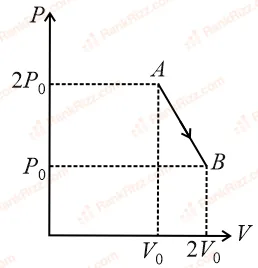
nn moles of an ideal gas undergoes a process A→BA \to B as shown in the figure. The maximum temperature of the gas during the process will be:

Figure for JEE Main 2016 Physics question on Work done in thermodynamic processes and P-V diagrams
  1. A

    9P0V02nR\frac{9P_0V_0}{2nR}

  2. B

    9P0V0nR\frac{9P_0V_0}{nR}

  3. C

    9P0V04nR\frac{9P_0V_0}{4nR}

  4. D

    3P0V02nR\frac{3P_0V_0}{2nR}

JEE MAIN 2016 · 03 APR OFFLINEIsobaric, isochoric and polytropic processes

An ideal gas undergoes a quasi-static, reversible process in which its molar heat capacity C remains constant. If during this process the relation of pressure P and volume V is given by PVnPV^n = constant, then n is given by (Here CPC_P and CVC_V are molar specific heat at constant pressure and constant volume, respectively):

  1. A

    n=CP−CC−CVn = \frac{C_P - C}{C - C_V}

  2. B

    n=C−CVC−CPn = \frac{C - C_V}{C - C_P}

  3. C

    n=CPCVn = \frac{C_P}{C_V}

  4. D

    n=C−CPC−CVn = \frac{C - C_P}{C - C_V}

JEE MAIN 2015 · 10 APR ONLINEWork done in thermodynamic processes and P-V diagrams

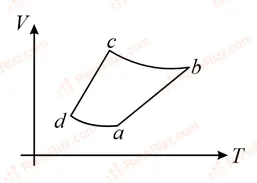
An ideal gas goes through a reversible cycle a→b→c→da \rightarrow b \rightarrow c \rightarrow d has the V - T diagram shown below. Process d→ad \rightarrow a and b→cb \rightarrow c are adiabatic.

Figure for JEE Main 2015 Physics question on Work done in thermodynamic processes and P-V diagrams

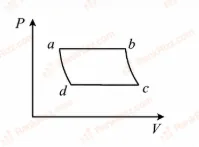
The corresponding P - V diagram for the process is (all figures are schematic and not drawn to scale):

  1. A
    Figure for JEE Main 2015 Physics question on Work done in thermodynamic processes and P-V diagrams
  2. B
    Figure for JEE Main 2015 Physics question on Work done in thermodynamic processes and P-V diagrams
  3. C
    Figure for JEE Main 2015 Physics question on Work done in thermodynamic processes and P-V diagrams
  4. D
    Figure for JEE Main 2015 Physics question on Work done in thermodynamic processes and P-V diagrams
JEE MAIN 2015 · 04 APR OFFLINEIsothermal and adiabatic processes

Consider a spherical shell of radius R at temperature T. The black body radiation inside it can be considered as an ideal gas of photons with internal energy per unit volume u=UV∝T4u = \frac{U}{V} \propto T^4 and pressure p=13(UV)p = \frac{1}{3}\left(\frac{U}{V}\right). If the shell now undergoes an adiabatic expansion the relation between T and R is:

  1. A

    T∝1R3T \propto \frac{1}{R^3}

  2. B

    T∝e−RT \propto e^{-R}

  3. C

    T∝e−3RT \propto e^{-3R}

  4. D

    T∝1RT \propto \frac{1}{R}

JEE MAIN 2015 · 04 APR OFFLINESecond law, heat engines, refrigerators and reversibility

A solid body of constant heat capacity 1 J (∘^\circC)−1^{-1} is being heated by keeping it in contact with reservoirs in two ways: (i) Sequentially keeping in contact with 2 reservoirs such that each reservoir supplies the same amount of heat. (ii) Sequentially keeping in contact with 8 reservoirs such that each reservoir supplies the same amount of heat. In both cases the body is brought from initial temperature 100 K to final temperature 200 K. Entropy change of the body in the two cases respectively is: Note: This question was awarded as a bonus since temperatures were given in centigrade instead of in Kelvin. Proper corrections are made in the question to avoid it.

  1. A

    2ln⁡2, 8ln⁡22\ln 2,\ 8\ln 2

  2. B

    ln⁡2, 4ln⁡2\ln 2,\ 4\ln 2

  3. C

    ln⁡2, ln⁡2\ln 2,\ \ln 2

  4. D

    ln⁡2, 2ln⁡2\ln 2,\ 2\ln 2

JEE MAIN 2014 · 19 APR ONLINEZeroth and first law of thermodynamics

A monoatomic gas is compressed from a volume of 2 m3^3 to a volume of 1 m3^3 at a constant pressure of 100 N m2^2. Then it is heated at constant volume by supplying 150 J of energy. As a result, the internal energy of the gas:

  1. A

    Decreases by 50 J

  2. B

    Increases by 250 J

  3. C

    Decreases by 250 J

  4. D

    0 J

JEE MAIN 2014 · 12 APR ONLINECarnot engine and Carnot cycle

A Carnot engine absorbs 1000 J of heat energy from a reservoir at 127°C and rejects 600 J of heat energy during each cycle. The efficiency of engine and temperature of sink will be:

  1. A

    20% and −43-43°C

  2. B

    40% and −33-33°C

  3. C

    50% and −20-20°C

  4. D

    70% and −10-10°C

JEE MAIN 2014 · 11 APR ONLINEIsothermal and adiabatic processes

During an adiabatic compression, 830 J of work is done on 2 moles of a diatomic ideal gas to reduce its volume by 50%. The change in its temperature is nearly: (R = 8.3 JK−1^{-1} mol−1^{-1})

  1. A

    40 K

  2. B

    33 K

  3. C

    20 K

  4. D

    14 K