RankRizz

Thermodynamics — JEE Main Previous Year Questions

Every Thermodynamics question JEE Main has set from 2004–2026, grouped by the idea it tests rather than the order of the syllabus. 190 questions across 6 distinct ideas. Free to read, answer key on every one.

DATA UPDATED

Questions

190

Distinct ideas

6

Share of marks

3%

Difficulty

MEDIUM

The ideas inside Thermodynamics

A chapter is not one subject — it is a handful of procedures the examiner reuses. These are the ones Thermodynamics questions actually test.

Every Thermodynamics question

81–100 OF 190 · NEWEST FIRST

JEE MAIN 2022 · 29 JUN S2Isothermal and adiabatic processes

Starting with the same initial conditions, an ideal gas expands from volume V1V_1 to V2V_2 in three different ways. The work done by the gas is W1W_1 if the process is purely isothermal, W2W_2, if the process is purely adiabatic and W3W_3 if the process is purely isobaric. Then, choose the correct option

  1. A

    W2<W1<W3W_2 < W_1 < W_3

  2. B

    W1<W2<W3W_1 < W_2 < W_3

  3. C

    W2<W3<W1W_2 < W_3 < W_1

  4. D

    W3<W1<W2W_3 < W_1 < W_2

JEE MAIN 2022 · 28 JUN S1Isothermal and adiabatic processes

Statement - I : When μ\mu amount of an ideal gas undergoes adiabatic change from state (P1,V1,T1)(P_1, V_1, T_1) to state (P2,V2,T2)(P_2, V_2, T_2), then work done is W=μR(T2−T1)1−γW = \frac{\mu R(T_2 - T_1)}{1-\gamma}, where γ=CpCv\gamma = \frac{C_p}{C_v} and RR = universal gas constant.
Statement - II : In the above case, when work is done on the gas, the temperature of the gas would rise.

  1. A

    Both statement-I and statement-II are true.

  2. B

    Both statement-I and statement-II are false.

  3. C

    Statement-I is true but statement-II is false.

  4. D

    Statement-I is false but statement-II is true.

JEE MAIN 2022 · 28 JUN S2Zeroth and first law of thermodynamics

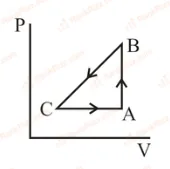
A sample of an ideal gas is taken through the cyclic process ABCAABCA as shown in figure. It absorbs, 40 J of heat during the part ABAB, no heat during BCBC and rejects 60 J of heat during CACA. A work of 50 J is done on the gas during the part BCBC. The internal energy of the gas at AA is 1560 J. The work done by the gas during the part CACA is

Figure for JEE Main 2022 Physics question on Zeroth and first law of thermodynamics
  1. A

    20 J

  2. B

    30 J

  3. C

    −30-30 J

  4. D

    −60-60 J

JEE MAIN 2022 · 27 JUN S1Carnot engine and Carnot cycle

In a carnot engine, the temperature of reservoir is 527°527°C and that of sink is 200200 K. If the work done by the engine when it transfers heat from reservoir to sink is 1200012000 kJ, the quantity of heat absorbed by the engine from reservoir is ______ ×106\times 10^6 J.

JEE MAIN 2022 · 26 JUN S1Carnot engine and Carnot cycle

The efficiency of a Carnot's engine, working between steam point and ice point, will be

  1. A

    26.81%26.81\%

  2. B

    37.81%37.81\%

  3. C

    47.81%47.81\%

  4. D

    57.81%57.81\%

JEE MAIN 2022 · 26 JUN S2Carnot engine and Carnot cycle

A heat engine operates with the cold reservoir at temperature 324324 K. The minimum temperature of the hot reservoir, if the heat engine takes 300300 J heat from the hot reservoir and delivers 180180 J heat to the cold reservoir per cycle, is ______ K.

JEE MAIN 2022 · 24 JUN S1Carnot engine and Carnot cycle

A Carnot engine whose heat sinks at 27°27°C, has an efficiency of 25%25\%. By how many degrees should the temperature of the source be changed to increase the efficiency by 100%100\% of the original efficiency?

  1. A

    Increases by 18°18°C

  2. B

    Increases by 200°200°C

  3. C

    Increases by 120°120°C

  4. D

    Increases by 73°73°C

JEE MAIN 2022 · 24 JUN S2Carnot engine and Carnot cycle

A Carnot engine takes 50005000 kcal of heat from a reservoir at 727°727°C and gives heat to a sink at 127°127°C. The work done by the engine is

  1. A

    3×1063 \times 10^6 J

  2. B

    Zero

  3. C

    8.4×1068.4 \times 10^6 J

  4. D

    12.6×10612.6 \times 10^6 J

JEE MAIN 2022 · 24 JUN S2Isobaric, isochoric and polytropic processes

A monoatomic gas performs a work of Q4\frac{Q}{4} where QQ is the heat supplied to it. The molar heat capacity of the gas will be ______ RR.
Where RR is the gas constant.

JEE MAIN 2021 · 01 SEP S2Isobaric, isochoric and polytropic processes

The temperature of 3.00 mol of an ideal diatomic gas is increased by 40.0°C without changing the pressure of the gas. The molecules in the gas rotate but do not oscillate. If the ratio of change in internal energy of the gas to the amount of workdone by the gas is x10\frac{x}{10}. Then the value of xx (round off to the nearest integer) is _________.
(Given R = 8.31 J mol−1mol^{-1} K−1K^{-1})

JEE MAIN 2021 · 31 AUG S1Carnot engine and Carnot cycle

A reversible engine has an efficiency of 14\frac{1}{4}. If the temperature of the sink is reduced by 58°C, its efficiency becomes double. Calculate the temperature of the sink:

  1. A

    180.4°C

  2. B

    382°C

  3. C

    174 K

  4. D

    280°C

JEE MAIN 2021 · 31 AUG S1Isobaric, isochoric and polytropic processes

For an ideal gas the instantaneous change in pressure PP with volume VV is given by the equation dPdV=−aP\frac{dP}{dV} = -aP. If P=P0P = P_0 at V=0V = 0 is the given boundary condition, then the maximum temperature one mole of gas can attain is: (Here R\mathcal{R} is the gas constant)

  1. A

    aP0eR\frac{aP_0}{e\mathcal{R}}

  2. B

    infinity

  3. C

    0°C

  4. D

    P0aeR\frac{P_0}{ae\mathcal{R}}

JEE MAIN 2021 · 31 AUG S2Isothermal and adiabatic processes

A sample of gas with γ=1.5\gamma = 1.5 is taken through an adiabatic process in which the volume is compressed from 1200 cm3^3 to 300 cm3^3. If the initial pressure is 200 kPa. The absolute value of the workdone by the gas in the process = _________ J.

JEE MAIN 2021 · 27 AUG S2Carnot engine and Carnot cycle

A heat engine operates between a cold reservoir at temperature T2=400T_2 = 400 K and a hot reservoir at temperature T1T_1. It takes 300 J of heat from the hot reservoir and delivers 240 J of heat to the cold reservoir in a cycle. The minimum temperature of the hot reservoir has to be _________.

JEE MAIN 2021 · 26 AUG S1Zeroth and first law of thermodynamics

An electric appliance supplies 6000 J min−1^{-1}, heat to the system. If the system delivers a power of 90 W. How long it would take to increase the internal energy by 2.5×1032.5 \times 10^3 J?

  1. A

    2.5×1012.5 \times 10^1 s

  2. B

    2.5×1022.5 \times 10^2 s

  3. C

    2.4×1032.4 \times 10^3 s

  4. D

    4.1×1014.1 \times 10^1 s

JEE MAIN 2021 · 26 AUG S2Carnot engine and Carnot cycle

A refrigerator consumes an average 35 W power to operate between temperature -10°C to 25°C. If there is no loss of energy then how much average heat per second does it transfer?

  1. A

    350 J s−1^{-1}

  2. B

    298 J s−1^{-1}

  3. C

    263 J s−1^{-1}

  4. D

    35 J s−1^{-1}

JEE MAIN 2021 · 27 JUL S1Work done in thermodynamic processes and P-V diagrams

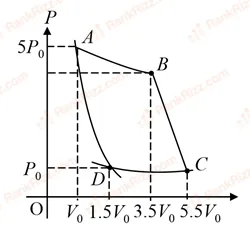
In the reported figure, there is a cyclic process ABCDAABCDA on a sample of 1 mol of a diatomic gas. The temperature of the gas during the process A→BA \rightarrow B and C→DC \rightarrow D are T1T_1 and T2T_2 (T1>T2T_1 > T_2) respectively.

Figure for JEE Main 2021 Physics question on Work done in thermodynamic processes and P-V diagrams


Choose the correct option out of the following for work done if processes BCBC and DADA are adiabatic.

  1. A

    WAB=WDCW_{AB} = W_{DC}

  2. B

    WAD=WBCW_{AD} = W_{BC}

  3. C

    WBC+WDA>0W_{BC} + W_{DA} > 0

  4. D

    WAB<WCDW_{AB} < W_{CD}

JEE MAIN 2021 · 27 JUL S2Isothermal and adiabatic processes

One mole of an ideal gas is taken through an adiabatic process where the temperature rises from 27°C to 37°C. If the ideal gas is composed of polyatomic molecule that has 4 vibrational modes, which of the following is true? [R = 8.314 J mol−1^{-1} K−1^{-1}]

  1. A

    work done by the gas is close to 332 J

  2. B

    work done on the gas is close to 582 J

  3. C

    work done by the gas is close to 582 J

  4. D

    work done on the gas is close to 332 J

JEE MAIN 2021 · 27 JUL S2Carnot engine and Carnot cycle

Two Carnot engines AA and BB operate in series such that engine A absorbs heat at T1T_1 and rejects heat to a sink at temperature T. Engine B absorbs half of the heat rejected by Engine AA and rejects heat to the sink at T3T_3. When workdone in both the cases is equal, to value of T is:

  1. A

    23T1+32T3\frac{2}{3}T_1 + \frac{3}{2}T_3

  2. B

    13T1+23T3\frac{1}{3}T_1 + \frac{2}{3}T_3

  3. C

    32T1+13T3\frac{3}{2}T_1 + \frac{1}{3}T_3

  4. D

    23T1+13T3\frac{2}{3}T_1 + \frac{1}{3}T_3

JEE MAIN 2021 · 25 JUL S1Isothermal and adiabatic processes

A monoatomic ideal gas, initially at temperature T1T_1 is enclosed in a cylinder fitted with a frictionless piston. The gas is allowed to expand adiabatically to a temperature T2T_2 by releasing the piston suddenly. If l1l_1 and l2l_2 are the lengths of the gas column, before and after the expansion respectively, then the value of T1T2\frac{T_1}{T_2} will be:

  1. A

    (l1l2)2/3\left(\frac{l_1}{l_2}\right)^{2/3}

  2. B

    (l2l1)2/3\left(\frac{l_2}{l_1}\right)^{2/3}

  3. C

    l2l1\frac{l_2}{l_1}

  4. D

    l1l2\frac{l_1}{l_2}