RankRizz

Thermodynamics — JEE Main Previous Year Questions

Every Thermodynamics question JEE Main has set from 2004–2026, grouped by the idea it tests rather than the order of the syllabus. 190 questions across 6 distinct ideas. Free to read, answer key on every one.

DATA UPDATED

Questions

190

Distinct ideas

6

Share of marks

3%

Difficulty

MEDIUM

The ideas inside Thermodynamics

A chapter is not one subject — it is a handful of procedures the examiner reuses. These are the ones Thermodynamics questions actually test.

Every Thermodynamics question

161–180 OF 190 · NEWEST FIRST

JEE MAIN 2014 · 09 APR ONLINEIsobaric, isochoric and polytropic processes

The equation of state for a gas is given by PV=nRT+αVPV = nRT + \alpha V, where n is the number of moles and α\alpha is a positive constant. The initial temperature and pressure of one mole of the gas contained in a cylinder are T0_0 and P0_0 respectively. The work done by the gas when its temperature doubles isobarically will be:

  1. A

    P0T0ln⁡2P_0 T_0 \ln 2

  2. B

    P0T0RP0+α\frac{P_0 T_0 R}{P_0 + \alpha}

  3. C

    P0T0RP0−α\frac{P_0 T_0 R}{P_0 - \alpha}

  4. D

    P0T0RP_0 T_0 R

JEE MAIN 2014 · 06 APR OFFLINEZeroth and first law of thermodynamics

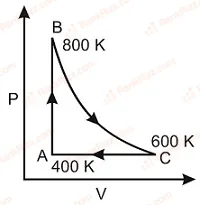
One mole of diatomic ideal gas undergoes a cyclic process ABC as shown in figure. The process BC is adiabatic. The temperatures at A, B and C are 400 K, 800 K and 600 K respectively. Choose the correct statement:

Figure for JEE Main 2014 Physics question on Zeroth and first law of thermodynamics
  1. A

    The change in internal energy in whole cyclic process is 250 R

  2. B

    The change in internal energy in the process CA is 700 R

  3. C

    The change in internal energy in the process AB is -350 R

  4. D

    The change in internal energy in the process BC is -500 R

JEE MAIN 2013 · 25 APR ONLINEWork done in thermodynamic processes and P-V diagrams

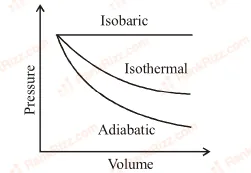
A sample of gas expands from V1V_1 to V2V_2. In which of the following, the work done will be greatest?

Figure for JEE Main 2013 Physics question on Work done in thermodynamic processes and P-V diagrams
  1. A

    Same in all processes

  2. B

    Isobaric process

  3. C

    Isothermal process

  4. D

    Adiabatic process

JEE MAIN 2013 · 22 APR ONLINEZeroth and first law of thermodynamics

Given that 1 g of water in liquid phase has volume 1 cm3^3 and in vapour phase 1671 cm3^3 at atmospheric pressure and the latent heat of vaporization of water is 2256 J/g; the change in the internal energy in joules for 1 g of water at 373 K when it changes from liquid phase to vapour phase at the same temperature is :

  1. A

    2256

  2. B

    167

  3. C

    2089

  4. D

    1

JEE MAIN 2013 · 22 APR ONLINEIsothermal and adiabatic processes

An ideal gas at atmospheric pressure is adiabatically compressed so that its density becomes 32 times of its initial value. If the final pressure of gas is 128 atmospheres, the value of 'γ\gamma' of the gas is :

  1. A

    1.5

  2. B

    1.4

  3. C

    1.3

  4. D

    1.6

JEE MAIN 2013 · 22 APR ONLINEWork done in thermodynamic processes and P-V diagrams

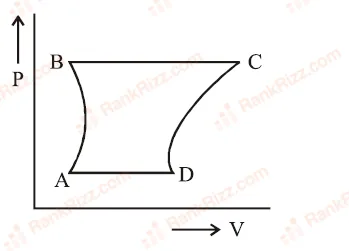
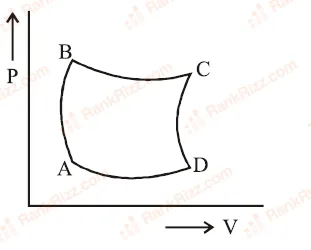
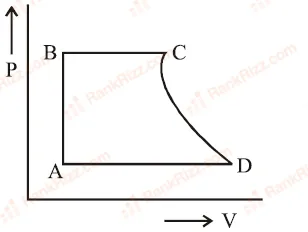
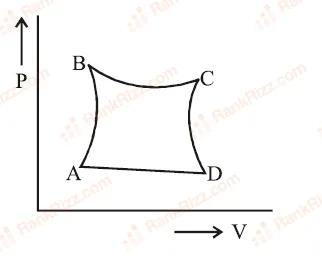
A certain amount of gas is taken through a cyclic process (A B C D A) that has two isobars, one isochore and one isothermal. The cycle can be represented on a P - V indicator diagram as :

  1. A
    Figure for JEE Main 2013 Physics question on Work done in thermodynamic processes and P-V diagrams
  2. B
    Figure for JEE Main 2013 Physics question on Work done in thermodynamic processes and P-V diagrams
  3. C
    Figure for JEE Main 2013 Physics question on Work done in thermodynamic processes and P-V diagrams
  4. D
    Figure for JEE Main 2013 Physics question on Work done in thermodynamic processes and P-V diagrams
JEE MAIN 2013 · 09 APR ONLINEZeroth and first law of thermodynamics

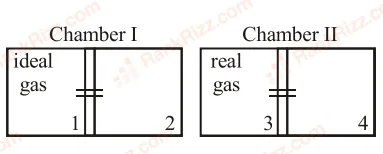
There are two identical chambers, completely thermally insulated from surroundings. Both chambers have a partition wall dividing the chambers in two compartments. Compartment 1 is filled with an ideal gas and Compartment 3 is filled with a real gas. Compartments 2 and 4 are vacuum. A small hole (orifice) is made in the partition walls and the gases are allowed to expand in vacuum.
Statement - 1 : No change in the temperature of the gas takes place when ideal gas expands in vacuum. However, the temperature of real gas goes down (cooling) when it expands in vacuum.
Statement - 2 : The internal energy of an ideal gas is only kinetic. The internal energy of a real gas is kinetic as well as potential.

Figure for JEE Main 2013 Physics question on Zeroth and first law of thermodynamics
  1. A

    Statement-1 is false and Statement-2 is true.

  2. B

    Statement-1 and Statement-2 both are true. Statement-2 is the correct explanation of Statement-1.

  3. C

    Statement-1 is true and Statement-2 is false.

  4. D

    Statement-1 and Statement-2 both are true. Statement-2 is not correct explanation of Statement-1.

JEE MAIN 2013 · 07 APR ONLINESecond law, heat engines, refrigerators and reversibility

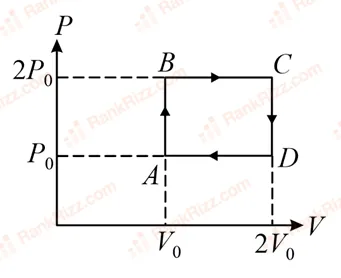
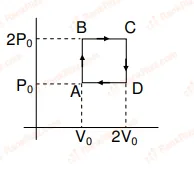
The below P-V diagram represents the thermodynamic cycle of an engine, operating with an ideal mono-atomic gas. The amount of heat, extracted from the source in a single cycle, is:

Figure for JEE Main 2013 Physics question on Second law, heat engines, refrigerators and reversibility
  1. A

    (112)P0V0\left(\frac{11}{2}\right)P_0V_0

  2. B

    4P0V04P_0V_0

  3. C

    P0V0P_0V_0

  4. D

    (132)P0V0\left(\frac{13}{2}\right)P_0V_0

JEE MAIN 2012Second law, heat engines, refrigerators and reversibility

Helium gas goes through a cycle ABCDAABCDA (consisting of two isochoric and two isobaric lines) as shown in figure. Efficiency of this cycle is nearly: (Assume the gas to be close to ideal gas)Figure for JEE Main 2012 Physics question on Second law, heat engines, refrigerators and reversibility

  1. A

    15.4%15.4\%

  2. B

    9.1%9.1\%

  3. C

    10.5%10.5\%

  4. D

    12.5%12.5\%

JEE MAIN 2012Carnot engine and Carnot cycle

A Carnot engine, whose efficiency is 40%40\%, takes in heat from a source maintained at a temperature of 500 K500\ K. It is desired to have an engine of efficiency 60%60\%. Then, the intake temperature for the same exhaust (sink) temperature must be

  1. A

    efficiency of Carnot engine cannot be made larger than 50%50\%

  2. B

    1200 K1200\ K

  3. C

    750 K750\ K

  4. D

    600 K600\ K

JEE MAIN 2012Isothermal and adiabatic processes

This question has Statement 1 and Statement 2. Of the four choices given after the Statements, choose the one that best describes the two Statements. Statement 1: In an adiabatic process, change in internal energy of a gas is equal to work done on/by the gas in the process. Statement 2: The temperature of a gas remains constant in an adiabatic process.

  1. A

    Statement 1 is true, Statement 2 is true, Statement 2 is a correct explanation of Statement 1.

  2. B

    Statement 1 is true, Statement 2 is false.

  3. C

    Statement 1 is false, Statement 2 is true.

  4. D

    Statement 1 is false, Statement 2 is true, Statement 2 is not a correct explanation of Statement 1.

JEE MAIN 2012Second law, heat engines, refrigerators and reversibility

The door of a working refrigerator is left open in a well insulated room. The temperature of air in the room will

  1. A

    decrease

  2. B

    increase in winters and decrease in summers

  3. C

    remain the same

  4. D

    increase

JEE MAIN 2012Isothermal and adiabatic processes

An ideal monatomic gas with pressure PP, volume VV and temperature TT is expanded isothermally to a volume 2V2V and a final pressure PiP_i. If the same gas is expanded adiabatically to a volume 2V2V, the final pressure is PaP_a. The ratio PaPi\frac{P_a}{P_i} is

  1. A

    2−1/32^{-1/3}

  2. B

    21/362^{1/3^6}

  3. C

    22/32^{2/3}

  4. D

    2−2/32^{-2/3}

JEE MAIN 2012Carnot engine and Carnot cycle

This question has Statement 1 and Statement 2. Of the four choices given after the Statements, choose the one that best describes the two Statements. Statement 1: An inventor claims to have constructed an engine that has an efficiency of 30%30\% when operated between the boiling and freezing points of water. This is not possible. Statement 2: The efficiency of a real engine is always less than the efficiency of a Carnot engine operating between the same two temperatures.

  1. A

    Statement 1 is true, Statement 2 is true, Statement 2 is not the correct explanation of Statement 1.

  2. B

    Statement 1 is true, Statement 2 is false.

  3. C

    Statement 1 is false, Statement 2 is true.

  4. D

    Statement 1 is true, Statement 2 is true, Statement 2 is the correct explanation of Statement 1.

JEE MAIN 2012Work done in thermodynamic processes and P-V diagrams

The pressure of an ideal gas varies with volume as P=αVP = \alpha V, where α\alpha is a constant. One mole of the gas is allowed to undergo expansion such that its volume becomes mm times its initial volume. The work done by the gas in the process is

  1. A

    αV2(m2−1)\frac{\alpha V}{2}(m^2-1)

  2. B

    α2V22(m2−1)\frac{\alpha^2 V^2}{2}(m^2-1)

  3. C

    α2(m2−1)\frac{\alpha}{2}(m^2-1)

  4. D

    αV22(m2−1)\frac{\alpha V^2}{2}(m^2-1)

JEE MAIN 2012Isothermal and adiabatic processes

A given ideal gas with γ=CpCv=1.5\gamma = \dfrac{C_p}{C_v} = 1.5 at a temperature TT. If the gas is compressed adiabatically to one-fourth of its initial volume, the final temperature will be

  1. A

    22T2\sqrt{2}T

  2. B

    4T4T

  3. C

    2T2T

  4. D

    8T8T

JEE MAIN 2012Work done in thermodynamic processes and P-V diagrams

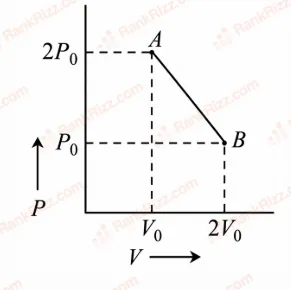
nn moles of an ideal gas undergo a process A→BA \to B as shown in the figure. Maximum temperature of the gas during the process is

Figure for JEE Main 2012 Physics question on Work done in thermodynamic processes and P-V diagrams
  1. A

    9P0V0nR\dfrac{9P_0V_0}{nR}

  2. B

    3P0V02nR\dfrac{3P_0V_0}{2nR}

  3. C

    9P0V02nR\dfrac{9P_0V_0}{2nR}

  4. D

    9P0V04nR\dfrac{9P_0V_0}{4nR}

JEE MAIN 2011Carnot engine and Carnot cycle

A Carnot engine operating between temperatures T1T_1 and T2T_2 has efficiency 16\dfrac{1}{6}. When T2T_2 is lowered by 62 K62 \, \text{K}, its efficiency increases to 13\dfrac{1}{3}. Then T1T_1 and T2T_2 are, respectively:

  1. A

    372 K372 \, \text{K} and 330 K330 \, \text{K}

  2. B

    330 K330 \, \text{K} and 268 K268 \, \text{K}

  3. C

    310 K310 \, \text{K} and 248 K248 \, \text{K}

  4. D

    372 K372 \, \text{K} and 310 K310 \, \text{K}

JEE MAIN 2011Zeroth and first law of thermodynamics

A thermally insulated vessel contains an ideal gas of molecular mass MM and ratio of specific heats γ\gamma. It is moving with speed vv and is suddenly brought to rest. Assuming no heat is lost to the surroundings, its temperature increases by:

  1. A

    (γ−1)2γRMv2 K\dfrac{(\gamma-1)}{2\gamma R} M v^2 \, \text{K}

  2. B

    γMv22R K\dfrac{\gamma M v^2}{2R} \, \text{K}

  3. C

    (γ−1)2RMv2 K\dfrac{(\gamma-1)}{2R} M v^2 \, \text{K}

  4. D

    (γ−1)2(γ+1)RMv2 K\dfrac{(\gamma-1)}{2(\gamma+1)R} M v^2 \, \text{K}

JEE MAIN 2010Second law, heat engines, refrigerators and reversibility

A diatomic ideal gas is used in a Car engine as the working substance. If during the adiabatic expansion part of the cycle, volume of the gas increases from VV to 32V32V the efficiency of the engine is

  1. A

    0.5

  2. B

    0.75

  3. C

    0.99

  4. D

    0.25