RankRizz

Thermodynamics — JEE Main Previous Year Questions

Every Thermodynamics question JEE Main has set from 2004–2026, grouped by the idea it tests rather than the order of the syllabus. 190 questions across 6 distinct ideas. Free to read, answer key on every one.

DATA UPDATED

Questions

190

Distinct ideas

6

Share of marks

3%

Difficulty

MEDIUM

The ideas inside Thermodynamics

A chapter is not one subject — it is a handful of procedures the examiner reuses. These are the ones Thermodynamics questions actually test.

Every Thermodynamics question

181–190 OF 190 · NEWEST FIRST

JEE MAIN 2009Work done in thermodynamic processes and P-V diagrams

Directions: Questions 7 to 9 are based on the following figure showing a thermodynamic cycle ABCDA on a P-V diagram. (Figure not available; the cycle ABCDA involves gas state changes with given pressure-volume values from the original paper.) Assuming the gas to be ideal the work done on the gas in taking it from AA to BB is

  1. A

    200R200R

  2. B

    300R300R

  3. C

    400R400R

  4. D

    500R500R

JEE MAIN 2009Work done in thermodynamic processes and P-V diagrams

The work done on the gas in taking it from DD to AA is

  1. A

    −414R-414R

  2. B

    +414R+414R

  3. C

    −690R-690R

  4. D

    +690R+690R

JEE MAIN 2009Work done in thermodynamic processes and P-V diagrams

The net work done on the gas in the cycle ABCDA is

  1. A

    Zero

  2. B

    276R276R

  3. C

    1076R1076R

  4. D

    1904R1904R

JEE MAIN 2007Second law, heat engines, refrigerators and reversibility

A Carnot engine, having an efficiency of η=1/10\eta = 1/10 as heat engine, is used as a refrigerator. If the work done on the system is 10 J, the amount of energy absorbed from the reservoir at lower temperature is

  1. A

    99 J

  2. B

    90 J

  3. C

    1 J

  4. D

    100 J

JEE MAIN 2007Zeroth and first law of thermodynamics

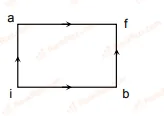
When a system is taken from state ii to state ff along the path iaf, it is found that Q=50Q = 50 cal and W=20W = 20 cal.Figure for JEE Main 2007 Physics question on Zeroth and first law of thermodynamics
Along the path 'ibf' Q=36Q = 36 cal. W along the path ibf is

  1. A

    6 cal

  2. B

    16 cal.

  3. C

    66 cal.

  4. D

    14 cal.

JEE MAIN 2006Isothermal and adiabatic processes

The work of 146 kJ146\,kJ is performed in order to compress one kilo mole of gas adiabatically and in this process the temperature of the gas increases by 7∘C7^\circ C. The gas is (R=8.3 J mol−1 K−1)(R = 8.3\,J\,mol^{-1}\,K^{-1})

  1. A

    monoatomic

  2. B

    diatomic

  3. C

    triatomic

  4. D

    a mixture of monoatomic and diatomic

JEE MAIN 2005Zeroth and first law of thermodynamics

Which of the following is incorrect regarding the first law of thermodynamics?

  1. A

    It is applicable to any cyclic process

  2. B

    It is a restatement of the principle of conservation of energy

  3. C

    It introduces the concept of the internal energy

  4. D

    It introduces the concept of the entropy

JEE MAIN 2005Second law, heat engines, refrigerators and reversibility

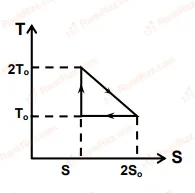
The temperature-entropy diagram of a reversible engine cycle is given in the figure. Its efficiency is Figure for JEE Main 2005 Physics question on Second law, heat engines, refrigerators and reversibility

  1. A

    1/21/2

  2. B

    1/41/4

  3. C

    1/31/3

  4. D

    2/32/3

JEE MAIN 2005Zeroth and first law of thermodynamics

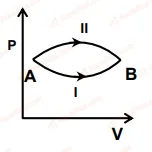
A system goes from AA to BB via two processes I and II as shown in the figure. If ΔU1\Delta U_1 and ΔU2\Delta U_2 are the changes in internal energies in the processes I and II respectively, the Figure for JEE Main 2005 Physics question on Zeroth and first law of thermodynamics

  1. A

    ΔU1=ΔU2\Delta U_1 = \Delta U_2

  2. B

    relation between ΔU1\Delta U_1 and ΔU2\Delta U_2 can not be determined

  3. C

    ΔU2>ΔU1\Delta U_2 > \Delta U_1

  4. D

    ΔU2<ΔU1\Delta U_2 < \Delta U_1

JEE MAIN 2004Zeroth and first law of thermodynamics

Which of the following statements is correct for any thermodynamic system?

  1. A

    The internal energy changes in all processes.

  2. B

    Internal energy and entropy are state functions.

  3. C

    The change in entropy can never be zero.

  4. D

    The work done in an adiabatic process is always zero.