JEE MAIN 2024 · 05 APR S1Work done in thermodynamic processes and P-V diagrams
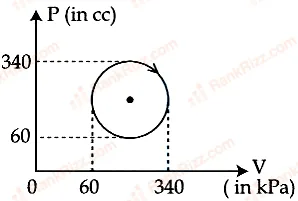
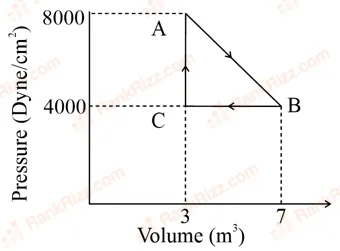
The heat absorbed by a system in going through the given cyclic process is :
- A
- B
- C
- D
Every Thermodynamics question JEE Main has set from 2004–2026, grouped by the idea it tests rather than the order of the syllabus. 190 questions across 6 distinct ideas. Free to read, answer key on every one.
DATA UPDATED
Questions
190
Distinct ideas
6
Share of marks
3%
Difficulty
MEDIUM
A chapter is not one subject — it is a handful of procedures the examiner reuses. These are the ones Thermodynamics questions actually test.
41–60 OF 190 · NEWEST FIRST
The heat absorbed by a system in going through the given cyclic process is :
During an adiabatic process, if the pressure of a gas is found to be proportional to the cube of its absolute temperature, then the ratio of for the gas is :
A sample of gas at temperature is adiabatically expanded to double its volume. Adiabatic constant for the gas is . The work done by the gas in the process is: ( mole)
The pressure and volume of an ideal gas are related as (Constant). The work done when the gas is taken from state to state is :
The given figure represents two isobaric processes for the same mass of an ideal gas, then
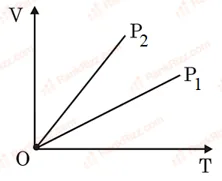
Two thermodynamical processes are shown in the figure. The molar heat capacity for process and are and . The molar heat capacity at constant pressure and constant volume are represented by and , respectively. Choose the correct statement.
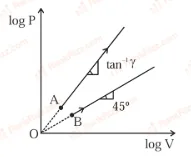
and
Choose the correct statement for processes & shown in figure.
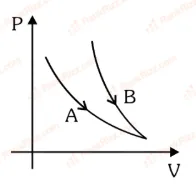
for process and for process
for process and
for process and for process
for process and for process
A thermodynamic system is taken from an original state to an intermediate state by a linear process as shown in the figure. Its volume is then reduced to the original value from to by an isobaric process. The total work done by the gas from to and to would be :
J
J
J
J
During an adiabatic process, the pressure of a gas is found to be proportional to the cube of its absolute temperature. The ratio of for the gas is :
A thermodynamic system is taken through cyclic process. The total work done in the process is :
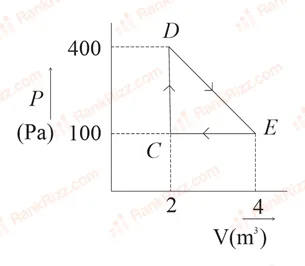
J
J
J
Zero
The initial pressure and volume of an ideal gas are and . The final pressure of the gas when the gas is suddenly compressed to volume will be:
(Given = ratio of specific heats at constant pressure and at constant volume.)
An engine operating between the boiling and freezing points of water will have
A. Efficiency more than 27%.
B. Efficiency less than the efficiency of a Carnot engine operating between the same two temperatures.
C. Efficiency equal to 27%.
D. Efficiency less than 27%.
Choose the correct answer from the options given below
B, C and D only
A and B only
B and D only
B and C only
1 kg of water at 100C is converted into steam at 100C by boiling at atmospheric pressure. The volume of water changes from m as a liquid to 1.671 m as steam. The change in internal energy of the system during the process will be (Given latent heat of vaporisation = 2257 kJ/kg, Atmospheric pressure Pa)
kJ
kJ
kJ
kJ
The thermodynamic process, in which internal energy of the system remains constant is
Isochoric
Adiabatic
Isothermal
Isobaric
Consider two containers A and B containing monoatomic gases at the same Pressure , Volume and Temperature . The gas in A is compressed isothermally to of its original volume while the gas in B is compressed adiabatically to of its original volume. The ratio of final pressure of gas in B to that of gas in A is
8
4
A gas is compressed adiabatically, which one of the following statement is NOT true?
There is no heat supplied to the system
There is no change in the internal energy
The temperature of the gas increases
The change in the internal energy is equal to the work done on the gas
Given below are two statements:
Statement I: If heat is added to a system, its temperature must increase.
Statement II: If positive work is done by a system in a thermodynamic process, its volume must increase.
In the light of the above statements, choose the correct answer from the options given below
Statement I is true but Statement II is false
Both Statement I and Statement II are false
Both Statement I and Statement II are true
Statement I is false but Statement II is true
Work done by a Carnot engine operating between temperatures 127C and 27C is 2 kJ. The amount of heat transferred to the engine by the reservoir is:
8 kJ
2.67 kJ
2 kJ
4 kJ
A source supplies heat to a system at the rate of 1000 W. If the system performs work at a rate of 200 W. The rate at which internal energy of the system increases is
600 W
800 W
500 W
1200 W
A sample of gas at temperature is adiabatically expanded to double its volume. The work done by the gas in the process is, (given ):
JEE Advanced has set 42 Thermodynamics questions too. Thermodynamics JEE Advanced PYQs →
OTHER PHYSICS CHAPTERS